


Airport Sleeping Pods Market Size
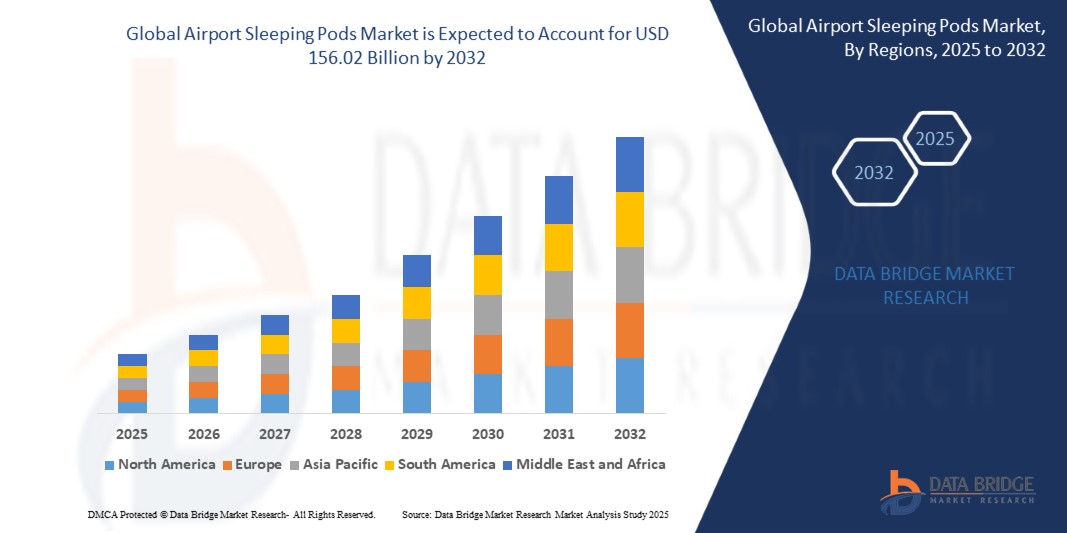
- The global airport sleeping pods market size was valued at USD 85.61 billion in 2024 and is expected to reach USD 156.02 billion by 2032, at a CAGR of 7.79% during the forecast period
- The market growth is largely fuelled by the rising demand for enhanced passenger comfort, increased layover durations, and the growing number of long-haul international flights that necessitate rest facilities within airport terminals
- The expanding network of international airports, coupled with airport modernization initiatives, is further driving the deployment of sleeping pods to improve overall traveler experience and non-aeronautical revenue generation
Airport Sleeping Pods Market Analysis
- The increasing preference for contactless and private resting solutions, especially in the post-pandemic era, has significantly accelerated the adoption of airport sleeping pods across major hubs
- Advancements in smart technologies, including app-based booking, integrated climate control, and touchless access, are transforming sleeping pods into high-tech micro-lodging solutions that align with the expectations of modern travelers
- North America dominated the airport sleeping pods market with the largest revenue share of 38.72% in 2024, supported by the rising demand for passenger comfort, efficient airport infrastructure, and growing business travel frequency
- Asia-Pacific region is expected to witness the highest growth rate in the global airport sleeping pods market, driven by surging air travel demand, expanding middle-class population, and infrastructural investments in countries such as China, Japan, and South Korea. Regional governments and airport authorities are prioritizing passenger comfort, prompting the inclusion of innovative pod-based resting facilities. The rising number of budget-conscious travelers seeking short-term comfort solutions is also accelerating market expansion across Asia-Pacific
- The single occupancy segment dominated the market with the largest revenue share in 2024, driven by growing demand for personal space, enhanced privacy, and comfort during layovers. Travelers increasingly prefer private pods to relax or work without disturbance, particularly in busy international terminals. Airlines and airports are investing in single pods to enhance the premium passenger experience and meet expectations for hygiene and individualized services
Report Scope and Airport Sleeping Pods Market Segmentation
|
Attributes |
Airport Sleeping Pods Key Market Insights |
|
Segments Covered |
|
|
Countries Covered |
North America
Europe
Asia-Pacific
Middle East and Africa
South America
|
|
Key Market Players |
|
|
Market Opportunities |
|
|
Value Added Data Infosets |
In addition to the market insights such as market value, growth rate, market segments, geographical coverage, market players, and market scenario, the market report curated by the Data Bridge Market Research team includes in-depth expert analysis, import/export analysis, pricing analysis, production consumption analysis, and pestle analysis. |
Airport Sleeping Pods Market Trends
“Growing Integration of Smart Technologies in Sleeping Pods”
- The increasing emphasis on touchless solutions in public spaces is driving airports to adopt smart sleeping pods with contactless check-in, app-based controls, and automated cleaning features. These technologies ensure higher hygiene standards, appealing to health-conscious travelers. The trend reflects broader airport digitization efforts for passenger safety and convenience
- Smart sleeping pods are being equipped with premium features such as adjustable climate control, ambient lighting, and soundproof enclosures. These enhancements offer a personalized rest experience, especially for business travelers and long-haul passengers. As airports compete to offer better amenities, tech-enabled comfort is becoming a key differentiator
- Real-time monitoring and analytics systems embedded in smart pods help airport operators track usage patterns, optimize availability, and improve maintenance schedules. This data-driven approach enhances operational efficiency and resource planning. It also supports dynamic pricing models, improving revenue generation from pod installations
- For instance, Abu Dhabi International Airport installed GoSleep pods with reclining seats, secure storage, and mobile charging—operated via a contactless interface. These pods offer a private, tech-integrated space for travelers to rest, and have significantly improved passenger satisfaction levels. The airport's success has encouraged similar upgrades in other global hubs
- In conclusion, smart technologies are transforming sleeping pods from basic rest units into personalized, efficient micro-lodging solutions. This evolution aligns with rising expectations for comfort, cleanliness, and digital access. As the aviation sector modernizes, tech-driven pods will play a crucial role in enhancing non-aeronautical services and passenger loyalty
Airport Sleeping Pods Market Dynamics
Driver
“Increasing Demand for Comfortable in-Terminal Resting Solutions”
- With rising air traffic and longer layover times, passengers are seeking comfortable and private rest spaces within airport terminals. Sleeping pods offer a quiet, secure alternative to waiting lounges or hotel rooms. Their compact design makes them ideal for airports with limited space
- Business travelers and transit passengers frequently face overnight connections and irregular flight schedules. Sleeping pods provide a flexible resting option without the need to leave the airport. This demand is particularly strong in hub airports and international terminals
- Airports are under pressure to enhance the passenger experience and boost non-aeronautical revenue. Installing sleeping pods allows them to monetize unused terminal areas while offering value-added services. This dual advantage is a strong driver of adoption among airport operators
- For instance, London Heathrow and Munich Airport have introduced premium sleeping pods equipped with privacy screens, lighting controls, and charging ports. These facilities have received positive feedback from travelers and contributed to better dwell time monetization
- In conclusion, growing passenger expectations and the need for efficient, on-the-go rest options are significantly driving the airport sleeping pods market. As airports strive to improve customer satisfaction and optimize terminal usage, demand for compact, comfortable sleeping pods is expected to grow steadily across both developed and emerging regions
Restraint/Challenge
“High Installation and Maintenance Costs”
- The initial cost of installing sleeping pods—including infrastructure upgrades, smart integration, and premium furnishings—can be prohibitive, especially for small or budget-constrained airports. This restricts market growth in cost-sensitive regions
- Regular maintenance, cleaning, and software updates are necessary to keep pods hygienic and operational. These recurring costs can impact profitability, particularly when occupancy rates are inconsistent or seasonal
- Integration with airport management systems, mobile apps, and payment gateways requires technical expertise and cybersecurity safeguards. Smaller airports often lack the resources to implement and manage these systems effectively, leading to adoption hesitancy
- For instance, some regional airports in Southeast Asia postponed pod installations due to budget reallocations after the COVID-19 pandemic. The high cost of retrofitting terminals with digital and electrical systems proved to be a major barrier post-crisis recovery
- In conclusion, while airport sleeping pods offer clear passenger benefits, their high setup and operational costs remain a challenge. Unless offset by high usage rates or government support, these financial hurdles may slow deployment, especially in Tier-2 airports or regions with lower footfall
Airport Sleeping Pods Market Scope
The market is segmented on the basis of product, module, price, stay hours, airports, application, and end-user.
• By Product
On the basis of product, the airport sleeping pods market is segmented into single occupancy sleeping pods and shared occupancy sleeping pods. The single occupancy segment dominated the market with the largest revenue share in 2024, driven by growing demand for personal space, enhanced privacy, and comfort during layovers. Travelers increasingly prefer private pods to relax or work without disturbance, particularly in busy international terminals. Airlines and airports are investing in single pods to enhance the premium passenger experience and meet expectations for hygiene and individualized services.
The shared occupancy segment is expected to witness fastest growth rate from 2025 to 2032, fueled by affordability and space optimization at high-traffic airports. Shared pods appeal to budget travelers or groups seeking cost-effective rest options, especially in regions where overnight stays are common. The segment’s growth is supported by modular designs that maintain privacy while maximizing floor space.
• By Module
On the basis of module, the market is segmented into compact nap pod, single nap pod, double nap pod, and multiple nap pod. The single nap pod segment accounted for the largest market share in 2024, attributed to its wide adoption in airport lounges and terminals catering to solo travelers. These pods offer essential comfort features, compact design, and integrated smart systems for sleep or work, which make them the preferred module type.
The multiple nap pod segment is expected to witness fastest growth rate from 2025 to 2032, due to rising demand for family or group accommodation solutions in airport rest areas. These modules provide flexible layouts that support simultaneous occupancy, particularly useful in long-haul transit hubs and family-centric travel scenarios.
• By Price
Based on price, the market is divided into economic and premium. The premium segment led the market in 2024, supported by rising adoption among business and first-class travelers seeking luxurious and technologically advanced sleep environments. Premium pods often include additional amenities such as entertainment systems, adjustable lighting, noise cancellation, and personalized temperature control, enhancing the user experience.
The economic segment is expected to witness fastest growth rate from 2025 to 2032, driven by increased demand from price-sensitive passengers. These pods provide basic comfort at lower costs and are being rapidly installed in low-cost terminals, especially in Asia-Pacific and Latin America, to meet growing passenger volumes and improve transit convenience.
• By Stay Hours
On the basis of stay hours, the market is segmented into less than 2 hours and more than 2 hours. The more than 2 hours segment held the highest market revenue share in 2024, owing to longer layovers, delays, and flight rescheduling in international travel routes. These pods serve as a short-term lodging alternative, attracting travelers who need rest before long-haul flights or during night-time stopovers.
The less than 2 hours segment is expected to witness fastest growth rate from 2025 to 2032, driven by demand for quick power naps and refreshment between short-haul connections. Airports are offering flexible hourly packages to cater to business professionals and transit passengers with tighter schedules.
• By Airports
On the basis of airports, the market is classified into international and domestic. The international airport segment dominated the market in 2024, driven by high passenger traffic, long wait times, and increased emphasis on premium amenities. International terminals often feature a greater variety of sleeping pod services integrated into lounges and rest zones, boosting adoption.
The domestic airport segment is expected to witness fastest growth rate from 2025 to 2032, fueled by growing domestic air traffic and the push for infrastructure modernization. Regional governments and private airport operators are incorporating sleeping pods to improve traveler satisfaction and reduce stress during delays.
• By Application
Based on application, the market is segmented into airport and corporate offices. The airport segment accounted for the largest market share in 2024 due to the core use case of sleeping pods in transit zones, terminals, and lounges. Rising demand for comfort, convenience, and productivity during layovers continues to drive adoption across global airports.
The corporate office segment is expected to witness fastest growth rate from 2025 to 2032, supported by the integration of wellness and productivity solutions in modern workplaces. Companies are installing sleeping pods to offer employees short rest breaks, improve mental health, and enhance workplace efficiency.
• By End-User
On the basis of end-user, the market is segmented into children and adult. The adult segment held the dominant share of the market in 2024, primarily due to the higher proportion of adult travelers and professionals using pods during transit or work hours. Adults seek ergonomic sleeping options and private rest environments, making them the key target group.
The children segment is expected to witness fastest growth rate from 2025 to 2032, driven by increasing family travel and rising demand for child-friendly pods with safety features. Airports catering to families are deploying pods that offer safe, quiet, and visually engaging environments tailored to younger users.
Airport Sleeping Pods Market Regional Analysis
- North America dominated the airport sleeping pods market with the largest revenue share of 38.72% in 2024, supported by the rising demand for passenger comfort, efficient airport infrastructure, and growing business travel frequency
- The region has witnessed a growing preference for short-term resting solutions among travelers experiencing long layovers or flight delays, with sleeping pods becoming an essential facility in major airports
- This growth is further supported by the integration of smart technologies in pods, increased investment by airport authorities in enhancing passenger experience, and the surge in domestic and international travel across the U.S. and Canada
U.S. Airport Sleeping Pods Market Insight
The U.S. airport sleeping pods market held the highest revenue share in 2024 within North America, driven by an increase in overnight airport traffic, long-haul travel routes, and a heightened focus on airport hospitality upgrades. Key U.S. airports such as Hartsfield-Jackson Atlanta and Dallas/Fort Worth have begun deploying pod units to accommodate travelers during extended layovers. The growth of remote work culture has also contributed to demand for quiet, private rest areas, prompting airport authorities to invest in modular and self-contained nap solutions that enhance traveler convenience and satisfaction
Europe Airport Sleeping Pods Market Insight
The Europe airport sleeping pods market is expected to witness fastest growth rate from 2025 to 2032, driven by the rising number of international travelers and the expansion of budget airlines resulting in longer layovers. Increased investments in airport modernization across the U.K., France, and Germany are enhancing terminal infrastructure to support traveler wellbeing. Sleeping pods are being adopted as cost-effective alternatives to airport hotels, particularly in busy transit hubs. Sustainability concerns and space constraints in European airports are also promoting compact pod solutions that offer flexibility and comfort
U.K. Airport Sleeping Pods Market Insight
The U.K. airport sleeping pods market is expected to witness fastest growth rate from 2025 to 2032, supported by the surge in solo and business travel, particularly at airports such as London Heathrow and Manchester. The demand for flexible, on-demand rest spaces is increasing among passengers waiting for connecting flights or recovering from travel fatigue. The U.K.’s strong tourism industry and adoption of premium airport amenities have encouraged airport operators to incorporate sleeping pods as part of their modernization strategies
Germany Airport Sleeping Pods Market Insight
The Germany airport sleeping pods market is expected to witness fastest growth rate from 2025 to 2032, driven by the country’s emphasis on passenger-centric airport facilities and improved transit efficiency. Airports such as Frankfurt and Munich are exploring pod installations to provide rest options for transit passengers. German travelers increasingly value privacy and wellness, and sleeping pods offer a convenient solution in congested airport environments. The country’s focus on smart airport initiatives and energy-efficient infrastructure is also fostering the deployment of modular resting units
Asia-Pacific Airport Sleeping Pods Market Insight
The Asia-Pacific airport sleeping pods market is expected to witness fastest growth rate from 2025 to 2032, owing to a significant rise in air travel, growth of budget airlines, and government investment in smart airport infrastructure. Countries such as China, India, and Japan are witnessing growing adoption of sleeping pods as part of airport upgrades to enhance passenger experience. The expansion of air travel routes, combined with rising middle-class income and a preference for tech-integrated rest areas, is fueling demand across the region
Japan Airport Sleeping Pods Market Insight
The Japan airport sleeping pods market is expected to witness fastest growth rate from 2025 to 2032, due to the country’s advanced airport infrastructure and strong emphasis on efficiency and user experience. Pod services are being rolled out at major airports such as Narita and Haneda to cater to both domestic and international travelers. Japan’s culture of technological innovation and compact space utilization makes it an ideal environment for high-tech, self-contained nap pods that support relaxation and privacy in crowded terminals
China Airport Sleeping Pods Market Insight
The China airport sleeping pods market accounted for the highest revenue share within Asia-Pacific in 2024, supported by the country's booming air travel sector, growing business travel, and push for modernized airport infrastructure. Major airports such as Beijing Capital and Shanghai Pudong have adopted pod solutions to accommodate increasing passenger volumes and reduce the burden on airport hotels. With smart city development and traveler-focused amenities becoming a national priority, sleeping pods are being increasingly deployed to improve convenience and airport service quality
Sleeping Pods Market Share
The Airport Sleeping Pods industry is primarily led by well-established companies, including:
- GoSleep (Finland)
- Metronaps (U.S.)
- Snooze at my space (India)
- NapCabs GmbH (Germany)
- Minute Suites (U.S.)
- SnoozeCube (U.A.E.)
- Jet Quay (Singapore)
- Sleepbox (U.K.)
- ZZZleepandGo (Italy)
- JetQuay (Singapore)
- YOTELAIR (U.K.)
- Sleep 'n fly (U.A.E.)
- AirPod (Slovenia)
Latest Developments in Global Airport Sleeping Pods Market
- In July 2022, Dubai International Airport introduced a sprawling 600-square-meter section dedicated to sleeping pods, capable of accommodating up to 46 individuals simultaneously. Situated within Terminal 3, this expansive sleeping lounge, dubbed "sleep 'n fly," stands as the airport's largest of its kind. The facility offers a variety of accommodations, including family cabins, bunk beds, double pods, power nap pods, and FlexiSuite pods

- Interactive Data Analysis Dashboard
- Company Analysis Dashboard for high growth potential opportunities
- Research Analyst Access for customization & queries
- Competitor Analysis with Interactive dashboard
- Latest News, Updates & Trend analysis
- Harness the Power of Benchmark Analysis for Comprehensive Competitor Tracking
Data collection and base year analysis are done using data collection modules with large sample sizes. The stage includes obtaining market information or related data through various sources and strategies. It includes examining and planning all the data acquired from the past in advance. It likewise envelops the examination of information inconsistencies seen across different information sources. The market data is analysed and estimated using market statistical and coherent models. Also, market share analysis and key trend analysis are the major success factors in the market report. To know more, please request an analyst call or drop down your inquiry.
The key research methodology used by DBMR research team is data triangulation which involves data mining, analysis of the impact of data variables on the market and primary (industry expert) validation. Data models include Vendor Positioning Grid, Market Time Line Analysis, Market Overview and Guide, Company Positioning Grid, Patent Analysis, Pricing Analysis, Company Market Share Analysis, Standards of Measurement, Global versus Regional and Vendor Share Analysis. To know more about the research methodology, drop in an inquiry to speak to our industry experts.
Data Bridge Market Research is a leader in advanced formative research. We take pride in servicing our existing and new customers with data and analysis that match and suits their goal. The report can be customized to include price trend analysis of target brands understanding the market for additional countries (ask for the list of countries), clinical trial results data, literature review, refurbished market and product base analysis. Market analysis of target competitors can be analyzed from technology-based analysis to market portfolio strategies. We can add as many competitors that you require data about in the format and data style you are looking for. Our team of analysts can also provide you data in crude raw excel files pivot tables (Fact book) or can assist you in creating presentations from the data sets available in the report.













