


Airway Stent and Lung Stent Market Size
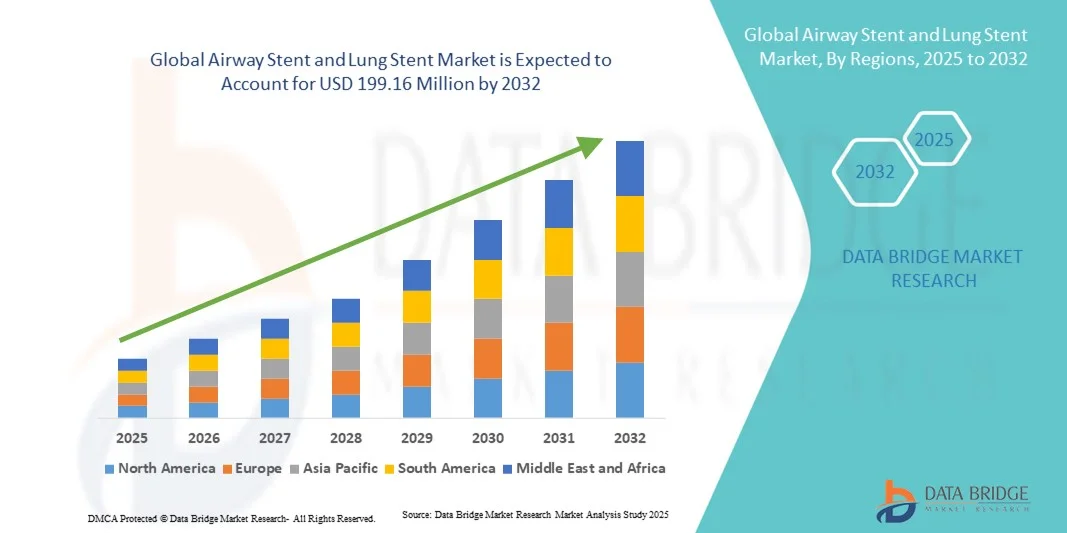
- The global airway stent and lung stent market size was valued at USD 122.72 million in 2024 and is expected to reach USD 199.16 million by 2032, at a CAGR of 6.24% during the forecast period
- The market growth is largely fueled by the rising prevalence of respiratory disorders such as tracheal and bronchial obstructions, coupled with advancements in minimally invasive procedures and stent technologies
- Furthermore, increasing adoption of biocompatible, drug-eluting, and customizable stents, along with growing awareness of effective palliative care solutions, is driving demand in both hospital and outpatient care settings. These converging factors are accelerating the uptake of airway and lung stent solutions, thereby significantly boosting the industry's growth
Airway Stent and Lung Stent Market Analysis
- Airway and lung stents, providing minimally invasive support to maintain patency in tracheal, bronchial, and other airway structures, are increasingly essential in managing obstructive respiratory conditions and facilitating palliative care, particularly in patients with lung cancer or severe airway stenosis
- The escalating demand for airway and lung stents is primarily driven by the rising prevalence of respiratory diseases, technological advancements in stent materials and designs and growing preference for minimally invasive procedures over traditional surgeries
- North America dominated the airway and lung stent market with the largest revenue share of 38% in 2024, attributed to well-established healthcare infrastructure, high patient awareness, and the presence of key medical device companies, with the U.S. witnessing substantial adoption of advanced stent technologies in hospitals and specialized pulmonary care centers
- Asia-Pacific is expected to be the fastest-growing region in the airway and lung stent market during the forecast period due to increasing healthcare investments, rising incidence of respiratory disorders, and expanding access to advanced interventional pulmonology treatments
- Metal stent segment dominated the airway and lung stent market with a market share of 45.5% in 2024, driven by its superior structural support, durability, and widespread use in both benign and malignant airway obstructions
Report Scope and Airway Stent and Lung Stent Market Segmentation
|
Attributes |
Airway Stent and Lung Stent Key Market Insights |
|
Segments Covered |
|
|
Countries Covered |
North America
Europe
Asia-Pacific
Middle East and Africa
South America
|
|
Key Market Players |
|
|
Market Opportunities |
|
|
Value Added Data Infosets |
In addition to the insights on market scenarios such as market value, growth rate, segmentation, geographical coverage, and major players, the market reports curated by the Data Bridge Market Research also include in-depth expert analysis, pricing analysis, brand share analysis, consumer survey, demography analysis, supply chain analysis, value chain analysis, raw material/consumables overview, vendor selection criteria, PESTLE Analysis, Porter Analysis, and regulatory framework. |
Airway Stent and Lung Stent Market Trends
Advancements Through 3D Printing and Customized Designs
- A significant and accelerating trend in the global airway and lung stent market is the increasing adoption of 3D printing technologies to create patient-specific stents that perfectly match individual airway anatomies
- For instance, customized 3D-printed stents are being designed for patients with complex tracheal or bronchial obstructions, improving fit and reducing complications compared to standard stents
- Technological innovations also allow for bioresorbable and drug-eluting stents, which enhance treatment outcomes, minimize tissue reaction, and reduce the need for repeat procedures
- The integration of imaging software with stent design facilitates pre-procedural planning, enabling clinicians to visualize and optimize stent placement for each patient
- This trend toward personalized, technologically advanced stents is reshaping clinical expectations for airway management, pushing manufacturers to develop more patient-focused, versatile solutions
- The demand for stents offering precise anatomical customization and enhanced therapeutic benefits is growing rapidly across hospitals and specialized pulmonary centers, as physicians prioritize patient safety and procedure efficiency
Airway Stent and Lung Stent Market Dynamics
Driver
Increasing Prevalence of Respiratory Disorders and Minimally Invasive Interventions
- The rising incidence of tracheal, bronchial, and other airway obstructions, along with the growing preference for minimally invasive procedures, is a key driver of the airway and lung stent market
- For instance, in May 2024, Merit Medical advanced its airway stent solutions with improved delivery systems for minimally invasive bronchoscopic procedures, supporting broader clinical adoption
- As awareness of obstructive respiratory conditions grows, stents provide effective management by maintaining airway patency, improving breathing, and enhancing quality of life
- Furthermore, the growing adoption of interventional pulmonology and hospital-based airway management programs is boosting demand for advanced stent solutions
- The convenience of shorter procedure times, reduced hospital stays, and the availability of stents compatible with various airway anatomies are key factors propelling adoption in clinical settings
- The trend toward patient-specific stent design and integration with modern imaging and navigation technologies further accelerates market growth across specialized medical centers
Restraint/Challenge
Risk of Complications and Regulatory Compliance Hurdle
- Potential complications such as stent migration, tissue overgrowth, and airway irritation present a significant challenge to widespread adoption of airway and lung stents
- For instance, reports of stent-related infections or granulation tissue formation have made some clinicians cautious about using certain stent types, particularly in high-risk patients
- Ensuring regulatory compliance for biocompatible materials, safety standards, and clinical efficacy is crucial, as stringent approvals can delay product launches and limit market access
- In addition, high costs of advanced stents, especially drug-eluting or bioresorbable options, can restrict use in price-sensitive healthcare systems or regions
- While technological improvements are reducing complication rates, perceived risks and cost considerations can still hinder adoption in some clinical settings
- Overcoming these challenges through improved stent designs, clinical training, and compliance with international medical device regulations is vital for sustained market expansion
Airway Stent and Lung Stent Market Scope
The market is segmented on the basis of type, product type, material, and end user.
- By Type
On the basis of type, the airway and lung stent market is segmented into tracheobronchial stents and laryngeal stents. The tracheobronchial stents segment dominated the market with the largest revenue share in 2024, driven by the higher prevalence of tracheal and bronchial obstructions due to conditions such as lung cancer, chronic obstructive pulmonary disease (COPD), and benign strictures. These stents are widely used in hospitals and specialized pulmonary care centers to restore airway patency and improve breathing in patients with severe obstruction. The segment’s dominance is also supported by technological advancements, including drug-eluting and 3D-printed patient-specific stents, which enhance clinical outcomes and reduce complications. Physicians often prefer tracheobronchial stents due to their versatility in treating complex airway anatomies and compatibility with minimally invasive bronchoscopic procedures. Continuous innovation in stent design and deployment systems has further strengthened their adoption across established healthcare facilities.
The laryngeal stents segment is expected to witness the fastest growth during the forecast period, driven by rising awareness of airway management in voice and swallowing disorders, pediatric airway interventions, and post-surgical airway reconstruction. Laryngeal stents are increasingly preferred in specialized ENT and thoracic centers for managing laryngeal stenosis and post-operative edema. The growth is further supported by improved materials, such as silicone and hybrid stents, which reduce irritation and improve patient comfort. Increasing investments in healthcare infrastructure and training of clinicians in minimally invasive ENT procedures are expected to boost the adoption of laryngeal stents worldwide.
- By Product Type
On the basis of product type, the airway and lung stent market is segmented into self-expandable stents, non-expandable stents, and balloon-expandable stents. The self-expandable stents segment dominated the market in 2024, attributed to their ease of deployment, flexibility, and ability to conform to complex airway anatomies. Self-expandable stents are widely used in both benign and malignant airway obstructions due to their reduced risk of migration and lower procedural complications. Their popularity is reinforced by advancements in nitinol-based designs that provide optimal radial force while minimizing tissue trauma. Hospitals and specialized pulmonary centers prefer self-expandable stents for long-term airway support and in cases where repeated bronchoscopic interventions are required. In addition, self-expandable stents can be combined with drug-eluting coatings to reduce granulation tissue formation, further driving market adoption.
The balloon-expandable stents segment is expected to witness the fastest growth during forecast period, due to increasing use in pediatric and precision airway interventions where controlled expansion is critical. Balloon-expandable stents allow clinicians to achieve precise stent sizing and placement, making them suitable for anatomically challenging cases. Their use is growing in advanced pulmonary procedures supported by improved imaging and bronchoscopic guidance systems. Rising awareness of minimally invasive stent deployment techniques and enhanced training programs for interventional pulmonologists are expected to accelerate segment growth during the forecast period.
- By Material
On the basis of material, the airway and lung stent market is segmented into metal stents, silicone stents, and hybrid stents. The metal stents segment dominated the market in 2024 with a market share of 45.5%, driven by their structural strength, durability, and effectiveness in treating both benign and malignant airway obstructions. Metal stents, particularly nitinol-based designs, offer high radial force, long-term patency, and compatibility with drug-eluting coatings. Hospitals and specialized clinics often prefer metal stents for complex airway procedures due to their reliability and long-term clinical outcomes. The segment is also supported by technological innovations in anti-migration designs and flexible structures that reduce complications.
The silicone stents segment is expected to witness the fastest growth during forecast period, owing to rising demand for biocompatible and patient-friendly options that minimize tissue irritation and facilitate easy removal or repositioning. Silicone stents are increasingly used in pediatric, post-surgical, and palliative care settings for airway management. Their non-reactive surface reduces inflammation and granulation tissue formation, improving patient comfort. Continuous product innovation, combined with growing awareness among clinicians about patient-centric airway solutions, is driving segment adoption.
- By End User
On the basis of end user, the airway and lung stent market is segmented into hospitals and ambulatory surgery centers. The hospitals segment dominated the market in 2024, owing to the presence of well-equipped pulmonary and thoracic departments, access to advanced imaging and bronchoscopic tools, and higher procedural volumes. Hospitals remain the preferred setting for airway and lung stent procedures due to their ability to manage complex cases, provide intensive care support, and handle post-procedural monitoring.
The ambulatory surgery centers segment is expected to witness the fastest growth during forecast period, as minimally invasive stent procedures increasingly shift to outpatient settings, driven by cost-effectiveness, shorter recovery times, and growing investments in specialized centers. Improved procedural techniques, coupled with the availability of compact imaging and delivery systems, are enabling the growth of stent deployment outside traditional hospital environments. Rising awareness among patients and clinicians about outpatient airway interventions is expected to fuel adoption in this segment.
Airway Stent and Lung Stent Market Regional Analysis
- North America dominated the airway and lung stent market with the largest revenue share of 38% in 2024, attributed to well-established healthcare infrastructure, high patient awareness, and the presence of key medical device companies, with the U.S. witnessing substantial adoption of advanced stent technologies in hospitals and specialized pulmonary care centers
- Patients and healthcare providers in the region prioritize airway stents for their effectiveness in treating tracheal and bronchial obstructions, improved clinical outcomes, and compatibility with advanced imaging and bronchoscopic guidance systems
- This widespread adoption is further supported by well-established hospitals, specialized pulmonary care centers, skilled interventional pulmonologists, and strong presence of leading medical device manufacturers, establishing airway and lung stents as a preferred solution for managing obstructive airway conditions in both benign and malignant cases
U.S. Airway Stent and Lung Stent Market Insight
The U.S. airway and lung stent market captured the largest revenue share of 82% in 2024 within North America, fueled by the rising prevalence of obstructive respiratory diseases and the growing adoption of minimally invasive pulmonary interventions. Patients and clinicians increasingly prioritize advanced stent technologies for effective airway management, improved clinical outcomes, and reduced procedural risks. The demand for drug-eluting, self-expandable, and patient-specific stents, combined with well-equipped hospitals and specialized pulmonary care centers, further propels the market. Moreover, the integration of imaging-guided bronchoscopic procedures and outpatient interventions is significantly contributing to market expansion.
Europe Airway and Lung Stent Market Insight
The Europe airway and lung stent market is projected to expand at a substantial CAGR throughout the forecast period, primarily driven by increasing incidence of tracheal and bronchial disorders and stringent healthcare standards. The growth of specialized pulmonary centers and investments in interventional pulmonology are fostering stent adoption. European clinicians and patients are increasingly drawn to the precision, safety, and minimally invasive nature of advanced stent technologies. The market is witnessing significant growth across hospitals and specialty clinics, with airway stents being incorporated into both routine and complex airway management procedures.
U.K. Airway and Lung Stent Market Insight
The U.K. airway and lung stent market is anticipated to grow at a noteworthy CAGR during the forecast period, driven by rising awareness of respiratory health and demand for minimally invasive airway interventions. Concerns regarding airway obstruction due to chronic diseases and malignancies are encouraging hospitals and specialty clinics to adopt advanced stent solutions. The U.K.’s well-developed healthcare infrastructure, coupled with strong research initiatives and access to cutting-edge stent technologies, is expected to continue stimulating market growth.
Germany Airway and Lung Stent Market Insight
The Germany airway and lung stent market is expected to expand at a considerable CAGR during the forecast period, fueled by increasing awareness of airway management, the growing prevalence of respiratory disorders, and demand for technologically advanced solutions. Germany’s strong healthcare system, emphasis on innovation, and availability of specialized interventional pulmonology centers promote stent adoption, particularly in hospitals and tertiary care facilities. The integration of advanced stent systems with imaging and bronchoscopic technologies is also becoming increasingly prevalent, aligning with local clinical expectations.
Asia-Pacific Airway and Lung Stent Market Insight
The Asia-Pacific airway and lung stent market is poised to grow at the fastest CAGR during the forecast period of 2025 to 2032, driven by increasing prevalence of respiratory diseases, rising healthcare investments, and expanding access to minimally invasive interventions in countries such as China, Japan, and India. Growing awareness of advanced airway management, coupled with government initiatives promoting healthcare modernization, is driving adoption. Furthermore, APAC is emerging as a hub for stent manufacturing, improving affordability and accessibility for hospitals and specialty centers.
Japan Airway and Lung Stent Market Insight
The Japan airway and lung stent market is gaining momentum due to the country’s advanced healthcare infrastructure, high awareness of respiratory disorders, and demand for minimally invasive interventions. The market emphasizes precision airway management, with adoption driven by advanced stent technologies, imaging-guided placement, and integration with bronchoscopic procedures. In addition, Japan’s aging population is such asly to spur demand for safer, more effective airway solutions in both hospitals and outpatient centers.
India Airway and Lung Stent Market Insight
The India airway and lung stent market accounted for the largest revenue share in Asia-Pacific in 2024, attributed to rising prevalence of obstructive airway diseases, expanding healthcare infrastructure, and increasing awareness of minimally invasive stent procedures. India is witnessing strong adoption of advanced stent solutions in hospitals and specialty pulmonary centers. Government initiatives supporting healthcare modernization, along with growing access to affordable stent options and local manufacturing, are key factors propelling market growth in India.
Airway Stent and Lung Stent Market Share
The Airway Stent and Lung Stent industry is primarily led by well-established companies, including:
- Boston Scientific Corporation (U.S.)
- Cook (U.S.)
- Olympus Corporation (Japan)
- Intersect ENT, Inc. (U.S.)
- Micro-Tech (Nanjing) Co., Ltd. (China)
- VisionAir Solutions (U.S.)
- Thoracent, Inc. (U.S.)
- AnatomikModeling SAS (France)
- Novatech, Inc. (U.S.)
- E. Benson Hood Laboratories, Inc. (U.S.)
- TAEWOONG (South Korea)
- ENDO-FLEX GmbH (Germany)
What are the Recent Developments in Global Airway Stent and Lung Stent Market?
- In June 2025, a groundbreaking medical procedure was performed at NEIGRIHMS in Shillong, India, where a critically ill young woman suffering from 'stump blowout' received a life-saving, non-surgical intervention. A customized Y-shaped silicone stent was introduced into her airway, temporarily sealing the damaged airway stump and preventing infection spread to the healthy lung. This innovative device enabled her to breathe independently and provided a temporary solution while preparing her for future reconstructive surgery
- In December 2024, Cleveland Clinic published a review highlighting the strengths and limitations of available airway stents and the latest advances in the field. The review emphasizes the need for standardized practices and further research to optimize the use of airway stents in clinical settings, aiming to enhance patient outcomes and reduce variability in treatment approaches
- In October 2024, Peytant Solutions received FDA De Novo clearance for the AMStent® Tracheobronchial Covered Stent System. This novel stent is designed for treating tracheobronchial strictures caused by malignant neoplasms in adult patients
- In July 2024, VisionAir Solutions announced the development of over 600 custom 3D-printed airway stents using their AI VisionAir 3D Stent Software. These patient-specific stents aim to improve treatment outcomes for individuals with complex airway anatomies
- In August 2023, Wellead Medical launched the Wei Nasal Jet Tube (WNJ), a new device for supraglottic jet oxygenation/ventilation. The device has received CE and FDA approvals, marking its readiness for commercialization

- Interactive Data Analysis Dashboard
- Company Analysis Dashboard for high growth potential opportunities
- Research Analyst Access for customization & queries
- Competitor Analysis with Interactive dashboard
- Latest News, Updates & Trend analysis
- Harness the Power of Benchmark Analysis for Comprehensive Competitor Tracking
Data collection and base year analysis are done using data collection modules with large sample sizes. The stage includes obtaining market information or related data through various sources and strategies. It includes examining and planning all the data acquired from the past in advance. It likewise envelops the examination of information inconsistencies seen across different information sources. The market data is analysed and estimated using market statistical and coherent models. Also, market share analysis and key trend analysis are the major success factors in the market report. To know more, please request an analyst call or drop down your inquiry.
The key research methodology used by DBMR research team is data triangulation which involves data mining, analysis of the impact of data variables on the market and primary (industry expert) validation. Data models include Vendor Positioning Grid, Market Time Line Analysis, Market Overview and Guide, Company Positioning Grid, Patent Analysis, Pricing Analysis, Company Market Share Analysis, Standards of Measurement, Global versus Regional and Vendor Share Analysis. To know more about the research methodology, drop in an inquiry to speak to our industry experts.
Data Bridge Market Research is a leader in advanced formative research. We take pride in servicing our existing and new customers with data and analysis that match and suits their goal. The report can be customized to include price trend analysis of target brands understanding the market for additional countries (ask for the list of countries), clinical trial results data, literature review, refurbished market and product base analysis. Market analysis of target competitors can be analyzed from technology-based analysis to market portfolio strategies. We can add as many competitors that you require data about in the format and data style you are looking for. Our team of analysts can also provide you data in crude raw excel files pivot tables (Fact book) or can assist you in creating presentations from the data sets available in the report.













