


Alcohol Septal Ablation Market Size
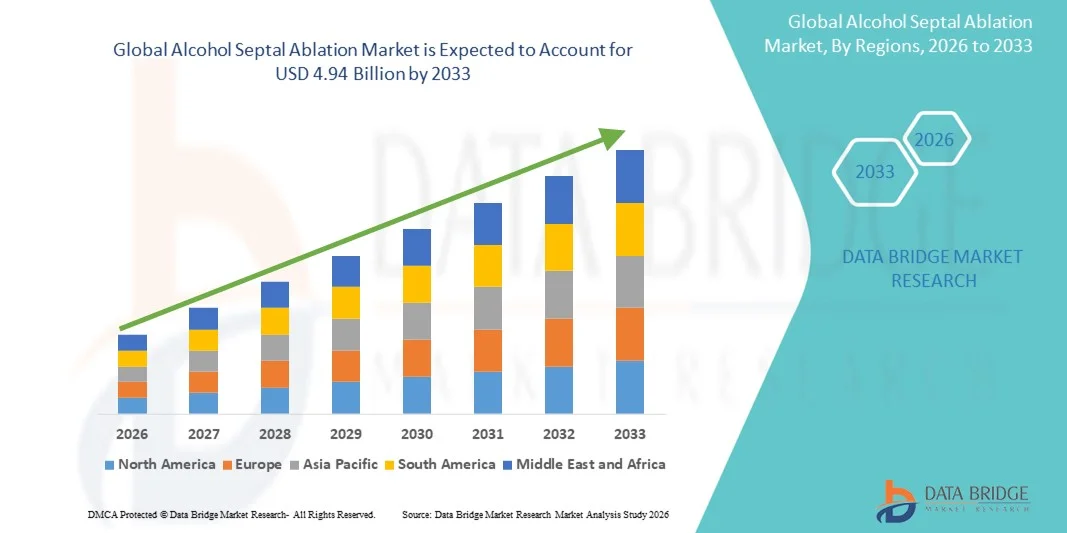
- The global alcohol septal ablation market size was valued at USD 3.10 billion in 2025 and is expected to reach USD 4.94 billion by 2033, at a CAGR of 6.00% during the forecast period
- The market growth is largely fueled by the increasing prevalence of hypertrophic cardiomyopathy (HCM) and other obstructive cardiac conditions, along with rising awareness and early diagnosis of structural heart diseases in both developed and developing regions
- Furthermore, growing demand for minimally invasive, effective, and patient-friendly treatment options is establishing alcohol septal ablation as a preferred therapeutic procedure in eligible patients. These converging factors are accelerating the uptake of Alcohol Septal Ablation solutions, thereby significantly boosting the industry's growth
Alcohol Septal Ablation Market Analysis
- Alcohol septal ablation, a minimally invasive catheter-based procedure used to treat hypertrophic obstructive cardiomyopathy (HOCM), is becoming an increasingly important therapeutic option in modern cardiology due to its effectiveness in reducing left ventricular outflow tract obstruction and improving patient quality of life
- The rising demand for alcohol septal ablation is primarily fueled by the growing prevalence of hypertrophic cardiomyopathy, increasing awareness of advanced interventional cardiology procedures, and a rising preference for minimally invasive alternatives to open-heart surgery
- North America dominated the alcohol septal ablation market with the largest revenue share of 38.7% in 2025, supported by advanced healthcare infrastructure, high adoption of innovative cardiac procedures, strong reimbursement frameworks, and the presence of leading cardiac care centers, with the U.S. witnessing significant procedural growth due to a higher diagnosis rate of hypertrophic cardiomyopathy and greater access to specialized interventional cardiologists
- Asia-Pacific is expected to be the fastest growing region in the alcohol septal ablation market during the forecast period due to rapidly improving healthcare infrastructure, rising healthcare expenditure, growing urbanization, and increasing awareness of cardiovascular diseases in emerging economies such as China and India
- The HOCM segment dominated the largest market revenue share of 68.4% in 2025, driven by the rising prevalence of hypertrophic cardiomyopathy worldwide and the growing recognition of Alcohol Septal Ablation as a minimally invasive alternative to surgical septal myectomy
Report Scope and Alcohol Septal Ablation Market Segmentation
|
Attributes |
Alcohol Septal Ablation Key Market Insights |
|
Segments Covered |
|
|
Countries Covered |
North America
Europe
Asia-Pacific
Middle East and Africa
South America
|
|
Key Market Players |
• Boston Scientific Corporation (U.S.) |
|
Market Opportunities |
|
|
Value Added Data Infosets |
In addition to the insights on market scenarios such as market value, growth rate, segmentation, geographical coverage, and major players, the market reports curated by the Data Bridge Market Research also include in-depth expert analysis, patient epidemiology, pipeline analysis, pricing analysis, and regulatory framework. |
Alcohol Septal Ablation Market Trends
Advancements in Precision-Guided Catheter-Based Interventions
- A significant and accelerating trend in the global alcohol septal ablation market is the increasing reliance on precision-guided, minimally invasive, catheter-based techniques supported by advanced imaging modalities such as intracardiac echocardiography (ICE), cardiac MRI, and real-time 3D mapping systems. These technologies enable cardiologists to more accurately identify the hypertrophied septal region responsible for left ventricular outflow tract obstruction and to deliver ethanol with enhanced precision, thereby improving patient outcomes and reducing the risk of complications associated with traditional surgical myectomy
- For instance, in March 2024, several leading cardiac centers expanded the use of intracardiac ultrasound-guided septal reduction protocols for patients with obstructive hypertrophic cardiomyopathy who are non-surgical candidates. These protocols utilize enhanced catheter guidance and mapping systems to improve ethanol delivery accuracy, resulting in better symptom relief, improved exercise capacity, and reduced procedural risks. This clinical development highlights the growing adoption of advanced imaging-assisted techniques within Alcohol Septal Ablation procedures
- The integration of sophisticated fluoroscopic imaging, contrast-enhanced visualization, and pressure-gradient monitoring systems is further optimizing the procedural workflow. These advancements allow clinicians to assess real-time hemodynamic changes, confirm successful reduction in outflow obstruction, and make precise adjustments during the procedure, leading to higher procedural success rates and shorter recovery times for patients
- The trend toward less invasive cardiac interventions is also being supported by continuous improvements in catheter technology, including more flexible micro-catheters and targeted infusion systems that enable controlled administration of alcohol to the desired septal branch. These innovations help minimize collateral tissue damage and reduce the likelihood of conduction disturbances, such as complete heart block
- As patient preference increasingly shifts toward minimally invasive treatment options that offer shorter hospital stays and reduced recovery periods, Alcohol Septal Ablation is becoming a more widely accepted alternative to open-heart surgery in selected cases of hypertrophic obstructive cardiomyopathy (HOCM)
- This ongoing evolution toward greater procedural precision, improved safety profiles, and enhanced patient outcomes is significantly strengthening clinical confidence in Alcohol Septal Ablation, positioning it as a key therapeutic option in the broader structural heart disease and interventional cardiology treatment landscape
Alcohol Septal Ablation Market Dynamics
Driver
Growing Clinical Demand for Minimally Invasive Treatment of Hypertrophic Obstructive Cardiomyopathy
- The rising prevalence of hypertrophic obstructive cardiomyopathy (HOCM), coupled with increased awareness and improved diagnostic rates through echocardiography and cardiac MRI, is a significant driver of demand for Alcohol Septal Ablation procedures across global healthcare systems
- For instance, in June 2025, a leading European cardiac research consortium published expanded clinical guidelines supporting Alcohol Septal Ablation as an effective alternative for carefully selected high-risk or elderly patients who are unsuitable for surgical myectomy. This clinical endorsement has led to increased procedural volumes across specialized cardiac care centers and is expected to accelerate market growth during the forecast period
- As more cardiologists gain expertise in catheter-based structural heart interventions, the capacity to perform Alcohol Septal Ablation has expanded beyond major academic hospitals into advanced regional medical centers, improving patient access to this treatment
- The growing preference for shorter hospital stays, reduced postoperative pain, and quicker recovery times is also contributing to higher acceptance of this procedure among patients and physicians alike
- In addition, technological advancements in catheter systems, imaging tools, and pre-procedural planning software are continuously improving overall procedural outcomes, thereby reinforcing the sustained growth of the Alcohol Septal Ablation market
Restraint/Challenge
Potential for Procedure-Related Complications and Limited Availability of Specialized Expertise
- Despite its minimally invasive nature, alcohol septal ablation carries inherent risks such as complete heart block, ventricular arrhythmias, myocardial infarction, and the potential requirement for permanent pacemaker implantation, which may limit its adoption in certain patient groups
- For instance, in February 2023, a multi-center observational study highlighted a measurable incidence of post-procedure conduction abnormalities requiring pacemaker placement in a subset of patients undergoing septal ablation. This finding prompted several institutions to adopt stricter patient selection criteria, which has somewhat restrained the broader use of the procedure
- The success of Alcohol Septal Ablation is heavily dependent on operator experience, advanced imaging capabilities, and access to specialized interventional cardiology infrastructure. In many developing and rural regions, the lack of trained specialists and appropriate equipment significantly restricts widespread adoption
- Furthermore, the need for precise patient evaluation, complex pre-operative planning, and extended post-procedure monitoring increases the overall cost burden on healthcare systems, limiting accessibility in price-sensitive markets
- Addressing these challenges through enhanced physician training programs, improved procedural standardization, and broader development of specialized cardiac centers will be essential to support the sustained expansion of the global alcohol septal ablation market
Alcohol Septal Ablation Market Scope
The market is segmented on the basis of application, drug type, end-users, and distribution channel.
- By Application
On the basis of application, the Alcohol Septal Ablation market is segmented into Hypertrophic Obstructive Cardiomyopathy (HOCM) and Others. The HOCM segment dominated the largest market revenue share of 68.4% in 2025, driven by the rising prevalence of hypertrophic cardiomyopathy worldwide and the growing recognition of Alcohol Septal Ablation as a minimally invasive alternative to surgical septal myectomy. Increasing awareness among cardiologists regarding the effectiveness of septal reduction therapy in relieving left ventricular outflow tract obstruction has significantly boosted its adoption. Technological advancements in catheter-based procedures have further improved procedural success rates. The rising geriatric population, which is more susceptible to cardiomyopathies, also adds to the demand. Greater accessibility of interventional cardiology facilities is another supporting factor. Continuous clinical research validating positive outcomes has encouraged physicians to recommend this treatment. Favorable reimbursement structures in developed economies also contribute to its market dominance. Moreover, shorter recovery times and reduced hospitalization compared to open-heart surgery make it a preferred option. Improved imaging guidance and procedural safety have enhanced physician confidence. Increasing patient preference for less invasive treatment options continues to solidify the strong position of this segment in the global market.
The Others segment is expected to witness the fastest CAGR of 11.6% from 2026 to 2033, owing to the expanding application scope of Alcohol Septal Ablation in rare cardiac conditions and emerging clinical studies exploring its broader use. Growing investments in cardiovascular research and innovation are opening new therapeutic pathways. Improved diagnostic technologies are helping identify additional patient groups who may benefit from septal ablation. Rising adoption in developing regions due to improving healthcare infrastructure further contributes to growth. Increasing awareness and training among cardiologists also play a crucial role. The development of next-generation catheters enables more precise delivery, encouraging trial use in non-traditional cases. Demand is also rising from academic institutions conducting clinical trials. Expansion of specialized cardiac care centers is accelerating the use of advanced techniques. Supportive government initiatives for cardiac disease management encourage innovation. As evidence continues to build, the adoption rate of these applications is expected to rise. This evolving clinical landscape strongly supports the rapid growth of this segment.
- By Drug Type
On the basis of drug type, the Alcohol Septal Ablation market is segmented into Local Anesthetics, Anticoagulants, and Others. The Local Anesthetics segment dominated the largest market revenue share of 54.9% in 2025, due to their essential role in ensuring patient comfort and safety during the procedure. Local anesthetics are consistently used to numb the targeted cardiac area, minimizing pain and discomfort for the patient. Their widespread availability and cost-effectiveness further drive dominance. Continuous advancements in formulation have improved onset time and duration of action. Physicians prefer local anesthetics due to better patient compliance and low complication rates. Increasing procedural volumes in hospitals contribute to higher consumption. Standardized procedural protocols worldwide recommend their focused use. High safety margins and reduced systemic side effects increase adoption. Growing outpatient and short-stay cardiac procedures also rely heavily on local anesthetic use. Their compatibility with imaging and catheter-based technologies is another advantage. The strong clinical necessity of these drugs ensures steady demand. As procedure rates grow, this segment is expected to maintain its leading position.
The Anticoagulants segment is projected to witness the fastest CAGR of 12.4% from 2026 to 2033, driven by the increasing focus on reducing procedural and post-procedural thrombotic risks. Greater awareness of clotting complications during cardiac interventions has led to a rise in anticoagulant use. Advanced drugs with improved safety profiles are being adopted at a faster rate. The growing prevalence of comorbidities, such as atrial fibrillation and coronary artery disease, necessitates anticoagulant administration. Technological innovations supporting precise dosage control encourage wider adoption. Increasing geriatric population with higher clotting risk further contributes to growth. Continuous clinical studies highlighting improved patient outcomes favor this segment. Expanding hospital protocols now emphasize preventive anticoagulation therapy. Better accessibility in emerging markets also drives demand. Pharmaceutical companies are investing heavily in developing safer variants. Rising awareness among clinicians continues to support this rapid expansion.
- By End-Users
On the basis of end-users, the Alcohol Septal Ablation market is segmented into Clinic, Hospital, and Others. The Hospital segment dominated the largest market revenue share of 63.7% in 2025, attributed to the availability of advanced interventional cardiology infrastructure. Hospitals are equipped with specialized cardiac catheterization labs required for complex procedures like Alcohol Septal Ablation. The presence of skilled cardiologists and multidisciplinary support teams enhances treatment reliability. Higher patient inflow for cardiac cases also strengthens hospitals’ dominant position. Favorable reimbursement policies encourage patients to opt for hospital-based treatment. Hospitals provide better monitoring, emergency support, and post-procedure care. Continuous investment in modern medical equipment ensures high procedural success. Research and clinical trials are largely conducted in hospital settings. Strong referral networks further drive patient volume. Increasing government funding for hospital upgrades also boosts dominance. Patient trust in hospitals for high-risk procedures remains a major influencing factor. All these aspects together help hospitals retain a significant market share.
The Clinic segment is expected to witness the fastest CAGR of 10.8% from 2026 to 2033, due to rising outpatient visits and decentralization of cardiac care services. Smaller cardiac clinics are increasingly being equipped with advanced diagnostic and minor intervention capabilities. Reduced waiting time and personalized care improve patient preference. Growing awareness of early diagnosis encourages regular clinic visits. Expansion of specialized cardiology clinics across urban and semi-urban areas fuels growth. Technological advancements in portable diagnostic tools support clinic-based procedures. Rising investments by private healthcare providers contribute significantly. Improved cost efficiency compared to hospital treatment also attracts more patients. Telecardiology integration supports quicker referrals and follow-ups. Increasing health insurance coverage for outpatient cardiac services is another driver. Continuous training programs for clinic physicians enhance service quality. These factors together result in the rapid growth of the clinic segment.
- By Distribution Channel
On the basis of distribution channel, the Alcohol Septal Ablation market is segmented into Hospital Pharmacy, Retail Pharmacy, and Online Pharmacy. The Hospital Pharmacy segment dominated the largest market revenue share of 58.6% in 2025, as most procedures are performed in hospital environments. Hospital pharmacies ensure immediate availability of essential drugs, including anesthetics and anticoagulants. Centralized procurement maintains consistent quality and regulatory compliance. Bulk purchasing reduces per-unit costs, making it the preferred channel. Integration with hospital inventory systems helps maintain continuous supply. Prescribed medications are administered under medical supervision, increasing reliance on this channel. Strong relationships with pharmaceutical suppliers enhance efficiency. Emergency availability of medications further supports its dominance. High patient admission rates for cardiac complications drive higher demand. Institutional trust and standardized protocols influence uptake. The ability to manage temperature-sensitive drugs also provides an advantage. All these elements strengthen the stronghold of hospital pharmacies in this market.
The Online Pharmacy segment is expected to witness the fastest CAGR of 13.2% from 2026 to 2033, due to the rapid growth of digital healthcare and e-commerce platforms. Online services offer convenience, doorstep delivery, and time-saving benefits. Increasing smartphone and internet penetration strongly supports this channel. Growing awareness about digital prescription services fuels adoption. Cost-effective pricing and discount models attract a large consumer base. Subscription services for repeat medications enhance customer retention. Enhanced data security and authentication methods build trust among users. Expansion in rural and remote regions improves market reach. Integration of AI-based prescription management improves reliability. Growing partnerships between hospitals and e-pharmacies accelerate distribution. As digital literacy improves globally, demand for online pharmaceuticals is expected to rise significantly, driving this segment’s rapid growth.
Alcohol Septal Ablation Market Regional Analysis
- North America dominated the alcohol septal ablation market with the largest revenue share of 38.7% in 2025
- Supported by advanced healthcare infrastructure, high adoption of innovative cardiac procedures, strong reimbursement frameworks, and the presence of leading cardiac care centers in the region
- The rising prevalence of hypertrophic obstructive cardiomyopathy (HOCM), increasing awareness about minimally invasive treatment options, and a well-established network of interventional cardiologists continue to strengthen market leadership in North America for Alcohol Septal Ablation procedures
U.S. Alcohol Septal Ablation Market Insight
The U.S. alcohol septal ablation market captured the largest revenue share within North America in 2025, driven by a higher diagnosis rate of hypertrophic cardiomyopathy, widespread availability of specialized cardiac centers, and greater access to experienced interventional cardiologists. The increasing preference for minimally invasive alternatives to surgical septal myectomy, combined with strong healthcare spending and advanced imaging technologies, further supports the growth of the Alcohol Septal Ablation market in the United States.
Europe Alcohol Septal Ablation Market Insight
The Europe alcohol septal ablation market is projected to expand at a substantial CAGR during the forecast period, primarily driven by growing awareness of advanced cardiac therapies, increasing adoption of minimally invasive procedures, and the presence of well-established healthcare systems in countries such as Germany, France, and the U.K. Continuous investments in cardiac research and technological advancements in interventional cardiology are expected to further stimulate market expansion across the region.
U.K. Alcohol Septal Ablation Market Insight
The U.K. alcohol septal ablation market is anticipated to grow at a noteworthy CAGR, supported by rising prevalence of cardiovascular disorders, increasing focus on early diagnosis, and continuous improvements in cardiac treatment infrastructure. The country’s emphasis on modernizing healthcare services and expanding access to specialized cardiac procedures is promoting the adoption of Alcohol Septal Ablation therapies.
Germany Alcohol Septal Ablation Market Insight
The Germany alcohol septal ablation market is expected to expand at a considerable CAGR due to strong investment in healthcare innovation, widespread availability of advanced medical equipment, and a growing number of specialized cardiac care facilities. Germany’s well-developed hospital network and strong focus on precision medicine and minimally invasive therapies further contribute to the increasing adoption of Alcohol Septal Ablation procedures.
Asia-Pacific Alcohol Septal Ablation Market Insight
The Asia-Pacific alcohol septal ablation market region is expected to be the fastest-growing market during the forecast period, driven by rapidly improving healthcare infrastructure, rising healthcare expenditure, growing urbanization, and increasing awareness of cardiovascular diseases in emerging economies such as China and India. Expanding access to advanced diagnostic tools, growing medical tourism, and rising government initiatives to strengthen cardiac care services are significantly accelerating the adoption of Alcohol Septal Ablation in the region.
Japan Alcohol Septal Ablation Market Insight
The Japan alcohol septal ablation market is gaining traction due to the country’s aging population, high prevalence of cardiovascular conditions, and advanced medical technology landscape. Japan’s strong focus on precision-based and minimally invasive treatment approaches, along with continuous research in cardiology, is expected to drive steady growth of the market.
China Alcohol Septal Ablation Market Insight
The China alcohol septal ablation market accounted for the largest market revenue share within Asia-Pacific in 2025, attributed to increasing cases of hypertrophic cardiomyopathy, rapid improvements in healthcare infrastructure, rising disposable incomes, and growing access to specialized cardiac treatments. Government initiatives to enhance hospital capabilities, along with the expansion of private and public cardiac care centers, are major factors propelling the adoption of Alcohol Septal Ablation procedures in the country.
Alcohol Septal Ablation Market Share
The Alcohol Septal Ablation industry is primarily led by well-established companies, including:
• Boston Scientific Corporation (U.S.)
• Abbott (U.S.)
• Medtronic (Ireland)
• Johnson & Johnson (U.S.)
• Bayer AG (Germany)
• Pfizer Inc. (U.S.)
• GE HealthCare (U.S.)
• Philips Healthcare (Netherlands)
• Siemens Healthineers (Germany)
• Biotronik SE & Co. KG (Germany)
• Terumo Corporation (Japan)
• AbbVie Inc. (U.S.)
• AstraZeneca plc (U.K.)
• Novartis AG (Switzerland)
• Sanofi S.A. (France)
• Guerbet Group (France)
• Merit Medical Systems (U.S.)
• Cardinal Health (U.S.)
• B. Braun Melsungen AG (Germany)
Latest Developments in Global Alcohol Septal Ablation Market
- In April 2022, researchers published a large, retrospective analysis comparing long-term survival after Alcohol Septal Ablation vs. surgical myectomy. The study found that patients undergoing ASA had a significantly higher 10-year all-cause mortality than those who received myectomy, raising new questions about long-term risk-benefit trade-offs for ASA in hypertrophic obstructive cardiomyopathy
- In November 2023, the updated 2023 ESC Guidelines for Cardiomyopathies reaffirmed the role of ASA. The guidelines stated that in experienced centers, ASA “has outcomes similar to surgery in terms of gradient reduction, symptom improvement, and exercise capacity,” making it a primary option in many treatment centers
- In July 2023, a multinational registry study published long-term data showing that ASA remains effective even in patients with very high left ventricular outflow tract gradient (≥ 100 mm Hg). After ~5.8 years of follow-up, survival outcomes were similar to those with lower gradients, although more repeat procedures were needed in the very high-gradient group
- In October 2023, a retrospective single-center analysis reported outcomes for ASA in patients aged 75 years or older. The study found that older patients had similar in-hospital mortality (1.0%) compared to younger patients, though they experienced a higher rate of AV block requiring permanent pacemaker implantation — highlighting both safety and age-related risk factors
- In March 2024, a tertiary-center study reported on the use of early ASA in mildly symptomatic HOCM (NYHA II) patients. The authors found the procedure was safe, with very low 30-day mortality, and effective in reducing outflow gradients — suggesting that more timely intervention may benefit certain patient groups

- Interactive Data Analysis Dashboard
- Company Analysis Dashboard for high growth potential opportunities
- Research Analyst Access for customization & queries
- Competitor Analysis with Interactive dashboard
- Latest News, Updates & Trend analysis
- Harness the Power of Benchmark Analysis for Comprehensive Competitor Tracking
Data collection and base year analysis are done using data collection modules with large sample sizes. The stage includes obtaining market information or related data through various sources and strategies. It includes examining and planning all the data acquired from the past in advance. It likewise envelops the examination of information inconsistencies seen across different information sources. The market data is analysed and estimated using market statistical and coherent models. Also, market share analysis and key trend analysis are the major success factors in the market report. To know more, please request an analyst call or drop down your inquiry.
The key research methodology used by DBMR research team is data triangulation which involves data mining, analysis of the impact of data variables on the market and primary (industry expert) validation. Data models include Vendor Positioning Grid, Market Time Line Analysis, Market Overview and Guide, Company Positioning Grid, Patent Analysis, Pricing Analysis, Company Market Share Analysis, Standards of Measurement, Global versus Regional and Vendor Share Analysis. To know more about the research methodology, drop in an inquiry to speak to our industry experts.
Data Bridge Market Research is a leader in advanced formative research. We take pride in servicing our existing and new customers with data and analysis that match and suits their goal. The report can be customized to include price trend analysis of target brands understanding the market for additional countries (ask for the list of countries), clinical trial results data, literature review, refurbished market and product base analysis. Market analysis of target competitors can be analyzed from technology-based analysis to market portfolio strategies. We can add as many competitors that you require data about in the format and data style you are looking for. Our team of analysts can also provide you data in crude raw excel files pivot tables (Fact book) or can assist you in creating presentations from the data sets available in the report.












