


Algae-Based Packaging Materials Market Size
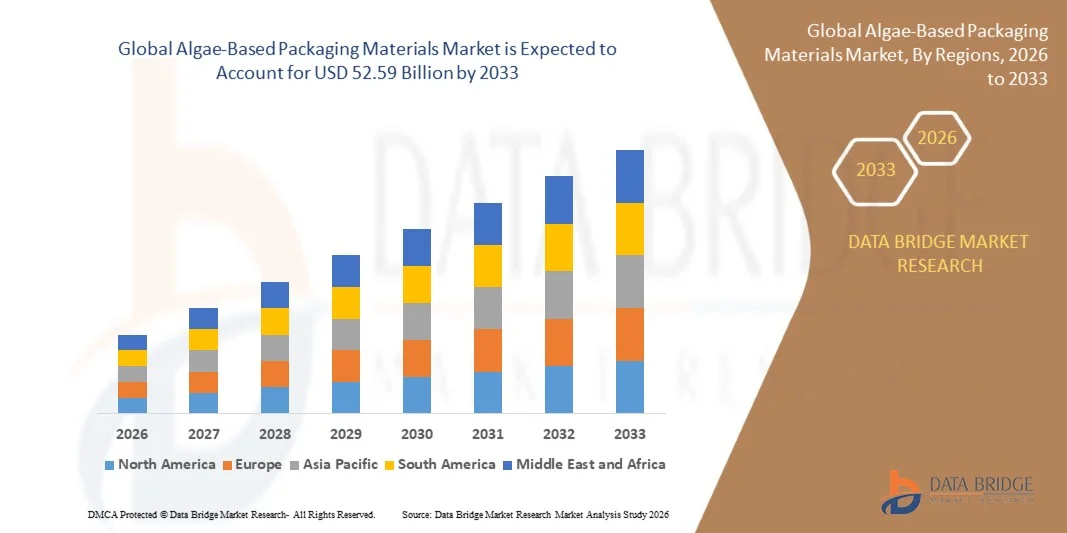
- The global algae-based packaging materials market size was valued at USD 20.50 billion in 2025 and is expected to reach USD 52.59 billion by 2033, at a CAGR of 12.50% during the forecast period
- The market growth is largely fuelled by the increasing shift toward sustainable and biodegradable packaging alternatives driven by rising environmental concerns and stringent regulations on single-use plastics
- Growing demand from food and beverage industries for eco-friendly packaging solutions is further accelerating market expansion, as manufacturers focus on reducing plastic waste and carbon footprint
Algae-Based Packaging Materials Market Analysis
- The market is witnessing strong momentum due to rapid advancements in biopolymer processing technologies and increasing investment in research and development for scalable algae-based material production
- Rising consumer preference for sustainable packaging, coupled with corporate sustainability commitments and government initiatives promoting green materials, is significantly supporting long-term market growth
- North America dominated the global algae-based packaging materials market with the largest revenue share in 2025, driven by increasing demand for sustainable packaging solutions and rising environmental concerns across food, beverage, and personal care industries
- The Asia-Pacific region is expected to witness the highest growth rate in the global algae-based packaging materials market, driven by expanding food and beverage industries, rising environmental awareness, increasing adoption of eco-friendly packaging solutions, and strong manufacturing capabilities in countries such as China, India, and Japan
- The brown algae segment held the largest market revenue share in 2025 driven by its high availability, strong biopolymer content, and superior film-forming properties suitable for packaging applications. Brown algae-based materials are widely used due to their enhanced barrier performance and biodegradability, making them ideal for sustainable packaging solutions across multiple industries
Report Scope and Algae-Based Packaging Materials Market Segmentation
|
Attributes |
Algae-Based Packaging Materials Key Market Insights |
|
Segments Covered |
|
|
Countries Covered |
North America
Europe
Asia-Pacific
Middle East and Africa
South America
|
|
Key Market Players |
• Notpla (U.K.) |
|
Market Opportunities |
• Expansion In Sustainable Food Packaging Solutions |
|
Value Added Data Infosets |
In addition to the insights on market scenarios such as market value, growth rate, segmentation, geographical coverage, and major players, the market reports curated by the Data Bridge Market Research also include import export analysis, production capacity overview, production consumption analysis, price trend analysis, climate change scenario, supply chain analysis, value chain analysis, raw material/consumables overview, vendor selection criteria, PESTLE Analysis, Porter Analysis, and regulatory framework. |
Algae-Based Packaging Materials Market Trends
“Rising Shift Toward Biodegradable And Compostable Packaging Solutions”
• The increasing global emphasis on reducing plastic waste is significantly shaping the algae-based packaging materials market, as industries move toward biodegradable and compostable alternatives. Algae-based packaging is gaining traction due to its ability to decompose naturally while offering strong barrier properties and sustainability benefits. This trend is accelerating adoption across food, beverage, and consumer goods packaging applications, supporting large-scale material innovation
• Growing environmental awareness among consumers and stricter government regulations on single-use plastics are further boosting demand for algae-derived packaging solutions. Companies are increasingly investing in eco-friendly packaging development to align with sustainability targets and circular economy goals. This shift is also encouraging collaboration between biotech firms and packaging manufacturers to enhance material performance and scalability
• Sustainability-driven branding strategies are influencing purchasing decisions, with companies focusing on eco-labeling, carbon reduction claims, and renewable sourcing transparency. These initiatives are helping brands strengthen market positioning while increasing consumer trust in green packaging alternatives. Marketing efforts highlighting biodegradability and low environmental impact are further supporting product adoption
• For instance, in 2024, Unilever in the U.K. and Nestlé in Switzerland expanded their sustainable packaging portfolios by integrating algae-based and bio-derived packaging materials in select product lines. These initiatives were introduced to reduce reliance on petroleum-based plastics and improve environmental footprint, strengthening brand sustainability commitments and enhancing consumer loyalty in eco-conscious markets
• While adoption is increasing, market expansion depends on improving production scalability, cost efficiency, and material durability to match conventional packaging performance standards. Continuous innovation in algae processing technologies and supply chain optimization will be critical for long-term commercialization and widespread industry adoption
Algae-Based Packaging Materials Market Dynamics
Driver
“Rising Demand For Sustainable And Eco-Friendly Packaging Solutions”
• Increasing global concern over plastic pollution is a major driver for the algae-based packaging materials market. Manufacturers are shifting toward renewable and biodegradable raw materials to reduce environmental impact and comply with sustainability regulations. This transition is also encouraging research into high-performance algae-based polymers suitable for industrial packaging applications
• Expanding use of sustainable packaging across food delivery, e-commerce, and retail sectors is supporting market growth. Algae-based materials offer lightweight structure, moisture resistance, and biodegradability, making them suitable for replacing conventional plastic packaging. The growing emphasis on ESG goals among corporations is further accelerating adoption
• Packaging manufacturers and consumer goods companies are actively investing in green material innovation and sustainability-driven product development. Strategic partnerships with biotech startups are also increasing to improve production efficiency and commercial viability of algae-based packaging solutions
• For instance, in 2023, PepsiCo in the U.S. and Danone in France expanded their sustainable packaging initiatives by testing algae-based and bio-material packaging solutions for beverage and dairy products. These developments supported reduction in plastic usage, enhanced brand sustainability image, and increased consumer engagement with eco-friendly product lines
• Although demand is rising, large-scale adoption depends on reducing production costs, improving material strength, and ensuring consistent supply of raw algae feedstock. Investment in advanced bioprocessing technologies and scalable manufacturing systems will be essential for market expansion
Restraint/Challenge
“High Production Costs And Limited Commercial Scalability”
• The relatively high cost of algae-based packaging materials compared to conventional plastics remains a major challenge, limiting large-scale adoption. Complex extraction, cultivation, and processing techniques contribute to higher production expenses, making price competitiveness difficult in cost-sensitive markets
• Limited industrial-scale production capacity and lack of standardized manufacturing infrastructure further restrict market penetration. Many companies are still in pilot or early commercialization stages, which slows down mass adoption across global packaging industries
• Supply chain limitations, including inconsistent algae biomass availability and dependency on controlled cultivation environments, also impact production efficiency. These challenges increase operational complexity and affect long-term scalability of algae-based packaging solutions
• For instance, in 2024, several packaging manufacturers in Singapore and Germany reported slower adoption of algae-based materials due to high production costs and limited supplier networks. Testing phases with food and beverage brands highlighted performance potential but also revealed cost and scalability constraints compared to traditional plastic packaging
• Overcoming these challenges will require investment in large-scale algae farming systems, cost-efficient extraction technologies, and improved processing infrastructure. Collaboration between material scientists, packaging companies, and policymakers will be essential to support commercialization and accelerate global adoption of algae-based packaging materials
Algae-Based Packaging Materials Market Scope
The algae-based packaging materials market is segmented into three notable segments based on material type, application, and end-use.
• By Material Type
On the basis of material type, the algae-based packaging materials market is segmented into brown algae, red algae, green algae, and other. The brown algae segment held the largest market revenue share in 2025 driven by its high availability, strong biopolymer content, and superior film-forming properties suitable for packaging applications. Brown algae-based materials are widely used due to their enhanced barrier performance and biodegradability, making them ideal for sustainable packaging solutions across multiple industries.
The green algae segment is expected to witness the fastest growth rate from 2026 to 2033 driven by its rapid cultivation cycle, cost-effectiveness, and increasing research focus on high-performance bio-based materials. Green algae-based packaging solutions are gaining traction due to their lightweight nature and strong potential for scalable production in eco-friendly packaging applications.
• By Application
On the basis of application, the algae-based packaging materials market is segmented into food packaging, beverage packaging, personal care packaging, pharmaceutical packaging, and others. The food packaging segment held the largest market revenue share in 2025 driven by rising demand for sustainable and biodegradable packaging solutions in processed and fresh food industries. Algae-based packaging is widely adopted in this segment due to its ability to preserve freshness while reducing plastic dependency.
The pharmaceutical packaging segment is expected to witness the fastest growth rate from 2026 to 2033 driven by increasing regulatory focus on sustainable packaging and the need for safe, non-toxic, and environmentally friendly packaging materials for medicines and healthcare products.
• By End-Use
On the basis of end-use, the algae-based packaging materials market is segmented into food and beverage, healthcare, personal care and cosmetics, retail, and others. The food and beverage segment held the largest market revenue share in 2025 driven by high consumption of packaged food products and increasing shift toward sustainable packaging alternatives among global brands. This segment benefits significantly from strong consumer preference for eco-friendly packaging solutions.
The healthcare segment is expected to witness the fastest growth rate from 2026 to 2033 driven by rising adoption of sustainable materials in medical packaging, increasing environmental regulations, and growing emphasis on safe and biodegradable packaging solutions in hospitals and pharmaceutical distribution channels.
Algae-Based Packaging Materials Market Regional Analysis
• North America dominated the global algae-based packaging materials market with the largest revenue share in 2025, driven by increasing demand for sustainable packaging solutions and rising environmental concerns across food, beverage, and personal care industries
• The region benefits from strong regulatory support for biodegradable and bio-based materials, along with growing corporate commitments toward reducing plastic waste and carbon footprint
• High consumer awareness regarding eco-friendly packaging, coupled with advanced R&D capabilities and the presence of key sustainable packaging innovators, further accelerates market adoption across commercial and retail applications
U.S. Algae-Based Packaging Materials Market Insight
The U.S. algae-based packaging materials market captured the largest revenue share in 2025 within North America, fueled by rapid expansion of sustainable packaging initiatives and strong demand from food and beverage brands transitioning toward biodegradable alternatives. Increasing investments in bio-based material innovation, along with rising adoption of compostable packaging solutions in retail and e-commerce sectors, are driving market growth. In addition, supportive government policies targeting single-use plastic reduction and the presence of advanced biotechnology companies are significantly contributing to market expansion.
Europe Algae-Based Packaging Materials Market Insight
The Europe algae-based packaging materials market is expected to witness the fastest growth rate from 2026 to 2033, primarily driven by stringent environmental regulations and strong sustainability goals across the region. The European Union’s focus on circular economy practices and plastic waste reduction is encouraging the adoption of algae-based packaging across food packaging, pharmaceutical packaging, and personal care applications. Increasing consumer preference for eco-friendly products and rising investments in green packaging innovations are further supporting market expansion.
U.K. Algae-Based Packaging Materials Market Insight
The U.K. algae-based packaging materials market is expected to witness strong growth from 2026 to 2033, driven by rising environmental awareness and increasing demand for biodegradable packaging alternatives. The country’s strong focus on reducing plastic usage in retail and food service sectors is encouraging businesses to adopt algae-based solutions. In addition, growing sustainability commitments from major brands and the expansion of eco-friendly packaging startups are contributing to market growth.
Germany Algae-Based Packaging Materials Market Insight
The Germany algae-based packaging materials market is expected to witness significant growth from 2026 to 2033, fueled by the country’s emphasis on environmental sustainability and advanced material innovation. Germany’s strong industrial base and focus on green technologies are supporting the development and adoption of algae-based packaging solutions, particularly in food, healthcare, and cosmetics packaging. The increasing shift toward circular packaging systems and strict regulatory frameworks on plastic usage are further accelerating market penetration.
Asia-Pacific Algae-Based Packaging Materials Market Insight
The Asia-Pacific algae-based packaging materials market is expected to witness the fastest growth rate from 2026 to 2033, driven by rapid urbanization, rising environmental concerns, and increasing demand for sustainable packaging in countries such as China, India, and Japan. Expanding food and beverage industries, along with growing government initiatives promoting biodegradable materials, are boosting market adoption. In addition, the region’s strong manufacturing capabilities and cost advantages are making algae-based packaging more accessible to a wider consumer base.
Japan Algae-Based Packaging Materials Market Insight
The Japan algae-based packaging materials market is expected to witness strong growth from 2026 to 2033 due to the country’s advanced technological ecosystem and strong focus on sustainability. Increasing demand for eco-friendly packaging in food, personal care, and pharmaceutical sectors is driving adoption. Japan’s emphasis on innovation in biopolymers and biodegradable materials, along with growing consumer preference for environmentally responsible products, is further supporting market growth.
China Algae-Based Packaging Materials Market Insight
The China algae-based packaging materials market accounted for the largest market revenue share in Asia-Pacific in 2025, attributed to rapid industrialization, strong government support for green materials, and expanding demand for sustainable packaging solutions. The country’s large food and beverage industry, along with increasing environmental regulations targeting plastic waste reduction, is driving adoption. In addition, the presence of strong domestic manufacturers and growing investments in bio-based material production are significantly propelling market growth.
Algae-Based Packaging Materials Market Share
The Algae-Based Packaging Materials industry is primarily led by well-established companies, including:
• Notpla (U.K.)
• Evoware (Indonesia)
• Loliware (U.S.)
• Cruz Foam (U.S.)
• Algix (U.S.)
• Sway (U.S.)
• TIPA Corp Ltd. (Israel)
• Kelpi (U.K.)
• FlexSea (U.K.)
• Algaia (France)
• Symbrosia (U.S.)
• Marine Innovation Group (Australia)
• Phycom (Netherlands)
• Smart Solve Industries (U.S.)
• Blue Ocean Closures (Sweden)

- Interactive Data Analysis Dashboard
- Company Analysis Dashboard for high growth potential opportunities
- Research Analyst Access for customization & queries
- Competitor Analysis with Interactive dashboard
- Latest News, Updates & Trend analysis
- Harness the Power of Benchmark Analysis for Comprehensive Competitor Tracking
Global Algae Based Packaging Materials Market, Supply Chain Analysis and Ecosystem Framework
To support market growth and help clients navigate the impact of geopolitical shifts, DBMR has integrated in-depth supply chain analysis into its Global Algae Based Packaging Materials Market research reports. This addition empowers clients to respond effectively to global changes affecting their industries. The supply chain analysis section includes detailed insights such as Global Algae Based Packaging Materials Market consumption and production by country, price trend analysis, the impact of tariffs and geopolitical developments, and import and export trends by country and HSN code. It also highlights major suppliers with data on production capacity and company profiles, as well as key importers and exporters. In addition to research, DBMR offers specialized supply chain consulting services backed by over a decade of experience, providing solutions like supplier discovery, supplier risk assessment, price trend analysis, impact evaluation of inflation and trade route changes, and comprehensive market trend analysis.
Data collection and base year analysis are done using data collection modules with large sample sizes. The stage includes obtaining market information or related data through various sources and strategies. It includes examining and planning all the data acquired from the past in advance. It likewise envelops the examination of information inconsistencies seen across different information sources. The market data is analysed and estimated using market statistical and coherent models. Also, market share analysis and key trend analysis are the major success factors in the market report. To know more, please request an analyst call or drop down your inquiry.
The key research methodology used by DBMR research team is data triangulation which involves data mining, analysis of the impact of data variables on the market and primary (industry expert) validation. Data models include Vendor Positioning Grid, Market Time Line Analysis, Market Overview and Guide, Company Positioning Grid, Patent Analysis, Pricing Analysis, Company Market Share Analysis, Standards of Measurement, Global versus Regional and Vendor Share Analysis. To know more about the research methodology, drop in an inquiry to speak to our industry experts.
Data Bridge Market Research is a leader in advanced formative research. We take pride in servicing our existing and new customers with data and analysis that match and suits their goal. The report can be customized to include price trend analysis of target brands understanding the market for additional countries (ask for the list of countries), clinical trial results data, literature review, refurbished market and product base analysis. Market analysis of target competitors can be analyzed from technology-based analysis to market portfolio strategies. We can add as many competitors that you require data about in the format and data style you are looking for. Our team of analysts can also provide you data in crude raw excel files pivot tables (Fact book) or can assist you in creating presentations from the data sets available in the report.













