


Algae Biofuel Market Size
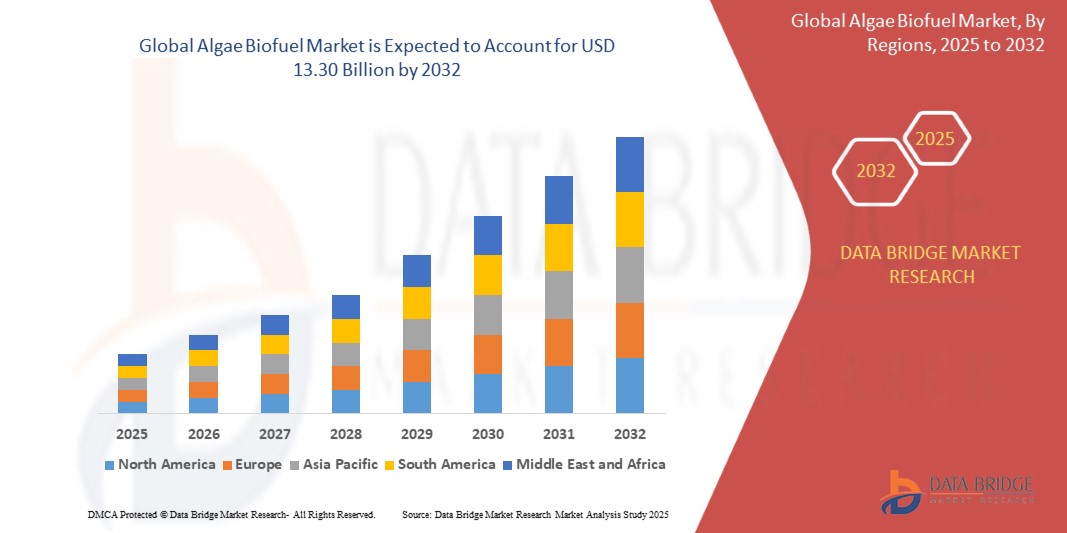
- The global algae biofuel market was valued at USD 8.50 billion in 2024 and is expected to reach USD 13.30 billion by 2032
- During the forecast period of 2025 to 2032 the market is likely to grow at a CAGR of 5.76%, primarily driven by rising demand for aviation and marine biofuels
- This growth is driven by factors such as volatility of fossil fuel prices, advancements in biofuel production technologies and growing consumer & investor pressure
Algae Biofuel Market Analysis
- Algae biofuels are emerging as a key component of the global renewable energy sector, offering a sustainable alternative to conventional fossil fuels. These biofuels are derived from microalgae, known for their high lipid content, which makes them an efficient source for biodiesel production. Algae biofuels play a significant role in the transition toward cleaner energy, particularly in the transportation, aviation, and marine industries
- The market growth is significantly driven by increasing environmental concerns and advancements in biofuel production technologies. As governments and industries seek to reduce carbon emissions, the demand for sustainable fuels is rising. Innovations in algae cultivation, harvesting, and lipid extraction techniques are enhancing production efficiency, making algae biofuels more commercially viable
- In addition, regulatory support and policies promoting renewable energy adoption are accelerating market expansion. Governments worldwide are implementing biofuel mandates, tax incentives, and funding programs to encourage large-scale algae biofuel production
For instance, ExxonMobil and Synthetic Genomics have developed genetically modified algae strains that produce higher lipid yields, significantly improving the efficiency and cost-effectiveness of algae biofuel production
- Globally, algae biofuels are gaining traction as a viable alternative within the renewable energy sector, following first-generation biofuels such as ethanol and biodiesel
Report Scope and Algae Biofuel Market Segmentation
|
Attributes |
Algae Biofuel Key Market Insights |
|
Segments Covered |
|
|
Countries Covered |
North America
Europe
Asia-Pacific
Middle East and Africa
South America
|
|
Key Market Players |
|
|
Market Opportunities |
|
|
Value Added Data Infosets |
In addition to the insights on market scenarios such as market value, growth rate, segmentation, geographical coverage, and major players, the market reports curated by the Data Bridge Market Research also include import export analysis, production capacity overview, production consumption analysis, price trend analysis, climate change scenario, supply chain analysis, value chain analysis, raw material/consumables overview, vendor selection criteria, PESTLE Analysis, Porter Analysis, and regulatory framework. |
Algae Biofuel Market Trends
Advancements in Genetic Engineering
- One prominent trend in the global ophthalmic operational microscope market is the advancements in genetic engineering
- This trend is evident in developing genetically modified algae strains that produce higher oil content, improving the efficiency and cost-effectiveness of biofuel production
- For instance, ExxonMobil and Synthetic Genomics successfully developed genetically modified algae strains that doubled their oil production efficiency while maintaining robust growth rates. This breakthrough, achieved through targeted genetic modifications, has the potential to make algae-based biofuels commercially viable on a larger scale
- This trend is accelerating commercialization efforts and making algae biofuels more competitive with conventional fossil fuels
- As genetic engineering continues to advance, it is expected to play a crucial role in accelerating the commercialization of algae biofuels. With ongoing research, industry collaborations, and government funding supporting these innovations, engineered algae strains will contribute to making biofuels more competitive, cost-effective, and scalable
Algae Biofuel Market Dynamics
Driver
“Growing Technological Advancements”
- A key driver of the algae biofuel market is the continuous advancement of technology, which is revolutionizing the way algae-based biofuels are produced, processed, and commercialized. Innovations in bioreactor design, artificial intelligence (AI)-assisted cultivation, genetic engineering, and advanced lipid extraction techniques are significantly improving the efficiency, scalability, and cost-effectiveness of algae biofuel production
- These advancements help address major industry challenges such as high production costs, low lipid accumulation, and energy-intensive harvesting methods
- In addition, automation, machine learning, and Internet of Things (IoT)-based monitoring systems are optimizing algae cultivation by controlling factors such as light exposure, nutrient delivery, and carbon dioxide absorption, leading to higher biomass yields and improved oil extraction efficiency
- Such technological breakthroughs are making algae biofuels a more commercially viable and competitive alternative to fossil fuels and first-generation biofuels
- With increasing investments in R&D, growing industry collaborations, and supportive government policies, the integration of advanced technologies will be instrumental in driving the algae biofuel market toward mass adoption and long-term growth
For instance,
- Heliae Development LLC has pioneered advanced closed-loop photobioreactors that optimize algae growth by maintaining ideal conditions such as temperature, pH levels, and CO₂ concentration. These systems have significantly enhanced biomass production while minimizing land and water usage
- Researchers at the National Renewable Energy Laboratory (NREL) have developed innovative hydrothermal liquefaction (HTL) techniques, which enable direct conversion of algae biomass into bio-crude oil, drastically reducing processing time and energy requirements
- As technological advancements continue to evolve, they are set to play a transformative role in the large-scale commercialization of algae biofuels. Cutting-edge innovations in cultivation, harvesting, and fuel conversion are addressing cost and efficiency barriers, positioning algae biofuels as a sustainable and economically viable energy source
Opportunity
“Increasing Demand for Biofuels in Road Vehicles”
- The rising demand for biofuels in road transportation presents a significant opportunity for the algae biofuel market. With growing concerns over carbon emissions, fuel security, and the depletion of fossil fuel reserves, governments and automotive industries worldwide are actively seeking renewable fuel alternatives
- Algae biofuels, known for their high energy content, minimal land and water requirements, and carbon-neutral properties, have emerged as a promising solution. Unlike first-generation biofuels derived from food crops, algae-based fuels do not compete with food production, making them an attractive option for sustainable transportation
- As regulatory frameworks strengthen, oil price volatility continues, and sustainability goals become more ambitious, the adoption of algae-based fuels is expected to rise
For instance,
- Neste Corporation, a global leader in renewable fuels, has expanded its algae biofuel research to enhance its sustainable diesel offerings, reinforcing the commercial potential of algae-derived fuels
- leading automakers such as Volkswagen and Audi have explored algae biofuels as a viable alternative to traditional fossil fuels, showcasing the industry's commitment to sustainable mobility solutions
- The increasing demand for biofuels in road vehicles creates a compelling growth opportunity for the algae biofuel market preferences. With continuous innovation and strategic collaborations, the algae biofuel market is well-positioned to capitalize on the expanding demand for sustainable road transport solutions
Restraint/Challenge
“Limited Scalability”
- The transition from small-scale laboratory production to large-scale commercial operations presents numerous challenges. Scaling up algae cultivation facilities requires substantial investment in infrastructure, technology, and operational expertise
- In addition, maintaining optimal growing conditions, such as temperature, nutrients, and light exposure, becomes more complex at larger scales
- The logistics of harvesting, processing, and transporting algae biomass also become more challenging with increased production volumes
For instance,
- ExxonMobil's algae biofuel program, despite significant investments, has faced delays in reaching commercial-scale production, primarily due to cost and efficiency constraints
- Limited scalability remains a critical barrier to the widespread adoption of algae biofuels landscape. Government incentives, research collaborations, and technological breakthroughs will be essential in making large-scale algae biofuel production a feasible and economically sustainable solution for the global energy market
Algae Biofuel Market Scope
The market is segmented on the basis of product type, end use, and application.
|
Segmentation |
Sub-Segmentation |
|
By Product Type |
|
|
By End Use |
|
|
By Application |
|
Algae Biofuel Market Regional Analysis
“North America is the Dominant Region in the Algae Biofuel Market”
- North America dominates the Algae Biofuel market, driven by the growing adoption of renewable energy sources across sectors, aligning with sustainability goals
- The U.S. holds a significant share due to significant investments in renewable energy, strong government support, and the presence of leading biofuel research institutions
- The region's strategic focus on algae biofuel research and development, coupled with favorable regulatory frameworks, further amplifies its market position
- As demand for clean energy solutions continues to surge, North America is poised to maintain its stronghold in the algae biofuel market
“Asia-Pacific is Projected to Register the Highest Growth Rate”
- The Asia-Pacific region is expected to witness the highest growth rate in the Algae Biofuel market, due to rising government initiatives and policies in countries such as China, Japan, and South Korea that are promoting the adoption of renewable energy sources to reduce carbon emissions and enhance energy security
- In addition, rapid industrialization and economic expansion in emerging economies such as India and Vietnam are increasing the demand for clean energy solutions across various sectors, including transportation, power generation, and manufacturing
- Advancements in algae cultivation and biofuel extraction technologies are further reducing production costs and improving efficiency, making algae biofuel a more viable and scalable alternative to conventional fossil fuels
- With the growing need for energy diversification and carbon neutrality commitments, Asia-Pacific is positioned as a high-growth market for algae biofuels, attracting significant investments and collaborations from both regional and global players
Algae Biofuel Market Share
The market competitive landscape provides details by competitor. Details included are company overview, company financials, revenue generated, market potential, investment in research and development, new market initiatives, global presence, production sites and facilities, production capacities, company strengths and weaknesses, product launch, product width and breadth, application dominance. The above data points provided are only related to the companies' focus related to market.
The Major Market Leaders Operating in the Market Are:
- OriginClear (U.S.)
- Genifuel Corporation. (U.S.)
- ALGAE PRODUCTION SYSTEMS (U.S.)
- Culture Biosciences (U.S.)
- proviron (Belgium)
- Cellana Inc (U.S.)
- The Daily Digest (U.S.)
- Neste (Finland)
- Glencore (Switzerland)
- Louis Dreyfus Holding B.V (Netherlands)
- Renewable Energy Group, Inc. (U.S.)
- Evergreen Biofuels Holding Sdn Bhd (Malaysia)

- Interactive Data Analysis Dashboard
- Company Analysis Dashboard for high growth potential opportunities
- Research Analyst Access for customization & queries
- Competitor Analysis with Interactive dashboard
- Latest News, Updates & Trend analysis
- Harness the Power of Benchmark Analysis for Comprehensive Competitor Tracking
Global Algae Biofuel Market, Supply Chain Analysis and Ecosystem Framework
To support market growth and help clients navigate the impact of geopolitical shifts, DBMR has integrated in-depth supply chain analysis into its Global Algae Biofuel Market research reports. This addition empowers clients to respond effectively to global changes affecting their industries. The supply chain analysis section includes detailed insights such as Global Algae Biofuel Market consumption and production by country, price trend analysis, the impact of tariffs and geopolitical developments, and import and export trends by country and HSN code. It also highlights major suppliers with data on production capacity and company profiles, as well as key importers and exporters. In addition to research, DBMR offers specialized supply chain consulting services backed by over a decade of experience, providing solutions like supplier discovery, supplier risk assessment, price trend analysis, impact evaluation of inflation and trade route changes, and comprehensive market trend analysis.
Data collection and base year analysis are done using data collection modules with large sample sizes. The stage includes obtaining market information or related data through various sources and strategies. It includes examining and planning all the data acquired from the past in advance. It likewise envelops the examination of information inconsistencies seen across different information sources. The market data is analysed and estimated using market statistical and coherent models. Also, market share analysis and key trend analysis are the major success factors in the market report. To know more, please request an analyst call or drop down your inquiry.
The key research methodology used by DBMR research team is data triangulation which involves data mining, analysis of the impact of data variables on the market and primary (industry expert) validation. Data models include Vendor Positioning Grid, Market Time Line Analysis, Market Overview and Guide, Company Positioning Grid, Patent Analysis, Pricing Analysis, Company Market Share Analysis, Standards of Measurement, Global versus Regional and Vendor Share Analysis. To know more about the research methodology, drop in an inquiry to speak to our industry experts.
Data Bridge Market Research is a leader in advanced formative research. We take pride in servicing our existing and new customers with data and analysis that match and suits their goal. The report can be customized to include price trend analysis of target brands understanding the market for additional countries (ask for the list of countries), clinical trial results data, literature review, refurbished market and product base analysis. Market analysis of target competitors can be analyzed from technology-based analysis to market portfolio strategies. We can add as many competitors that you require data about in the format and data style you are looking for. Our team of analysts can also provide you data in crude raw excel files pivot tables (Fact book) or can assist you in creating presentations from the data sets available in the report.













