


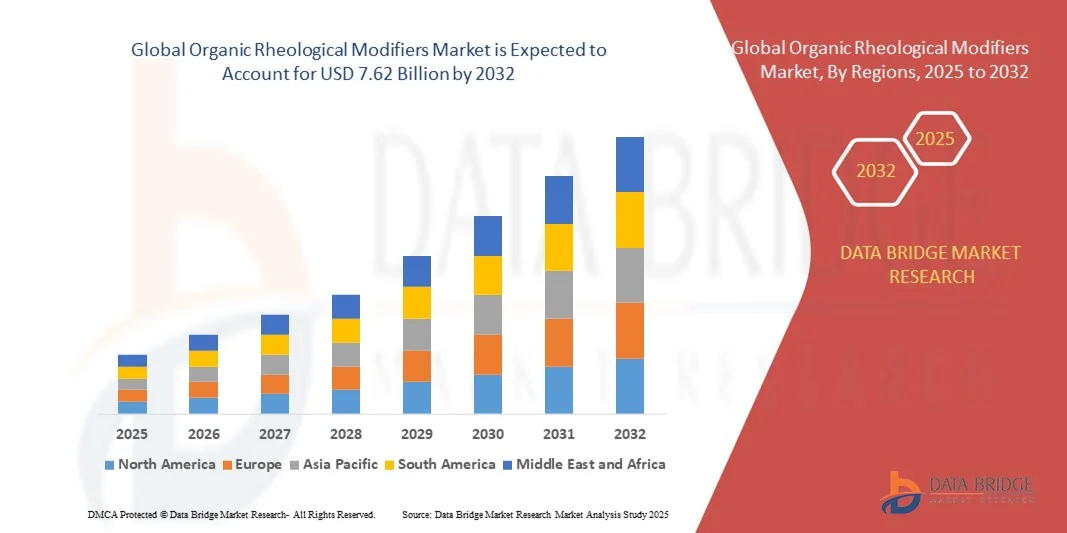
What is the Global Organic Rheological Modifiers Market Size and Growth Rate?
- The global organic rheological modifiers market size was valued at USD 4.57 billion in 2024 and is expected to reach USD 7.62 billion by 2032, at a CAGR of 4.10% during the forecast period
- The rise in crude oil production and shale gas exploration across the globe acts as one of the major factors driving the growth of the organic rheological modifiers market. The increase in demand for products having low VOC due to the rising concerns regarding the environment and high demand for organic cosmetics and personal care products accelerate the market growth
- The surge in demand for organic rheological modifiers because of the increasing number of construction activities and high use in the various applications such as adhesives, sealants, and binders further influence the market
What are the Major Takeaways of Organic Rheological Modifiers Market?
- Rapid urbanization and industrialization, a rise in investment in research projects, and increased research and development activities positively affect the organic rheological modifiers market. Furthermore, the rise in deep and ultra-deep-water drilling extends profitable opportunities to the market players
- On the other hand, the shift from print to digital media is expected to obstruct market growth. Environmental impact is projected to challenge the organic rheological modifiers
- Asia-Pacific dominated the organic rheological modifiers market with the largest revenue share of 41.3% in 2024, driven by rising industrialization, rapid urbanization, and expanding end-use industries such as paints and coatings, construction, and personal care
- Asia-Pacific is expected to be the fastest growing region in the Organic Rheological Modifiers market during the forecast period due to increasing urbanization and rising disposable incomes
- The synthetic segment dominated the market with the largest revenue share of 58.6% in 2024, owing to its superior performance characteristics such as enhanced viscosity control, thermal stability, and compatibility across diverse formulations
Report Scope and Organic Rheological Modifiers Market Segmentation
|
Attributes |
Organic Rheological Modifiers Key Market Insights |
|
Segments Covered |
|
|
Countries Covered |
North America
Europe
Asia-Pacific
Middle East and Africa
South America
|
|
Key Market Players |
|
|
Market Opportunities |
|
|
Value Added Data Infosets |
In addition to the insights on market scenarios such as market value, growth rate, segmentation, geographical coverage, and major players, the market reports curated by the Data Bridge Market Research also include in-depth expert analysis, pricing analysis, brand share analysis, consumer survey, demography analysis, supply chain analysis, value chain analysis, raw material/consumables overview, vendor selection criteria, PESTLE Analysis, Porter Analysis, and regulatory framework. |
What is the Key Trend in the Organic Rheological Modifiers Market?
Shift Towards Bio-Based and Sustainable Formulations
- A key and accelerating trend in the global organic rheological modifiers market is the transition from petroleum-derived products to bio-based and sustainable formulations that reduce environmental footprint. This shift is strongly influenced by tightening regulations and consumer demand for greener chemicals
- For instance, BASF SE and Clariant have launched eco-friendly rheology modifiers designed for personal care and coatings, replacing traditional synthetic alternatives. Similarly, Ashland is focusing on plant-derived polymers for sustainable performance solutions
- Bio-based rheology modifiers enhance performance in paints, coatings, cosmetics, and adhesives while aligning with sustainability goals. For instance, Clariant’s natural-based Aristoflex Eco T delivers high viscosity and stability in skincare formulations without compromising safety
- The adoption of renewable raw materials and biodegradable solutions is expanding across industries such as cosmetics, construction, and packaging, offering formulators a competitive advantage in regulatory compliance and eco-label certifications
- This ongoing trend is redefining product development strategies, as companies invest heavily in green chemistry innovations to meet future regulatory frameworks and consumer expectations
- The movement towards sustainable, biodegradable, and plant-based rheology modifiers is expected to dominate market innovations, reinforcing long-term growth across multiple industries
What are the Key Drivers of Organic Rheological Modifiers Market?
- The growing demand for eco-friendly and multifunctional additives in paints, coatings, adhesives, cosmetics, and pharmaceuticals is a major driver for market growth
- For instance, in April 2024, Evonik introduced a new line of sustainable rheology modifiers for personal care applications, enhancing sensory properties while maintaining natural origins. Such developments by key players are propelling industry adoption
- Rising construction activities and automotive production are driving the need for rheological modifiers that provide improved viscosity control, stability, and application performance in paints, coatings, and sealants
- Increasing consumer preference for natural and clean-label cosmetics is pushing manufacturers to adopt bio-based rheology modifiers that deliver texture, stability, and skin-friendly profiles
- In addition, regulatory support for sustainable chemicals and the rising importance of circular economy practices are accelerating the adoption of organic rheology modifiers worldwide
Which Factor is Challenging the Growth of the Organic Rheological Modifiers Market?
- One of the primary challenges for the organic rheological modifiers market is the higher cost of bio-based formulations compared to synthetic alternatives, which may limit adoption in price-sensitive industries
- For instance, smaller cosmetic and coatings manufacturers often hesitate to switch to premium-priced natural rheology modifiers, especially in cost-competitive markets such as Asia-Pacific
- Another challenge lies in the performance limitations of some bio-based rheology modifiers, such as reduced compatibility or stability under extreme conditions, which can hinder their widespread use
- Availability of raw materials such as plant-based polymers is also subject to agricultural supply chain fluctuations, adding uncertainty to production planning and cost management
- While chemical giants such as BASF and Arkema are investing in advanced technologies to overcome these barriers, achieving cost parity and ensuring consistent performance remain pressing hurdles
- Addressing these challenges through scalable green chemistry innovations, cost optimization, and improved performance formulations will be vital for sustaining market growth in the coming years
How is the Organic Rheological Modifiers Market Segmented?
The market is segmented on the basis of type, application, and end-use industry.
- By Type
On the basis of type, the organic rheological modifiers market is segmented into cellulosic and synthetic. The synthetic segment dominated the market with the largest revenue share of 58.6% in 2024, owing to its superior performance characteristics such as enhanced viscosity control, thermal stability, and compatibility across diverse formulations. Synthetic variants are widely used in paints, coatings, and construction applications where high durability and stability are essential. Their consistent quality and adaptability make them the preferred choice in industrial processes requiring precise rheology control.
The cellulosic segment is projected to witness the fastest growth rate of 9.2% from 2025 to 2032, supported by increasing demand for bio-based and eco-friendly materials. Growing awareness of sustainability, coupled with regulatory pushes for green chemistry solutions, is accelerating the adoption of cellulosic rheological modifiers, particularly in cosmetics and personal care formulations. This shift reflects the market’s gradual transition towards renewable solutions.
- By Application
On the basis of application, the organic rheological modifiers market is segmented into adhesives, sealants, binders, and others. The adhesives segment accounted for the largest revenue share of 36.7% in 2024, driven by its extensive use in packaging, construction, and automotive industries. Adhesives require precise viscosity management to ensure durability, bonding strength, and application ease, making rheological modifiers indispensable in achieving consistent performance. In addition, innovations in lightweight packaging and eco-friendly adhesives further bolster demand for organic rheology solutions.
The sealants segment is expected to witness the fastest CAGR of 8.5% from 2025 to 2032, fueled by expanding applications in construction and infrastructure development. Sealants benefit from rheological modifiers that enhance stability, sag resistance, and adhesion across varying surfaces. Growing demand for advanced sealants in green building projects and energy-efficient infrastructure is expected to accelerate adoption, positioning this segment as a major growth driver over the forecast period.
- By End-Use Industry
On the basis of end-use industry, the organic rheological modifiers market is segmented into paints and coatings, personal care, pharmaceuticals, oil and gas, construction, and others. The paints and coatings segment dominated the market with the largest revenue share of 42.3% in 2024, driven by rising demand for high-performance architectural and industrial coatings. Organic rheology modifiers are vital for improving suspension, viscosity, and application properties, ensuring consistent surface finish and durability. Rapid urbanization and infrastructure growth further support this dominance.
The personal care segment is projected to record the fastest CAGR of 9.8% from 2025 to 2032, propelled by the surging demand for natural and clean-label cosmetics. Organic rheological modifiers play a critical role in formulating skincare, haircare, and makeup products by delivering smooth texture, stability, and consumer-friendly sensory appeal. With increasing consumer awareness and stricter regulations promoting sustainable formulations, the personal care sector is emerging as a key growth engine for the market.
Which Region Holds the Largest Share of the Organic Rheological Modifiers Market?
- Asia-Pacific dominated the organic rheological modifiers market with the largest revenue share of 41.3% in 2024, driven by rising industrialization, rapid urbanization, and expanding end-use industries such as paints and coatings, construction, and personal care
- The region benefits from abundant availability of raw materials, cost-effective labor, and increasing demand for eco-friendly, bio-based solutions. These factors collectively position Asia-Pacific as the global hub for production and consumption of organic rheology modifiers
- Strong government initiatives supporting green chemistry, combined with the growing middle-class population’s demand for high-quality consumer goods, further reinforce the region’s leadership in the market
China Organic Rheological Modifiers Market Insight
The China organic rheological modifiers market captured the largest revenue share of 52% in Asia-Pacific in 2024, fueled by booming construction, packaging, and personal care industries. The country’s rapid urbanization and focus on sustainable building materials are driving adoption. In addition, China’s strong domestic manufacturing base and government-backed initiatives for eco-friendly chemicals contribute significantly to market expansion. The rise of local players producing cost-competitive modifiers further strengthens China’s dominance within the region.
India Organic Rheological Modifiers Market Insight
The India organic rheological modifiers market is anticipated to grow at a robust CAGR during the forecast period, supported by infrastructure growth, increasing demand for coatings and adhesives, and rising consumption of personal care products. India’s push toward sustainable construction and packaging solutions enhances market prospects. Moreover, the expansion of pharmaceutical manufacturing and the adoption of bio-based additives across industries highlight India’s growing role in the regional market.
Japan Organic Rheological Modifiers Market Insight
The Japan organic rheological modifiers market is gaining traction, driven by the country’s emphasis on high-performance, eco-friendly solutions in cosmetics, coatings, and specialty chemicals. Japan’s strong R&D ecosystem and focus on innovation support the development of advanced modifiers tailored for premium applications. In addition, consumer preference for sustainable and high-quality personal care formulations is boosting the use of bio-based rheology modifiers.
Which Region is the Fastest Growing Region in the Organic Rheological Modifiers Market?
North America is projected to register the fastest CAGR of 10.5% from 2025 to 2032, driven by stringent regulatory frameworks promoting sustainable chemicals and the rising adoption of eco-friendly formulations across industries. The U.S. leads the region with strong demand from paints, coatings, and personal care sectors, supported by advanced R&D capabilities and higher consumer awareness regarding sustainability. The presence of global chemical leaders such as Dow, Ashland, and Lubrizol further accelerates innovation and commercialization of bio-based rheology modifiers. Increasing construction activities, alongside demand for high-performance and sustainable industrial products, positions North America as the fastest-growing regional market.
U.S. Organic Rheological Modifiers Market Insight
The U.S. organic rheological modifiers market held the largest share in North America in 2024, driven by the rising adoption of sustainable materials across paints, coatings, and personal care industries. Stringent environmental regulations and growing consumer awareness toward eco-friendly products are pushing manufacturers to develop bio-based and high-performance rheology solutions. The construction sector’s strong rebound, alongside increased demand for adhesives and sealants, is also fueling market growth. Furthermore, the presence of leading players such as Dow, Ashland, and Lubrizol, combined with continuous innovation in green chemistry, reinforces the U.S. as a central hub for organic rheology modifier advancements.
Canada Organic Rheological Modifiers Market Insight
The Canada organic rheological modifiers market is experiencing steady growth, supported by increasing infrastructure development, demand for sustainable construction materials, and rising investments in the coatings and adhesives industries. Canadian consumers are also showing growing preference for clean-label and natural personal care products, which is boosting the uptake of bio-based rheology modifiers. Moreover, the government’s focus on environmental sustainability and adoption of green building standards are driving demand across industrial applications. With growing collaboration between regional distributors and global manufacturers, Canada is emerging as a promising market, particularly for specialty and high-performance organic rheology modifiers.
Which are the Top Companies in Organic Rheological Modifiers Market?
The organic rheological modifiers industry is primarily led by well-established companies, including:
- BASF SE (Germany)
- Clariant (Switzerland)
- The Lubrizol Corporation (U.S.)
- ELEMENTIS PLC (U.K.)
- Arkema (France)
- Ashland (U.S.)
- Dow (U.S.)
- ADDAPT Chemicals B.V. (Netherlands)
- Altana (Germany)
- CLiQ SwissTech (Deutschland) GmbH (Germany)
- Evonik Industries AG (Germany)
- King Industries, Inc. (U.S.)
- Lamberti S.p.A. (Italy)
- Mallard Creek Polymers (U.S.)
- MÜNZING Corporation (Germany)
- Borchers Inc. (U.S.)
- Radiant Chemicals (India)
- Scott Bader Company Ltd. (U.K.)
- Royal Cosun (Netherlands)
- Eastman Chemical Company (U.S.)
- FENCHEM (China)
What are the Recent Developments in Global Organic Rheological Modifiers Market?
- In April 2025, Fermentalg, a company leveraging aquatic microorganisms for bio-solutions, announced significant progress with its natural blue dye, Everzure Galdieria, developed in collaboration with Givaudan. The company confirmed that Everzure Galdieria has received FDA approval in the U.S., and Givaudan has partnered with Fermentalg to lead its marketing and commercialization. This milestone highlights a major step forward in the adoption of sustainable natural colorants
- In June 2024, Brevel, an Israeli innovator in microOrganic Rheological Modifiers, inaugurated the country’s first large-scale microOrganic Rheological Modifiers plant on the desert outskirts of Kiryat Gat. Spanning 27,000 square feet (2,500 square meters), the facility is designed to produce hundreds of tons of microOrganic Rheological Modifiers powder annually. This development marks a transformative leap in scaling up alternative protein production
- In April 2024, Solar Foods launched a commercial-scale factory in Vantaa, Finland, dedicated to producing its pioneering protein, Solein. The site currently offers an annual output capacity of 160 tons, with ambitions to expand to 230 tons by 2026. This expansion emphasizes the company’s commitment to advancing future food solutions
- In April 2024, the Danish Technological Institute (DTI) concluded its ReMAPP project in Brande, Denmark, successfully implementing a closed-loop algae cultivation system within a biogas facility. This system transformed CO₂ and nutrient-rich byproducts into high-protein microalgae feed for livestock and poultry, utilizing tube-shaped plastic photobioreactor bags. With an annual production capacity of 4,700 tonnes, this initiative demonstrates the vast potential of integrating algae systems into industrial setups

- Interactive Data Analysis Dashboard
- Company Analysis Dashboard for high growth potential opportunities
- Research Analyst Access for customization & queries
- Competitor Analysis with Interactive dashboard
- Latest News, Updates & Trend analysis
- Harness the Power of Benchmark Analysis for Comprehensive Competitor Tracking
Global Algae Protein Market, Supply Chain Analysis and Ecosystem Framework
To support market growth and help clients navigate the impact of geopolitical shifts, DBMR has integrated in-depth supply chain analysis into its Global Algae Protein Market research reports. This addition empowers clients to respond effectively to global changes affecting their industries. The supply chain analysis section includes detailed insights such as Global Algae Protein Market consumption and production by country, price trend analysis, the impact of tariffs and geopolitical developments, and import and export trends by country and HSN code. It also highlights major suppliers with data on production capacity and company profiles, as well as key importers and exporters. In addition to research, DBMR offers specialized supply chain consulting services backed by over a decade of experience, providing solutions like supplier discovery, supplier risk assessment, price trend analysis, impact evaluation of inflation and trade route changes, and comprehensive market trend analysis.
Data collection and base year analysis are done using data collection modules with large sample sizes. The stage includes obtaining market information or related data through various sources and strategies. It includes examining and planning all the data acquired from the past in advance. It likewise envelops the examination of information inconsistencies seen across different information sources. The market data is analysed and estimated using market statistical and coherent models. Also, market share analysis and key trend analysis are the major success factors in the market report. To know more, please request an analyst call or drop down your inquiry.
The key research methodology used by DBMR research team is data triangulation which involves data mining, analysis of the impact of data variables on the market and primary (industry expert) validation. Data models include Vendor Positioning Grid, Market Time Line Analysis, Market Overview and Guide, Company Positioning Grid, Patent Analysis, Pricing Analysis, Company Market Share Analysis, Standards of Measurement, Global versus Regional and Vendor Share Analysis. To know more about the research methodology, drop in an inquiry to speak to our industry experts.
Data Bridge Market Research is a leader in advanced formative research. We take pride in servicing our existing and new customers with data and analysis that match and suits their goal. The report can be customized to include price trend analysis of target brands understanding the market for additional countries (ask for the list of countries), clinical trial results data, literature review, refurbished market and product base analysis. Market analysis of target competitors can be analyzed from technology-based analysis to market portfolio strategies. We can add as many competitors that you require data about in the format and data style you are looking for. Our team of analysts can also provide you data in crude raw excel files pivot tables (Fact book) or can assist you in creating presentations from the data sets available in the report.













