


Alloy of Automotive Market Overview
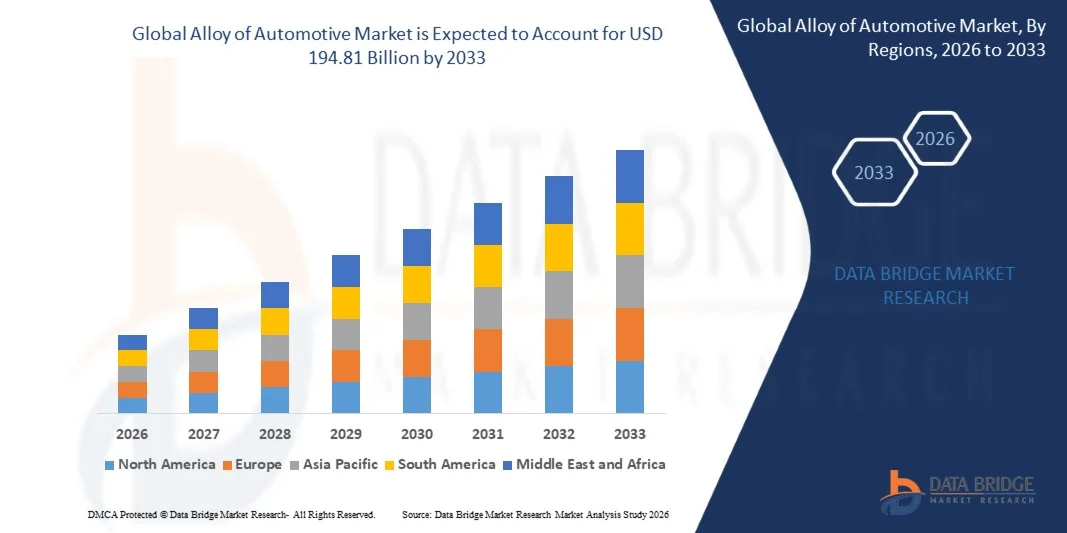
As per Data Bridge Market Research Analysis the alloy of automotive market was valued at USD 125.03 billion in 2025 and is projected to reach USD 194.81 billion by 2033, growing at a CAGR of 5.70% from 2026 to 2033. The market is experiencing steady growth, driven by increasing vehicle production, stringent fuel efficiency and emission regulations, and the rising adoption of lightweight materials across passenger and commercial vehicles. Automotive manufacturers are increasingly utilizing advanced alloys such as steel, aluminium, magnesium, titanium, and copper to reduce vehicle weight, enhance structural strength, improve fuel efficiency, and extend the driving range of electric vehicles. The growing production of electric vehicles (EVs), along with increasing investments in lightweight vehicle architectures, is further supporting market expansion across OEM manufacturing and component supply chains.
Moreover, continuous advancements in alloy processing technologies, including high-strength steel production, aluminium casting, magnesium die-casting, and precision forging, are creating significant growth opportunities for manufacturers. Companies are increasingly focusing on developing high-performance, corrosion-resistant, and recyclable alloy materials to improve vehicle safety, durability, and sustainability while complying with evolving environmental regulations. Rising demand for lightweight structural components, battery enclosures, chassis systems, powertrain components, and crash management structures is expected to accelerate alloy adoption across the automotive industry, supporting sustained market growth throughout the forecast period.
Market Size & Forecast
- Global Market Value (2025): XX Billion
- Expected Market Value (2033): USD XX Billion
- Forecast CAGR (2026–2033): 20.60%
- Leading Region in 2025: Asia-Pacific
- Fastest Growing Region: North America
Key Market Trends & Insights
- Asia-Pacific dominated the alloy of automotive market with the largest revenue share of approximately 56.0% in 2025, driven by high vehicle production, well-established automotive manufacturing hubs, increasing electric vehicle (EV) adoption, and robust demand for lightweight alloy materials across China, Japan, India, and South Korea.
- North America is expected to be the fastest-growing regional market during 2026–2033, registering a CAGR of 10.33%, supported by increasing electric vehicle production, growing investments in domestic automotive manufacturing, stringent fuel economy and emission regulations, and rising adoption of lightweight aluminium, advanced high-strength steel, and magnesium alloys across passenger and commercial vehicles.
- The passenger cars segment accounted for the largest market share in 2025, supported by its dominant share in automobile production, growing consumer demand for fuel-efficient and premium vehicles, and increasing integration of lightweight alloys to improve vehicle performance, safety, and electric driving range.
- The aluminium segment held the largest share of the alloy of automotive market share 60.0 % in 2025, owing to its excellent strength-to-weight ratio, corrosion resistance, recyclability, and widespread use in structural components, battery enclosures, chassis, and body panels. Meanwhile, the magnesium segment is anticipated to witness the fastest growth during the forecast period, driven by increasing demand for ultra-lightweight materials in electric and next-generation vehicles.
- The structural segment captured the highest market share in 2025, primarily due to the extensive use of advanced high-strength steel and aluminium alloys in vehicle frames, body structures, crash management systems, and battery protection enclosures. The powertrain segment is expected to witness significant growth during the forecast period, supported by increasing adoption of lightweight alloy components in electric motors, transmission systems, and battery housing applications.
- Steel and aluminium alloys continue to account for the majority of alloy of automotive consumption, as manufacturers increasingly adopt multi-material vehicle architectures to reduce vehicle weight, improve fuel efficiency, enhance crash performance, and comply with evolving emission standards while maintaining cost-effective mass production.
Report Scope and Alloy of Automotive Market Segmentation
|
Attributes |
Alloy of Automotive Key Market Insights |
|
Segments Covered |
|
|
Countries Covered |
North America
Europe
Asia-Pacific
Middle East and Africa
South America
|
|
Key Market Players |
|
|
Market Opportunities |
|
|
Value Added Data Infosets |
In addition to the market insights such as market value, growth rate, market segments, geographical coverage, market players, and market scenario, the market report curated by the Data Bridge Market Research team includes in-depth expert analysis, import/export analysis, pricing analysis, production consumption analysis, and pestle analysis. |
What is the Key Trend in the Alloy of Automotive Market?
- The alloy of automotive market is increasingly shifting toward high-recycled-content aluminum alloys that deliver the strength, formability, and surface quality required for modern vehicle manufacturing while significantly reducing lifecycle carbon emissions. Automakers are increasingly integrating recycled aluminum into body structures and exterior panels to achieve lightweighting objectives alongside their broader sustainability and circular economy goals.
- This trend is being driven by automakers' commitments to carbon neutrality and stricter environmental regulations, which require suppliers to reduce the embodied carbon of raw materials in addition to improving vehicle fuel efficiency. Closed-loop recycling systems between aluminum suppliers and vehicle manufacturers are becoming increasingly important for ensuring material quality while minimizing energy consumption and production-related emissions.
- For instance, in February 2025, JLR and Novelis successfully completed large-scale trials of a new aluminum sheet alloy containing up to 85% recycled content for exterior vehicle body panels. The development builds on their long-standing REALCAR closed-loop recycling partnership and supports aluminum production that requires up to 95% less energy than primary aluminum manufacturing. The alloy is designed to maintain premium surface quality while helping reduce carbon emissions across future Jaguar Land Rover vehicles.
- As recycled aluminum technologies continue to achieve near-primary material performance, their adoption is expected to accelerate across both conventional and electric vehicles, supporting lightweight vehicle design, circular material utilization, and lower lifecycle emissions.
What are the Key Drivers of the Alloy of Automotive Market?
- The rapid expansion of electric vehicle production and the adoption of giga-casting technologies are driving demand for advanced lightweight alloy of automotive s. Automakers are increasingly replacing complex steel assemblies with large aluminum alloy castings to reduce vehicle weight, improve structural rigidity, simplify manufacturing, and extend driving range.
- Giga-casting enables manufacturers to produce large structural vehicle components as single aluminum alloy castings, significantly reducing component count, welding operations, manufacturing complexity, and production costs while improving overall manufacturing efficiency.
- For instance, in July 2025, a study published in Designs (MDPI) highlighted Tesla's implementation of giga-casting technology in the Model Y, where a single rear aluminum alloy casting replaced approximately 171 individual sheet-metal components, eliminating around 1,600 welds and approximately 300 robots while reducing manufacturing costs by nearly 40%. The study also noted increasing investments in giga-casting technologies by automakers including Toyota, Volvo, Ford, and Hyundai.
- Continued investments in lightweight vehicle architectures and advanced casting technologies are expected to strengthen long-term demand for high-performance alloy of automotive s across electric and hybrid vehicle platforms.
Which Factors are Challenging the Growth of the Alloy of Automotive Market?
- Heavy dependence on China for primary magnesium supply remains a significant challenge for the alloy of automotive market. Since magnesium is an essential alloying element for lightweight automotive components, supply concentration exposes manufacturers to raw material price volatility, geopolitical risks, and procurement uncertainties.
- According to Eurostat and the European Commission, the European Union continues to rely heavily on Chinese magnesium imports, while magnesium remains classified as a critical raw material because of limited domestic production capacity. Supply disruptions and export control measures have further increased concerns regarding long-term supply security.
- For instance, in December 2024, China expanded export control measures covering several strategic materials, increasing concerns about the stability of critical mineral supply chains. In response, European companies accelerated investments in new magnesium production projects, including Verde Magnesium's proposed facility in Romania and additional projects across Southeast Europe to diversify regional supply.
- Continued dependence on imported magnesium is expected to increase procurement risks and production costs for alloy of automotive manufacturers until alternative commercial production capacity becomes available.
What are the Key Opportunities in the Alloy of Automotive Market?
- Growing investments in domestic magnesium production outside China are creating significant opportunities for alloy of automotive manufacturers by improving supply chain resilience and reducing dependence on imported raw materials. Governments and private companies are increasingly supporting new extraction and processing technologies to strengthen the availability of lightweight metals used in vehicle manufacturing.
- For instance, in October 2025, TETRA Technologies and Magrathea Metals announced a joint venture to establish a commercial-scale magnesium production facility in Arkansas using proprietary electrolytic technology to extract magnesium from produced brine. By May 2026, Magrathea announced more than USD 100 million in commercial agreements and strategic commitments to accelerate development of the project, supporting the creation of a reliable domestic magnesium supply chain.
- As domestic magnesium production capacity expands, alloy of automotive manufacturers are expected to benefit from greater supply security, reduced geopolitical sourcing risks, and increased adoption of lightweight magnesium-based alloys across next-generation vehicle platforms.
Alloy of Automotive Market Scope
The alloy of automotive market is segmented on the basis of alloy type, vehicle type, and application
- By Alloy Type
On the basis of alloy type, the alloy of automotive market is segmented into steel, aluminium, magnesium, iron, copper, titanium, and others. The style segment held the largest market revenue share of approximately 39.1% in 2025, driven by increasing demand for lightweight, durable, and aesthetically enhanced automotive components across passenger and commercial vehicles. Automakers are increasingly adopting advanced alloys in exterior body panels, trim components, wheels, and decorative elements to improve vehicle appearance while reducing overall weight and enhancing fuel efficiency. Rising consumer preference for premium vehicle designs, growing production of electric vehicles, and continuous advancements in alloy forming and finishing technologies continue to support the strong growth of the style segment in the alloy of automotive market.
The magnesium segment is projected to register the fastest growth during the forecast period from 2026 to 2033, driven by its ultra-lightweight properties, Increasing adoption of magnesium alloys in steering wheels, seat frames, transmission housings, instrument panel structures, and battery components is helping manufacturers reduce overall vehicle mass while improving energy efficiency and vehicle performance. Continuous advancements in alloy processing technologies and rising investments in lightweight vehicle platforms are expected to further accelerate segment growth.
- By Vehicle Type
On the basis of vehicle type, the alloy of automotive market is segmented into passenger cars, light commercial vehicles (LCVs), and heavy commercial vehicles (HCVs). The passenger cars segment held the largest market revenue share in 2025, driven by its high production volumes and increasing demand for lightweight materials to improve fuel efficiency, reduce emissions, and enhance electric vehicle performance. Automakers are increasingly incorporating aluminium, magnesium, and advanced steel alloys in body structures, chassis, closures, and battery enclosures to comply with stringent emission regulations and improve vehicle efficiency.
The light commercial vehicles (LCVs) segment is expected to witness the fastest growth during the forecast period from 2026 to 2033, driven by the rapid expansion of e-commerce, logistics, and last-mile delivery services. Growing demand for lightweight commercial vehicles with improved payload capacity, fuel efficiency, and durability is encouraging manufacturers to increase the use of advanced alloy of automotive s in vehicle frames, body panels, suspension systems, and powertrain components.
- By Application
On the basis of application, the alloy of automotive market is segmented into structural, powertrain, exterior, chassis, and interior.The structural segment held the largest market revenue share of approximately 42.8% in 2025, driven by the increasing use of aluminium, advanced high-strength steel (AHSS), and magnesium alloys in vehicle body structures, crash management systems, pillars, and battery enclosures. Automakers are increasingly adopting lightweight structural alloys to improve fuel efficiency, enhance vehicle safety, and extend the driving range of electric vehicles while complying with stringent emission regulations.
The powertrain segment is expected to witness the fastest growth during the forecast period from 2026 to 2033, driven by the increasing production of hybrid and electric vehicles and rising demand for lightweight alloy components in engines, transmissions, electric motors, and battery systems. Growing adoption of advanced alloys to improve energy efficiency, thermal management, and overall vehicle performance is expected to further accelerate segment growth.
Alloy of Automotive Market Analysis
Asia-Pacific Alloy of Automotive Market Insight
The Asia-Pacific alloy of automotive market dominated the market with the largest revenue share of approximately 56.0% in 2025 and is expected to maintain its leading position throughout the forecast period, primarily driven by high automobile production in China, Japan, India, and South Korea, increasing electric vehicle (EV) manufacturing, and rising demand for lightweight alloy materials. The region is benefiting from expanding automotive manufacturing capacity, strong investments in aluminium and advanced high-strength steel production, supportive government policies promoting clean mobility, and the presence of leading automotive OEMs and component manufacturers.
North America Alloy of Automotive Market Insight
The North America alloy of automotive market is expected to be the fastest-growing regional market during 2026–2033, registering a CAGR of 10.33%, supported by increasing electric vehicle production, growing investments in domestic automotive manufacturing, stringent fuel economy and emission regulations, and rising adoption of lightweight aluminium, advanced high-strength steel, and magnesium alloys across passenger and commercial vehicles. The region is also benefiting from expanding EV battery manufacturing facilities, increasing investments in sustainable and recycled alloy production, and government initiatives promoting domestic supply chains for critical minerals and advanced manufacturing. Furthermore, the presence of major automotive OEMs, rising demand for fuel-efficient vehicles, and continuous technological advancements in lightweight automotive materials are expected to further accelerate market growth across the U.S., Canada, and Mexico.
China Alloy of Automotive Market Insight
China dominated the Asia-Pacific alloy of automotive market in 2025 and is expected to maintain its leadership throughout the forecast period, supported by its position as the world's largest automobile producer, rapid electric vehicle (EV) adoption, and strong investments in lightweight vehicle manufacturing. China is projected to register the highest CAGR of 11.6% during the forecast period, driven by expanding production of passenger and commercial vehicles, increasing demand for aluminium, advanced high-strength steel, and magnesium alloys, supportive government policies promoting new energy vehicles (NEVs), and continuous investments in advanced automotive manufacturing technologies. Furthermore, the presence of leading automotive OEMs, a well-established supply chain, and rising exports of electric vehicles are expected to further accelerate market growth across the country.
Japan Alloy of Automotive Market Insight
The Japan alloy of automotive market is expected to witness steady growth during the forecast period, driven by the country's strong automotive manufacturing base, technological leadership in lightweight materials, and increasing production of hybrid and electric vehicles. Japan is home to leading automotive OEMs and material manufacturers that are continuously investing in advanced high-strength steel, aluminium, magnesium, and titanium alloys to improve vehicle fuel efficiency, safety, and performance. Furthermore, rising investments in sustainable manufacturing, recyclable alloy technologies, and next-generation mobility solutions, coupled with increasing demand for lightweight automotive components, are expected to support continued market growth across the country.
U.S. Alloy of Automotive Market Insight
The U.S. dominated the North America alloy of automotive market with the largest revenue share in 2025, supported by its well-established automotive manufacturing industry, increasing electric vehicle (EV) production, and rising demand for lightweight materials to improve fuel efficiency and vehicle performance. The country is benefiting from substantial investments in domestic EV battery and vehicle manufacturing, expanding production of advanced high-strength steel and aluminium alloys, and supportive government initiatives promoting localized supply chains.
Europe Alloy of Automotive Market Insight
The Europe alloy of automotive market is expected to witness substantial growth during the forecast period, primarily driven by stringent vehicle emission regulations, increasing electric vehicle production, and rising demand for lightweight materials across passenger and commercial vehicles. Growing investments in sustainable manufacturing, expanding adoption of aluminium, advanced high-strength steel, magnesium, and titanium alloys, and increasing emphasis on vehicle lightweighting are supporting market growth.
Germany Alloy of Automotive Market Insight
Germany held a dominant revenue share in the Western Europe alloy of automotive market in 2025 and is expected to grow at a CAGR of 9.9% during the forecast period. The country's growth is driven by its strong automotive manufacturing base, presence of leading premium vehicle manufacturers, and increasing demand for lightweight materials to improve vehicle efficiency and reduce emissions. Rising production of electric and luxury vehicles, growing investments in aluminium, advanced high-strength steel, and magnesium alloy technologies, and continuous innovation in automotive engineering are strengthening Germany's market position. Additionally, supportive government initiatives for sustainable mobility, increasing adoption of recyclable alloys, and the country's focus on advanced manufacturing and vehicle lightweighting are expected to sustain its leadership in the Western Europe alloy of automotive market throughout the forecast period.
U.K. Alloy of Automotive Market Insight
The U.K. alloy of automotive market is expected to witness significant growth during the forecast period, primarily driven by increasing electric vehicle production, rising investments in sustainable automotive manufacturing, and growing demand for lightweight materials to improve vehicle efficiency and reduce carbon emissions. Increasing adoption of aluminium, advanced high-strength steel, and magnesium alloys across passenger and commercial vehicles, coupled with expanding investments in battery manufacturing and advanced material technologies, is supporting market expansion. Furthermore, supportive government policies promoting zero-emission vehicles, continuous innovation in recyclable alloy solutions, and the presence of advanced automotive engineering capabilities are expected to drive market growth in the U.K. throughout the forecast period.
Alloy of Automotive Market Share
The alloy of automotive market is primarily led by well-established companies, including:
- ArcelorMittal (Luxembourg)
- Nippon Steel Corporation (Japan)
- POSCO Holdings (South Korea)
- Novelis Inc. (U.S.)
- Alcoa Corporation (U.S.)
- thyssenkrupp AG (Germany)
- Tata Steel (India)
- Norsk Hydro ASA (Norway)
- Constellium SE (France)
- China Hongqiao (China)
- Rio Tinto (U.K.)
- Kobe Steel, Ltd. (Japan)
- Nucor Corporation (U.S.)
- United States Steel Corporation (U.S.)
- SSAB AB (Sweden)
- Kaiser Aluminum (U.S.)
- Aurubis AG (Germany)
- Materion Corporation (U.S.)
- AMG (Netherlands)
- VSMPO-AVISMA (Russia)
Latest Developments in Alloy of Automotive Market
- In November 2025, Maxion Wheels announced a strategic expansion of its light vehicle aluminium wheels business in South America by acquiring a 50.1% stake in Polimetal (Argentina) and expanding production capacity in Brazil. The initiative strengthens regional OEM supply chains and addresses growing demand for lightweight aluminium wheels.
- In November 2025, Maxion Wheels announced the start of serial production for its forged aluminium truck wheels at its new manufacturing facility in Manisa, Türkiye, expanding its lightweight commercial vehicle wheel portfolio for European OEMs.
- In May 2025, Uno Minda Limited announced the establishment of a new two-wheeler alloy wheel manufacturing facility in Bawal, Haryana, with an annual production capacity of approximately 1.5 million alloy wheels, while simultaneously expanding alloy wheel production at its Supa, Maharashtra plant.

- Interactive Data Analysis Dashboard
- Company Analysis Dashboard for high growth potential opportunities
- Research Analyst Access for customization & queries
- Competitor Analysis with Interactive dashboard
- Latest News, Updates & Trend analysis
- Harness the Power of Benchmark Analysis for Comprehensive Competitor Tracking
Data collection and base year analysis are done using data collection modules with large sample sizes. The stage includes obtaining market information or related data through various sources and strategies. It includes examining and planning all the data acquired from the past in advance. It likewise envelops the examination of information inconsistencies seen across different information sources. The market data is analysed and estimated using market statistical and coherent models. Also, market share analysis and key trend analysis are the major success factors in the market report. To know more, please request an analyst call or drop down your inquiry.
The key research methodology used by DBMR research team is data triangulation which involves data mining, analysis of the impact of data variables on the market and primary (industry expert) validation. Data models include Vendor Positioning Grid, Market Time Line Analysis, Market Overview and Guide, Company Positioning Grid, Patent Analysis, Pricing Analysis, Company Market Share Analysis, Standards of Measurement, Global versus Regional and Vendor Share Analysis. To know more about the research methodology, drop in an inquiry to speak to our industry experts.
Data Bridge Market Research is a leader in advanced formative research. We take pride in servicing our existing and new customers with data and analysis that match and suits their goal. The report can be customized to include price trend analysis of target brands understanding the market for additional countries (ask for the list of countries), clinical trial results data, literature review, refurbished market and product base analysis. Market analysis of target competitors can be analyzed from technology-based analysis to market portfolio strategies. We can add as many competitors that you require data about in the format and data style you are looking for. Our team of analysts can also provide you data in crude raw excel files pivot tables (Fact book) or can assist you in creating presentations from the data sets available in the report.













