


Almond Oil Market Overview
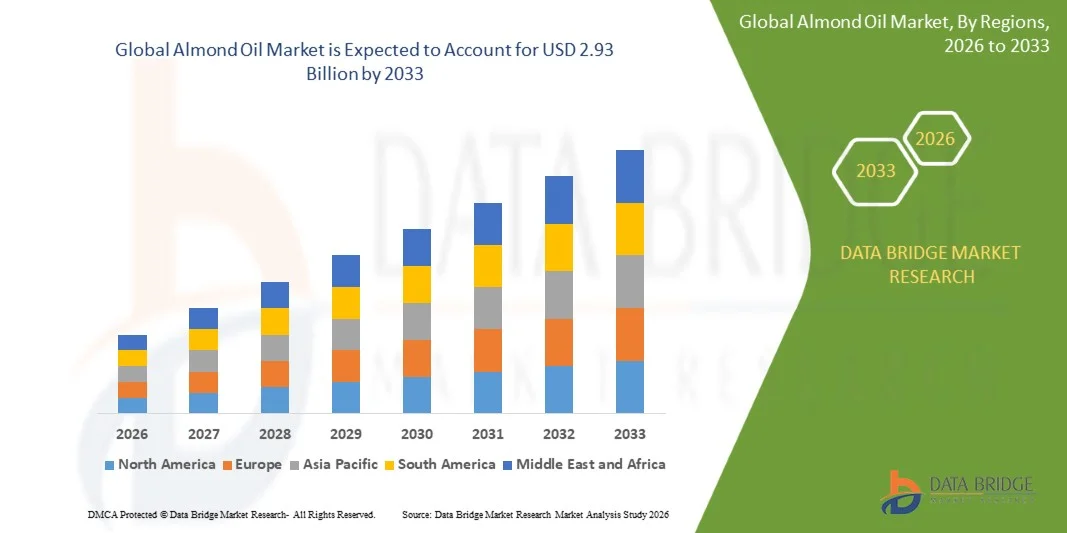
As per Data Bridge Market Research analysis, the almond oil market was valued at USD 1.43 billion in 2025 and is projected to reach USD 2.93 billion by 2033, growing at a CAGR of 9.40% from 2026 to 2033. Market expansion is supported by rising demand for natural-origin personal care ingredients, wider use in food preparation and pharmaceutical formulations, and improved availability through organized retail and digital channels.
Almond oil is obtained from almond kernels and is widely used in skincare, hair care, massage oils, pharmaceuticals, aromatherapy, and selected food applications. Sweet almond oil is the mainstream commercial product because of its broad use in cosmetics and wellness formulations, while bitter almond oil remains a smaller specialized category. Growing interest in natural ingredients, plant-based personal care, and wellness products is supporting demand across both developed and emerging markets.
Market Size & Forecast
- Global Market Value (2025): USD 1.43 Billion
- Expected Market Value (2034): USD 2.93 Billion
- Forecast CAGR (2026-2034): 9.40%
- Leading Region: North America
- Fastest-Growing Region: Asia-Pacific
Key Market Trends & Insights
- North America dominated the almond oil market with the largest revenue share in 2025, supported by strong demand for natural and organic personal care products, established food and wellness applications, local almond-processing capabilities, and mature retail and e-commerce networks.
- Asia-Pacific is expected to register the fastest regional growth as beauty, food, pharmaceutical, and wellness demand expands across China, India, Japan, and South Korea
- The sweet almond oil segment dominated the market in 2025, driven by its extensive use in cosmetics, personal care products, pharmaceuticals, and food applications due to its moisturizing, nourishing, and skin-friendly properties.
- The bitter almond oil segment is projected to register the fastest growth during the forecast period, supported by its increasing use in aromatherapy, fragrances, specialty pharmaceuticals, and flavoring applications, along with rising demand for natural essential oils.
- The cosmetics segment accounted for the largest revenue share in 2025, owing to the growing demand for natural skincare, haircare, and anti-aging products, coupled with increasing consumer preference for clean-label and plant-based beauty ingredients.
Report Scope and Almond Oil Market Segmentation
|
Attributes |
Almond Oil Key Market Insights |
|
Segments Covered |
|
|
Countries Covere |
North America
Europe
Asia-Pacific
Latin America
Middle East and Africa
|
|
Key Market Players |
|
|
Market Opportunities |
|
|
Value Added Data Infosets |
In addition to market value, growth rate, segmentation, geographical coverage, and key players, the report includes analysis of application demand, distribution channels, end-user trends, raw-material supply conditions, sustainability developments, and competitive positioning across major regions. |
Almond Oil Market Trends
Trend: Rising Demand for Clean-Label, Multi-Functional, and Premium Almond Oil Products
Consumer preference for natural, plant-based ingredients is transforming almond oil from a traditional carrier oil into a premium multifunctional ingredient across beauty, wellness, food, and pharmaceutical applications. Sweet almond oil is increasingly used in facial serums, body lotions, massage oils, baby-care products, hair treatments, nutraceutical formulations, and specialty culinary products due to its moisturizing, antioxidant, and nutrient-rich properties. Consumers are also showing greater preference for organic, cold-pressed, unrefined, non-GMO, and sustainably sourced almond oils as ingredient transparency and product authenticity become key purchasing factors.
The growth of e-commerce and direct-to-consumer (DTC) channels is accelerating demand for premium almond oil products by enabling brands to offer specialized formulations, refill packs, and personalized product bundles. At the same time, manufacturers are expanding certified product portfolios to strengthen consumer trust. For instance, in June 2024, ofi (Olam Food Ingredients) became the first company to achieve Rainforest Alliance Certification for almond orchards in the United States, validating sustainable farming practices, biodiversity conservation, and responsible water management across its almond supply chain. Similarly, in April 2025, Blue Diamond Growers continued expanding its value-added almond ingredient portfolio by increasing investments in premium almond-based ingredients for food and personal care manufacturers, reflecting the growing commercial importance of high-quality almond derivatives. These developments demonstrate how sustainability certification, premium processing methods, and digital distribution are becoming central strategies for product differentiation in the global almond oil market.
Almond Oil Market Dynamics
Key Market Driver: Growing Consumer Preference for Natural and Plant-Based Personal Care Ingredients
The almond oil market is primarily driven by increasing consumer demand for botanical, minimally processed ingredients across cosmetics, personal care, pharmaceuticals, aromatherapy, and functional food applications. Almond oil is widely valued for its moisturizing, anti-inflammatory, and antioxidant properties, making it a preferred ingredient in skincare formulations, haircare products, massage oils, and wellness products. The continued shift toward clean beauty and natural cosmetics has encouraged manufacturers to replace synthetic ingredients with plant-derived alternatives.
The expanding global almond industry is also supporting market growth by ensuring the availability of high-quality raw materials. According to the Almond Board of California, California continues to produce approximately 80% of the world's almonds, making it the primary source of almonds used for oil extraction worldwide. In May 2025, the USDA's National Agricultural Statistics Service forecast California's 2025 almond production at approximately 2.8 billion meat pounds, reflecting stable long-term production despite seasonal fluctuations. Continued investments in sustainable orchard management, improved irrigation practices, and advanced cultivation techniques are supporting the long-term availability of almonds for oil manufacturers while meeting growing global demand.
Key Restraint/Challenge: Climate-Driven Supply Volatility and Rising Production Costs
One of the major challenges facing the almond oil market is its dependence on agricultural production, which remains highly vulnerable to climate variability, water availability, pollination conditions, labor shortages, pest infestations, and fluctuating transportation costs. Weather-related events can significantly influence almond yields, resulting in unstable raw material prices and affecting profit margins for almond oil manufacturers. Premium categories such as organic and cold-pressed almond oils also require additional certification, quality assurance, segregation, and traceability measures, increasing operational costs throughout the supply chain.
Supply uncertainty continues to highlight this challenge. The Almond Board of California and USDA have repeatedly revised production forecasts over recent years due to changing weather patterns, water availability, and orchard conditions. California's prolonged drought conditions, followed by periods of excessive rainfall, have increased production uncertainty while placing additional pressure on irrigation costs and orchard management. As a result, almond oil manufacturers are increasingly diversifying sourcing strategies, improving inventory planning, and investing in long-term supplier partnerships to reduce supply chain risks while maintaining product quality and pricing stability.
Key Market Opportunity: Expansion of Certified Premium Products and Sustainable Supply Chains
Growing consumer demand for premium-quality, ethically sourced, and environmentally responsible products presents significant opportunities for almond oil manufacturers. Consumers are increasingly willing to pay premium prices for almond oils that offer organic certification, cold-pressed processing, verified origin, food- and cosmetic-grade compliance, and sustainable packaging. Direct-to-consumer sales channels further support this opportunity by enabling manufacturers to educate consumers, offer subscription-based purchasing, and market specialized formulations for skincare, wellness, aromatherapy, and culinary applications.
Sustainability certifications are becoming an increasingly important competitive differentiator. In June 2024, ofi became the first company to receive Rainforest Alliance Certification for U.S. almond orchards, establishing new standards for biodiversity protection, water stewardship, and responsible agricultural practices within the almond supply chain. Additionally, the Almond Board of California continues to promote its Almond Sustainability Program (CASP), under which the majority of California almond growers participate in continuous improvement initiatives focused on water efficiency, pollinator health, soil management, and reduced environmental impact. Companies that combine certified sourcing, premium processing technologies, transparent supply chains, and strong digital commerce capabilities are expected to capture higher-value opportunities as consumers increasingly prioritize sustainability, product purity, and ingredient traceability.
Almond Oil Market Scope
The almond oil market is segmented on the basis of product type, application, and distribution channel.
- By Product Type
On the basis of product type, the global almond oil market is segmented into sweet almond oil and bitter almond oil. The sweet almond oil segment dominated the market in 2025, owing to its widespread use across cosmetics, personal care, pharmaceutical, aromatherapy, and food applications. Its mild aroma, high vitamin E content, moisturizing properties, and suitability for sensitive skin make it the preferred choice among manufacturers and consumers. The segment also benefits from strong demand for natural skincare, haircare, baby-care, and wellness products.
The bitter almond oil segment is projected to register the fastest growth during the forecast period from 2026 to 2033, driven by increasing use in aromatherapy, fragrance formulations, specialty pharmaceutical products, and flavoring applications. Growing consumer interest in essential oils, natural wellness therapies, and premium botanical ingredients is expected to support the expansion of this segment.
- By Application
On the basis of application, the global almond oil market is segmented into cosmetics, food and beverage, pharmaceuticals, aromatherapy, and others. The cosmetics segment accounted for the largest market share in 2025, supported by the increasing adoption of almond oil in facial serums, moisturizers, body lotions, hair oils, massage products, and anti-aging formulations. Rising consumer preference for plant-based, clean-label, and chemical-free beauty products continues to drive demand from personal care manufacturers.
The pharmaceuticals segment is expected to witness the fastest growth during the forecast period from 2026 to 2033, driven by the expanding use of almond oil in topical medications, therapeutic formulations, nutraceutical products, and wellness supplements. Its recognized emollient, anti-inflammatory, and antioxidant properties are contributing to increased adoption in healthcare and preventive wellness applications.
- By Distribution Channel
On the basis of distribution channel, the global almond oil market is segmented into online and offline channels. The offline segment dominated the market in 2025, owing to the strong presence of supermarkets, hypermarkets, pharmacies, specialty beauty stores, health-food retailers, and wellness outlets. Consumers often prefer offline purchases for personal care and edible oil products because they can directly evaluate product quality, packaging, certification labels, and brand authenticity before purchase.
The online segment is projected to register the fastest growth during the forecast period from 2026 to 2033, driven by the rapid expansion of e-commerce platforms, increasing digital shopping adoption, wider availability of premium and certified almond oil products, and the convenience of home delivery. Online channels also enable brands to offer subscription models, refill packs, educational content, and application-specific product bundles, further accelerating segment growth.
North America Almond Oil Market Insight
North America accounted for the largest share of the global almond oil market in 2025, driven by strong consumer demand for natural and plant-based personal care products, increasing adoption of clean-label ingredients, and the well-established use of almond oil across cosmetics, food, pharmaceutical, and wellness applications. The region also benefits from a mature retail and e-commerce landscape, advanced processing capabilities, and a robust almond cultivation industry, particularly in the United States, which supports a stable supply of raw materials. Continuous product innovation in organic, cold-pressed, and sustainably sourced almond oil further strengthens the region's market position.
U.S. Almond Oil Market Insight
The U.S. represents the largest market in North America and serves as the global hub for almond production and processing. California's extensive almond cultivation provides a reliable supply of raw materials for manufacturers producing cosmetic-grade, food-grade, and pharmaceutical-grade almond oil. Growing consumer interest in natural skincare, functional foods, aromatherapy, and wellness products, combined with the rapid expansion of online retail channels, continues to drive domestic demand. In addition, increasing emphasis on sustainable farming practices and supply chain transparency is shaping purchasing decisions across both consumer and industrial markets.
Asia-Pacific Almond Oil Market Insight
Asia-Pacific is projected to register the fastest growth in the global almond oil market during the forecast period, supported by rising disposable incomes, expanding beauty and personal care industries, growing pharmaceutical manufacturing, and increasing consumer awareness of natural health and wellness products. Rapid urbanization, improving retail infrastructure, and the expansion of e-commerce platforms are further enhancing product accessibility across major economies, including China, India, Japan, South Korea, Australia, and Southeast Asian countries. The region is witnessing growing demand for both retail-ready almond oil products and bulk ingredients used in cosmetics, food processing, and pharmaceutical formulations.
China Almond Oil Market Insight
China is emerging as one of the fastest-growing markets for almond oil, driven by its expanding cosmetics and personal care manufacturing sector, rising demand for premium skincare products, and growing consumer preference for natural botanical ingredients. Almond oil is increasingly incorporated into facial care, haircare, massage oils, aromatherapy products, and functional food applications. The continued growth of cross-border e-commerce and premium imported beauty products is further supporting market expansion, while manufacturers increasingly seek high-purity, certified, and application-specific almond oil ingredients to meet evolving consumer expectations.
Japan Almond Oil Market Insight
Japan remains an important premium market for almond oil, characterized by strong demand for high-quality, traceable, and naturally derived ingredients. Consumers place significant emphasis on product safety, purity, formulation quality, and sustainable sourcing, encouraging manufacturers to develop premium cosmetic, wellness, and aromatherapy products containing almond oil. Demand is further supported by the country's established skincare and personal care industry, where almond oil is widely utilized in moisturizers, massage oils, anti-aging formulations, and specialty wellness products. Manufacturers that offer certified sourcing, premium packaging, and consistent product quality are well positioned to strengthen their presence in the Japanese market.
Almond Oil Market Share
The almond oil market is led by well established companies:
- Blue Diamond Growers (U.S.)
- Caloy Company, LP (U.S.)
- Jiangxi Baicao Pharmaceutical Co., Ltd. (China)
- Gustav Heess Oleochemische Erzeugnisse GmbH (Germany)
- Henry Lamotte Oils GmbH (Germany)
- Olam Food Ingredients (ofi) (Singapore)
- AAK AB (Sweden)
- Liberty Vegetable Oil Company (U.S.)
- Huiles Bertin S.A.S. (France)
- AOS Products Private Limited (India)
- Ashwin Fine Chemicals & Pharmaceuticals (India)
- Flora Manufacturing & Distributing Ltd. (Canada)
- NOW Health Group, Inc. (U.S.)
- Indian Natural Oils (India)
- Aromex Industry (India)
- Kanta Enterprises Private Limited (India)
- Paras Perfumers (India)
Latest Developments in Almond Oil Market
- In August 2023, Bajaj Consumer Care Ltd. expanded its personal care portfolio with the launch of an Anti Hair Fall Shampoo enriched with almond oil and vitamin E. The product was introduced to address growing consumer demand for naturally derived hair care solutions while strengthening the company's presence in the premium hair care segment.
- In June 2022, Bajaj Consumer Care Ltd. announced the expansion of its Bajaj Almond Drops portfolio beyond hair oil by introducing new products across the hair care and skin care categories. As part of this strategy, the company launched a moisturizing soap under the Bajaj Almond Drops brand, aiming to diversify its product offerings, leverage the brand's strong consumer recognition, and capitalize on the increasing demand for almond oil-based personal care products.
- In September 2024, Arquiste introduced Almond Suede, a luxury fragrance created in collaboration with master perfumer Calice Becker of Givaudan. The fragrance features bitter almond oil among its key top notes, combined with marzipan-inspired gourmand accords and suede leather notes to recreate the olfactory heritage of medieval Córdoba. The launch highlights the expanding application of bitter almond oil in premium niche perfumery and luxury fragrance innovation.

- Interactive Data Analysis Dashboard
- Company Analysis Dashboard for high growth potential opportunities
- Research Analyst Access for customization & queries
- Competitor Analysis with Interactive dashboard
- Latest News, Updates & Trend analysis
- Harness the Power of Benchmark Analysis for Comprehensive Competitor Tracking
Global Almond Oil Market, Supply Chain Analysis and Ecosystem Framework
To support market growth and help clients navigate the impact of geopolitical shifts, DBMR has integrated in-depth supply chain analysis into its Global Almond Oil Market research reports. This addition empowers clients to respond effectively to global changes affecting their industries. The supply chain analysis section includes detailed insights such as Global Almond Oil Market consumption and production by country, price trend analysis, the impact of tariffs and geopolitical developments, and import and export trends by country and HSN code. It also highlights major suppliers with data on production capacity and company profiles, as well as key importers and exporters. In addition to research, DBMR offers specialized supply chain consulting services backed by over a decade of experience, providing solutions like supplier discovery, supplier risk assessment, price trend analysis, impact evaluation of inflation and trade route changes, and comprehensive market trend analysis.
Data collection and base year analysis are done using data collection modules with large sample sizes. The stage includes obtaining market information or related data through various sources and strategies. It includes examining and planning all the data acquired from the past in advance. It likewise envelops the examination of information inconsistencies seen across different information sources. The market data is analysed and estimated using market statistical and coherent models. Also, market share analysis and key trend analysis are the major success factors in the market report. To know more, please request an analyst call or drop down your inquiry.
The key research methodology used by DBMR research team is data triangulation which involves data mining, analysis of the impact of data variables on the market and primary (industry expert) validation. Data models include Vendor Positioning Grid, Market Time Line Analysis, Market Overview and Guide, Company Positioning Grid, Patent Analysis, Pricing Analysis, Company Market Share Analysis, Standards of Measurement, Global versus Regional and Vendor Share Analysis. To know more about the research methodology, drop in an inquiry to speak to our industry experts.
Data Bridge Market Research is a leader in advanced formative research. We take pride in servicing our existing and new customers with data and analysis that match and suits their goal. The report can be customized to include price trend analysis of target brands understanding the market for additional countries (ask for the list of countries), clinical trial results data, literature review, refurbished market and product base analysis. Market analysis of target competitors can be analyzed from technology-based analysis to market portfolio strategies. We can add as many competitors that you require data about in the format and data style you are looking for. Our team of analysts can also provide you data in crude raw excel files pivot tables (Fact book) or can assist you in creating presentations from the data sets available in the report.













