


What is the Aluminium Piston Market Size and Growth Rate?
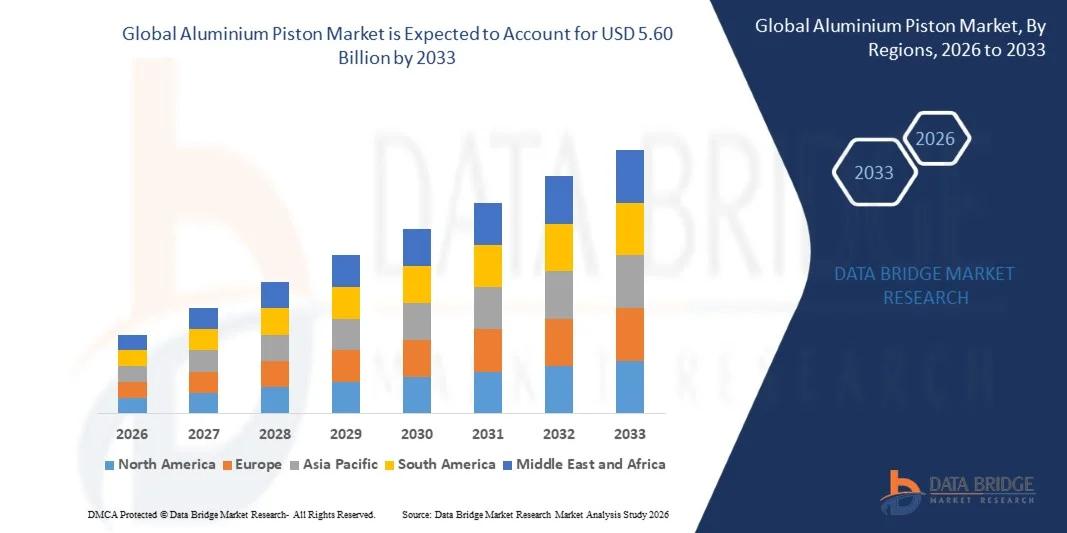
- As per Data Bridge Market Research analysis, the aluminium piston market was valued at USD 4.36 billion in 2025 and is projected to reach USD 5.60 billion by 2033, growing at a CAGR of 3.20% from 2026 to 2033.
- The market is experiencing consistent growth driven by rising automobile production, increasing demand for lightweight engine components, advancements in aluminium alloy technologies, and the need for improved fuel efficiency and lower emissions.
- The growing adoption of lightweight materials in automotive engines, combined with stringent fuel-efficiency and emissions requirements, is compelling automakers and piston manufacturers to develop advanced aluminium piston designs. Improved thermal management, high-performance alloys, and advanced casting and forging technologies are supporting the use of aluminium pistons across passenger cars and commercial vehicles, particularly in expanding automotive manufacturing markets.
Market Size & Forecast
- Global Market Value (2025): USD 4.36 Billion
- Expected Market Value (2033): USD 5.60 Billion
- Forecast CAGR (2026–2033): 3.20%
- Leading Region in 2025: North America
- Fastest Growing Region: Asia Pacific
What are the Major Takeaways of the Aluminium Piston Market?
- North America dominated the aluminium piston market with the largest revenue share of 32% in 2025, supported by established automotive manufacturing, strong demand for high-performance engines, and increasing adoption of lightweight engine components.
- Asia-Pacific is expected to be the fastest-growing region at a CAGR of 4.7% from 2026 to 2033, fueled by expanding automotive production, increasing vehicle ownership, and rising demand for lightweight and fuel-efficient engine components across China, India, and Japan.
- The aluminium 4032 segment led the market with a 58.7% share in 2025, driven by its high silicon content, low thermal expansion, strong wear resistance, and dimensional stability.
- Aluminium 2618 are the fastest-growing alloy type, projected to register a CAGR of 3.5%, reflecting the surge in high strength, fatigue resistance, and ability to withstand elevated operating temperatures.
- The dry film lubricant segment dominated the coating type category with a 64.3% revenue share in 2025, led by its ability to reduce friction and wear between piston surfaces and cylinder walls.
- Cast accounted for 57% of the market share in 2025, preferred by its cost efficiency and suitability for high-volume automotive piston production
- The piston pin segment is the fastest-growing component category, with a CAGR of 3.8%, driven by requirements for lightweight and durable piston assemblies.
Report Scope and Aluminium Piston Market Segmentation
|
Attributes |
Aluminium Piston Key Market Insights |
|
Segments Covered |
|
|
Countries Covered |
North America
Europe
Asia-Pacific
Middle East and Africa
South America
|
|
Key Market Players |
|
|
Market Opportunities |
|
|
Value Added Data Infosets |
In addition to the market insights such as market value, growth rate, market segments, geographical coverage, market players, and market scenario, the market report curated by the Data Bridge Market Research team includes in-depth expert analysis, import/export analysis, pricing analysis, production consumption analysis, and pestle analysis. |
What is the Key Trend in the Aluminium Piston Market?
- Aluminium piston manufacturers are increasingly developing lightweight, high-strength piston designs with optimized geometries, advanced alloys, and thermal-management features to improve engine efficiency, durability, and resistance to high combustion temperatures.
- For instance, in April 2025, Suzuki Motor Corporation reported that friction losses in the cylinder bore account for about 40% of total engine friction losses in its compact air-cooled engine research, highlighting the importance of reducing piston-related friction.
- Advanced piston designs are increasingly incorporating low-friction surfaces, improved skirt geometries, and specialized coatings to reduce mechanical losses and improve fuel efficiency in internal combustion engines.
- Manufacturers and research organizations are also exploring advanced aluminium alloys and additive manufacturing to produce pistons capable of operating under higher thermal loads while maintaining the weight advantages of aluminium.
- For instance, in February 2025, Oak Ridge National Laboratory (ORNL) published work on the additive manufacturing of a high-temperature aluminium alloy specifically for automotive engine pistons, demonstrating the development of advanced manufacturing approaches for next-generation piston applications.
- As engine manufacturers continue to prioritize lightweighting, friction reduction, thermal management, and higher power density, the adoption of advanced aluminium alloys, coatings, and optimized piston designs is expected to accelerate, reinforcing aluminium pistons as an important component for improving the efficiency and durability of modern internal combustion engines.
What are the Key Drivers of the Aluminium Piston Market?
- The growing emphasis on vehicle lightweighting and fuel efficiency is increasing demand for aluminium pistons because their lower weight reduces reciprocating mass, inertia forces, and mechanical losses while supporting improved engine efficiency.
- For instance, in February 2024, the National University International Journal of Business published research on RSA-612 nanostructured aluminium alloy pistons, reporting that the machined piston was 13.5% lighter than a conventional Aluminium 2618 piston, supporting the use of lightweight aluminium alloys to reduce reciprocating mass and improve engine efficiency.
- Increasing requirements for higher engine power density, thermal efficiency, and durability are encouraging manufacturers to use advanced aluminium-silicon alloys, ceramic coatings, and optimized piston structures capable of withstanding severe thermal and mechanical loading.
- Automotive manufacturers and piston suppliers are integrating advanced materials, coatings, and computational design techniques into piston development to improve wear resistance, reduce friction, and maintain dimensional stability under increasingly demanding engine operating conditions.
- For instance, in February 2025, Journal of Materials Research and Technology published research on an optimized Aluminium T6 2618 piston with a ceramic crown coating, demonstrating improved mechanical and thermal performance while reducing piston weight, supporting the growing use of advanced aluminium piston designs for more efficient engines.
- With automakers continuing to pursue lightweight, efficient, and durable internal combustion engines across passenger and commercial vehicles, demand for advanced aluminium pistons will remain supported by improvements in alloy technology, surface engineering, thermal management, and precision manufacturing.
Which Factors are Challenging the Growth of the Aluminium Piston Market?
- Aluminium pistons face technical limitations under increasingly severe engine operating conditions because high combustion temperatures and pressures can accelerate thermal fatigue, wear, deformation, and cracking, requiring advanced alloys and surface treatments.
- For instance, in September 2024, Engineering Failure Analysis, published by Elsevier, reported that aluminium-alloy pistons can reach operating temperatures of 350–400°C and that high combustion pressure and temperature contribute to piston wear, erosion, cracking, and thermal-fatigue failure.
- These challenges can increase material-development, testing, coating, and manufacturing requirements for piston suppliers, particularly when components must maintain dimensional stability and durability under high-temperature and high-pressure engine operation.
- The increasing use of high-output and turbocharged engines further raises thermal and mechanical loads on aluminium pistons, creating challenges in maintaining strength, wear resistance, and long-term reliability without significantly increasing component weight or manufacturing complexity.
- For instance, in August 2021, Fatigue & Fracture of Engineering Materials & Structures, published by Wiley, reported that thermal-mechanical fatigue testing of an Al–Si alloy piston under 100–350°C temperature cycles produced microcracks around primary silicon particles and eventually macrocracks.
- The need for specialized alloy compositions, thermal coatings, cooling features, precision machining, and extensive durability validation can increase production complexity and component costs, creating challenges for aluminium piston manufacturers competing with alternative materials and advanced piston technologies.
How is the Aluminium Piston Market Segmented?
The aluminium piston market is segmented on the basis of alloy type, coating type, manufacturing process, vehicle type, fuel type, shape, component, and industrial application.
- By Alloy Type
On the basis of alloy type, the aluminium piston market is segmented into Aluminium 2618 and Aluminium 4032. The aluminium 4032 segment dominated the market with 58.7% share in 2025, owing to its high silicon content, low thermal expansion, strong wear resistance, and dimensional stability. These properties make the alloy suitable for passenger vehicles and high-performance engine applications. Its lower thermal expansion enables tighter piston-to-cylinder clearances, supporting efficient engine operation. The alloy also provides good machinability and durability under demanding conditions. Increasing demand for lightweight and fuel-efficient engine components is further supporting its adoption.
The aluminium 2618 segment is projected to register the fastest growth at 3.5% CAGR from 2026 to 2033, driven by its high strength, fatigue resistance, and ability to withstand elevated operating temperatures. The alloy is widely associated with high-performance and motorsport piston applications. Its mechanical properties make it suitable for engines operating under high thermal and combustion loads. Increasing adoption of turbocharged and high-output engines is creating additional demand for high-strength piston alloys. Manufacturers are also improving heat-treatment processes to enhance its durability. These characteristics are expected to support continued growth of Aluminium 2618 in demanding applications.
- By Coating Type
On the basis of coating type, the aluminium piston market is segmented into dry film lubricant, thermal barriers, and oil shedding coatings. The dry film lubricant segment dominated the market with 64.3% share in 2025, supported by its ability to reduce friction and wear between piston surfaces and cylinder walls. These coatings are particularly useful in high-speed and high-performance engine applications. Lower friction helps reduce mechanical losses during piston movement. Dry-film coatings can also improve piston durability under demanding operating conditions. Their use is increasing as engine manufacturers focus on fuel efficiency and friction reduction. The combination of lubrication performance and wear protection continues to support their adoption.
The dry film lubricant segment is also projected to register the fastest growth at 3.3% CAGR from 2026 to 2033, driven by increasing emphasis on friction reduction and piston durability. These coatings provide solid lubrication where conventional lubrication may be insufficient. They are increasingly used in high-performance, racing, and heavy-duty engine applications. Improvements in coating formulations are enhancing wear resistance and operating stability. Increasing engine power density is creating greater demand for low-friction piston surfaces. The growing focus on fuel economy and reduced mechanical losses is expected to sustain the segment's growth.
- By Manufacturing Process
On the basis of manufacturing process, the aluminium piston market is segmented into Cast and Forged. The Cast segment dominated the market with 57% share in 2025, supported by its cost efficiency and suitability for high-volume automotive piston production. Casting enables manufacturers to produce complex piston geometries efficiently. The process is widely used for passenger vehicles and conventional internal combustion engines. Established casting infrastructure also allows manufacturers to achieve consistent production volumes. Improvements in aluminium alloy composition and casting precision are enhancing component reliability. The cost advantages of casting continue to support its leading position across mass-market applications.
The forged segment is projected to register the fastest growth at 5.6% CAGR from 2026 to 2033, driven by increasing demand for high-strength pistons in performance and high-load engines. Forging provides improved structural integrity and fatigue resistance compared with conventional casting. These properties are important for turbocharged and high-performance engines exposed to greater combustion pressures. Forged pistons also provide a favorable strength-to-weight ratio. Increasing demand for motorsport and performance vehicles is creating additional opportunities for forged designs. Continued development of lightweight forging technologies is expected to support faster adoption.
- By Vehicle Type
On the basis of vehicle type, the aluminium piston market is segmented into passenger cars, light commercial vehicle (LCV), and high commercial vehicle (HCV). The passenger cars segment dominated the market with 64.6% share in 2025, supported by high passenger-vehicle production and widespread use of aluminium pistons in gasoline and diesel engines. Lightweight pistons help reduce reciprocating mass and improve engine efficiency. Passenger vehicles also represent a large installed base of internal combustion engines globally. Increasing adoption of turbocharged and high-efficiency engines is supporting demand for advanced piston designs. Automakers are increasingly optimizing piston materials and coatings to meet fuel-efficiency requirements. The large volume of passenger-car production continues to sustain the segment's dominant position.
The light commercial vehicle segment is projected to register the fastest growth at 2.7% CAGR from 2026 to 2033, supported by rising demand for delivery vans, commercial fleets, and urban transportation vehicles. LCV engines require pistons that combine durability with low weight and efficient heat dissipation. Growth in e-commerce and last-mile delivery is increasing commercial vehicle utilization. Fleet operators are also placing greater emphasis on fuel economy and operating costs. Aluminium pistons can help reduce reciprocating mass while maintaining suitable thermal performance. Increasing adoption of downsized and turbocharged LCV engines is expected to further support demand.
- By Fuel Type
On the basis of fuel type, the aluminium piston market is segmented into gasoline, diesel, and alternate fuel. The gasoline segment dominated the market with 45% share in 2025, supported by extensive use of aluminium pistons in passenger-car gasoline engines. Aluminium provides low density and high thermal conductivity, making it suitable for high-speed engine operation. Gasoline engines increasingly incorporate turbocharging and direct injection, creating demand for optimized piston designs. High global passenger-vehicle production also supports the segment's large installed base. Manufacturers are improving piston geometry and coatings to manage higher combustion temperatures. Continued use of internal combustion and hybrid gasoline engines is supporting demand for aluminium pistons.
The alternate fuel segment is projected to register the fastest growth at 3.8% CAGR from 2026 to 2033, driven by increasing adoption of alternative and lower-carbon fuels in internal combustion applications. Alternative-fuel engines can expose piston components to different thermal and combustion conditions. This is encouraging the development of specialized aluminium alloys and surface treatments. Increasing use of hybrid powertrains is also extending the application of internal combustion engines using advanced fuel technologies. Manufacturers are focusing on improving piston durability under changing combustion characteristics. The continued diversification of automotive fuels is expected to create additional opportunities for advanced aluminium piston designs.
- By Shape
On the basis of shape, the aluminium piston market is segmented into flat-top piston, bowl piston, and dome piston. The flat-top piston segment dominated the market with 48% share in 2025, supported by its simple geometry and broad application across conventional gasoline and internal combustion engines. The flat crown can provide an efficient combustion-chamber configuration in suitable engine designs. Its relatively straightforward geometry also supports efficient manufacturing and machining. Flat-top pistons are widely used in passenger vehicles and other high-volume applications. Their established manufacturing processes help control production costs. Continued use in mainstream engine platforms supports the segment's leading position.
The bowl piston segment is projected to register the fastest growth at 3.0% CAGR from 2026 to 2033, driven by increasing application in direct-injection and diesel engine designs. The bowl-shaped crown helps control fuel-air mixing and combustion within the cylinder. Modern engines require increasingly optimized combustion geometry to improve efficiency. Bowl designs can support more controlled fuel distribution in suitable direct-injection configurations. Growing emphasis on lower emissions is encouraging manufacturers to optimize piston-crown designs. Continued development of high-efficiency diesel and direct-injection engines is expected to support demand for bowl pistons.
- By Component
On the basis of component, the aluminium piston market is segmented into piston head, piston ring, and piston pin. The piston head segment dominated the market with 49% share in 2025, supported by its direct exposure to combustion pressure and temperature. The piston head forms the primary load-bearing portion of the piston assembly. Aluminium alloys provide low weight and good thermal conductivity for this demanding application. Manufacturers are increasingly optimizing crown geometry to improve combustion and thermal management. Advanced coatings are also being applied to piston-head surfaces to improve heat resistance and durability. Its critical role in engine operation supports the segment's leading position.
The piston pin segment is projected to register the fastest growth at 3.8% CAGR from 2026 to 2033, driven by increasing requirements for lightweight and durable piston assemblies. Piston pins transfer combustion forces between the piston and connecting rod and experience repeated cyclic loads. Engine downsizing and turbocharging can increase the mechanical stresses experienced by piston assemblies. Manufacturers are developing optimized pin designs to reduce weight while maintaining strength. Improved surface treatments can also enhance wear resistance and service life. Increasing use of high-performance engine architectures is expected to support demand for advanced piston-pin designs.
- By Industrial Application
On the basis of industrial application, the aluminium piston market is segmented into pumps, compressors, and cylinders. The pumps segment dominated the market with 45% share in 2025, supported by the use of lightweight aluminium piston components in reciprocating pumping systems. Aluminium provides low density, good thermal conductivity, and machinability. These characteristics are beneficial where piston movement occurs repeatedly under mechanical loading. Applications span industrial, agricultural, automotive, and fluid-handling equipment. Established casting and machining technologies also support cost-efficient piston production. Increasing demand for efficient reciprocating equipment continues to support aluminium piston use in pump applications.
The compressors segment is projected to register the fastest growth at 3.4% CAGR from 2026 to 2033, supported by increasing demand for compressed-air and gas-handling equipment. Aluminium pistons can reduce reciprocating mass and provide effective heat dissipation during compressor operation. Industrial automation is increasing demand for compressed-air systems across manufacturing facilities. Growth in HVAC, refrigeration, automotive servicing, and industrial gas applications is also supporting compressor deployment. Manufacturers are focusing on reducing friction and improving piston durability to enhance compressor efficiency. These developments are expected to create additional demand for advanced aluminium piston designs in compressor applications.
Which Region Holds the Largest Share of the Aluminium Piston Market?
- North America dominated the aluminium piston market with the largest revenue share of 32% in 2025, supported by established automotive manufacturing, strong demand for high-performance engines, and increasing adoption of lightweight engine components.
- The region also benefits from extensive OEM and aftermarket networks, continued investment in engine efficiency technologies, and demand for advanced piston materials and designs. The U.S. represents the major contributor within North America, while Canada and Mexico strengthen the regional automotive supply chain. Increasing adoption of turbocharged and hybrid-compatible internal combustion engines, together with ongoing vehicle maintenance and replacement demand, continues to support North America's position in the global aluminium piston marke
U.S. Aluminium Piston Market Insight
The U.S. aluminium piston market is witnessing steady growth due to the country’s strong automotive manufacturing base, established aftermarket network, and continued demand for lightweight engine components. Automotive manufacturers and piston producers are increasingly adopting advanced aluminium alloys, optimized piston designs, and surface treatments to improve engine efficiency, durability, and thermal performance. In addition, growing demand for fuel-efficient vehicles, turbocharged engines, and high-performance powertrains is supporting aluminium piston adoption across passenger cars, commercial vehicles, and performance applications.
Asia-Pacific Aluminium Piston Market Insight
The Asia-Pacific aluminium piston market is expected to witness rapid growth, driven by expanding automotive production, increasing vehicle ownership, and rising demand for lightweight and fuel-efficient engine components across countries such as China, India, and Japan. Growing adoption of advanced aluminium alloys, forged piston technologies, and low-friction coatings is supporting regional market expansion. Additionally, increasing investments in automotive manufacturing, engine technology, and high-performance vehicles are accelerating aluminium piston adoption across passenger and commercial vehicle applications.
Japan Aluminium Piston Market Insight
The Japan aluminium piston market is witnessing consistent growth due to the country’s advanced automotive manufacturing capabilities, strong emphasis on engine efficiency, and continuous development of lightweight powertrain components. Automotive manufacturers and component suppliers are increasingly adopting high-strength aluminium alloys, precision piston designs, and advanced coatings for improved thermal management and durability. Moreover, increasing development of fuel-efficient, turbocharged, hybrid-compatible, and high-performance powertrains is further contributing to aluminium piston demand in Japan.
China Aluminium Piston Market Insight
The China aluminium piston market is growing rapidly, driven by expanding automotive production, increasing demand for fuel-efficient vehicles, and continued development of advanced engine technologies. Growing adoption of lightweight aluminium alloys, forged pistons, and specialized surface coatings across passenger and commercial vehicle applications is significantly boosting market demand. In addition, rising investments in automotive component manufacturing, engine research and development, and high-performance powertrain technologies are positioning China as an important growth market for aluminium pistons.
U.K. Aluminium Piston Market Insight
The U.K. aluminium piston market is experiencing steady growth, supported by its established automotive manufacturing ecosystem, motorsport industry, and increasing demand for lightweight high-performance engine components. Automotive manufacturers, specialist engine developers, and motorsport organizations are increasingly utilizing advanced aluminium pistons to improve engine efficiency, thermal performance, and durability. Furthermore, continued integration of lightweight materials, precision manufacturing, and advanced piston coatings is supporting aluminium piston development across automotive, performance, and specialized engine applications.
Germany Aluminium Piston Market Insight
The Germany aluminium piston market is expanding steadily due to the country’s strong automotive manufacturing base, advanced engineering capabilities, and increasing adoption of high-performance engine technologies. Automotive companies, piston manufacturers, and motorsport organizations are increasingly utilizing lightweight aluminium alloys, forged piston designs, and advanced coatings for improved engine efficiency and durability. Continuous advancements in powertrain engineering, thermal management, and precision manufacturing, along with strong demand for fuel-efficient and high-performance vehicles, are further driving aluminium piston adoption in Germany.
Which are the Top Companies in Aluminium Piston Market?
The aluminium piston industry is primarily led by well-established companies, including:
- MAHLE GmbH (Germany)
- Rheinmetall AG (Germany)
- TPR Co., Ltd. (Japan)
- NPR-RIKEN CORPORATION (Japan)
- India Pistons Limited (India)
- Menon Pistons Limited (India)
- Aisin Corporation (Japan)
- Musashi Seimitsu Industry Co., Ltd. (Japan)
- Daido Metal Co., Ltd. (Japan)
- Caterpillar Inc. (U.S.)
- Cummins Inc. (U.S.)
- Hyundai WIA Corporation (South Korea)
- IHI Corporation (Japan)
- Mitsubishi Heavy Industries, Ltd. (Japan)
- KSPG Automotive India Private Limited (India)
- Piston Rings & Components Private Limited (India)
- Engine Power Components, Inc. (U.S.)
- Art Piston (U.S.)
- Ross Racing Pistons (U.S.)
What are Latest Developments in Aluminium Piston Market?
- In July 2025, Wiseco introduced its first shelf-stock piston specifically engineered for Brodix BRX 18 cylinder heads. The new piston is manufactured from 2618 aluminium and incorporates a fully machined undercrown, ArmorGlide skirt coating, forced pin oiling, and application-specific dome configurations. Wiseco stated that the product was developed for high-output and severe-duty racing applications, providing engine builders with a ready-to-order alternative to custom pistons.
- In April 2024, Wiseco launched new RED Series 23° Small Block Chevy pistons. The new range includes dished and flat-top piston configurations and is engineered, forged, and machined in the U.S. from 2618 aluminium. The pistons incorporate dedicated forgings, ArmorGlide skirt coating, horizontal slot oiling, and other features designed for performance and power-adder applications.
- In November 2024, JE Pistons introduced its Dual Velocity Gas Ports technology for its piston range. The new design combines vertical and lateral gas-port pathways to improve pressure delivery behind the top piston ring, supporting improved ring sealing and reduced blow-by. JE Pistons reported that the technology was developed and tested for performance applications and can be incorporated into its shelf-stock and custom piston offerings.
- In July 2023, MAHLE announced a series order from DEUTZ to develop and supply power-cell components for hydrogen engines, including aluminium pistons, piston rings, and piston pins. MAHLE stated that it adapted and further developed its aluminium piston and ring-pack technology from conventional diesel applications for hydrogen combustion. The development represented an expansion of aluminium piston technology into alternative-fuel engine applications.
- In July 2021, Rheinmetall announced a major development and production order for customized aluminium pistons for a new passenger-car engine. The seven-year program covered customized aluminium pistons together with piston rings and piston pins for a four-cylinder petrol engine intended for the North American market. Rheinmetall planned development in Germany followed by regional adaptation and optimization in Mexico, demonstrating continued investment in application-specific aluminium piston systems.

- Interactive Data Analysis Dashboard
- Company Analysis Dashboard for high growth potential opportunities
- Research Analyst Access for customization & queries
- Competitor Analysis with Interactive dashboard
- Latest News, Updates & Trend analysis
- Harness the Power of Benchmark Analysis for Comprehensive Competitor Tracking
Data collection and base year analysis are done using data collection modules with large sample sizes. The stage includes obtaining market information or related data through various sources and strategies. It includes examining and planning all the data acquired from the past in advance. It likewise envelops the examination of information inconsistencies seen across different information sources. The market data is analysed and estimated using market statistical and coherent models. Also, market share analysis and key trend analysis are the major success factors in the market report. To know more, please request an analyst call or drop down your inquiry.
The key research methodology used by DBMR research team is data triangulation which involves data mining, analysis of the impact of data variables on the market and primary (industry expert) validation. Data models include Vendor Positioning Grid, Market Time Line Analysis, Market Overview and Guide, Company Positioning Grid, Patent Analysis, Pricing Analysis, Company Market Share Analysis, Standards of Measurement, Global versus Regional and Vendor Share Analysis. To know more about the research methodology, drop in an inquiry to speak to our industry experts.
Data Bridge Market Research is a leader in advanced formative research. We take pride in servicing our existing and new customers with data and analysis that match and suits their goal. The report can be customized to include price trend analysis of target brands understanding the market for additional countries (ask for the list of countries), clinical trial results data, literature review, refurbished market and product base analysis. Market analysis of target competitors can be analyzed from technology-based analysis to market portfolio strategies. We can add as many competitors that you require data about in the format and data style you are looking for. Our team of analysts can also provide you data in crude raw excel files pivot tables (Fact book) or can assist you in creating presentations from the data sets available in the report.













