


Aluminum Welding Market Analysis
The aluminum welding market is experiencing robust growth, driven by advancements in technology, the increasing demand for lightweight materials, and the growing application of aluminum in various industries. Aluminum welding plays a crucial role in sectors such as automotive, aerospace, construction, and shipbuilding due to its ability to provide strong, lightweight joints. As industries push for improved fuel efficiency and reduced carbon emissions, the demand for aluminum in manufacturing processes is rising. Technological advancements in welding techniques, such as laser beam welding, gas metal-arc welding (GMAW), and resistance welding, have enhanced the precision and efficiency of aluminum welding, making it more cost-effective and accessible. Innovations in welding equipment and automated systems are also contributing to the market’s growth, as they allow for faster, higher-quality welding processes. Furthermore, the increasing use of aluminum in sustainable and eco-friendly applications, such as electric vehicles (EVs) and renewable energy infrastructure, is expected to further propel market growth. With the rise of these new applications and technology improvements, the aluminum welding market is poised for continued expansion over the forecast period.
Aluminum Welding Market Size
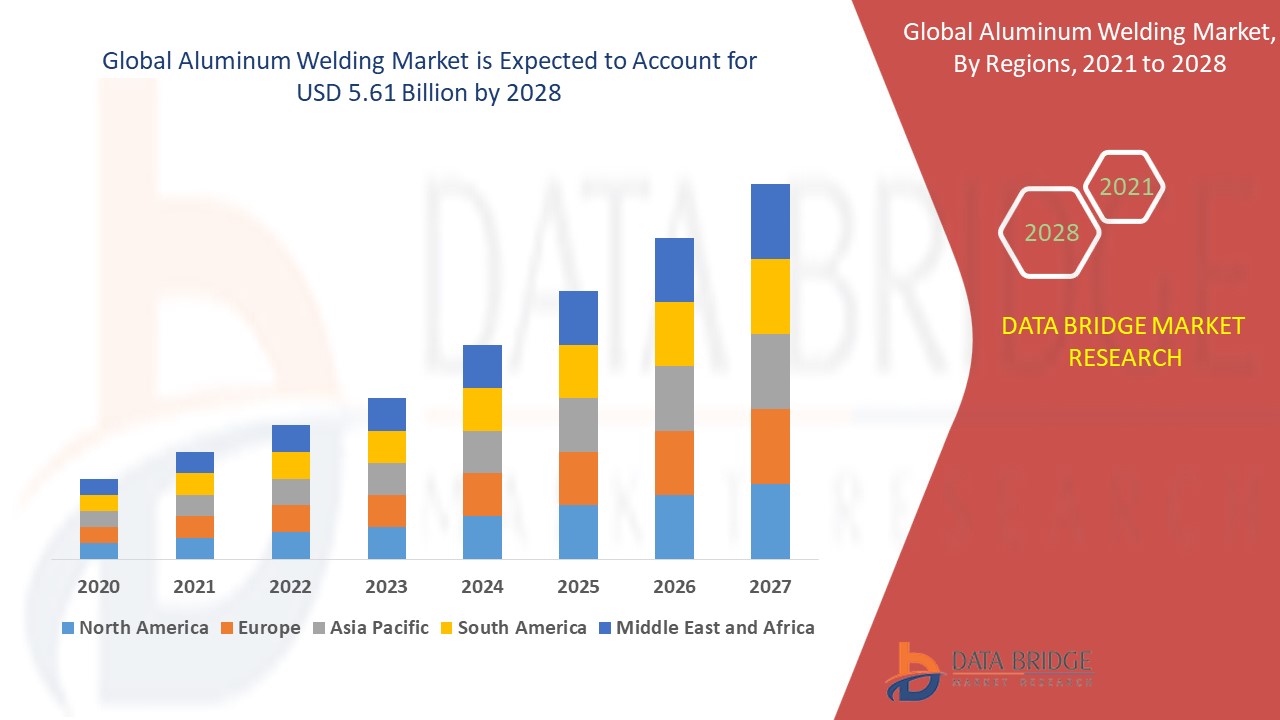
The global aluminum welding market size was valued at USD 4.47 billion in 2024 and is projected to reach USD 7.02 billion by 2032, with a CAGR of 5.80% during the forecast period of 2025 to 2032. In addition to the insights on market scenarios such as market value, growth rate, segmentation, geographical coverage, and major players, the market reports curated by the Data Bridge Market Research also include import export analysis, production capacity overview, production consumption analysis, price trend analysis, climate change scenario, supply chain analysis, value chain analysis, raw material/consumables overview, vendor selection criteria, PESTLE Analysis, Porter Analysis, and regulatory framework.
Aluminum Welding Market Trends
“Growing Demand for Lightweight Materials”
A key trend driving the aluminum welding market is the growing demand for lightweight materials, particularly in the automotive and aerospace industries. As industries continue to prioritize fuel efficiency and sustainability, aluminum's lightweight properties make it an ideal material for manufacturing. For instance, in the automotive sector, aluminum is used extensively in vehicle body panels and frames to reduce weight, enhance fuel economy, and meet environmental regulations on carbon emissions. This has led to a surge in the adoption of advanced welding techniques, such as gas metal-arc welding (GMAW) and laser welding, which provide high precision and durability for aluminum joints. The aerospace industry is also leveraging aluminum welding to produce lightweight aircraft components, contributing to improved fuel efficiency and performance. As demand for fuel-efficient vehicles and aircraft grows, the trend toward using aluminum in manufacturing processes will continue to drive innovations in aluminum welding, positioning it as a vital element in achieving sustainability goals across industries.
Report Scope and Aluminum Welding Market Segmentation
|
Attributes |
Aluminum Welding Key Market Insights |
|
Segments Covered |
|
|
Countries Covered |
U.S., Canada and Mexico in North America, Germany, France, U.K., Netherlands, Switzerland, Belgium, Russia, Italy, Spain, Turkey, Rest of Europe in Europe, China, Japan, India, South Korea, Singapore, Malaysia, Australia, Thailand, Indonesia, Philippines, Rest of Asia-Pacific (APAC) in the Asia-Pacific (APAC), Saudi Arabia, U.A.E., South Africa, Egypt, Israel, Rest of Middle East and Africa (MEA) as a part of Middle East and Africa (MEA), Brazil, Argentina and Rest of South America as part of South America |
|
Key Market Players |
The Lincoln Electric Company (U.S.), ESAB (Sweden), Hilarius Haarlem Holland B.V. (Netherlands), EWM GmbH (Germany), Hermann Fliess and Co. GmbH (Germany), Drahtwerk ELISENTAL W. Erdmann GmbH & Co. (Germany), SAFRA SPA (Italy), Mech Static Hydraulics (India), Atlantic China Welding Consumables (China), Anand Arc Ltd. (India), Gruppo Petitto (Italy), Tianjin Bridge Welding Materials Group Co., Ltd. (China), Aerospace Engineering Equipment (Suzhou) Co., Ltd. (China), Welding Alloys (U.K.), Air Liquide (France), Jinglei Welding (China), Sumitomo Electric Industries, Ltd. (Japan), Novametal SA (Switzerland), TWI Ltd. (U.K.), and BÖHLER Edelstahl GmbH & Co KG (Austria) |
|
Market Opportunities |
|
|
Value Added Data Infosets |
In addition to the insights on market scenarios such as market value, growth rate, segmentation, geographical coverage, and major players, the market reports curated by the Data Bridge Market Research also include import export analysis, production capacity overview, production consumption analysis, price trend analysis, climate change scenario, supply chain analysis, value chain analysis, raw material/consumables overview, vendor selection criteria, PESTLE Analysis, Porter Analysis, and regulatory framework. |
Aluminum Welding Market Definition
Aluminum welding is the process of joining two or more aluminum pieces together using heat and/or pressure, often with the addition of a filler material, to form a strong, durable bond. This process is commonly used in various industries, including automotive, aerospace, construction, and shipbuilding, due to aluminum's lightweight, corrosion-resistant, and high-strength properties.
Aluminum Welding Market Dynamics
Drivers
- Rising Demand for Lightweight Materials
As industries focus on reducing weight to enhance efficiency and performance, aluminum's lightweight and high-strength properties make it a material of choice. The automotive industry, in particular, is utilizing aluminum extensively for vehicle body panels to reduce overall vehicle weight, which directly improves fuel economy and reduces emissions. For instance, the use of aluminum in the Ford F-150 pickup truck’s body and frame has resulted in a significant weight reduction, helping the vehicle achieve better fuel efficiency. In construction, aluminum’s strength-to-weight ratio is driving its adoption for building facades, roofing materials, and structural elements, where lighter materials can contribute to faster construction times and improved energy efficiency. This surge in demand across multiple sectors is fueling the need for aluminum welding solutions that enable the assembly of lightweight aluminum components while maintaining structural integrity, positioning aluminum welding as a critical market driver.
- Growing Automotive and Aerospace Industries
The automotive and aerospace industries are at the forefront of adopting aluminum to meet environmental goals, particularly reducing weight to improve fuel efficiency and decrease emissions. Aluminum welding is vital in producing the components needed for this shift, from car body structures to engine parts. For instance, Tesla’s electric vehicles use aluminum extensively, and the welding of these components is crucial to assembling lightweight, high-performance vehicles. The aerospace industry also heavily relies on aluminum welding to manufacture aircraft and spacecraft, as aluminum’s low weight coupled with its strength is ideal for high-performance airframes and structures. For instance, the Boeing 787 Dreamliner uses aluminum extensively in its construction, and welding techniques are employed to ensure that the parts are strong yet lightweight, contributing to fuel efficiency and operational performance. As the automotive and aerospace industries continue to grow, the demand for aluminum welding solutions expands, making it a key market driver.
Opportunities
- Increasing Technological Advancements in Welding Technologies
The aluminum welding market is benefiting from significant advancements in welding technologies, which are improving the precision, efficiency, and cost-effectiveness of the process. Innovations such as robotic welding and laser welding allow for greater automation and precision, reducing labor costs and improving weld quality. For instance, robotic welding is now commonly used in automotive manufacturing to join aluminum components with high accuracy, ensuring structural integrity and meeting strict safety standards. In addition, laser welding provides a more focused and heat-efficient method for welding aluminum, ideal for high-strength applications such as aerospace and automotive components. These advancements enhance production capabilities and enable manufacturers to use aluminum in increasingly complex and demanding applications. With automation and robotic solutions improving efficiency, there is greater adoption of aluminum welding technology across various sectors such as automotive, aerospace, and construction, presenting a significant market opportunity to meet growing demand for innovative welding solutions.
- Increasing Environmental Regulations
As governments worldwide implement stricter environmental regulations to reduce carbon emissions and improve fuel efficiency, industries are increasingly turning to lightweight materials such as aluminum to comply with these standards. Aluminum’s inherent properties, such as its lightweight and strength-to-weight ratio, make it an ideal material for applications that aim to reduce emissions, such as in the automotive and aerospace sectors. For instance, electric vehicle manufacturers, such as Tesla, use aluminum to construct lighter bodies and frames to increase energy efficiency and reduce environmental impact. With such environmental regulations promoting the use of aluminum in manufacturing, the demand for aluminum welding solutions is expected to rise as these industries require high-quality, durable welds to maintain the strength and integrity of aluminum structures. This shift toward sustainable manufacturing presents a significant market opportunity for aluminum welding technologies, positioning them as essential to meeting regulatory requirements and driving the adoption of aluminum across industries.
Restraints/Challenges
- Shortage of Skilled Workers
The aluminum welding industry is facing a significant shortage of skilled workers, which has become a major challenge. Aluminum welding is more complex than welding other materials such as steel, requiring precise techniques and high-level expertise to avoid issues such as cracking, distortion, or poor weld quality. As industries such as automotive and aerospace increasingly turn to aluminum for its lightweight and high-strength properties, the demand for skilled welders has risen dramatically. However, the supply of trained professionals is insufficient to meet this demand. This shortage of skilled labor can lead to longer lead times for projects, delays in production, and higher labor costs, ultimately impacting the quality and efficiency of the welding process. In addition, this gap in expertise can prevent companies from fully capitalizing on the growing aluminum demand, as they may struggle to fill positions with qualified workers. Companies that cannot find qualified labor might face increased competition for skilled workers, driving up wages, which could further strain their budgets.
- High Production Costs
Aluminum welding, particularly in industries such as automotive, aerospace, and construction, comes with high production costs. This is due to the specialized equipment, advanced technology, and skilled labor required for the process. For instance, welding aluminum often requires more precise temperature control and specialized welding machines such as TIG and MIG welders. These machines are costly, and the advanced technology required to produce high-quality aluminum welds can push the cost even higher. Furthermore, the labor involved in aluminum welding is also a significant cost factor. Skilled welders, who must have expertise in working with aluminum, often command higher wages due to the complexity of the work and the required training. The combined expenses of equipment, technology, and labor can make aluminum welding more expensive than welding other materials, such as steel. Smaller players or businesses with limited budgets may find it difficult to afford the necessary equipment or meet the labor demand, ultimately limiting their ability to compete in the market.
This market report provides details of new recent developments, trade regulations, import-export analysis, production analysis, value chain optimization, market share, impact of domestic and localized market players, analyses opportunities in terms of emerging revenue pockets, changes in market regulations, strategic market growth analysis, market size, category market growths, application niches and dominance, product approvals, product launches, geographic expansions, technological innovations in the market. To gain more info on the market contact Data Bridge Market Research for an Analyst Brief, our team will help you take an informed market decision to achieve market growth.
Impact and Current Market Scenario of Raw Material Shortage and Shipping Delays
Data Bridge Market Research offers a high-level analysis of the market and delivers information by keeping in account the impact and current market environment of raw material shortage and shipping delays. This translates into assessing strategic possibilities, creating effective action plans, and assisting businesses in making important decisions. Apart from the standard report, we also offer in-depth analysis of the procurement level from forecasted shipping delays, distributor mapping by region, commodity analysis, production analysis, price mapping trends, sourcing, category performance analysis, supply chain risk management solutions, advanced benchmarking, and other services for procurement and strategic support.
Expected Impact of Economic Slowdown on the Pricing and Availability of Products
When economic activity slows, industries begin to suffer. The forecasted effects of the economic downturn on the pricing and accessibility of the products are taken into account in the market insight reports and intelligence services provided by DBMR. With this, our clients can typically keep one step ahead of their competitors, project their sales and revenue, and estimate their profit and loss expenditures.
Aluminum Welding Market Scope
The market is segmented on the basis of wire type, technique, and application. The growth amongst these segments will help you analyse meagre growth segments in the industries and provide the users with a valuable market overview and market insights to help them make strategic decisions for identifying core market applications.
Wire Type
- Pure Aluminum Welding Wire
- Aluminum Magnesium Alloy Welding Wire
- Al-Si Alloy Welding Wire
Technique
- Arc Welding
- Gas Metal-Arc (MIG) Welding
- Gas Tungsten-Arc (TIG) Welding
- Torch Welding
- Laser Beam Welding
- Electron Beam Welding
- Resistance Welding
Application
- Automobile Industry
- Construction Industry
- Shipbuilding Industry
- Appliance Industry
- Others
Aluminum Welding Market Regional Analysis
The market is analysed and market size insights and trends are provided by country, wire type, technique, and application as referenced above.
The countries covered in the market report are U.S., Canada and Mexico in North America, Germany, France, U.K., Netherlands, Switzerland, Belgium, Russia, Italy, Spain, Turkey, Rest of Europe in Europe, China, Japan, India, South Korea, Singapore, Malaysia, Australia, Thailand, Indonesia, Philippines, Rest of Asia-Pacific (APAC) in the Asia-Pacific (APAC), Saudi Arabia, U.A.E., South Africa, Egypt, Israel, Rest of Middle East and Africa (MEA) as a part of Middle East and Africa (MEA), Brazil, Argentina and Rest of South America as part of South America.
Asia-Pacific dominates the aluminum welding market, driven by the increasing adoption of aluminum products across key end-use industries such as automotive and construction. The rapid industrialization and urbanization in countries such as India and China are major contributors to this growth, as they fuel demand for lightweight and durable materials. Meanwhile, North America is projected to witness substantial growth during the forecast period, primarily due to significant infrastructure development initiatives across the region. The rising focus on modernizing construction and transportation systems is further propelling the market's expansion in North America.
North America and Europe are the fastest-growing regions in the aluminum welding market, driven by increasing demand for lightweight and sustainable materials in industries such as automotive, aerospace, and construction. In North America, advancements in infrastructure and the adoption of modern manufacturing techniques are boosting the demand for aluminum welding solutions. Similarly, Europe is witnessing significant growth due to stringent environmental regulations promoting the use of eco-friendly materials and the rising adoption of aluminum in electric vehicles and renewable energy projects.
The country section of the report also provides individual market impacting factors and changes in regulation in the market domestically that impacts the current and future trends of the market. Data points such as down-stream and upstream value chain analysis, technical trends and porter's five forces analysis, case studies are some of the pointers used to forecast the market scenario for individual countries. Also, the presence and availability of global brands and their challenges faced due to large or scarce competition from local and domestic brands, impact of domestic tariffs and trade routes are considered while providing forecast analysis of the country data.
Aluminum Welding Market Share
The market competitive landscape provides details by competitor. Details included are company overview, company financials, revenue generated, market potential, investment in research and development, new market initiatives, global presence, production sites and facilities, production capacities, company strengths and weaknesses, product launch, product width and breadth, application dominance. The above data points provided are only related to the companies' focus related to market.
Aluminum Welding Market Leaders Operating in the Market Are:
- The Lincoln Electric Company (U.S.)
- ESAB (Sweden)
- Hilarius Haarlem Holland B.V. (Netherlands)
- EWM GmbH (Germany)
- Hermann Fliess and Co. GmbH (Germany)
- Drahtwerk ELISENTAL W. Erdmann GmbH & Co. (Germany)
- SAFRA SPA (Italy)
- Mech Static Hydraulics (India)
- Atlantic China Welding Consumables (China)
- Anand Arc Ltd. (India)
- Gruppo Petitto (Italy)
- Tianjin Bridge Welding Materials Group Co., Ltd. (China)
- Aerospace Engineering Equipment (Suzhou) Co., Ltd. (China)
- Welding Alloys (U.K.)
- Air Liquide (France)
- Jinglei Welding (China)
- Sumitomo Electric Industries, Ltd. (Japan)
- Novametal SA (Switzerland)
- TWI Ltd. (U.K.)
- BÖHLER Edelstahl GmbH & Co KG (Austria)
Latest Developments in Aluminum Welding Market
- In March 2024, ARO Welding Technologies unveiled an advanced aluminum welding solution, earning praise from Ford. This solution is designed to meet the automotive industry's growing use of aluminum, offering efficient and reliable welding capabilities for a wide range of applications
- In March 2023, Kemppi launched the Master M 205 and Master M 323, portable and versatile welding machines for MIG/MAG welding. These units are tailored for industrial welding in shipyards and repair shops, as well as for hobby welders. Their compact design and exceptional performance make them ideal for on-the-go repairs, with the Master M series offering ease of use, top-tier welding results, and a straightforward parameter setup
- In September 2022, OTC DAIHEN introduced the Synchro Feed Evolution with Push Arc mode, a cutting-edge technology for welding high-tensile materials and aluminum. This innovation improves wire feed control and introduces new waveform control, reducing spatter, improving joint tolerance, and enhancing the overall quality of die-cast aluminum welds
- In October 2022, Alstom launched a state-of-the-art aluminum welding line at its Wroclaw facility in Poland. The €10 million investment includes new equipment, infrastructure upgrades, and comprehensive employee training, positioning the site to produce aluminum components for regional trains across Europe, in line with the industry’s shift to lightweight, efficient materials
- In September 2023, Ador Welding Limited debuted the Rhino E Electric Welder at the Schweissen & Schneiden International Trade Fair in Germany. India’s first battery-powered electric welder, the Rhino E is designed to reduce carbon emissions and noise levels. Developed in just four months, this product reflects Ador’s commitment to sustainable welding technologies

- Interactive Data Analysis Dashboard
- Company Analysis Dashboard for high growth potential opportunities
- Research Analyst Access for customization & queries
- Competitor Analysis with Interactive dashboard
- Latest News, Updates & Trend analysis
- Harness the Power of Benchmark Analysis for Comprehensive Competitor Tracking
Global Aluminum Welding Market, Supply Chain Analysis and Ecosystem Framework
To support market growth and help clients navigate the impact of geopolitical shifts, DBMR has integrated in-depth supply chain analysis into its Global Aluminum Welding Market research reports. This addition empowers clients to respond effectively to global changes affecting their industries. The supply chain analysis section includes detailed insights such as Global Aluminum Welding Market consumption and production by country, price trend analysis, the impact of tariffs and geopolitical developments, and import and export trends by country and HSN code. It also highlights major suppliers with data on production capacity and company profiles, as well as key importers and exporters. In addition to research, DBMR offers specialized supply chain consulting services backed by over a decade of experience, providing solutions like supplier discovery, supplier risk assessment, price trend analysis, impact evaluation of inflation and trade route changes, and comprehensive market trend analysis.
Data collection and base year analysis are done using data collection modules with large sample sizes. The stage includes obtaining market information or related data through various sources and strategies. It includes examining and planning all the data acquired from the past in advance. It likewise envelops the examination of information inconsistencies seen across different information sources. The market data is analysed and estimated using market statistical and coherent models. Also, market share analysis and key trend analysis are the major success factors in the market report. To know more, please request an analyst call or drop down your inquiry.
The key research methodology used by DBMR research team is data triangulation which involves data mining, analysis of the impact of data variables on the market and primary (industry expert) validation. Data models include Vendor Positioning Grid, Market Time Line Analysis, Market Overview and Guide, Company Positioning Grid, Patent Analysis, Pricing Analysis, Company Market Share Analysis, Standards of Measurement, Global versus Regional and Vendor Share Analysis. To know more about the research methodology, drop in an inquiry to speak to our industry experts.
Data Bridge Market Research is a leader in advanced formative research. We take pride in servicing our existing and new customers with data and analysis that match and suits their goal. The report can be customized to include price trend analysis of target brands understanding the market for additional countries (ask for the list of countries), clinical trial results data, literature review, refurbished market and product base analysis. Market analysis of target competitors can be analyzed from technology-based analysis to market portfolio strategies. We can add as many competitors that you require data about in the format and data style you are looking for. Our team of analysts can also provide you data in crude raw excel files pivot tables (Fact book) or can assist you in creating presentations from the data sets available in the report.













