What is the Amino Acid Fertilizer Market Size and Growth Rate?
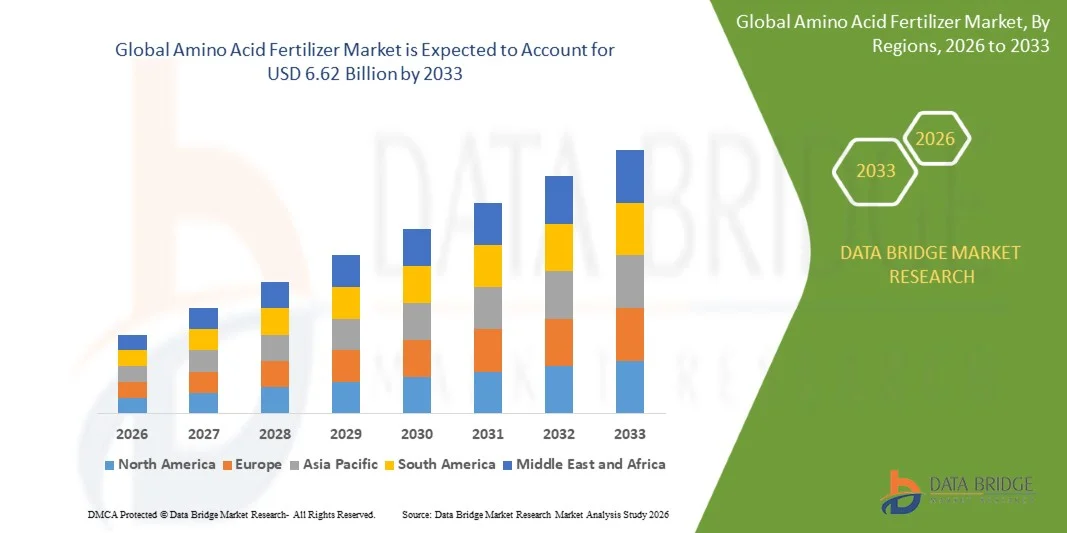
- As per Data Bridge Market Research analysis, the amino acid fertilizer market was valued at USD 3.50 billion in 2025 and is projected to reach USD 6.62 billion by 2033, growing at a CAGR of 8.30% from 2026 to 2033.
- The market is experiencing consistent growth driven by rising demand for sustainable agricultural inputs, increasing adoption of bio-based fertilizers, and growing awareness of amino acid fertilizers’ ability to improve nutrient uptake, crop quality, and plant stress tolerance.
- The increasing focus on soil health, efficient nutrient utilization, and sustainable farming practices, combined with rising global food requirements, is encouraging farmers to adopt amino acid fertilizers. These products can support crop development while helping reduce reliance on conventional nitrogen and urea applications, while continued research into natural and organic fertilizer formulations is creating additional opportunities for market player
Market Size & Forecast
- Global Market Value (2025): USD 3.50 Billion
- Expected Market Value (2033): USD 6.62 Billion
- Forecast CAGR (2026–2033): 8.30%
- Leading Region in 2025: North America
- Fastest Growing Region: Asia Pacific
What are the Major Takeaways of the Amino Acid Fertilizer Market?
- North America dominated the global amino acid fertilizer market with the largest revenue share of 37.75% in 2025, supported by advanced agricultural practices, strong demand for specialty fertilizers, and increasing adoption of sustainable crop-nutrition solutions.
- Asia-Pacific is expected to be the fastest-growing region at a CAGR of 9.6% from 2026 to 2033, fueled by expanding agricultural production, increasing adoption of modern farming practices, and rising demand for efficient crop-nutrition solutions.
- The amino acid blend fertilizers segment led the market with a 35.0% share in 2025, driven by its broad applicability across multiple crops and farming systems
- Amino acid chelate fertilizers are the fastest-growing product type, projected to register a CAGR of 9.0%, reflecting the surge in demand for improved micronutrient availability and more efficient nutrient uptake
- The plant-based segment dominated the source category with a 62.0% revenue share in 2025, led by its growing demand for sustainable and bio-based agricultural inputs.
- Liquid formulated fertilizers accounted for 52.3% of the market share in 2025, preferred by commercial growers and farmers due to their easy application, rapid nutrient availability, and compatibility with foliar spraying and fertigation systems.
- The horticulture & gardening segment is the fastest-growing crop type category, with a CAGR of 9.2%, driven by the expansion of greenhouse farming, protected cultivation, ornamental production, and intensive gardening practices
Report Scope and Amino Acid Fertilizer Market Segmentation
|
Attributes |
Amino Acid Fertilizer Key Market Insights |
|
Segments Covered |
|
|
Countries Covered |
North America
Europe
Asia-Pacific
Middle East and Africa
South America
|
|
Key Market Players |
|
|
Market Opportunities |
|
|
Value Added Data Infosets |
In addition to the insights on market scenarios such as market value, growth rate, segmentation, geographical coverage, and major players, the market reports curated by the Data Bridge Market Research also include import export analysis, production capacity overview, production consumption analysis, price trend analysis, climate change scenario, supply chain analysis, value chain analysis, raw material/consumables overview, vendor selection criteria, PESTLE Analysis, Porter Analysis, and regulatory framework. |
What is the Key Trend in the Amino Acid Fertilizer Market?
- The amino acid fertilizer market is increasingly shifting toward biostimulant-based crop nutrition, as farmers seek solutions that improve nutrient-use efficiency, crop quality, and tolerance to drought, heat, and other environmental stresses while complementing conventional fertilizers.
- For instance, in May 2025, an article published in Discover Agriculture highlighted the increasing use of amino acids as plant biostimulants, noting their role in improving photosynthesis, antioxidant activity, crop growth, and resistance to abiotic stress, supporting the shift toward amino-acid-based crop nutrition.
- Plant-derived amino acids and protein hydrolysates are gaining traction as manufacturers focus on naturally sourced inputs that can support sustainable farming, improve plant metabolism, and provide crops with readily available organic compounds.
- Commercial formulations are increasingly combining amino acids with other biostimulant ingredients, including seaweed extracts, humic substances, vitamins, and beneficial microorganisms, creating multifunctional products designed to address several crop-development requirements simultaneously.
- For instance, in October 2025, a research article published in Discover Applied Sciences found that foliar application of commercial amino acid biostimulants significantly improved potato nutrient uptake and tuber quality; the plant-based amino acid treatment increased total soluble solids from 18.12% to 28.20% and produced the highest tuber yield among the tested treatments.
- Foliar application and fertigation are gaining importance because amino acid formulations can be delivered directly through leaves or irrigation systems, enabling targeted nutrient supplementation during critical crop-growth stages and periods of environmental stress.
What are the Key Drivers of the Amino Acid Fertilizer Market?
- The growing emphasis on sustainable agriculture and nutrient-use efficiency is increasing demand for amino acid fertilizers and biostimulants that complement conventional fertilizers while improving crop performance, nutrient absorption, and tolerance to abiotic stresses.
- For instance, in May 2025, Mosaic Biosciences launched Neptunion in China, a biostimulant added to water-soluble fertilizers to help crops withstand drought, salinity, and heat while improving nutrient-use efficiency and crop performance, demonstrating growing industry investment in stress-resilient crop nutrition.
- Increasing pressure to maintain agricultural productivity while managing soil health, water availability, fertilizer efficiency, and climate-related crop stress is encouraging growers to integrate amino acid-based products into broader crop-nutrition programs.
- Agricultural technology providers are also developing specialized biostimulant formulations and application technologies, allowing amino acid products to be integrated with foliar spraying, fertigation, seed treatment, and fertilizer-coating programs for more targeted crop nutrition.
- For instance, in August 2025, Bayer introduced Yoalo, a biological seed-treatment solution designed to improve plant access to nutrients and strengthen crop performance, reflecting the increasing integration of biological and biostimulant technologies into modern crop-nutrition programs
- With growers increasingly prioritizing resource-efficient crop production and resilient farming systems, continued investment in biologicals, specialty fertilizers, and amino-acid-based formulations is expected to strengthen demand for these products across high-value and commercial crops.
Which Factors are Challenging the Growth of the Amino Acid Fertilizer Market?
- Amino acid fertilizers generally involve higher production costs than conventional fertilizers because fermentation or hydrolysis processes require specialized equipment, processing technologies, and carefully controlled raw materials, creating pricing challenges in cost-sensitive agricultural markets.
- For instance, in July 2026, India’s Ministry of Chemicals and Fertilizers reported that geopolitical disruptions during 2025–26 increased fertilizer supply-chain costs, including higher freight and insurance expenses, shipment delays, and greater landed costs for imported fertilizer raw materials, demonstrating how external cost pressures can affect agricultural-input pricing.
- Raw-material and amino acid price volatility can further pressure manufacturers' margins and final product pricing, particularly when fermentation feedstocks, agricultural commodities, energy, or transportation costs fluctuate significantly across international supply chains.
- Regulatory requirements can also increase market-entry complexity because biostimulant and fertilizer products must satisfy different efficacy, safety, composition, labeling, and registration requirements across countries and regions.
- Limited farmer awareness and inconsistent understanding of amino acid fertilizer benefits remain a restraint, particularly in developing agricultural markets where growers may prioritize conventional fertilizers because of familiarity, established distribution networks, and clearer short-term cost comparisons.
- For instance, in September 2025, the Government of India highlighted that biostimulants had been brought under the Fertilizer Control Order (FCO), requiring regulation of product quality; such regulatory requirements can increase compliance obligations for manufacturers of amino-acid-based biostimulants and fertilizers.
- Variability in product composition and field performance can also constrain adoption, as the effectiveness of amino acid fertilizers depends on the amino acid source, concentration, crop type, application timing, and environmental conditions, making standardized performance and consistent farmer outcomes more difficult to achieve.
How is the Amino Acid Fertilizer Market Segmented?
The amino acid fertilizer market is segmented on the basis of product type, source, form, crop type, and application.
- By Product Type
On the basis of product type, the amino acid fertilizer market is segmented into single amino acid fertilizers, amino acid blend fertilizers, amino acid chelate fertilizers, and amino acid compound fertilizers. The amino acid blend fertilizers segment dominated the product category with an estimated 35.0% market share in 2025, supported by its broad applicability across multiple crops and farming systems. Blended products combine several amino acids and therefore provide more comprehensive support for plant metabolism, nutrient uptake, and stress tolerance. They are widely incorporated into foliar sprays, fertigation programs, and soil-application regimes. Their ability to address multiple crop requirements with one formulation improves convenience for commercial growers.
The amino acid chelate fertilizers segment is projected to be the fastest-growing product category, with an estimated CAGR of 9.0% from 2026 to 2033. Growth is being supported by rising demand for improved micronutrient availability and more efficient nutrient uptake. Amino acid chelation can help maintain nutrients in plant-available forms and is particularly relevant for high-value crops and challenging soil conditions. The segment is benefiting from increasing adoption of precision nutrient-management practices and foliar feeding. Growing use of micronutrient-enriched specialty fertilizers is creating additional opportunities for amino acid chelate formulations. Continued product innovation aimed at improving fertilizer-use efficiency is expected to accelerate the segment's adoption.
- By Source
On the basis of source, the market is segmented into plant-based, animal-based, and synthetic amino acids. The plant-based segment dominated the source category with 62.0% market share in 2025. Plant-derived amino acids are increasingly preferred because they align with growing demand for sustainable and bio-based agricultural inputs. Raw materials such as soy, corn, and wheat provide scalable feedstocks for amino acid production. Their compatibility with sustainable and environmentally conscious farming practices is encouraging adoption across commercial agriculture. Increasing attention to soil health and reduced dependence on conventional chemical inputs is further strengthening the segment. Plant-based formulations are therefore expected to retain their leading position in the source category.
The synthetic amino acid segment is expected to register the fastest growth, with an estimated CAGR of 8.8% from 2026 to 2033. Synthetic production provides manufacturers with greater control over amino acid concentration, purity, and formulation consistency. This characteristic is valuable for specialty products requiring precisely defined compositions and predictable performance. Increasing demand for customized crop-nutrition products is creating opportunities for synthetic amino acids. They can also be incorporated into specialized chelated and compound fertilizer formulations. Growing investment in precision agriculture is increasing demand for products with consistent and measurable nutrient characteristics.
- By Form
On the basis of form, the market is segmented into liquid formulated fertilizers and dry formulated fertilizers. The liquid formulated fertilizers segment dominated the market with 52.3% share in 2025, according to recent market estimates. Liquid products are widely preferred because they can be rapidly distributed through foliar spraying, drip irrigation, and fertigation systems. Their compatibility with water-soluble fertilizers allows growers to combine amino acids with other crop-nutrition inputs. Liquid formulations are especially suitable for horticulture, greenhouse farming, and precision agriculture where accurate dosing is important. Ease of application and relatively rapid nutrient availability further support adoption. Expansion of irrigation infrastructure and precision nutrient management is expected to maintain the segment's market leadership.
The dry formulated fertilizers segment is projected to be the fastest-growing form, with an estimated CAGR of 7.8% from 2026 to 2033. Recent market assessments indicate that powder formulations are benefiting from lower transportation costs, longer shelf life, and high nutrient concentration. Dry formulations are easier to store and transport over long distances, making them particularly attractive in developing agricultural markets. They can also be blended with other dry fertilizers, improving their integration into conventional fertilizer programs. Advances in powder and dry-formulation technologies are enhancing dispersibility and application efficiency. These logistical and cost advantages are expected to drive faster growth of dry amino acid fertilizer products.
- By Crop Type
On the basis of crop type, the market is segmented into cereals & grains, fruits & vegetables, oilseeds & pulses, horticulture & gardening, turf & ornamentals, and others. The fruits & vegetables segment dominated the crop category with 45.0% market share in 2025 in recent market estimates. Fruits and vegetables have comparatively high nutrient requirements and high economic value per hectare, making growers more willing to adopt specialty fertilizers. Amino acid products are used to support nutrient uptake, crop quality, fruit development, and tolerance to environmental stresses. Intensive cultivation and greenhouse production also encourage frequent and targeted nutrient applications. The increasing use of foliar feeding and fertigation in commercial horticulture further strengthens demand.
The horticulture & gardening segment is projected to be the fastest-growing crop-type category, with an estimated CAGR of 9.2% from 2026 to 2033. Growth is being supported by the expansion of greenhouse farming, protected cultivation, ornamental production, and intensive gardening practices. These systems rely heavily on precise nutrient management and therefore provide favorable conditions for amino acid fertilizer adoption. Horticultural growers can use amino acid products to support plant vigor, flowering, fruit formation, and resistance to environmental stress. Increasing consumer demand for high-quality and sustainably produced horticultural products is creating additional momentum. The relatively high value of specialty crops also improves the economic justification for premium crop-nutrition products.
- By Application
On the basis of application, the market is segmented into horticulture, crops, and others. The crops segment dominated the application category with 60.0% market share in 2025. The segment includes broad-acre applications across cereals, grains, oilseeds, pulses, and other major agricultural crops. Amino acid fertilizers are increasingly incorporated into crop-nutrition programs to support nutrient-use efficiency, plant development, and resistance to drought and salinity. The enormous global cultivated area associated with field crops provides a substantial volume opportunity for fertilizer manufacturers. Increasing food requirements are also encouraging growers to improve yields and optimize fertilizer utilization. Consequently, crop applications remain the largest application category in the global amino acid fertilizer market.
The horticulture segment is projected to be the fastest-growing application segment, with an estimated CAGR of 8.9% from 2026 to 2033. driven by rising demand for high-quality and residue-conscious fruits and vegetables. The segment is benefiting from increasing adoption of greenhouse cultivation, precision irrigation, and controlled-environment agriculture. Amino acid fertilizers are particularly suitable for these systems because application rates and timing can be closely controlled. Premium horticultural crops also provide higher returns from improvements in yield, quality, appearance, and stress tolerance. Growing sustainability requirements and demand for specialized crop nutrition are creating additional opportunities.
Which Region Holds the Largest Share of the Amino Acid Fertilizer Market?
- North America dominated the global amino acid fertilizer market with the largest revenue share of 37.75% in 2025, supported by advanced agricultural practices, strong demand for specialty fertilizers, and increasing adoption of sustainable crop-nutrition solutions.
- The region also benefits from large-scale commercial farming, expanding precision agriculture, strong demand for high-value crops, and increasing adoption of amino acid-based biostimulants in the U.S. and Canada. The United States represents the major market within North America, supported by technologically advanced agriculture and growing emphasis on improving crop productivity, nutrient efficiency, and resilience to climate-related stresses.
U.S. Amino Acid Fertilizer Market Insight
The U.S. amino acid fertilizer market is witnessing steady growth due to rising demand for sustainable crop nutrition, improved nutrient-use efficiency, and biological agricultural inputs. The country’s advanced commercial farming ecosystem, along with increasing adoption of precision agriculture and specialty fertilizers, is driving demand for amino acid-based formulations across major crops. In addition, amino acid biostimulants are increasingly recognized for supporting nutrient uptake and plant stress resilience, strengthening their adoption across U.S. agricultural applications.
Asia-Pacific Amino Acid Fertilizer Market Insight
The Asia-Pacific amino acid fertilizer market is expected to witness rapid growth, driven by extensive agricultural production, rising food requirements, and increasing adoption of water-soluble and specialty crop-nutrition products across countries such as China, India, and Japan. Growing awareness regarding fertilizer-use efficiency, expanding horticultural cultivation, and increasing adoption of modern irrigation systems are supporting regional market expansion. In addition, research indicates that amino-acid-containing water-soluble fertilizers are already used across food crops, vegetables, fruits, and cash crops in China, supporting wider regional adoption.
Japan Amino Acid Fertilizer Market Insight
The Japan amino acid fertilizer market is witnessing consistent growth due to increasing emphasis on sustainable agriculture, soil health, and efficient crop nutrition. Agricultural organizations and input suppliers are increasingly exploring amino acid-based biostimulants to improve nutrient-use efficiency and strengthen crop tolerance to environmental stresses. Moreover, in March 2026, Japan’s Ministry of Agriculture, Forestry and Fisheries highlighted an Ajinomoto biostimulant based on AminoScience that uses amino-acid manufacturing by-products as fertilizer and supports nutrient-use efficiency and stress tolerance, demonstrating the country’s focus on circular and sustainable agricultural inputs.
China Amino Acid Fertilizer Market Insight
The China amino acid fertilizer market is growing rapidly, driven by extensive crop cultivation, increasing demand for higher agricultural productivity, and expanding utilization of specialized crop-nutrition products. Growing adoption of amino-acid-containing water-soluble fertilizers across food crops, vegetables, fruits, and cash crops is significantly supporting market demand. In addition, China's agricultural amino acid market continues to attract commercial interest, with amino acid products covering lysine, methionine, glutamic acid, leucine, valine, arginine, glycine, and other formulations. Increasing emphasis on efficient fertilizer application and modern crop-management practices is positioning China as a major growth market in the region.
U.K. Amino Acid Fertilizer Market Insight
The U.K. amino acid fertilizer market is experiencing steady growth, supported by increasing awareness of sustainable agriculture, growing adoption of biostimulants, and greater emphasis on improving nutrient-use efficiency and crop resilience. Farmers are increasingly incorporating amino acid-based products into crop-nutrition programs, particularly where stress tolerance and efficient nutrient uptake are important. Furthermore, the U.K. agricultural sector has established guidance and regulatory frameworks for plant biostimulants, while agricultural research has demonstrated the potential of amino acid-based biostimulants in intensive horticultural production.
Germany Amino Acid Fertilizer Market Insight
The Germany amino acid fertilizer market is expanding steadily due to the country’s focus on sustainable agricultural practices, efficient nutrient management, and wider adoption of biological crop-input technologies. Farmers are increasingly evaluating amino acid-based biostimulants to improve nutrient uptake, crop quality, and tolerance to environmental stresses while optimizing fertilizer use. Continuous development of biological crop-nutrition products and increasing interest in lower-impact agricultural inputs are further supporting market growth. Germany’s broader European agricultural environment, where biostimulants are increasingly assessed for nutrient-use efficiency, stress tolerance, and crop-quality benefits, is creating a favorable environment for amino acid-based fertilizer adoption.
Which are the Top Companies in Amino Acid Fertilizer Market?
The amino acid fertilizer industry is primarily led by well-established companies, including:
- Biolchim SPA (Italy)
- Haifa Negev technologies LTD (Israel)
- COMPO EXPERT GmbH (Germany)
- ICL (Israel)
- Bioiberica S.A.U. (Spain)
- Fertinagro Biotech, S.L. (Spain)
- TIMAC AGRO International SAS (France)
- Ajinomoto Healthy Supply Co., Inc. (Japan)
- Qingdao Seawin Biotech Group Co., Ltd. (China)
- Beijing Leili Agricultural Chemicals Co., Ltd. (China)
- Jinchengda Ecological Engineering Group Co., Ltd (China)
- Aries Agro Limited (India)
- Coromandel International Ltd. (India)
- Zuari FarmHub Limited (India)
- OMEX Agriculture Limited (U.K.)
- Futureco Bioscience S.A. (Spain)
- Humintech GmbH (Germany)
- Gowan Company (U.S.)
- TAGROW CO., LTD. (China)
- Chengdu Chelation Biology Technology Co., Ltd. (China)
What are Latest Developments in Amino Acid Fertilizer Market?
- In May 2025, ADOB, a Polish specialty fertilizer producer, announced two new calcium nitrate products, including a formulation containing glycine, an amino acid used as a biostimulant. The new calcium nitrate product contains 0.5% glycine and was developed for both root and foliar applications, with trial results presented showing improvements in plant chlorophyll and nitrogen status. The launch demonstrates the integration of amino acids directly into specialty fertilizer formulations to improve crop nutrition and plant performance.
- In January 2025, Arevo announced the market introduction of Arevo Booster for soy, its first commercial agricultural product based on an amino acid. The seed-treatment biostimulant uses arginine as an organic nitrogen source and is designed to improve early soybean establishment and nutrient-use efficiency while reducing nitrogen losses. Arevo reported that field trials showed an 8% improvement in plant quality and 7% improvement in plant development compared with standard methods.
- In November 2023, Veratin Limited launched Verigrow Supplement, expanding its amino-acid-rich liquid fertilizer portfolio. The new product combines macro- and micronutrients with the company’s existing amino-acid-rich fertilizer technology and was developed as a complementary crop-nutrition solution. Veratin stated that its existing nitrogen fertilizer was primarily amino-acid rich and that the amino acids could reduce the requirement for high levels of phosphorus and potassium.
- In March 2022, Sipcam Nichino Brazil launched Stilo Verde, an amino-acid-based biostimulant for agricultural crops. The formulation combines amino acids with nutrients and was introduced for use across a broad range of crops to improve plant vigor, physiological activity, photosynthetic capacity, and resistance to environmental stresses. The launch reflects increasing commercialization of amino-acid-based crop-nutrition products in major agricultural markets.
- In December 2021, Bayer launched Ambition in China as its first amino-acid-based biostimulant for the Chinese market. The product contains amino acids and fulvic acids and was developed to support crop growth, photosynthesis, fruit setting, nutrient efficiency, and tolerance to abiotic stress. Bayer positioned Ambition® as a crop supplement suitable for sustainable and organic farming systems, marking a significant commercial launch by a major agricultural-input company.

- Interactive Data Analysis Dashboard
- Company Analysis Dashboard for high growth potential opportunities
- Research Analyst Access for customization & queries
- Competitor Analysis with Interactive dashboard
- Latest News, Updates & Trend analysis
- Harness the Power of Benchmark Analysis for Comprehensive Competitor Tracking
Data collection and base year analysis are done using data collection modules with large sample sizes. The stage includes obtaining market information or related data through various sources and strategies. It includes examining and planning all the data acquired from the past in advance. It likewise envelops the examination of information inconsistencies seen across different information sources. The market data is analysed and estimated using market statistical and coherent models. Also, market share analysis and key trend analysis are the major success factors in the market report. To know more, please request an analyst call or drop down your inquiry.
The key research methodology used by DBMR research team is data triangulation which involves data mining, analysis of the impact of data variables on the market and primary (industry expert) validation. Data models include Vendor Positioning Grid, Market Time Line Analysis, Market Overview and Guide, Company Positioning Grid, Patent Analysis, Pricing Analysis, Company Market Share Analysis, Standards of Measurement, Global versus Regional and Vendor Share Analysis. To know more about the research methodology, drop in an inquiry to speak to our industry experts.
Data Bridge Market Research is a leader in advanced formative research. We take pride in servicing our existing and new customers with data and analysis that match and suits their goal. The report can be customized to include price trend analysis of target brands understanding the market for additional countries (ask for the list of countries), clinical trial results data, literature review, refurbished market and product base analysis. Market analysis of target competitors can be analyzed from technology-based analysis to market portfolio strategies. We can add as many competitors that you require data about in the format and data style you are looking for. Our team of analysts can also provide you data in crude raw excel files pivot tables (Fact book) or can assist you in creating presentations from the data sets available in the report.