What is the Amino Acid Based Biostimulants Market Size and Growth Rate?
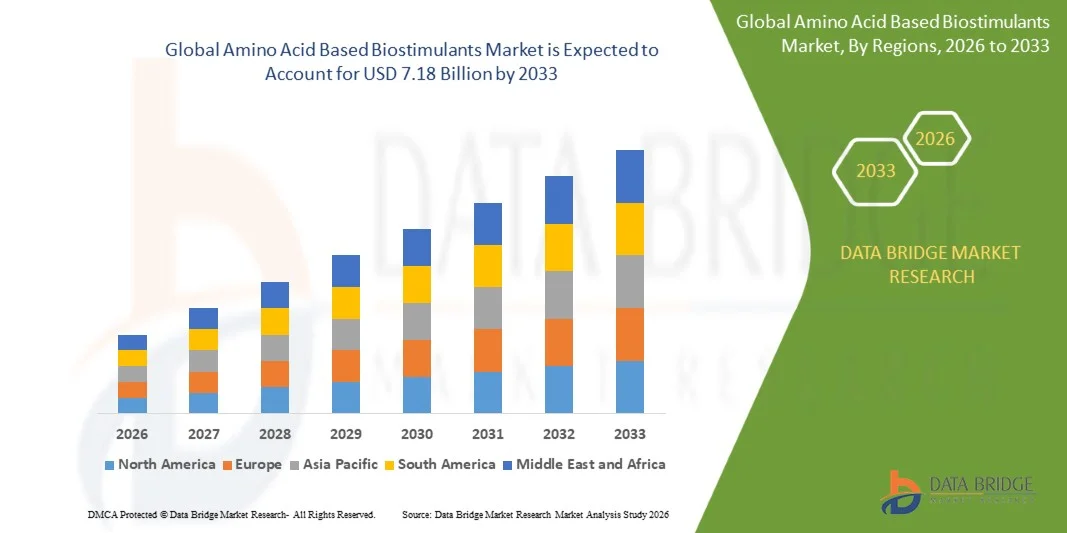
- As per Data Bridge Market Research analysis, the amino acid based biostimulants market was valued at USD 2.80 billion in 2025 and is projected to reach USD 7.18 billion by 2033, growing at a CAGR of 12.50% from 2026 to 2033.
- The market is experiencing significant growth driven by growing awareness of sustainable agricultural practices, rising demand for superior crop quality, the need to improve crop productivity, and advancements in biostimulant formulations and increased research and development efforts.
- The expanding adoption of amino acid-based biostimulants across diverse crop types and geographical regions, together with increasing demand for sustainable agricultural solutions, is further supporting market growth. Amino acid-based biostimulants are increasingly being used to improve crop productivity and quality while supporting more sustainable farming practices. The increasing need for sustainable agricultural production, combined with pressure to reduce dependence on synthetic fertilizers and improve crop resilience against drought, salinity, heat, and other environmental stresses, is supporting adoption of amino acid-based biostimulants.
Market Size & Forecast
- Global Market Value (2025): USD 2.80 Billion
- Expected Market Value (2033): USD 7.18 Billion
- Forecast CAGR (2026–2033): 12.50%
- Leading Region in 2025: North America
- Fastest Growing Region: Asia Pacific
What are the Major Takeaways of the Amino Acid Based Biostimulants Market?
- North America dominated the amino acid based biostimulants market with 36.4% of the market share in 2025, supported by large-scale agricultural production, increasing adoption of amino acid biostimulants to improve nitrogen-use efficiency, and growing demand for sustainable farming practices.
- Asia-Pacific is expected to be the fastest-growing region at a CAGR of 16.92% from 2026 to 2033, fueled by increasing demand for sustainable agriculture and the adoption of biostimulants to improve crop yield and productivity.
- The cereals & grains segment led the market with a 42.0% share in 2025, driven by the extensive cultivation of wheat, rice, corn, barley, and other major cereal crops
- Fruits & vegetables are the fastest-growing crop type, projected to register a CAGR of 19.11%, reflecting the surge in demand for high-quality horticultural produce and greater adoption of biostimulants.
- The foliar treatment segment dominated the application method category with a 42.5% revenue share in 2025, led by rapid nutrient delivery and direct application of amino acids to plant foliage.
- Liquid accounted for 68.3% of the market share in 2025, preferred by its ease of application, rapid plant uptake, and compatibility with spraying and fertigation systems.
- The synthetic biostimulants segment is the fastest-growing origin category, with a CAGR of 15.66%, driven by increasing demand for standardized formulations and growing adoption of technologically advanced biostimulant products in commercial agriculture.
Report Scope and Amino Acid Based Biostimulants Market Segmentation
|
Attributes |
Amino Acid Based Biostimulants Key Market Insights |
|
Segments Covered |
|
|
Countries Covered |
North America
Europe
Asia-Pacific
Middle East and Africa
South America
|
|
Key Market Players |
|
|
Market Opportunities |
|
|
Value Added Data Infosets |
In addition to the insights on market scenarios such as market value, growth rate, segmentation, geographical coverage, and major players, the market reports curated by the Data Bridge Market Research also include import export analysis, production capacity overview, production consumption analysis, price trend analysis, climate change scenario, supply chain analysis, value chain analysis, raw material/consumables overview, vendor selection criteria, PESTLE Analysis, Porter Analysis, and regulatory framework. |
What is the Key Trend in the Amino Acid Based Biostimulants Market?
- Amino acid-based biostimulants are increasingly being adopted for sustainable crop production, as they can improve crop yield, plant growth, nutrient-use efficiency, and tolerance to drought, salinity, and other environmental stresses.
- For instance, in June 2024, research published in the Journal of Sustainable Agriculture and Environment found that Vitalnova Prime, an amino acid- and peptide-based biostimulant, applied as a foliar spray in soilless strawberry cultivation increased the number of marketable fruits by 55% and average fruit weight by 56% in the ‘Malling Ace’ cultivar compared with the control.
- Foliar application is emerging as a particularly important trend, because amino acids applied directly to plant foliage can promote photosynthesis, chlorophyll synthesis, nutrient assimilation, and protection against oxidative stress.
- Protein hydrolysate-based formulations are gaining attention as amino acid-rich biostimulants, with research identifying their potential to improve crop productivity, plant resilience, nutrient uptake, root development, and tolerance to adverse environmental conditions.
- The market is also moving toward application in high-value horticultural crops and controlled-environment agriculture, where amino acid biostimulants can support crop growth and productivity while reducing reliance on conventional agricultural inputs.
- For instance, in October 2025, research published in Discover Applied Sciences reported that foliar application of commercial amino acid biostimulants significantly enhanced nutrient uptake and potato tuber quality, with plant-based amino acid biostimulants increasing total soluble solids from 18.12% to 28.20% and starch content from 21.36% to 23.93%.
- As farmers increasingly prioritize efficient nutrient management and climate-resilient crop production, amino acid-based biostimulants are expected to become an increasingly important component of integrated crop nutrition and sustainable agricultural practices
What are the Key Drivers of the Amino Acid Based Biostimulants Market?
- The growing need for sustainable agricultural practices and improved nutrient-use efficiency is increasing demand for amino acid-based biostimulants that can enhance crop productivity while supporting reductions in excessive fertilizer use and associated environmental impacts.
- For instance, in January 2024, research published in Plants reported that amino acid-based biostimulants and protein hydrolysates can improve nutrient-use efficiency, crop performance, root development, and tolerance to drought and salt stress, supporting their adoption as sustainable agricultural inputs.
- Climate change, drought, salinity, and other abiotic stresses are encouraging farmers to adopt biostimulants that can improve plant resilience, stimulate antioxidant activity, and maintain crop performance under unfavorable environmental conditions.
- Increasing demand for higher crop yields and quality is encouraging the use of amino acids and protein hydrolysates, which research associates with improved plant growth, photosynthetic activity, nutrient assimilation, root development, and crop quality.
- The expansion of foliar treatment is supporting market growth, as amino acids can be rapidly delivered to plant tissues and have demonstrated effects on photosynthesis, chlorophyll production, antioxidant activity, and stress tolerance.
- For instance, in August 2024, research published in BMC Plant Biology found that amino acid biostimulant treatment increased lettuce yield by 34% under 50 mM salt stress, while biostimulant applications also improved nutrient uptake by 15–109%, demonstrating their potential to maintain crop productivity under water and salinity-related stresses.
- With agriculture increasingly focused on higher productivity, efficient nutrient utilization, and resilience against climate-related stresses, amino acid-based biostimulants are expected to remain an important input for sustainable crop production and integrated plant nutrition.
Which Factors are Challenging the Growth of the Amino Acid Based Biostimulants Market?
- Variability in the composition and biological activity of commercial biostimulants remains a major challenge, as differences in raw materials and manufacturing processes can produce inconsistent results across crops, environments, and application conditions.
- For instance, in June 2023, a study published in the International Journal of Molecular Sciences reported that protein hydrolysates have variable composition depending on the raw-material source and production process, while excessive uptake of free amino acids can sometimes cause intracellular amino-acid imbalance, inhibition of nitrate uptake, and growth suppression in horticultural crops, highlighting the challenge of achieving consistent product efficacy.
- The absence of fully harmonized characterization and quality-control practices makes it difficult to compare products, reproduce research findings, establish consistent efficacy, and build confidence among farmers and agricultural users.
- Regulatory requirements can also restrict product development and market access, particularly for protein hydrolysates derived from animal by-products, because manufacturers must demonstrate product identity, safety, composition, efficacy, and compliance with applicable standards.
- For instance, in December 2025, a study published in Discover Agriculture reported that biostimulant efficacy can vary substantially across crops, environmental conditions, and application methods, while differences in raw-material composition and the lack of standardized testing protocols make it difficult to establish consistent application rates and efficacy benchmarks.
- These composition, efficacy, quality-control, and regulatory challenges can increase product-development requirements and create uncertainty for manufacturers, particularly where biostimulant performance varies according to formulation, crop, dose, application method, and environmental conditions.
How is the Amino Acid Based Biostimulants Market Segmented?
The amino acid based biostimulants market is segmented on the basis of crop type, application method, form, origin, end user, and distribution channel.
- By Crop Type
On the basis of crop type, the global amino acid based biostimulants market is segmented into fruits & vegetables, cereals & grains, oilseeds & pulses, turf & ornamentals, and other crops. the cereals & grains segment dominated the market with 42.0% share in 2025, supported by the extensive cultivation of wheat, rice, corn, barley, and other major cereal crops. Amino acid-based biostimulants are increasingly applied to improve crop productivity, nutrient utilization, and tolerance to environmental stresses. The large cultivated area under cereals and grains provides a substantial application base for biostimulant products. Growing pressure to increase agricultural output from existing farmland is further encouraging adoption. Consequently, cereals and grains represent the largest crop-type opportunity in the global market.
The fruits & vegetables segment is projected to be the fastest-growing crop-type segment, registering 19.11% CAGR from 2026 to 2033, driven by increasing demand for high-quality horticultural produce and greater adoption of biostimulants. Fruits and vegetables require intensive nutrient management and are particularly suitable for specialized biostimulant applications. Amino acids and protein hydrolysates can support plant growth, photosynthesis, nutrient assimilation, root development, and tolerance to abiotic stresses. The higher economic value of horticultural crops also provides farmers with greater incentives to use productivity-enhancing inputs. Increasing emphasis on sustainable horticultural production is creating further opportunities. Therefore, fruits and vegetables are expected to expand faster than the other crop categories.
- By Application Method
On the basis of application method, the market is segmented into foliar treatment, soil treatment, and seed treatment. The foliar treatment segment dominated the market with 42.5% share in 2025, owing to rapid nutrient delivery and direct application of amino acids to plant foliage. Foliar treatment allows biostimulants to be applied at specific crop growth stages according to plant requirements. Amino acids delivered through foliage can support nutrient assimilation, photosynthetic activity, chlorophyll production, and stress tolerance. The method is particularly suitable for fruits, vegetables, cereals, and specialty crops. Compatibility with existing agricultural spraying programs further reduces adoption barriers. These characteristics continue to make foliar treatment the leading application method globally.
The soil treatment segment is projected to register the fastest growth at a CAGR of 18.2% from 2026 to 2033, supported by increasing emphasis on improving soil health, nutrient availability, root development, and overall soil fertility. Amino acid-based biostimulants applied to soil can interact with the root zone and support nutrient uptake and plant development. Increasing adoption of sustainable soil-management practices is encouraging farmers to use biological inputs alongside conventional fertilizers. Soil application is also gaining importance in large-scale agricultural production where improving nutrient-use efficiency is a major objective. Growing concerns regarding soil degradation and declining soil fertility are creating additional opportunities for soil-applied biostimulants. Consequently, increasing focus on healthy soils and efficient nutrient management is expected to accelerate the growth of the soil treatment segment.
- By Form
On the basis of form, the market is segmented into liquid and dry. The liquid segment dominated the market with 68.3% share in 2025, supported by its ease of application, rapid plant uptake, and compatibility with spraying and fertigation systems. Liquid formulations can be incorporated into established agricultural application programs. They also provide flexibility in adjusting dosage according to crop requirements and growth stages. Amino acid liquids can deliver bioavailable compounds directly to plant tissues or the root zone. Compatibility with tank-mixing and other agricultural inputs further supports their use. These characteristics make liquid formulations the leading form in the global amino acid based biostimulants market.
The dry segment is projected to be the fastest-growing form growing at a CAGR of 18.6% from 2026 to 2033. Dry formulations offer advantages including longer shelf life, lower transportation requirements, and easier storage. They can also be suitable for seed treatment and soil applications in broad-acre farming systems. Increasing demand for products that reduce logistics and storage costs can support dry-form adoption. Improvements in formulation technology are also enhancing the stability and application characteristics of dry biostimulants. Therefore, the dry segment provides a growth opportunity while liquid remains the dominant form.
- By Origin
On the basis of origin, the market is segmented into natural biostimulants and synthetic biostimulants. The natural biostimulants segment dominated the market with 69.4% share in 2025, supported by increasing preference for sustainable agricultural inputs and naturally derived crop-management solutions. Natural biostimulants can include amino acids and protein hydrolysates derived from plant and animal sources. They are increasingly used to support plant growth, nutrient utilization, and tolerance to environmental stresses. Growing consumer interest in sustainable and environmentally responsible food production is also supporting adoption. Regulatory and agricultural interest in naturally derived inputs provides an additional advantage. Consequently, natural biostimulants represent the leading origin category.
The synthetic biostimulants segment is projected to be the fastest-growing origin category, at 15.66% CAGR from 2026 to 2033. Synthetic formulations benefit from standardized composition, controlled dosage, and reproducible product characteristics. These characteristics are particularly relevant for commercial agricultural operations seeking consistent crop-management results. Synthetic amino acid formulations can also be developed with specific nutrient combinations and targeted performance characteristics. Growing demand for standardized agricultural inputs is creating opportunities for this segment. Therefore, synthetic biostimulants can experience faster expansion even though natural biostimulants retain the larger market position.
- By End User
On the basis of end user, the market is segmented into farmers, related industries, and research institutes. The farmers segment dominated the market, with an indicative share of 55.60%, reflecting the direct use of amino acid-based biostimulants in crop production. Farmers apply these products to improve crop productivity, nutrient assimilation, plant growth, and tolerance to environmental stresses. Increasing awareness of biostimulant benefits is encouraging their incorporation into crop nutrition programs. The products can be applied through foliar, soil, and seed-treatment methods. Increasing pressure to improve yields while maintaining sustainable production is further supporting adoption. Farmers therefore represent the principal end-user group for amino acid-based biostimulants.
The related industries segment is expected to be faster-growing opportunity growing at a CAGR of 13.8% from 2026 to 2033, with demand supported by increasing use of amino acid biostimulants across commercial horticulture, protected cultivation, agricultural input manufacturing, and other professional crop-production activities. Related industries can use these products as part of integrated crop-management and nutrition programs. Increasing commercialization of agriculture is encouraging professional users to adopt specialized inputs. Demand for consistent crop quality and productivity is also supporting utilization. Expansion of greenhouse and controlled-environment production provides additional opportunities for specialized biostimulant formulations. As agricultural value chains become more technology-oriented, related industries are expected to contribute increasingly to market expansion.
- By Distribution Channel
On the basis of distribution channel, the market is segmented into direct and indirect. The indirect segment dominated the market with 72.4% share in 2025, supported by the extensive role of agricultural distributors, dealers, retailers, and other intermediaries. These channels provide manufacturers with access to geographically dispersed farmers and agricultural users. Local distributors can also provide product information and technical guidance. Indirect channels are particularly important in fragmented agricultural markets where manufacturers may not maintain direct sales infrastructure. Established agricultural-input networks improve product accessibility and market penetration. Consequently, indirect distribution remains the leading channel for amino acid-based biostimulants.
The direct segment is projected to be the faster-growing distribution channel growing at a CAGR of 14.5% from 2026 to 2033, supported by increasing procurement by commercial farms, large agricultural operations, and professional agricultural users. Direct sales allow manufacturers to establish closer customer relationships and provide application-specific technical support. Digital agricultural platforms are also creating additional opportunities for direct purchasing. Large-scale users can benefit from bulk procurement and long-term supply arrangements. Direct channels also provide manufacturers with greater control over product positioning and customer feedback. Increasing commercialization and professionalization of agriculture are therefore expected to support faster expansion of direct distribution.
Which Region Holds the Largest Share of the Amino Acid Based Biostimulants Market?
- North America dominated the amino acid based biostimulants market with 36.4% of the market share in 2025, supported by large-scale agricultural production, increasing adoption of amino acid biostimulants to improve nitrogen-use efficiency, and growing demand for sustainable farming practices.
- The region also benefits from growing demand for sustainable farming practices, increasing emphasis on crop-yield optimization, and expanding applications of amino acid biostimulants for improving nutrient uptake and plant stress tolerance. The U.S. amino acid-based biostimulants market is particularly strong in commercial agriculture, while greenhouse and controlled-environment agriculture are creating additional opportunities for these products. Increasing concerns regarding soil degradation, changing climatic conditions, and resource efficiency are further supporting adoption.
U.S. Amino Acid Based Biostimulants Market Insight
The U.S. amino acid based biostimulants market is witnessing strong growth due to increasing adoption of sustainable agricultural inputs, rising crop-yield requirements, and growing emphasis on nutrient-use efficiency and plant stress tolerance. The U.S. is the dominant country in North America, accounting for 80.1% of North America's biostimulant formulation-material revenue in 2025, reflecting the country's established agricultural-input industry and technology-driven farming systems. Amino acids are increasingly incorporated into biological agricultural products because they can improve nutrient assimilation, plant growth, and tolerance to abiotic stress. In addition, the U.S.'s advanced agricultural research and established distribution networks are supporting commercialization of amino acid-based formulations.
Asia-Pacific Amino Acid Based Biostimulants Market Insight
The Asia-Pacific amino acid based biostimulants market is expected to witness rapid growth, with the region identified as the fastest-growing market globally, supported by expanding agricultural production, increasing demand for sustainable crop-management practices, and rising adoption of biostimulants in major agricultural economies. China, India, Vietnam, the Philippines, and Indonesia are identified as important emerging markets for amino acid-based biostimulants. Increasing crop productivity requirements and the need to improve nutrient-use efficiency are encouraging adoption. Amino acids can improve nutrient assimilation, root development, and tolerance to drought and salinity, making them relevant to the region's diverse agricultural conditions.
Japan Amino Acid Based Biostimulants Market Insight
The Japan amino acid based biostimulants market is witnessing consistent growth due to the country's focus on advanced agricultural technologies, crop quality, and efficient resource utilization. Japanese agriculture is increasingly incorporating technologies and inputs designed to improve productivity while addressing environmental and climatic stresses. Research on amino acid biostimulants has demonstrated their potential to improve nutrient assimilation, crop quality, and tolerance to abiotic stress. A study on a vegetal amino acid-based biostimulant evaluated its effects on the growth, metabolism, and postharvest performance of kiwifruit, demonstrating the application of amino acid biostimulants in high-value horticulture.
China Amino Acid Based Biostimulants Market Insight
The China amino acid based biostimulants market is growing rapidly, supported by the country's large agricultural production base, increasing demand for crop productivity, and expanding adoption of sustainable agricultural inputs. China is identified as an important emerging market within the Asia-Pacific amino acid-based biostimulants industry. The country's extensive fruit and vegetable production provides a substantial application base for biostimulants. Amino acids are increasingly relevant because they can support nutrient uptake, plant growth, and tolerance to environmental stresses. Research has also established that amino acids can act as organic nitrogen sources and influence physiological processes associated with plant development and stress response, supporting their use in intensive crop production.
U.K. Amino Acid Based Biostimulants Market Insight
The U.K. amino acid based biostimulants market is experiencing steady growth, supported by increasing policy and agricultural interest in plant biostimulants that improve nutrient-use efficiency, abiotic-stress tolerance, and soil nutrient availability. The U.K. government's carbon-budget and growth-delivery plan specifically identifies plant biostimulants as an agricultural measure to promote plant growth and reduce emissions. The country's regulatory framework also recognizes plant biostimulants in relation to plant nutrition and plant/rhizosphere characteristics. These policy developments provide a supportive environment for sustainable agricultural inputs. Increasing interest in resource-efficient crop production is further supporting opportunities for amino acid-based biostimulants.
Germany Amino Acid Based Biostimulants Market Insight
The Germany amino acid based biostimulants market is expanding steadily due to the country's strong agricultural research capabilities, emphasis on sustainable crop production, and increasing interest in alternatives to conventional fertilizer-intensive production. German agricultural research is increasingly examining biological inputs and their ability to improve nutrient efficiency and crop resilience. Research published in Agriculture from field trials in northern Germany highlights the growing interest in alternative fertilization strategies and biostimulants in response to nutrient surpluses associated with intensive agriculture. Amino acids and protein hydrolysates are particularly relevant because research has demonstrated their potential to improve nutrient uptake, crop productivity, and tolerance to abiotic stress. These factors are supporting the development of Germany's sustainable-biostimulant ecosystem.
Which are the Top Companies in Amino Acid Based Biostimulants Market?
The amino acid based biostimulants industry is primarily led by well-established companies, including:
- Bioiberica S.A.U. (Spain)
- Fertinagro Biotech, S.L. (Spain)
- Futureco Bioscience (Spain)
- Horizon Products (Spain)
- AGRO-SORB Sp. z o.o. (Poland)
- PROMISOL S.A. (Spain)
- AGRI NOVA SCIENCE, S.A. (Spain)
- BioAtlantis Ltd. (Ireland)
- ATLÁNTICA AGRÍCOLA (Spain)
- Desarrollo Agrícola y Minero, S.A. (Spain)
- Haifa Negev technologies LTD (Israel)
- ICL (Israel)
- Yara International ASA (Norway)
- AgriTECH.BIO S.R.L. (Italy)
- Valent Agro Pvt. Ltd. (India)
- Chico Crop Science Co., Ltd. (China)
- Cropenta (Spain)
- Tangel Agro (Spain)
- Sowbhagya Biotech Pvt Ltd (India)
- Ajinomoto Co., Inc. (Japan)
What are Latest Developments in Amino Acid Based Biostimulants Market?
- In February 2025, Agrii Polska launched three new foliQ biostimulant formulations foliQ AscoVigor Plus, foliQ AminoVigor Plus, and foliQ TrioPGA following multi-year research into plant physiology and stress responses. The foliQ AminoVigor Plus formulation contains an amino acid complex and is designed for application after a stress event, while the range also incorporates plant-derived bioactive compounds. The launch reflects the development of amino-acid-based biostimulants aimed at helping crops maintain physiological performance under increasingly variable growing conditions.
- In February 2025, Bioiberica launched Terra-Sorb granum, a new biostimulant designed for field crops such as cereals, legumes, oilseeds, and cruciferous crops. The formulation combines L-α-amino acids with sulfur, boron, zinc, and molybdenum to enhance nitrogen and sulfur absorption, crop efficiency, and productivity, particularly under stress conditions. The product was developed to support crop yield and quality while reducing reliance on synthetic nitrogen fertilizers. This launch demonstrates the development of amino-acid-based formulations specifically targeted at extensive field crops.
- In October 2023, Agri Technovation launched the RELEASE LPH range, comprising RELEASE LPH, Cu RELEASE LPH, Mn RELEASE LPH, Zn RELEASE LPH, and ZMC RELEASE LPH. The products combine fulvic acids, amino acids, kelp extracts, and selected nutrients and were developed as soil-revitalization products with biostimulant activity. The launch illustrates the expansion of amino-acid-containing biostimulant formulations into soil-management applications.
- In March 2022, Sipcam Nichino launched Stilo Verde in Brazil, an organomineral biostimulant containing amino acids and nutrients. The product was introduced for use across most crops in Brazil and was positioned to support plant vigor and productivity under environmental stress. According to Sipcam Nichino, field demonstrations showed benefits including heavier maize and soybean grains, higher coffee yield, larger tomato fruits, and an increase in the TCH indicator in sugarcane. The launch demonstrates the commercial expansion of amino-acid-containing biostimulants into major Brazilian crops.
- In January 2021, Syngenta launched Hicure, an amino-acid-based biostimulant for ornamental plants and turf applications. The liquid formulation contains readily absorbed amino acids and peptides designed to improve plant quality and tolerance to environmental stresses such as drought and high temperatures. Hicure® was developed following more than six years of research and contains 18 amino acids together with an immediately available energy source. The launch represented the expansion of amino-acid-based biostimulation into professional turf and ornamental crop management.

- Interactive Data Analysis Dashboard
- Company Analysis Dashboard for high growth potential opportunities
- Research Analyst Access for customization & queries
- Competitor Analysis with Interactive dashboard
- Latest News, Updates & Trend analysis
- Harness the Power of Benchmark Analysis for Comprehensive Competitor Tracking
Data collection and base year analysis are done using data collection modules with large sample sizes. The stage includes obtaining market information or related data through various sources and strategies. It includes examining and planning all the data acquired from the past in advance. It likewise envelops the examination of information inconsistencies seen across different information sources. The market data is analysed and estimated using market statistical and coherent models. Also, market share analysis and key trend analysis are the major success factors in the market report. To know more, please request an analyst call or drop down your inquiry.
The key research methodology used by DBMR research team is data triangulation which involves data mining, analysis of the impact of data variables on the market and primary (industry expert) validation. Data models include Vendor Positioning Grid, Market Time Line Analysis, Market Overview and Guide, Company Positioning Grid, Patent Analysis, Pricing Analysis, Company Market Share Analysis, Standards of Measurement, Global versus Regional and Vendor Share Analysis. To know more about the research methodology, drop in an inquiry to speak to our industry experts.
Data Bridge Market Research is a leader in advanced formative research. We take pride in servicing our existing and new customers with data and analysis that match and suits their goal. The report can be customized to include price trend analysis of target brands understanding the market for additional countries (ask for the list of countries), clinical trial results data, literature review, refurbished market and product base analysis. Market analysis of target competitors can be analyzed from technology-based analysis to market portfolio strategies. We can add as many competitors that you require data about in the format and data style you are looking for. Our team of analysts can also provide you data in crude raw excel files pivot tables (Fact book) or can assist you in creating presentations from the data sets available in the report.