Amla Extracts Market Overview
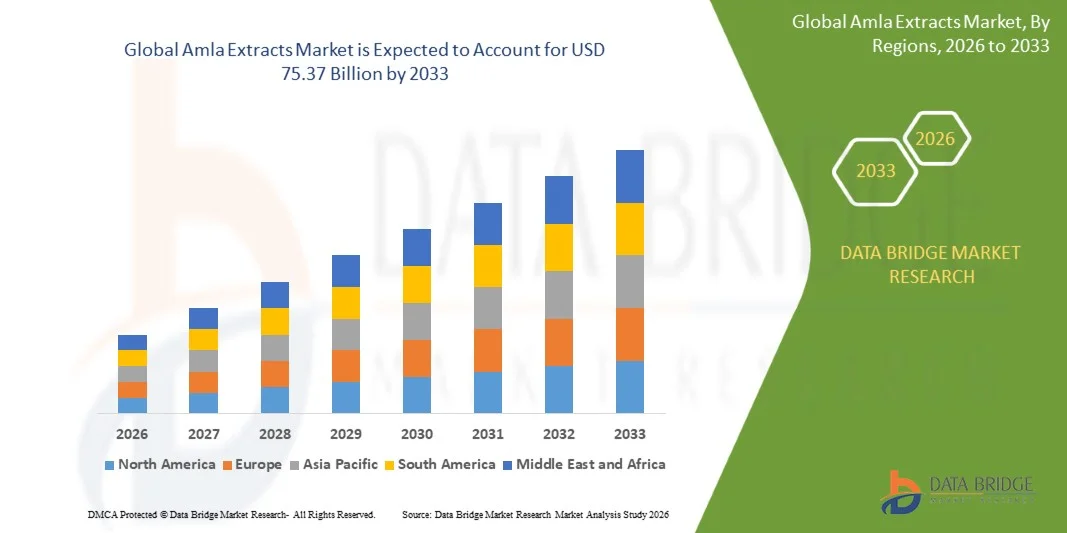
As per Data Bridge Market Research analysis The Amla Extracts Market was valued at USD 48.93 billion in 2025 and is projected to reach USD 75.37 billion by 2033, growing at a CAGR of 5.55% from 2026 to 2033. The market is witnessing steady growth driven by increasing consumer preference for natural and plant-based ingredients, rising awareness of the health benefits of amla (Indian gooseberry), and expanding applications across nutraceuticals, functional foods, cosmetics, and pharmaceuticals.
The growing demand for immunity-boosting and antioxidant-rich products, along with the global shift toward Ayurveda and herbal wellness solutions, is significantly supporting market expansion. In addition, advancements in extraction technologies and increasing incorporation of amla extracts in dietary supplements, skincare formulations, and hair care products are further accelerating adoption across both developed and emerging markets.
Key Market Trends & Insights
- North America dominated the Amla Extracts Market with the largest revenue share of 34.87% in 2025, supported by strong demand for dietary supplements, high consumer awareness of herbal nutraceuticals, and rapid adoption of clean-label health products.
- The Amla Powder segment led the market with a 38.64% share in 2025, driven by its widespread use across nutraceuticals, functional foods, beverages, and traditional herbal formulations.
- Asia-Pacific is expected to be the fastest-growing region at a CAGR of 7.8% from 2026 to 2033, fueled by rising disposable incomes, expanding Ayurvedic and herbal product consumption, and increasing manufacturing capacity in India and China.
- Standardized Extracts are the fastest-growing product type, projected to register a CAGR of 8.1%, reflecting the surge in demand for high-potency and scientifically validated herbal ingredients.
- The Powder segment dominated the form category with a 42.18% revenue share in 2025, led by its extensive utilization in dietary supplements, functional foods, herbal preparations, and beverage formulations.
- Diabetes accounted for 31.76% of the market, preferred by increasing utilization of amla extracts in blood glucose management and metabolic health supplements.
- The Skin and Collagen segment is the fastest-growing application category, with a CAGR of 8.7%, driven by the increasing demand for natural beauty and healthy-aging solutions
Market Size & Forecast
- Global Market Value (2025): USD 48.93 Billion
- Expected Market Value (2033): USD 75.37 Billion
- Forecast CAGR (2026–2033): 5.55%
- Leading Region in 2025: North America
- Fastest Growing Region: Asia Pacific
Report Scope and Amla Extracts Market Segmentation
|
Attributes |
Amla Extracts Key Market Insights |
|
Segments Covered |
|
|
Countries Covered |
North America · U.S. · Canada · Mexico Europe · Germany · France · U.K. · Netherlands · Switzerland · Belgium · Russia · Italy · Spain · Turkey · Rest of Europe Asia-Pacific · China · Japan · India · South Korea · Singapore · Malaysia · Australia · Thailand · Indonesia · Philippines · Rest of Asia-Pacific Middle East and Africa · Saudi Arabia · U.A.E. · South Africa · Egypt · Israel · Rest of Middle East and Africa South America · Brazil · Argentina · Rest of South America |
|
Key Market Players |
· Sabinsa Corporation (U.S.) · Arjuna Natural Pvt. Ltd. (India) · Dabur India Limited (India) · Organic India Pvt. Ltd. (India) · Natreon, Inc. (U.S.) · Ambe Phytoextracts Pvt. Ltd. (India) · Martin Bauer GmbH & Co. KG (Germany) · Nexira (France) · Kancor Ingredients Limited (India) · Himalaya Wellness Company (India) · Naturex SA (France) · Vidya Herbs Pvt. Ltd. (India) · Akay Natural Ingredients Pvt. Ltd. (India) · Bio-Botanica Inc. (U.S.) · Xi'an Greena Biotech Co., Ltd. (China) · Nutra Green Biotechnology Co., Ltd. (China) · Changsha Huir Biological-Tech Co., Ltd. (China) · Naturalin Bio-Resources Co., Ltd. (China) · Herbo Nutra Extract Private Limited (India) · Alpspure Lifesciences Private Limited (India) |
|
Market Opportunities |
· Rising global demand for plant-based immunity boosters · Expanding use of amla extracts in premium skincare and anti-aging cosmetic products · Increasing adoption of Ayurvedic and herbal medicine in Western markets |
|
Value Added Data Infosets |
In addition to the insights on market scenarios such as market value, growth rate, segmentation, geographical coverage, and major players, the market reports curated by the Data Bridge Market Research also include in-depth expert analysis, pricing analysis, brand share analysis, consumer survey, demography analysis, supply chain analysis, value chain analysis, raw material/consumables overview, vendor selection criteria, PESTLE Analysis, Porter Analysis, and regulatory framework. |
Amla Extracts Market Trends
Trend: Rising Demand for Functional Foods & Natural Wellness Products
Consumers are increasingly incorporating amla extracts into functional foods, beverages, and dietary supplements due to their high vitamin C content, antioxidant properties, and perceived immunity-enhancing benefits. The growing preference for clean-label and plant-based ingredients is encouraging manufacturers to formulate innovative products that align with health-conscious lifestyles. Food and beverage companies are similarly utilizing amla extracts to develop fortified products with added nutritional value, while advancements in extraction technologies improve product quality, stability, and bioavailability across diverse consumer applications.
For instance, in March 2024, several nutraceutical and functional beverage manufacturers in India expanded their amla-based product portfolios to address rising consumer demand for natural immunity and wellness solutions.
Amla Extracts Market Dynamics
Key Market Driver: Growing Consumer Preference for Natural and Herbal Ingredients
The increasing consumer shift toward natural, plant-based, and preventive healthcare solutions has created substantial demand for amla extracts across nutraceutical, pharmaceutical, food, and personal care applications. Manufacturers are incorporating amla extracts into a wide range of products due to their antioxidant, anti-inflammatory, and immune-supporting properties. Rising awareness of Ayurveda and traditional herbal remedies is further supporting market expansion, helping companies diversify product offerings, strengthen brand positioning, and meet evolving consumer wellness expectations across global markets.
For instance, in January 2024, multiple dietary supplement brands introduced standardized amla extract formulations aimed at supporting immunity, digestive health, and overall wellness.
Key Restraint/Challenge: Variability in Raw Material Quality and Supply
A significant restraint in the Amla Extracts Market is the variability in raw material availability and quality. Agricultural production is influenced by climatic conditions, seasonal fluctuations, and regional cultivation practices, creating challenges in maintaining consistent extract potency and product standardization. The total impact extends to procurement costs, quality assurance requirements, and manufacturing efficiency, making large-scale production more complex for extract manufacturers serving regulated international markets.
For instance, fluctuations in amla harvest yields across major producing regions in 2024 affected raw material sourcing and pricing, highlighting supply chain challenges for manufacturers.
Key Market Opportunity: Expansion of Amla-Based Nutraceutical and Personal Care Products
The expansion of amla-based nutraceuticals and natural personal care products presents a significant market opportunity. Amla extracts are increasingly utilized in dietary supplements, skincare formulations, and hair care products due to their antioxidant and bioactive compound profile. The development of standardized extracts, innovative delivery formats, and premium wellness formulations is further broadening consumer adoption, opening growth opportunities across developed and emerging markets where demand for natural health and beauty solutions continues to accelerate.
For instance, in July 2024, several cosmetic and nutraceutical companies launched new amla-infused product lines targeting consumers seeking plant-based wellness and personal care alternatives.
Amla Extracts Market Scope
The amla extracts market is segmented on the basis of product type, form, application, and end-user.
- By Product Type
On the basis of product type, the Amla Extracts Market is segmented into amla powder, standardized extracts, liquid extracts, capsules & tablets, and others. The Amla Powder segment dominated the market with a 38.64% share in 2025, owing to its widespread use across nutraceuticals, functional foods, beverages, and traditional herbal formulations. Amla powder is highly preferred due to its natural composition, long shelf life, and ease of incorporation into various products. The segment benefits from strong consumer acceptance in Asia-Pacific, particularly in Ayurvedic and traditional medicine applications. Manufacturers favor amla powder because of its cost-effectiveness and simple processing requirements. Growing demand for plant-based nutrition and immunity-support products is further supporting adoption. Its versatility across multiple industries continues to reinforce its leading market position.
The Standardized Extracts segment is projected to register the fastest growth at a CAGR of 8.1% from 2026 to 2033, driven by increasing demand for high-potency and scientifically validated herbal ingredients. These extracts provide consistent concentrations of bioactive compounds, making them suitable for premium nutraceutical and pharmaceutical formulations. Rising consumer preference for evidence-based natural health products is accelerating adoption. Manufacturers are increasingly investing in advanced extraction technologies to improve efficacy and product quality. Growing regulatory focus on ingredient standardization is also supporting market expansion. The segment is gaining traction in developed markets where quality assurance and clinical validation are major purchasing factors.
- By Form
On the basis of form, the Amla Extracts Market is segmented into powder, liquid, capsules, tablets, and softgels. The Powder segment dominated the market with a 42.18% share in 2025, driven by its extensive utilization in dietary supplements, functional foods, herbal preparations, and beverage formulations. Powdered amla extracts offer convenient storage, transportation, and formulation flexibility for manufacturers. The segment is supported by increasing demand for natural ingredients in health and wellness products. Consumers also prefer powder formats for smoothies, juices, and nutritional blends. Lower production costs compared to encapsulated formats further strengthen market penetration. Strong demand from both industrial and retail consumers continues to maintain segment leadership.
The Softgels segment is expected to witness the fastest growth at a CAGR of 8.4% from 2026 to 2033, fueled by rising demand for convenient and premium supplement delivery formats. Softgels provide enhanced bioavailability, ease of consumption, and improved consumer compliance. Increasing preference for ready-to-consume nutraceutical products is supporting segment expansion. Manufacturers are launching innovative formulations targeting immunity, skin health, and overall wellness. Growing health-conscious populations in North America and Europe are accelerating product adoption. The segment is also benefiting from advancements in encapsulation technologies and premium product positioning.
- By Application
On the basis of application, the Amla Extracts Market is segmented into diabetes, skin and collagen, heart health, blood vessel health, and others. The Diabetes segment accounted for the largest market share with 31.76% in 2025, driven by increasing utilization of amla extracts in blood glucose management and metabolic health supplements. Growing prevalence of diabetes worldwide is encouraging consumers to seek natural supportive health solutions. Amla’s antioxidant and bioactive properties have contributed to its popularity in diabetic wellness formulations. Nutraceutical manufacturers are increasingly incorporating amla extracts into targeted health products. Rising awareness regarding preventive healthcare is further supporting demand. The segment continues to benefit from growing acceptance of herbal and plant-based therapeutic ingredients.
The Skin and Collagen segment is projected to register the fastest growth at a CAGR of 8.7% from 2026 to 2033, owing to increasing demand for natural beauty and healthy-aging solutions. Amla extracts are rich in vitamin C and antioxidants that support collagen synthesis and skin vitality. Growing consumer preference for clean-label cosmetic and nutraceutical products is accelerating adoption. Manufacturers are developing innovative beauty-from-within supplements featuring amla-based formulations. Rising interest in preventive skincare and wellness trends is further strengthening demand. Expanding applications across both personal care and dietary supplement industries continue to drive segment growth.
- By End-User
On the basis of end-user, the Amla Extracts Market is segmented into pharmaceuticals, nutraceuticals, food & beverage, personal care & cosmetics, and others. The Nutraceuticals segment dominated the market with a 43.18% share in 2025, supported by strong demand for immunity-enhancing, antioxidant-rich, and preventive healthcare products. Consumers are increasingly adopting nutraceutical supplements as part of daily wellness routines. Amla extracts are widely utilized in capsules, powders, tablets, and functional nutrition products. Growing awareness of herbal health benefits and expanding distribution networks are boosting market penetration. Manufacturers continue to launch innovative formulations targeting multiple health conditions. The increasing focus on holistic health management further strengthens the segment’s leadership.
The Personal Care & Cosmetics segment is anticipated to experience the fastest growth at a CAGR of 8.3% from 2026 to 2033, driven by rising consumer demand for natural and botanical ingredients in beauty products. Amla extracts are increasingly incorporated into skincare, haircare, and anti-aging formulations due to their antioxidant and nourishing properties. Growing preference for clean beauty and plant-based cosmetic products is supporting adoption. Cosmetic manufacturers are investing in herbal ingredient innovation to differentiate product offerings. Expanding awareness of amla’s benefits for skin and hair health is creating new growth opportunities. The segment is further benefiting from premiumization trends and increasing spending on personal wellness products.
Amla Extracts Market Regional Analysis
North America dominated the Amla Extracts Market with the largest revenue share of 34.87% in 2025, supported by strong demand for dietary supplements, high consumer awareness of herbal nutraceuticals, and rapid adoption of clean-label health products. The region also benefits from advanced health and wellness distribution networks, high awareness of preventive healthcare, and growing incorporation of botanical extracts into functional foods, beverages, and personal care products. Rising interest in plant-based nutrition and clean-label formulations, coupled with expanding availability of Ayurvedic ingredients, continues to strengthen North America’s leadership position in the global market.
U.S. Amla Extracts Market Insight
The U.S. amla extracts market is witnessing strong growth due to rising consumer demand for natural dietary supplements, functional foods, and plant-based wellness products. The country’s mature nutraceutical industry, along with increasing awareness of Ayurvedic ingredients and preventive healthcare solutions, is driving demand across food, pharmaceutical, and personal care applications. In addition, growing emphasis on immunity support, healthy aging, and clean-label formulations is accelerating amla extract adoption among manufacturers and health-conscious consumers.
Europe Amla Extracts Market Insight
The Europe amla extracts market remains a major contributor to global revenue, driven by growing consumer preference for botanical ingredients, expanding nutraceutical consumption, and increasing demand for natural health products. The widespread use of amla extracts in dietary supplements, functional beverages, and personal care formulations is supporting market expansion across the region. Increasing investments in herbal product innovation, coupled with strong clean-label trends and wellness-focused consumer behavior, continue to enhance the adoption of amla extracts throughout Europe.
U.K. Amla Extracts Market Insight
The U.K. amla extracts market is experiencing steady growth, supported by rising demand for herbal supplements, natural beauty products, and functional nutrition solutions. Increasing investments in plant-based product development and growing consumer preference for preventive wellness products are contributing to market growth. Furthermore, expanding availability of Ayurvedic and botanical formulations through online and retail channels is improving product accessibility and consumer awareness, positioning the U.K. as a key market for amla extract products.
Germany Amla Extracts Market Insight
The Germany amla extracts market is expanding steadily due to the country’s strong nutraceutical sector, growing interest in natural healthcare solutions, and increasing demand for botanical ingredients. Food manufacturers, supplement producers, and cosmetic companies are increasingly utilizing amla extracts in health, wellness, and beauty applications. Continuous advancements in herbal ingredient processing, quality standardization, and clean-label product development, along with strong consumer focus on preventive healthcare, are further driving market growth in Germany.
Asia-Pacific Amla Extracts Market Insight
The Asia-Pacific amla extracts market is expected to witness rapid growth, driven by increasing health awareness, expanding herbal supplement consumption, and rising demand for traditional wellness products across countries such as India, China, and Japan. Growing awareness regarding preventive healthcare, rising adoption of natural ingredients, and increasing demand for affordable and effective nutritional solutions are supporting regional market expansion. In addition, the strong presence of raw material suppliers and herbal product manufacturers is accelerating amla extract adoption across food, nutraceutical, and personal care sectors.
Japan Amla Extracts Market Insight
The Japan amla extracts market is witnessing consistent growth due to rising demand for functional foods, nutritional supplements, and natural wellness products. Food manufacturers, nutraceutical companies, and personal care brands are increasingly adopting amla extracts for their antioxidant-rich properties and health benefits. Moreover, increasing incorporation of botanical ingredients into premium wellness formulations and the country’s focus on healthy aging and preventive healthcare are further contributing to market growth.
China Amla Extracts Market Insight
The China amla extracts market is growing rapidly, driven by increasing consumer awareness of natural health products, expanding functional food consumption, and rising demand for plant-based nutritional ingredients. Growing adoption of herbal and botanical extracts across food, nutraceutical, and cosmetic sectors is significantly boosting market demand. In addition, rising investments in health and wellness products, increasing focus on preventive healthcare, and rapid expansion of the natural ingredients industry are positioning China as one of the fastest-growing markets for amla extracts globally.
Amla Extracts Market Share
The amla extracts industry is primarily led by well-established companies, including:
- Sabinsa Corporation (U.S.)
- Arjuna Natural Pvt. Ltd. (India)
- Dabur India Limited (India)
- Organic India Pvt. Ltd. (India)
- Natreon, Inc. (U.S.)
- Ambe Phytoextracts Pvt. Ltd. (India)
- Martin Bauer GmbH & Co. KG (Germany)
- Nexira (France)
- Kancor Ingredients Limited (India)
- Himalaya Wellness Company (India)
- Naturex SA (France)
- Vidya Herbs Pvt. Ltd. (India)
- Akay Natural Ingredients Pvt. Ltd. (India)
- Bio-Botanica Inc. (U.S.)
- Xi'an Greena Biotech Co., Ltd. (China)
- Nutra Green Biotechnology Co., Ltd. (China)
- Changsha Huir Biological-Tech Co., Ltd. (China)
- Naturalin Bio-Resources Co., Ltd. (China)
- Herbo Nutra Extract Private Limited (India)
- Alpspure Lifesciences Private Limited (India)
Latest Developments in Amla Extracts Market
- In July 2024, Shiseido expanded its ingestible beauty portfolio with the launch of Ultimune Probiotic Powder containing amla fruit alongside probiotics and blueberry ingredients. The product demonstrated increasing utilization of amla ingredients in premium beauty-from-within and wellness formulations targeted at health-conscious consumers
- In June 2024, Sabinsa launched its "Sabinsa Knowledge Day" educational program across Europe, highlighting Saberry® amla extract among its flagship clinically validated botanical ingredients. The initiative focused on educating formulators and brand owners about applications of amla extracts in dietary supplements, beverages, and functional nutrition products, supporting broader commercialization across European markets
- In May 2024, Sabinsa announced that it would showcase its clinically studied Saberry® amla extract at Vitafoods Europe 2024. Standardized to 10% beta-glucogallin, Saberry® was highlighted for supporting healthy glucose and lipid metabolism, reinforcing the growing commercial demand for science-backed amla extracts in the global nutraceutical industry
- In May 2023, Sami-Sabinsa Group announced its commitment to renewable energy by commissioning captive solar power for its nutraceutical manufacturing operations. The initiative supports sustainable production of botanical ingredients, including herbal extracts such as amla, while reducing the environmental footprint of ingredient manufacturing
- In February 2023, Sabinsa announced the publication of a multicenter clinical study evaluating its Saberry® standardized amla extract for blood sugar support. The 90-day clinical trial demonstrated improvements in fasting and post-prandial blood glucose as well as lipid parameters, strengthening scientific evidence supporting standardized amla extracts for metabolic health applications

- Interactive Data Analysis Dashboard
- Company Analysis Dashboard for high growth potential opportunities
- Research Analyst Access for customization & queries
- Competitor Analysis with Interactive dashboard
- Latest News, Updates & Trend analysis
- Harness the Power of Benchmark Analysis for Comprehensive Competitor Tracking
Global Amla Extract Market, Supply Chain Analysis and Ecosystem Framework
To support market growth and help clients navigate the impact of geopolitical shifts, DBMR has integrated in-depth supply chain analysis into its Global Amla Extract Market research reports. This addition empowers clients to respond effectively to global changes affecting their industries. The supply chain analysis section includes detailed insights such as Global Amla Extract Market consumption and production by country, price trend analysis, the impact of tariffs and geopolitical developments, and import and export trends by country and HSN code. It also highlights major suppliers with data on production capacity and company profiles, as well as key importers and exporters. In addition to research, DBMR offers specialized supply chain consulting services backed by over a decade of experience, providing solutions like supplier discovery, supplier risk assessment, price trend analysis, impact evaluation of inflation and trade route changes, and comprehensive market trend analysis.
Data collection and base year analysis are done using data collection modules with large sample sizes. The stage includes obtaining market information or related data through various sources and strategies. It includes examining and planning all the data acquired from the past in advance. It likewise envelops the examination of information inconsistencies seen across different information sources. The market data is analysed and estimated using market statistical and coherent models. Also, market share analysis and key trend analysis are the major success factors in the market report. To know more, please request an analyst call or drop down your inquiry.
The key research methodology used by DBMR research team is data triangulation which involves data mining, analysis of the impact of data variables on the market and primary (industry expert) validation. Data models include Vendor Positioning Grid, Market Time Line Analysis, Market Overview and Guide, Company Positioning Grid, Patent Analysis, Pricing Analysis, Company Market Share Analysis, Standards of Measurement, Global versus Regional and Vendor Share Analysis. To know more about the research methodology, drop in an inquiry to speak to our industry experts.
Data Bridge Market Research is a leader in advanced formative research. We take pride in servicing our existing and new customers with data and analysis that match and suits their goal. The report can be customized to include price trend analysis of target brands understanding the market for additional countries (ask for the list of countries), clinical trial results data, literature review, refurbished market and product base analysis. Market analysis of target competitors can be analyzed from technology-based analysis to market portfolio strategies. We can add as many competitors that you require data about in the format and data style you are looking for. Our team of analysts can also provide you data in crude raw excel files pivot tables (Fact book) or can assist you in creating presentations from the data sets available in the report.