


Global Ammunition (Aerial Bombs) Market Size
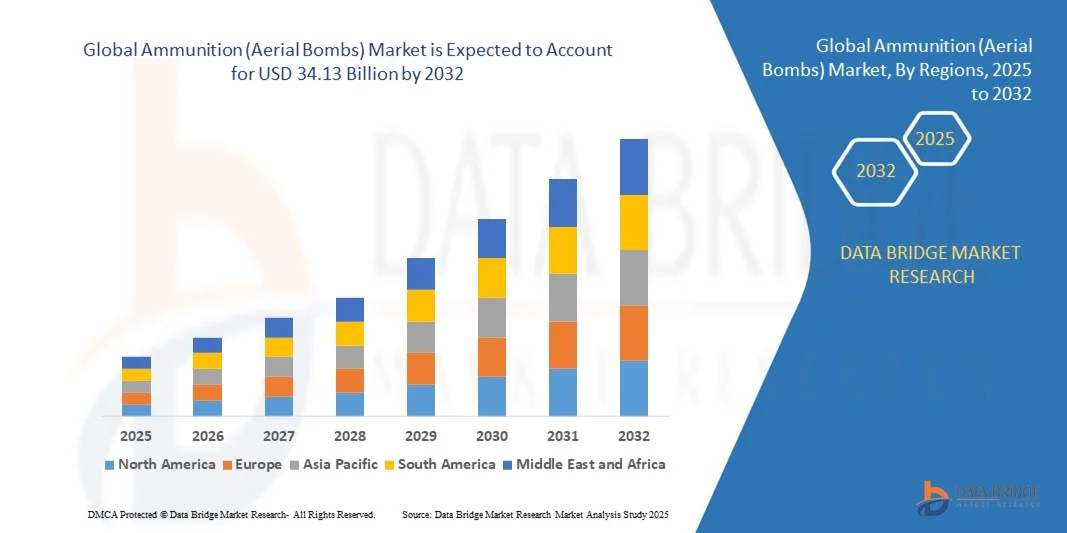
- The global ammunition (aerial bombs) market size was valued at USD 25.32 billion in 2024 and is projected to reach USD 34.13 billion by 2032, growing at a CAGR of 3.80% during the forecast period.
- The market growth is primarily driven by increasing defense budgets worldwide and advancements in precision-guided munitions technology, enhancing the effectiveness and accuracy of aerial bombs.
- Additionally, rising geopolitical tensions and modernization of military arsenals are fueling demand for sophisticated aerial ammunition, thereby significantly propelling the market expansion.
Global Ammunition (Aerial Bombs) Market Analysis
- Aerial bombs, as precision-guided or unguided munitions deployed from aircraft, remain critical components of modern military arsenals due to their strategic impact, enhanced targeting accuracy, and integration with advanced delivery platforms in both offensive and defensive operations.
- The rising demand for aerial bombs is primarily driven by increasing global defense expenditures, modernization of air forces, and the ongoing development of smart and precision-guided munition technologies.
- North America dominated the Global Ammunition (Aerial Bombs) Market with the largest revenue share of 39.05% in 2024, attributed to substantial defense budgets, advanced military infrastructure, and the presence of leading aerospace and defense manufacturers driving innovations in precision strike capabilities.
- Asia-Pacific is expected to be the fastest-growing region in the Global Ammunition (Aerial Bombs) Market during the forecast period, fueled by regional military modernization efforts, rising geopolitical tensions, and increased defense spending by emerging economies.
- The projectiles and warheads segment dominated the market with the largest revenue share of 38.7% in 2024, driven by its critical role in delivering destructive impact and evolving designs incorporating precision and advanced materials
Report Scope and Global Ammunition (Aerial Bombs) Market Segmentation
|
Attributes |
Global Ammunition (Aerial Bombs) key Market Insights |
|
Segments Covered |
|
|
Countries Covered |
North America
Europe
Asia-Pacific
Middle East and Africa
South America
|
|
Key Market Players |
|
|
Market Opportunities |
|
|
Value Added Data Infosets |
In addition to the insights on market scenarios such as market value, growth rate, segmentation, geographical coverage, and major players, the market reports curated by the Data Bridge Market Research also include in-depth expert analysis, pricing analysis, brand share analysis, consumer survey, demography analysis, supply chain analysis, value chain analysis, raw material/consumables overview, vendor selection criteria, PESTLE Analysis, Porter Analysis, and regulatory framework. |
Global Ammunition (Aerial Bombs) Market Trends
Enhanced Precision and Targeting Through AI and Advanced Guidance Systems
- A significant and accelerating trend in the global Ammunition (Aerial Bombs) Market is the increasing integration of artificial intelligence (AI) and advanced guidance systems, enhancing precision, effectiveness, and real-time adaptability of aerial munitions. This fusion of cutting-edge technologies is revolutionizing modern warfare by enabling smarter targeting and reduced collateral damage.
- For instance, precision-guided bombs equipped with AI-powered targeting algorithms can autonomously adjust flight paths mid-mission to accurately engage moving or concealed targets. Systems like the GBU-53/B StormBreaker incorporate AI to enhance targeting in complex environments, improving mission success rates.
- AI integration in aerial bombs allows for adaptive learning of battlefield scenarios, threat recognition, and dynamic re-targeting, thereby increasing operational flexibility. Some advanced models can analyze sensor data in real time to optimize impact points and avoid non-combatants. Furthermore, AI-enabled bombs provide enhanced data feedback to operators, enabling better decision-making and mission planning.
- The seamless integration of AI with aerial bomb delivery platforms and broader battlefield management systems facilitates coordinated strikes and synchronized operations across multiple units. Through centralized command interfaces, military forces can manage aerial munitions alongside surveillance, reconnaissance, and defense assets, creating a unified and highly responsive combat environment.
- This trend towards smarter, more autonomous, and interconnected munitions is fundamentally reshaping military doctrines and expectations for precision strike capabilities. Consequently, companies such as Northrop Grumman and BAE Systems are developing AI-enabled aerial bombs featuring real-time targeting updates, adaptive guidance, and integration with network-centric warfare systems.
- The demand for aerial bombs that offer seamless AI and advanced guidance integration is growing rapidly across global defense sectors, as armed forces prioritize enhanced accuracy, reduced collateral damage, and increased operational effectiveness in modern combat scenarios.
Global Ammunition (Aerial Bombs) Market Dynamics
Driver
Growing Need Due to Rising Geopolitical Tensions and Military Modernization
- The increasing geopolitical tensions worldwide, along with ongoing military modernization efforts by various countries, are significant drivers for the heightened demand for advanced aerial bombs.
- For instance, in early 2024, Northrop Grumman announced advancements in precision-guided munition technology aimed at enhancing strike accuracy and minimizing collateral damage, reflecting broader industry trends expected to fuel market growth during the forecast period.
- As global conflicts evolve and nations seek to upgrade their offensive capabilities, aerial bombs equipped with advanced guidance systems and higher payload versatility offer compelling advantages over traditional munitions, thereby accelerating adoption.
- Furthermore, the strategic shift toward network-centric warfare and integrated battlefield management systems is increasing demand for aerial bombs that can seamlessly communicate with command-and-control platforms and allied assets.
- The growing emphasis on precision strikes, coupled with the need for adaptable munitions to address asymmetric threats, is driving procurement across both established military powers and emerging defense markets. This trend is also supported by increasing investments in defense R&D and procurement budgets globally.
Restraint/Challenge
Concerns Regarding Cost, Regulatory Constraints, and Ethical Issues
- High development and production costs of advanced aerial bombs, combined with stringent export controls and regulatory compliance requirements, pose significant challenges to broader market expansion.
- For instance, strict international arms treaties and export restrictions can limit market access for some manufacturers, impacting global sales and distribution.
- Addressing these regulatory challenges requires robust compliance frameworks and transparent supply chain management by key players such as BAE Systems and Rheinmetall, who emphasize adherence to international arms control protocols.
- Additionally, ethical concerns related to collateral damage and civilian casualties in conflict zones raise scrutiny over the deployment of aerial bombs, prompting calls for enhanced targeting precision and accountability measures.
- While technological advances are improving the accuracy and reducing unintended impacts, high acquisition and maintenance costs may deter budget-constrained defense forces, especially in developing regions.
- Overcoming these challenges through cost optimization, regulatory navigation, and increased focus on precision and ethical use will be critical for sustained market growth in the coming years.
Global Ammunition (Aerial Bombs) Market Scope
The market is segmented on the basis of component, caliber, guidance, lethality and application.
- By Component
On the basis of component, the global ammunition (aerial bombs) market is segmented into fuzes and primers, propellants, bases, projectiles and warheads, and others. The projectiles and warheads segment dominated the market with the largest revenue share of 38.7% in 2024, driven by its critical role in delivering destructive impact and evolving designs incorporating precision and advanced materials. This segment benefits from continuous innovation in warhead technology to improve effectiveness and reduce collateral damage.
The propellants segment is expected to witness the fastest CAGR of 19.8% from 2025 to 2032, fueled by advancements in propellant chemistry that enhance range, stability, and performance. Increasing demand for environmentally friendly and high-energy propellants in aerial bombs is also propelling growth within this segment, as militaries seek greater efficiency and compliance with emerging regulations.
- By Caliber
On the basis of caliber, the global ammunition (aerial bombs) market is segmented into small, medium, large, and others. The large caliber segment held the largest market revenue share of 45.3% in 2024, primarily due to its widespread use in strategic bombing missions requiring significant payload delivery and destructive power. Large caliber bombs are preferred by major air forces for their versatility and ability to engage fortified targets.
The small caliber segment is projected to register the fastest CAGR of 21.5% during the forecast period, driven by increasing demand for lightweight and precision munitions that are compatible with unmanned aerial vehicles (UAVs) and smaller tactical aircraft. The rise of asymmetrical warfare and the need for precision with minimized collateral damage are boosting the adoption of small caliber aerial bombs.
- By Guidance
On the basis of guidance, the global ammunition (aerial bombs) market is segmented into non-guided and guided bombs. The guided segment dominated the market with a revenue share of 52.6% in 2024, propelled by the growing preference for precision-guided munitions (PGMs) that significantly improve strike accuracy and reduce unintended damage. Guided aerial bombs integrate GPS, laser, and infrared guidance systems, enhancing operational effectiveness in complex combat environments.
The non-guided segment is expected to experience a CAGR of 16.7% from 2025 to 2032, supported by its cost-effectiveness and continued use in large-scale conventional operations where precision is less critical. Despite growing preference for guided munitions, non-guided bombs remain important for saturation bombing and area denial missions.
- By Lethality
On the basis of lethality, the Global Ammunition (Aerial Bombs) Market is segmented into lethal and less-lethal munitions. The lethal segment accounted for the largest market revenue share of 89.4% in 2024, driven by persistent global military conflicts and ongoing defense modernization programs emphasizing effective combat munitions. Lethal aerial bombs include high-explosive and fragmentation types designed for maximum target neutralization.
The less-lethal segment is anticipated to register the fastest CAGR of 23.3% during the forecast period, driven by increasing use in peacekeeping operations, crowd control, and situations requiring minimal casualties. Less-lethal aerial bombs utilize technologies such as flashbangs and smoke to incapacitate without lethal force, reflecting evolving military and law enforcement needs.
- By Application
On the basis of application, the global ammunition (aerial bombs) market is segmented into defense, civil, and commercial sectors. The defense segment dominated the market with a commanding revenue share of 94.5% in 2024, due to the extensive use of aerial bombs in national military arsenals and ongoing investments in upgrading aerial strike capabilities. Defense applications cover offensive, tactical, and strategic operations requiring varied bomb types and sophisticated delivery systems.
The civil segment is expected to witness the fastest CAGR of 18.2% from 2025 to 2032, driven by applications such as controlled demolitions, firefighting, and rescue operations where precision aerial deployment of payloads can be critical. The commercial segment, though smaller, is gradually growing with niche uses in aerial surveying and industrial blasting operations.
Global Ammunition (Aerial Bombs) Market Regional Analysis
- North America dominated the global ammunition (aerial bombs) market with the largest revenue share of 39.05% in 2024, driven by substantial defense spending, advanced military infrastructure, and ongoing modernization of air forces.
- Defense agencies in the region prioritize precision-guided munitions and advanced aerial bombs to enhance operational capabilities and maintain technological superiority in global conflict scenarios.
- This strong market position is further supported by the presence of leading defense contractors, significant R&D investments, and strategic geopolitical interests, which collectively fuel demand across both residential and commercial military applications.
U.S. Ammunition (Aerial Bombs) Market Insight
The U.S. Ammunition (Aerial Bombs) Market captured the largest revenue share of 80% in 2024 within North America, driven by substantial defense budgets and ongoing modernization programs across all military branches. The demand for advanced precision-guided munitions, enhanced payload versatility, and next-generation aerial bombs is accelerating due to evolving combat requirements. The U.S. military’s focus on network-centric warfare and integration of AI technologies in munitions further propels market growth. Additionally, collaborations between defense contractors and the government to develop smarter, more efficient aerial bombs continue to expand the market.
Europe Ammunition (Aerial Bombs) Market Insight
The Europe Ammunition (Aerial Bombs) Market is projected to grow steadily at a substantial CAGR during the forecast period, supported by increasing defense spending and efforts to upgrade existing military arsenals. Heightened geopolitical tensions in Eastern Europe and the need for enhanced airstrike capabilities are driving investments in precision-guided bombs and related technologies. The region also benefits from robust defense manufacturing ecosystems in countries such as France, Germany, and the UK, which fuel innovation and production. Growing emphasis on compliance with international arms control regulations also shapes the development of safer and more precise aerial bombs.
U.K. Ammunition (Aerial Bombs) Market Insight
The U.K. Ammunition (Aerial Bombs) Market is expected to witness noteworthy growth during the forecast period, fueled by government initiatives to modernize the Royal Air Force and enhance strategic deterrence capabilities. Increasing adoption of precision-guided munitions and investments in smart bomb technologies are key factors driving the market. The U.K.’s advanced defense research infrastructure, coupled with collaborations between industry leaders and the Ministry of Defence, supports the development of innovative aerial bombs that meet evolving operational demands.
Germany Ammunition (Aerial Bombs) Market Insight
The Germany Ammunition (Aerial Bombs) Market is anticipated to expand at a considerable CAGR, driven by rising defense budgets and modernization of air force capabilities. Germany’s strong industrial base and emphasis on advanced technology development contribute to growing production of guided munitions and precision aerial bombs. Focus on eco-friendly propulsion and materials, along with adherence to strict regulatory standards, also influence market trends. Integration of aerial bombs into networked battlefield systems enhances operational efficiency, further supporting demand.
Asia-Pacific Ammunition (Aerial Bombs) Market Insight
The Asia-Pacific Ammunition (Aerial Bombs) Market is poised to grow at the fastest CAGR of 24% from 2025 to 2032, driven by increasing military modernization, strategic defense investments, and expanding regional conflicts. Countries such as China, India, Japan, and South Korea are rapidly upgrading their aerial munitions capabilities with a focus on precision-guided and smart bombs. Government initiatives promoting indigenous defense manufacturing and technology transfers fuel growth. Additionally, the region’s rising geopolitical tensions and increasing air power capabilities drive sustained demand for advanced aerial bombs.
Japan Ammunition (Aerial Bombs) Market Insight
The Japan Ammunition (Aerial Bombs) Market is gaining momentum due to the country’s strategic focus on strengthening self-defense forces amid regional security challenges. Investments in high-tech, precision-guided aerial bombs and integration with cutting-edge missile defense systems are key drivers. Japan’s emphasis on technological innovation, coupled with government support for domestic defense manufacturing, fosters market growth. The need for reliable, accurate munitions in a densely populated region increases demand for advanced aerial bombs with minimized collateral impact.
China Ammunition (Aerial Bombs) Market Insight
The China Ammunition (Aerial Bombs) Market accounted for the largest revenue share in Asia-Pacific in 2024, propelled by rapid military modernization and expanding strategic air capabilities. China’s increasing investment in precision-guided munitions and smart bomb technologies supports the development of sophisticated aerial bombs with enhanced targeting and adaptability. The country’s growing defense industrial complex and government-backed innovation initiatives contribute to strong market growth. Additionally, China’s focus on expanding its regional influence and power projection capabilities drives continuous demand for advanced aerial bombs across its armed forces.
Global Ammunition (Aerial Bombs) Market Share
Some of the major players operating in the market are:
- AMMO Inc (U.S.)
- Arsenal 2000 JSCo (Bulgaria)
- BAE Systems (U.K.)
- CBC Global Ammunition (Brazil)
- Denel SOC Ltd (South Africa)
- Chemring Group PLC (U.K.)
- Elbit Systems Ltd. (Israel)
- FIOCCHI MUNIZIONI SPA (Italy)
- General Dynamics Corporation (U.S.)
- Hanwha Group (South Korea)
- Herstal SA (Belgium)
- Hornady (U.S.)
- EXPAL Systems (Spain)
- Nammo AS (Norway)
- Nexter group KNDS (France)
- Norinco Private Limited (India)
- Northrop Grumman (U.S.)
- Olin Corporation (U.S.)
- Poongsan Corporation (South Korea)
- RUAG Group (Switzerland)
- REMINGTON OUTDOOR COMPANY (U.S.)
- Rheinmetall AG (Germany)
- Rosoboronexport (Russia )
What are the Recent Developments in Global Ammunition (Aerial Bombs) Market?
- In April 2023, Rheinmetall AG, a global leader in defense technology, announced the expansion of its aerial bomb production capabilities in South Africa. This strategic initiative aims to supply advanced munitions tailored to regional defense requirements, reinforcing Rheinmetall’s commitment to delivering innovative, reliable ammunition solutions while strengthening its foothold in the growing Global Ammunition (Aerial Bombs) Market.
- In March 2023, Nammo AS, a Nordic defense manufacturer, unveiled its latest precision-guided aerial bomb variant designed specifically for enhanced operational effectiveness in commercial and defense applications. This new development highlights Nammo’s focus on advancing safety and precision technology, ensuring improved protection for military assets and personnel across various conflict zones.
- In March 2023, Honeywell International Inc. successfully completed a major urban defense contract in India aimed at upgrading aerial bomb storage and deployment infrastructure. Leveraging state-of-the-art smart monitoring and safety technologies, Honeywell’s initiative strengthens urban safety protocols and underscores the increasing importance of secure ammunition management in emerging markets.
- In February 2023, CBC Global Ammunition formed a strategic partnership with several South American defense organizations to develop a localized supply chain for aerial bombs. This collaboration aims to enhance regional security readiness while streamlining ammunition logistics, exemplifying CBC’s dedication to innovation and operational efficiency within the global defense ammunition sector.
- In January 2023, BAE Systems launched the latest version of its guided aerial bomb system at an international defense exhibition. Equipped with improved targeting accuracy and enhanced lethality, the new product underscores BAE Systems’ ongoing commitment to integrating cutting-edge technology into defense munitions, offering armed forces around the world superior strategic capabilities.

- Interactive Data Analysis Dashboard
- Company Analysis Dashboard for high growth potential opportunities
- Research Analyst Access for customization & queries
- Competitor Analysis with Interactive dashboard
- Latest News, Updates & Trend analysis
- Harness the Power of Benchmark Analysis for Comprehensive Competitor Tracking
Data collection and base year analysis are done using data collection modules with large sample sizes. The stage includes obtaining market information or related data through various sources and strategies. It includes examining and planning all the data acquired from the past in advance. It likewise envelops the examination of information inconsistencies seen across different information sources. The market data is analysed and estimated using market statistical and coherent models. Also, market share analysis and key trend analysis are the major success factors in the market report. To know more, please request an analyst call or drop down your inquiry.
The key research methodology used by DBMR research team is data triangulation which involves data mining, analysis of the impact of data variables on the market and primary (industry expert) validation. Data models include Vendor Positioning Grid, Market Time Line Analysis, Market Overview and Guide, Company Positioning Grid, Patent Analysis, Pricing Analysis, Company Market Share Analysis, Standards of Measurement, Global versus Regional and Vendor Share Analysis. To know more about the research methodology, drop in an inquiry to speak to our industry experts.
Data Bridge Market Research is a leader in advanced formative research. We take pride in servicing our existing and new customers with data and analysis that match and suits their goal. The report can be customized to include price trend analysis of target brands understanding the market for additional countries (ask for the list of countries), clinical trial results data, literature review, refurbished market and product base analysis. Market analysis of target competitors can be analyzed from technology-based analysis to market portfolio strategies. We can add as many competitors that you require data about in the format and data style you are looking for. Our team of analysts can also provide you data in crude raw excel files pivot tables (Fact book) or can assist you in creating presentations from the data sets available in the report.













