


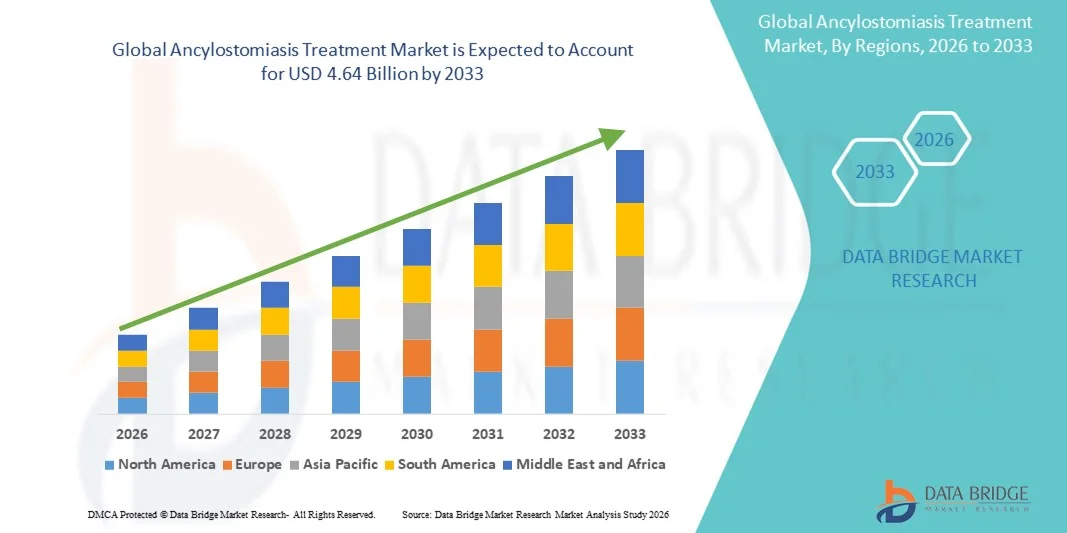
Ancylostomiasis Treatment Market Size
- The global ancylostomiasis treatment market size was valued at USD 3.34 billion in 2025 and is expected to reach USD 4.64 billion by 2033, at a CAGR of 4.20% during the forecast period
- The market growth is largely driven by the high prevalence of hookworm infections in tropical and subtropical regions, coupled with increasing awareness about parasitic diseases, improved diagnostic capabilities, and expanding access to anthelmintic medications through government and non-government health initiatives
- Furthermore, rising investments in public health infrastructure, sanitation improvement programs, and school-based deworming campaigns in developing countries are significantly accelerating the adoption of Ancylostomiasis treatment solutions and strengthening overall market expansion
Ancylostomiasis Treatment Market Analysis
- Ancylostomiasis treatment, which focuses on eliminating hookworm infections and managing related complications, is becoming increasingly important in public health programs due to the rising burden of soil-transmitted helminth infections and the growing emphasis on preventive and curative parasitic disease management in both rural and urban populations
- The escalating demand for Ancylostomiasis treatment is primarily driven by increasing awareness of parasitic infections, improved availability of anthelmintic drugs such as albendazole and mebendazole, and large-scale government-supported deworming initiatives targeting high-risk populations, especially children and immunocompromised individuals
- North America dominated the ancylostomiasis treatment market with the largest revenue share of 46.7% in 2025, due to a high prevalence of hookworm infections in densely populated, supported by expanded mass deworming campaigns, growing healthcare outreach programs, and increasing investments in sanitation and hygiene infrastructure
- Asia Pacific is expected to be the fastest-growing region in the ancylostomiasis treatment market during the forecast period, driven by persistent infection rates, rising international funding for neglected tropical disease (NTD) control, and strengthened healthcare delivery systems in sub-Saharan countries
- The Oral segment dominated the market with nearly 75.1% revenue share in 2025, due to the high use of tablet-based deworming medications
Report Scope and Ancylostomiasis Treatment Market Segmentation
|
Attributes |
Ancylostomiasis Treatment Key Market Insights |
|
Segments Covered |
|
|
Countries Covered |
North America
Europe
Asia-Pacific
Middle East and Africa
South America
|
|
Key Market Players |
|
|
Market Opportunities |
|
|
Value Added Data Infosets |
In addition to the insights on market scenarios such as market value, growth rate, segmentation, geographical coverage, and major players, the market reports curated by the Data Bridge Market Research also include in-depth expert analysis, patient epidemiology, pipeline analysis, pricing analysis, and regulatory framework. |
Ancylostomiasis Treatment Market Trends
Rising Focus on Mass Deworming Programs and Preventive Chemotherapy
- A significant and accelerating trend in the global ancylostomiasis treatment market is the increasing implementation of mass deworming and preventive chemotherapy programs, particularly in low- and middle-income countries. Governments, NGOs, and international health organizations such as the WHO and UNICEF are expanding deworming initiatives to reduce the burden of soil-transmitted helminth infections, including hookworm, which is the primary cause of Ancylostomiasis
- For instance, several endemic countries in Asia and Sub-Saharan Africa have incorporated Albendazole and Mebendazole distribution programs into school-based and community-based health campaigns to control hookworm infections among children and pregnant women. These programs aim to reduce anemia, malnutrition, and impaired physical development caused by chronic infection
- The rising adoption of integrated neglected tropical disease (NTD) control programs is also increasing diagnosis and treatment rates of Ancylostomiasis. These programs target multiple parasitic diseases simultaneously, improving treatment accessibility in underserved communities
- Furthermore, growing awareness about parasite-induced anemia, particularly in women of reproductive age and young children, is driving the demand for timely medical intervention and anthelmintic therapy
- Pharmaceutical companies and research institutions are increasing their focus on improving drug formulations, optimizing dosing regimens, and studying drug resistance patterns to enhance treatment effectiveness
- This global push toward preventive healthcare, combined with the expansion of rural healthcare infrastructure and mobile medical units, is significantly contributing to the consistent growth of the Ancylostomiasis Treatment market
Ancylostomiasis Treatment Market Dynamics
Driver
Rising Prevalence in Tropical and Subtropical Regions and Increased Public Health Awareness
- The increasing prevalence of ancylostomiasis in tropical and subtropical regions, where warm and humid soil conditions favor hookworm survival, is a key driver of market growth. Millions of people in regions such as Sub-Saharan Africa, Southeast Asia, and Latin America remain at risk due to poor sanitation and lack of access to clean water
- For instance, public health authorities in several endemic regions have reported sustained infection levels among rural farming communities, increasing the need for routine screening and anthelmintic treatment. These growing case numbers are encouraging governments and healthcare organizations to strengthen parasite control programs
- Rising awareness of the long-term impact of untreated Ancylostomiasis — such as iron-deficiency anemia, growth retardation, fatigue, and cognitive impairment — is motivating higher healthcare spending and stronger policy support for parasite control
- In addition, increased funding for Neglected Tropical Disease elimination programs by international bodies is boosting the procurement of antiparasitic medications, expanding treatment coverage, and accelerating the growth of the Ancylostomiasis Treatment market
- Improvements in diagnostic capabilities at primary healthcare centers, along with better disease surveillance systems, are also helping in early detection, thereby increasing demand for pharmaceutical intervention.
Restraint/Challenge
Limited Access to Healthcare and Risk of Drug Resistance
- One of the major challenges facing the Ancylostomiasis Treatment market is the limited access to healthcare services in remote and impoverished regions where the disease burden is highest. In many endemic areas, patients lack access to proper diagnostics, trained medical personnel, and affordable medication, which restricts consistent treatment uptake
- For instance, in several rural districts of Sub-Saharan Africa and Southeast Asia, patients must travel long distances to reach the nearest healthcare center, resulting in delayed diagnosis and irregular access to Albendazole and Mebendazole therapy, allowing the infection to persist and spread within communities
- Poor sanitation, lack of footwear, open defecation, and unsafe water sources continue to sustain high transmission rates, reducing the long-term effectiveness of treatment alone without proper infrastructure development
- Another emerging concern is the potential development of drug resistance to commonly used anthelmintics such as Albendazole and Mebendazole due to repeated mass drug administration. This could reduce treatment efficacy and require the development of newer, more advanced drug alternatives, increasing overall treatment costs
- In addition, limited public awareness, social stigma, and misconceptions about parasite infections prevent many individuals from seeking timely treatment. In some communities, symptoms are normalized or ignored, leading to underreporting and delayed medical intervention
- Overcoming these challenges will require stronger health education campaigns, improved sanitation infrastructure, expanded rural medical access, and continuous pharmaceutical research to ensure sustainable long-term disease control and market expansion
Ancylostomiasis Treatment Market Scope
The market is segmented on the basis of treatment, diagnosis, dosage, route of administration, symptoms, end-users, and distribution channel.
- By Treatment
On the basis of treatment, the Ancylostomiasis Treatment market is segmented into Anthelminthic Drugs, Blood Transfusion, and Others. The Anthelminthic Drugs segment dominated the largest market revenue share of approximately 68.4% in 2025, driven by the widespread use of Albendazole and Mebendazole as first-line therapies for hookworm infection. These drugs are highly effective, affordable, and recommended by the WHO in mass deworming programs across endemic regions. Their easy oral administration and short treatment duration increase patient compliance and support high adoption. Government-led parasitic control campaigns in Asia, Africa, and Latin America contribute significantly to volume demand. In addition, increasing awareness of parasitic diseases and improved access to essential medicines through global health initiatives further strengthen the position of this segment. Pharmaceutical companies continue to expand production to meet growing demand in developing countries. The segment benefits from inclusion in national essential medicines lists. Strong clinical success rate and low side-effect profile also reinforce dominance. Furthermore, international NGOs continuously support drug distribution in high-risk communities. All these factors together sustain the leadership of Anthelminthic Drugs in the overall market.
The Blood Transfusion segment is expected to witness the fastest CAGR of around 6.9% from 2026 to 2033, due to the rising number of severe anemia cases caused by chronic hookworm infections. In advanced cases, blood transfusion becomes a critical supportive therapy to stabilize patients, especially children and pregnant women. The growth of healthcare infrastructure in developing economies and increasing hospital admissions for complicated parasitic cases further contribute to its rising demand. Improved diagnostic capabilities now allow earlier detection of severe blood loss, increasing the need for transfusion therapy. Additionally, governments are strengthening blood bank networks, improving availability in rural and semi-urban regions. Awareness among healthcare professionals regarding early intervention in anemia is also improving. With increasing focus on comprehensive treatment rather than single-drug therapy, supportive care segments like blood transfusion are gaining attention. This trend positions it as the fastest-growing sub-segment in the forecast period.
- By Diagnosis
On the basis of diagnosis, the Ancylostomiasis Treatment market is segmented into Serologic Tests, Physical Examination, Ova and Parasites Stool Test, Microscopic Examination, and Others. The Ova and Parasites Stool Test segment dominated the market with over 52.6% revenue share in 2025, as it remains the gold-standard diagnostic technique for detecting hookworm eggs in infected individuals. This method is widely used in both hospital and field settings due to its simplicity, accuracy, and low cost. It is easily implemented in mass screening programs in schools and community health centers. Governments and NGOs conducting parasitic surveillance rely heavily on this technique. Its minimal equipment requirement makes it suitable even in low-resource settings. Additionally, trained technicians can perform large-scale testing in a short period. The test allows early detection, enabling timely treatment and preventing severe complications. Improved public health surveillance programs continue to increase the usage rate. Strong acceptance among clinicians ensures consistent demand for this method in both urban and rural regions.
The Serologic Tests segment is projected to grow at the fastest CAGR of 7.4% from 2026 to 2033, due to advancements in immunoassay technology and increasing demand for early-stage detection. These tests help identify antibodies even when eggs are not visible in stool samples. Hospitals and reference laboratories are increasingly adopting serology for more accurate and confirmatory diagnosis. Rising investments in molecular and advanced parasitology diagnostics contribute to this growth. Moreover, international research organizations are supporting the development of rapid diagnostic kits to improve outreach in remote regions. Growing awareness about the importance of early detection is further fueling market expansion. The increasing number of research laboratories and diagnostic centers in developing regions also enhances its adoption. As technology becomes more affordable, usage is expected to expand significantly during the forecast period.
- By Dosage
On the basis of dosage, the Ancylostomiasis Treatment market is segmented into Tablet, Injection, and Others. The Tablet segment dominated the market with a revenue share of around 72.8% in 2025, owing to its convenience, affordability, and widespread availability. Oral tablets like Albendazole and Mebendazole are the most commonly prescribed drugs for hookworm infection. Tablets are easy to store, transport, and distribute in mass deworming campaigns. Their non-invasive nature improves patient acceptance, especially in pediatric and rural populations. Governments favor tablet form in national parasitic disease control programs due to their cost-effectiveness. Pharmaceutical companies also find tablet production more scalable and economical. In addition, tablets offer longer shelf life and minimal storage requirements. This makes them ideal for use in tropical and resource-limited regions. As a result, the tablet dosage form continues to lead the overall market.
The Injection segment is expected to register the fastest CAGR of 6.3% from 2026 to 2033, primarily for use in severe or hospitalized cases. Injections are administered when oral treatment is not feasible or absorption is poor due to intestinal damage. As healthcare access improves, more patients with complicated infections are being admitted to hospitals, increasing the use of injectable therapy. The expansion of emergency care services in developing countries further boosts this segment. Moreover, physicians increasingly prefer injections for faster action in life-threatening cases. Technological improvements in formulation are also enhancing the effectiveness of injectable antiparasitic medicines. This rising clinical preference supports sustained growth in the injection segment.
- By Route of Administration
On the basis of route of administration, the Ancylostomiasis Treatment market is segmented into Oral, Intravenous, and Others. The Oral segment dominated the market with nearly 75.1% revenue share in 2025, due to the high use of tablet-based deworming medications. Oral administration is simple, painless, and convenient for all age groups, including children. It allows self-administration and does not require trained medical personnel. This makes it ideal for mass drug administration (MDA) programs in schools and rural areas. The WHO strongly recommends oral treatment for large-scale parasitic control initiatives. Easy transportation and administration in field settings further strengthen adoption. Additionally, the reduced cost of oral drugs supports large public health campaigns. Due to these strong advantages, the oral route remains the most preferred and widely used.
The Intravenous segment is expected to grow at the fastest CAGR of 6.0% from 2026 to 2033, supported by increasing hospital-based treatments. Intravenous administration is commonly used in patients with severe complications such as gastrointestinal bleeding and malnutrition. The growing number of advanced healthcare centers is improving access to IV therapy. Rising investments in hospital infrastructure across developing regions are further increasing usage. This method ensures rapid drug delivery, making it essential in critical cases. As awareness improves, more patients are being diagnosed at advanced stages, driving the demand for IV treatment. Therefore, this segment is projected to experience steady and fast growth.
- By Symptoms
On the basis of symptoms, the Ancylostomiasis Treatment market is segmented into Abdominal Pain, Anaemia, Diarrhea, Dyspepsia, Intestinal Bleeding, Eosinophilia, and Others. The Anaemia segment accounted for the dominant share of approximately 39.5% in 2025, as it is one of the most serious and common complications of hookworm infection. Chronic blood loss caused by parasites leads to iron-deficiency anemia, especially in children and pregnant women. This symptom is responsible for the majority of hospital visits and medical interventions. Public health programs primarily target anemia reduction, driving higher diagnosis and treatment rates. Increased awareness about anemia-related complications further encourages early treatment. NGOs and government agencies also distribute iron supplements along with deworming medicines. This integrated approach directly increases the dominance of this segment in the market.
The Intestinal Bleeding segment is projected to witness the highest CAGR of 7.1% from 2026 to 2033, due to rising detection of severe cases through improved diagnostic methods. Patients experiencing internal bleeding require immediate medical intervention, increasing hospitalization rates. Growing awareness of gastrointestinal complications is driving earlier reporting and screening. The expansion of advanced diagnostic facilities such as endoscopy is also increasing case detection. This increase in diagnosed cases contributes to faster market growth for this symptom segment. The rising burden of parasitic infections in tropical regions further reinforces this upward trend.
- By End-Users
On the basis of end-users, the Ancylostomiasis Treatment market is segmented into Clinic, Hospital, and Others. The Hospital segment dominated the market with nearly 57.9% share in 2025, due to the availability of advanced diagnostic and treatment facilities. Hospitals manage moderate to severe cases that require constant monitoring and supportive therapies. The increasing establishment of public hospitals in developing countries also contributes to higher patient inflow. Physicians prefer hospital settings for complicated cases involving anemia, malnutrition, and internal bleeding. In addition, government-funded treatment programs are largely implemented through hospitals. This strong institutional presence helps maintain the hospital segment’s market dominance.
The Clinic segment is expected to register the fastest CAGR of 6.6% during the forecast period, driven by the growing number of private and community-based clinics. Clinics are more accessible in rural and semi-urban areas. Increasing awareness and early-stage diagnosis increase patient visits to clinics instead of hospitals. Lower treatment costs and shorter waiting times make clinics preferable for initial treatment. Government investments in primary healthcare also support this expansion. These factors contribute to strong growth momentum in this segment.
- By Distribution Channel
On the basis of distribution channel, the Ancylostomiasis Treatment market is segmented into Hospital Pharmacy, Retail Pharmacy, and Online Pharmacy. The Hospital Pharmacy segment dominated the market with approximately 49.8% in 2025, due to the high number of patients treated in hospital settings. Most antiparasitic medications and supportive drugs are dispensed directly through hospital pharmacies. Large purchases by government agencies and NGOs are often routed through hospital systems. This ensures reliable supply and controlled distribution. The availability of qualified pharmacists and doctors also encourages patients to prefer hospital pharmacies. These factors strongly reinforce the dominance of this segment.
The Online Pharmacy segment is expected to grow at the fastest CAGR of 8.3% from 2026 to 2033, driven by the rapid digitalization of healthcare services. Increasing smartphone usage and internet penetration in developing countries support online drug ordering. Patients in remote areas are gaining easier access to medication through e-pharmacy platforms. Home delivery options and discounted prices also attract more consumers. The COVID-19 pandemic further accelerated the acceptance of online medicine purchase. This sustained digital shift makes online pharmacies the fastest-growing channel in the market.
Ancylostomiasis Treatment Market Regional Analysis
- North America dominated the ancylostomiasis treatment market with the largest revenue share of 46.7% in 2025
- Due to a relatively high prevalence of hookworm infections in certain vulnerable and migrant populations, supported by expanded mass deworming campaigns, strong healthcare infrastructure, increasing government and NGO-led awareness initiatives, and continuous investments in sanitation and hygiene improvement programs
- The presence of advanced diagnostic facilities and easy access to effective anthelminthic medications further contributes to the region’s leading position in the market
U.S. Ancylostomiasis Treatment Market Insight
The U.S. ancylostomiasis treatment market captured the largest revenue share in North America in 2025, driven by early diagnosis, greater access to healthcare services, and rising awareness amongst healthcare professionals and the general population regarding soil-transmitted helminth infections. Government-backed public health campaigns, improved diagnostic capabilities, and the widespread availability of prescription and over-the-counter anthelminthic drugs are playing a critical role in supporting market growth in the country.
Europe Ancylostomiasis Treatment Market Insight
The Europe ancylostomiasis treatment market is projected to expand at a moderate yet steady CAGR during the forecast period, primarily driven by increased surveillance of parasitic diseases among travelers and immigrant populations, improved laboratory diagnostic techniques, and strengthening public health response systems. Growing emphasis on preventive care, hygienic practices, and early-stage treatment is accelerating the region’s demand for effective therapeutic solutions.
U.K. Ancylostomiasis Treatment Market Insight
The U.K. ancylostomiasis treatment market is anticipated to grow at a consistent pace throughout the forecast period, supported by improved monitoring of infectious diseases, rising focus on tropical disease management in returning travelers, and better access to diagnostic testing and anthelminthic medications through national healthcare services.
Germany Ancylostomiasis Treatment Market Insight
The Germany ancylostomiasis treatment market is expected to expand steadily, driven by a strong healthcare system, rising investments in infectious disease prevention, and increased government initiatives to monitor and control parasitic infections. Research activities and advancements in diagnostics further strengthen Germany’s role in the regional market.
Asia-Pacific Ancylostomiasis Treatment Market Insight
The Asia-Pacific ancylostomiasis treatment market region is expected to be the fastest-growing market for Ancylostomiasis treatment during the forecast period, driven by persistent infection rates in tropical and subtropical areas, rising international funding for neglected tropical disease (NTD) control, and the strengthening of healthcare delivery systems in developing countries. Expanding public health initiatives, mass deworming programs, and improving access to affordable medications are significantly accelerating regional market growth.
Japan Ancylostomiasis Treatment Market Insight
The Japan ancylostomiasis treatment market is witnessing gradual growth due to increased awareness of parasitic diseases, advanced diagnostic capabilities, and a strong focus on preventive healthcare. Continuous monitoring of infectious diseases and improved medical infrastructure support stable demand in the country.
China Ancylostomiasis Treatment Market Insight
The China ancylostomiasis treatment market accounted for a significant revenue share in Asia-Pacific in 2025, driven by large population size, ongoing rural sanitation programs, and government-supported deworming initiatives. Increased healthcare spending, expanding access to medicines in remote regions, and collaborations with global health organizations are further contributing to the market’s expansion in China.
Ancylostomiasis Treatment Market Share
The Ancylostomiasis Treatment industry is primarily led by well-established companies, including:
• GlaxoSmithKline plc (U.K.)
• Pfizer Inc. (U.S.)
• Sanofi S.A. (France)
• Merck & Co., Inc. (U.S.)
• Bayer AG (Germany)
• Johnson & Johnson (U.S.)
• Eisai Co., Ltd. (Japan)
• Takeda Pharmaceutical Company (Japan)
• Teva Pharmaceutical Industries Ltd. (Israel)
• Lupin Limited (India)
• Sun Pharmaceutical Industries Ltd. (India)
• Aurobindo Pharma (India)
• Cipla Ltd. (India)
Latest Developments in Global Ancylostomiasis Treatment Market
- In January 2021, the World Health Organization published the Roadmap for Neglected Tropical Diseases 2021–2030, setting new global targets and strategic priorities (including for soil-transmitted helminths such as hookworm) that shaped funding, programmatic scale-up and research priorities for ancylostomiasis control
- In January 2023, the World Health Organization updated its fact sheet and program data for soil-transmitted helminthiases, restating WHO recommendations for preventive chemotherapy (albendazole/mebendazole) for at-risk populations and reporting global program progress that guides national hookworm control efforts
- In March 2024, Zinsou et al. (Lancet Infectious Diseases, ePub 18 Mar 2024 / print Jul 2024) reported a phase-1 randomized, observer-blind trial showing that co-administered Na-APR-1(M74) and Na-GST-1 hookworm vaccine candidates were safe and immunogenic in school-aged children in Gabon — a key proof-of-concept milestone for human hookworm vaccines that could change future prevention strategies
- In August 2024, the World Health Organization released a guideline on public-health control of strongyloidiasis that included recommendations supporting expanded use of ivermectin in mass-drug-administration contexts — an influential policy development relevant to integrated STH control programs (including strategies that affect hookworm/ancylostomiasis control)
- In December 2024, Medicines Development for Global Health (MDGH) and partners announced regulatory approval / marketing authorization of moxidectin for use against onchocerciasis in Ghana (a milestone for moxidectin rollout), increasing interest in moxidectin’s broader utility in NTD control programs and prompting discussion of its potential role in integrated helminth control research
- In January 2025, a peer-reviewed systematic review and meta-analysis (Malik et al., Medicine (Baltimore)) reported that co-administration ivermectin + albendazole shows improved efficacy versus monotherapy for some STHs, strengthening the clinical evidence base used by programs and policymakers considering combination regimens for improved ancylostomiasis control

- Interactive Data Analysis Dashboard
- Company Analysis Dashboard for high growth potential opportunities
- Research Analyst Access for customization & queries
- Competitor Analysis with Interactive dashboard
- Latest News, Updates & Trend analysis
- Harness the Power of Benchmark Analysis for Comprehensive Competitor Tracking
Data collection and base year analysis are done using data collection modules with large sample sizes. The stage includes obtaining market information or related data through various sources and strategies. It includes examining and planning all the data acquired from the past in advance. It likewise envelops the examination of information inconsistencies seen across different information sources. The market data is analysed and estimated using market statistical and coherent models. Also, market share analysis and key trend analysis are the major success factors in the market report. To know more, please request an analyst call or drop down your inquiry.
The key research methodology used by DBMR research team is data triangulation which involves data mining, analysis of the impact of data variables on the market and primary (industry expert) validation. Data models include Vendor Positioning Grid, Market Time Line Analysis, Market Overview and Guide, Company Positioning Grid, Patent Analysis, Pricing Analysis, Company Market Share Analysis, Standards of Measurement, Global versus Regional and Vendor Share Analysis. To know more about the research methodology, drop in an inquiry to speak to our industry experts.
Data Bridge Market Research is a leader in advanced formative research. We take pride in servicing our existing and new customers with data and analysis that match and suits their goal. The report can be customized to include price trend analysis of target brands understanding the market for additional countries (ask for the list of countries), clinical trial results data, literature review, refurbished market and product base analysis. Market analysis of target competitors can be analyzed from technology-based analysis to market portfolio strategies. We can add as many competitors that you require data about in the format and data style you are looking for. Our team of analysts can also provide you data in crude raw excel files pivot tables (Fact book) or can assist you in creating presentations from the data sets available in the report.













