


Anesthesia Delivery Units Market Overview
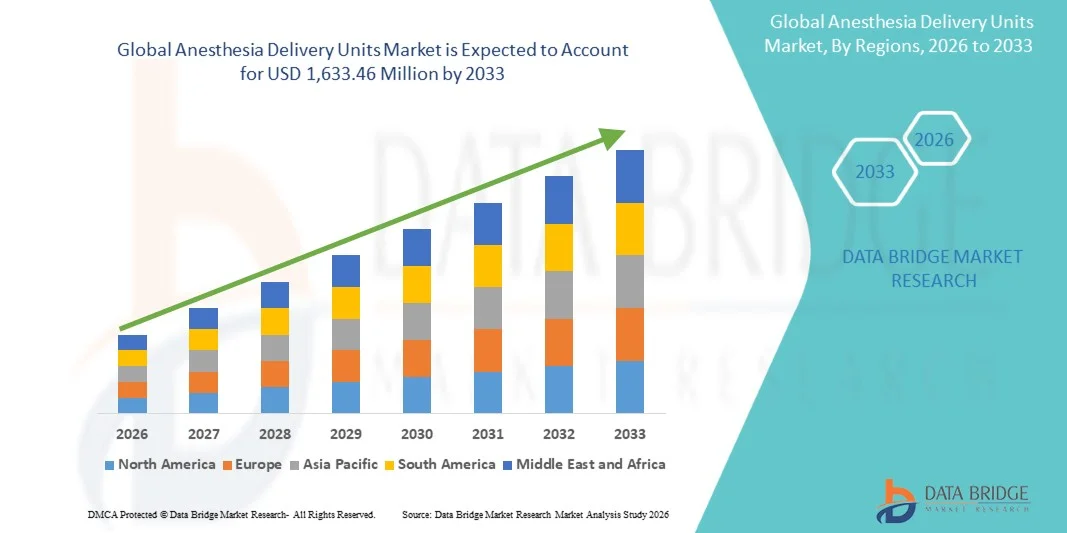
The Anesthesia Delivery Units Market was valued at USD 797.27 million in 2025 and is projected to reach USD 1,633.46 million by 2033, growing at a CAGR of 9.38% from 2026 to 2033. The market is witnessing steady expansion driven by the rising number of surgical procedures worldwide, increasing prevalence of chronic diseases requiring operative interventions, and continuous advancements in anesthesia workstation integration and patient monitoring technologies.
The growing demand for safer and more precise anesthesia administration, combined with strict regulatory focus on patient safety in operating rooms, is encouraging hospitals and ambulatory surgical centers to adopt advanced anesthesia delivery units. Modern systems with integrated ventilators, smart monitoring, and automated gas control are increasingly replacing conventional machines, enabling improved workflow efficiency, enhanced safety, and better perioperative outcomes across complex surgical environments.
Key Market Trends & Insights
- North America dominated the Anesthesia Delivery Units Market with the largest revenue share of 34.12% in 2025, supported by advanced healthcare infrastructure, high surgical volumes, and strong adoption of technologically advanced anesthesia workstations.
- The Anesthesia Delivery Devices segment led the market with a 46.38% share in 2025, driven by their central role in administering precise concentrations of anesthetic agents during surgical procedures across hospitals and surgical centers.
- Asia-Pacific is expected to be the fastest-growing region at a CAGR of 6.9% from 2026 to 2033, fueled by expanding hospital infrastructure, rising medical tourism, and increasing investments in surgical care capabilities across emerging economies.
- Monitoring Devices are the fastest-growing type, projected to register a CAGR of 6.8%, reflecting the surge in demand for real-time patient monitoring and anesthesia depth assessment during surgical procedures.
- The Smart Anesthesia Workstations segment dominated the technology category with a 38.92% revenue share in 2025, led by automotive OEMs adopting simulators for ADAS testing and autonomous vehicle validation.
- Anesthesia Machines accounted for 29.84% of the market, preferred by the primary hardware platform for administering and regulating anesthetic gases during surgical procedures.
- The Monitoring & Control Systems segment is the fastest-growing component category, with a CAGR of 7.2%, driven by increasing demand for precision monitoring and automated anesthesia regulation.
Market Size & Forecast
- Global Market Value (2025): USD 797.27 Million
- Expected Market Value (2033): USD 1,633.46 Million
- Forecast CAGR (2026–2033): 9.38%
- Leading Region in 2025: North America
- Fastest Growing Region: Asia Pacific
Report Scope and Anesthesia Delivery Units Market Segmentation
|
Attributes |
Anesthesia Delivery Units Key Market Insights |
|
Segments Covered |
|
|
Countries Covered |
North America · U.S. · Canada · Mexico Europe · Germany · France · U.K. · Netherlands · Switzerland · Belgium · Russia · Italy · Spain · Turkey · Rest of Europe Asia-Pacific · China · Japan · India · South Korea · Singapore · Malaysia · Australia · Thailand · Indonesia · Philippines · Rest of Asia-Pacific Middle East and Africa · Saudi Arabia · U.A.E. · South Africa · Egypt · Israel · Rest of Middle East and Africa South America · Brazil · Argentina · Rest of South America |
|
Key Market Players |
· Drägerwerk AG & Co. KGaA (Germany) · GE HealthCare (U.S.) · Mindray Medical International Limited (China) · Getinge AB (Sweden) · Hamilton Medical AG (Switzerland) · Penlon Limited (U.K.) · Spacelabs Healthcare, Inc. (U.S.) · Heyer Medical AG (Germany) · Medtronic (Ireland) · Koninklijke Philips N.V. (Netherlands) · Fresenius Kabi AG (Germany) · Smiths Medical (U.S.) · B. Braun SE (Germany) · OSI (U.S.) · Drägerwerk AG & Co. KGaA (Germany) · Siare Engineering International Group (Italy) · AEONMED Co., Ltd. (China) · Zoll Medical Corporation (U.S.) · Mindray DS USA Inc. (China) · Draeger India Pvt. Ltd. (Germany) |
|
Market Opportunities |
· Rising adoption of AI-integrated anesthesia workstations · Expansion of ambulatory surgical centers (ASCs) globally · Increasing focus on low-flow and eco-friendly anesthesia systems |
|
Value Added Data Infosets |
In addition to the insights on market scenarios such as market value, growth rate, segmentation, geographical coverage, and major players, the market reports curated by the Data Bridge Market Research also include in-depth expert analysis, patient epidemiology, pipeline analysis, pricing analysis, and regulatory framework. |
Anesthesia Delivery Units Market Trends
Trend: Growth in Smart & Integrated Anesthesia Workstations
Hospitals are increasingly adopting smart anesthesia delivery units integrated with advanced patient monitoring, ventilators, and automated gas control systems to improve surgical precision and patient safety. The shift toward digital operating rooms is enabling real-time anesthetic depth monitoring, data-driven dosage adjustments, and seamless connectivity with hospital information systems. For instance, modern anesthesia workstations now combine closed-loop control features with electronic health record integration to reduce manual errors and enhance perioperative efficiency across high-risk surgeries and complex procedures.
Anesthesia Delivery Units Market Dynamics
Key Market Driver: Rising Surgical Volumes and Chronic Disease Burden
The increasing prevalence of chronic diseases such as cardiovascular disorders, cancer, and respiratory conditions is significantly driving the demand for surgical interventions requiring anesthesia delivery units. Expanding geriatric populations and rising elective and emergency surgeries are further increasing utilization rates in hospitals and ambulatory surgical centers worldwide. For instance, large-scale hospital networks are expanding operating room capacities and upgrading anesthesia systems to handle higher patient inflow while ensuring improved safety standards and reduced procedural complications.
Key Restraint/Challenge: High Cost and Maintenance of Advanced Systems
A major restraint in the Anesthesia Delivery Units Market is the high acquisition cost and ongoing maintenance requirements of advanced integrated anesthesia workstations. These systems require regular calibration, software upgrades, consumables, and trained personnel, increasing the total cost of ownership for healthcare providers, especially in cost-sensitive regions. For instance, small and mid-sized hospitals in emerging economies often delay procurement of high-end anesthesia systems due to budget limitations and reliance on refurbished or basic anesthesia machines instead of fully integrated digital platforms.
Key Market Opportunity: Expansion of Ambulatory and Minimally Invasive Surgeries
The growing shift toward ambulatory surgical centers and minimally invasive procedures presents a significant opportunity for compact and mobile anesthesia delivery units. These environments require portable, efficient, and fast-deployable anesthesia systems that support short-duration surgeries with rapid patient turnover and minimal infrastructure. For instance, day-care surgery centers are increasingly adopting mobile anesthesia workstations equipped with simplified interfaces and integrated safety monitoring to support outpatient procedures while reducing hospital stay durations and overall treatment costs.
Anesthesia Delivery Units Market Scope
The anesthesia delivery units market is segmented on the basis of type, technology, component, end user, and distribution channel.
- By Type
On the basis of type, the Anesthesia Delivery Units Market is segmented into monitoring devices, anesthesia delivery devices, disposables device, and others. The Anesthesia Delivery Devices segment dominated the market with a 46.38% share in 2025, owing to their central role in administering precise concentrations of anesthetic agents during surgical procedures across hospitals and surgical centers. These systems form the core of operating room anesthesia infrastructure and are widely integrated with ventilators and monitoring modules for enhanced patient safety. Increasing surgical volumes and rising demand for advanced anesthesia workstations are further strengthening this segment’s dominance. Hospitals prefer integrated delivery systems due to improved workflow efficiency and reduced manual intervention. Continuous technological upgrades, including digital flow control and automated drug delivery, are enhancing performance reliability. The segment remains essential across all major surgical specialties, supporting both routine and complex procedures.
The Monitoring Devices segment is projected to register the fastest growth at a CAGR of 6.8% from 2026 to 2033, driven by rising demand for real-time patient monitoring and anesthesia depth assessment during surgical procedures. These devices help track vital parameters such as oxygen levels, gas concentration, and cardiovascular stability, improving patient safety outcomes. Increasing adoption of integrated operating room systems is further accelerating their use alongside anesthesia delivery units. Technological advancements in non-invasive monitoring and AI-based predictive analytics are enhancing clinical decision-making. Growing emphasis on reducing anesthesia-related complications is supporting adoption across hospitals and ambulatory centers. Rising healthcare digitization and smart OR integration are also boosting this segment’s expansion.
- By Technology
On the basis of technology, the Anesthesia Delivery Units Market is segmented into conventional anesthesia systems, digital systems, smart anesthesia workstations, and closed-loop anesthesia delivery systems. The Smart Anesthesia Workstations segment dominated the market with a 38.92% share in 2025, due to increasing adoption of integrated systems that combine anesthesia delivery, ventilation, and patient monitoring in a single platform. These systems enhance precision in drug administration and improve patient safety during complex surgeries. Hospitals prefer smart workstations because they reduce manual workload and minimize medication errors. Integration with hospital IT systems and electronic health records is further strengthening adoption. Continuous innovation in automation and real-time analytics is improving surgical efficiency. The segment is widely used in tertiary care hospitals and advanced surgical centers.
The Closed-loop Anesthesia Delivery Systems segment is projected to register the fastest growth at a CAGR of 7.4% from 2026 to 2033, driven by advancements in automation and AI-based drug control mechanisms. These systems automatically adjust anesthetic dosage based on patient physiological feedback, reducing clinician intervention. Increasing focus on precision medicine and patient-specific anesthesia management is accelerating adoption. Growing research in AI-assisted surgical systems is further supporting development. Hospitals are increasingly investing in next-generation automation technologies to enhance safety and efficiency. Regulatory emphasis on reducing anesthesia-related risks is also contributing to growth.
- By Component
On the basis of component, the Anesthesia Delivery Units Market is segmented into anesthesia machines, vaporizers, flow meters, breathing circuits, ventilators, waste gas scavenging systems, and monitoring & control systems. The Anesthesia Machines segment dominated the market with a 29.84% share in 2025, as they form the primary hardware platform for administering and regulating anesthetic gases during surgical procedures. These machines are widely installed across operating rooms due to their essential role in ensuring controlled and safe anesthesia delivery. Hospitals increasingly prefer integrated machines combining ventilation, monitoring, and vaporization functions. Rising surgical volumes and infrastructure expansion in healthcare facilities are further driving demand. Continuous upgrades in digital interfaces and safety systems are enhancing operational efficiency. The segment remains a core requirement across all healthcare settings performing surgical interventions.
The Monitoring & Control Systems segment is projected to register the fastest growth at a CAGR of 7.2% from 2026 to 2033, driven by increasing demand for precision monitoring and automated anesthesia regulation. These systems enable real-time tracking of patient vitals and anesthesia depth, reducing risks during surgery. Integration with AI-based analytics and hospital digital platforms is enhancing clinical decision-making. Growing emphasis on patient safety and regulatory compliance is further boosting adoption. Hospitals are increasingly investing in advanced control systems to improve surgical outcomes. Expansion of smart operating rooms is also accelerating segment growth.
- By End User
On the basis of end user, the Anesthesia Delivery Units Market is segmented into hospitals, research centres, clinics, and others. The Hospitals segment dominated the market with a 62.17% share in 2025, due to high surgical volumes, advanced infrastructure, and widespread availability of specialized operating rooms. Hospitals are the primary users of anesthesia delivery units for a wide range of procedures, from routine surgeries to complex critical care operations. Increasing investments in healthcare modernization and operating room upgrades are strengthening demand. Large hospital networks also prefer integrated anesthesia systems for efficiency and safety compliance. Rising prevalence of chronic diseases requiring surgical treatment further supports this dominance. Continuous expansion of hospital capacity in both developed and emerging markets is sustaining growth.
The Clinics segment is projected to register the fastest growth at a CAGR of 6.9% from 2026 to 2033, driven by the rising number of ambulatory surgical procedures and outpatient care facilities. Clinics are increasingly adopting compact and mobile anesthesia delivery units for minor and same-day surgeries. Growing preference for cost-effective and minimally invasive treatments is boosting adoption. Technological advancements are enabling smaller facilities to access advanced anesthesia systems. Expansion of private healthcare infrastructure and day-care surgery centers is further accelerating growth. Increasing patient preference for shorter hospital stays is also supporting this segment.
- By Distribution Channel
On the basis of distribution channel, the Anesthesia Delivery Units Market is segmented into direct sales and distributor networks. The Direct Sales segment dominated the market with a 57.43% share in 2025, as major manufacturers prefer direct engagement with hospitals and large healthcare systems for customized solutions and long-term service contracts. This channel ensures better pricing control, technical support, and installation services. Large-scale procurement by hospital networks and government healthcare systems further supports direct sales dominance. Manufacturers also benefit from stronger customer relationships and after-sales service integration. Increasing demand for high-value integrated systems encourages direct negotiations. This model is widely used for premium anesthesia workstations and hospital-grade installations.
The Distributor segment is projected to register the fastest growth at a CAGR of 6.7% from 2026 to 2033, driven by expanding healthcare infrastructure in emerging markets where distributors play a key role in market penetration. Distributors help manufacturers reach smaller hospitals and clinics with limited procurement capabilities. Growing demand in rural and semi-urban healthcare facilities is boosting channel expansion. They also provide localized support, maintenance, and training services. Increasing participation of regional medical equipment suppliers is strengthening distribution networks. This channel is becoming critical for scaling adoption in cost-sensitive regions.
Anesthesia Delivery Units Market Regional Analysis
North America dominated the Anesthesia Delivery Units Market with the largest revenue share of 34.12% in 2025, supported by advanced healthcare infrastructure, high surgical volumes, and strong adoption of technologically advanced anesthesia workstations. The region also benefits from well-established hospital networks, increasing prevalence of chronic diseases requiring surgical interventions, and strong presence of leading medical device manufacturers. Rapid integration of smart anesthesia systems, AI-enabled monitoring, and digitally connected operating rooms continues to strengthen regional dominance. Increasing focus on patient safety, perioperative efficiency, and minimally invasive surgical procedures further reinforces North America’s leadership position in the global market.
U.S. Anesthesia Delivery Units Market Insight
The U.S. anesthesia delivery units market is witnessing strong growth due to rising surgical volumes, high prevalence of chronic diseases, and increasing adoption of advanced anesthesia workstations across healthcare facilities. The country’s highly developed hospital infrastructure, along with strong penetration of minimally invasive surgeries and ambulatory surgical centers, is driving demand for precision-based anesthesia delivery systems. In addition, growing integration of smart monitoring systems, AI-enabled anesthesia management, and connected operating rooms is accelerating technology adoption. Increasing focus on patient safety standards and perioperative efficiency is further strengthening market expansion across hospitals and specialty surgical centers.
Europe Anesthesia Delivery Units Market Insight
The Europe anesthesia delivery units market remains a major contributor to global revenue, driven by strong healthcare systems, strict patient safety regulations, and widespread adoption of advanced surgical technologies. The region’s well-established hospital networks and increasing investments in digital operating rooms are supporting demand for integrated anesthesia workstations. Rising preference for energy-efficient and low-flow anesthesia systems, along with growing use of smart monitoring platforms, is enhancing adoption. Continuous focus on surgical precision, infection control, and regulatory compliance continues to strengthen market penetration across Europe.
U.K. Anesthesia Delivery Units Market Insight
The U.K. anesthesia delivery units market is experiencing steady growth, supported by modernization of healthcare infrastructure, increasing surgical procedures, and rising adoption of advanced anesthesia technologies in public and private hospitals. Growing investment in digital healthcare transformation and operating room automation is driving demand for integrated anesthesia systems. In addition, increasing use of ambulatory surgical centers and emphasis on cost-efficient healthcare delivery are contributing to market expansion. Integration of smart monitoring systems and improved perioperative care protocols is further enhancing system adoption across clinical settings.
Germany Anesthesia Delivery Units Market Insight
The Germany anesthesia delivery units market is expanding steadily due to strong medical device manufacturing capabilities, advanced hospital infrastructure, and increasing demand for high-precision surgical care. Hospitals and surgical centers are increasingly adopting smart anesthesia workstations for improved safety, efficiency, and automation in perioperative management. Rising focus on innovation, research-driven healthcare, and digital operating room technologies is further driving market growth. In addition, strong regulatory standards for patient safety and growing emphasis on minimally invasive surgeries are supporting sustained adoption across the country.
Asia-Pacific Anesthesia Delivery Units Market Insight
The Asia-Pacific anesthesia delivery units market is expected to witness rapid growth, driven by expanding healthcare infrastructure, rising surgical volumes, and increasing investments in hospital modernization across countries such as China, India, and Japan. Growing awareness of patient safety, rising adoption of advanced anesthesia systems, and increasing access to surgical care are supporting regional expansion. In addition, the rapid growth of ambulatory surgical centers and medical tourism is accelerating demand for cost-effective and portable anesthesia delivery units. Continuous technological advancements and improving healthcare spending are further strengthening market growth across the region.
Japan Anesthesia Delivery Units Market Insight
The Japan anesthesia delivery units market is witnessing consistent growth due to advanced healthcare infrastructure, strong focus on patient safety, and increasing adoption of high-precision medical technologies. Hospitals and surgical centers are increasingly integrating smart anesthesia workstations with real-time monitoring and automated control systems. Rising demand for minimally invasive procedures and aging population-driven surgical needs are further supporting market expansion. In addition, continuous innovation in medical robotics and digital operating room systems is enhancing efficiency and driving technology adoption across healthcare facilities.
China Anesthesia Delivery Units Market Insight
The China anesthesia delivery units market is growing rapidly, driven by expanding healthcare infrastructure, increasing surgical procedures, and rising government investment in hospital modernization and patient safety systems. Growing adoption of advanced anesthesia workstations, smart monitoring devices, and digital operating room technologies is significantly boosting market demand. In addition, increasing prevalence of chronic diseases, rising medical tourism, and expansion of tertiary care hospitals are supporting strong growth. Continuous technological advancements and rapid healthcare digitization are positioning China as one of the fastest-growing markets globally.
Anesthesia Delivery Units Market Share
The anesthesia delivery units industry is primarily led by well-established companies, including:
- Drägerwerk AG & Co. KGaA (Germany)
- GE HealthCare (U.S.)
- Mindray Medical International Limited (China)
- Getinge AB (Sweden)
- Hamilton Medical AG (Switzerland)
- Penlon Limited (U.K.)
- Spacelabs Healthcare, Inc. (U.S.)
- Heyer Medical AG (Germany)
- Medtronic (Ireland)
- Koninklijke Philips N.V. (Netherlands)
- Fresenius Kabi AG (Germany)
- Smiths Medical (U.S.)
- Braun SE (Germany)
- OSI (U.S.)
- Drägerwerk AG & Co. KGaA (Germany)
- Siare Engineering International Group (Italy)
- AEONMED Co., Ltd. (China)
- Zoll Medical Corporation (U.S.)
- Mindray DS USA Inc. (China)
- Draeger India Pvt. Ltd. (Germany)
Latest Developments in Anesthesia Delivery Units Market
- In February 2024, Getinge upgraded its Flow Family anesthesia platform, enhancing ventilation performance, gas efficiency, and ergonomic workflow design. The improved system supports a wide range of surgical procedures, from routine operations to complex interventions, with greater precision and reliability. It also improves compatibility with advanced monitoring systems used in perioperative environments, supporting integrated patient care. The platform is designed to simplify clinical workflows while maintaining high safety standards for anesthesia delivery
- In April 2023, Dräger introduced performance and digital workflow enhancements across its anesthesia systems portfolio, focusing on improving ventilation efficiency, user interface design, and hospital system integration. These updates aim to reduce clinician workload while increasing precision and consistency in anesthesia delivery. The improvements also strengthen connectivity between anesthesia workstations and patient monitoring systems, enabling better real-time clinical coordination. Hospitals benefit from improved safety, streamlined workflows, and enhanced operational efficiency in complex surgical procedures
- In May 2022, Mindray expanded the global deployment of its A9 anesthesia workstation, a high-performance system designed for intelligent ventilation and precise anesthesia delivery. The platform includes advanced gas monitoring, closed-loop ventilation capabilities, and integrated smart alarm systems to enhance patient safety during surgical procedures. It is widely used in high-acuity hospital settings where precision and reliability are critical. The system also features intuitive digital interfaces that improve usability and operational efficiency for anesthesiologists
- In September 2021, GE HealthCare enhanced its CARESCAPE anesthesia ecosystem by improving interoperability between anesthesia delivery systems and patient monitoring platforms. This development enables real-time data exchange across operating rooms, supporting improved clinical decision-making and more efficient perioperative management. The integration strengthens workflow efficiency by consolidating anesthesia data within centralized hospital systems. It also enhances patient safety through continuous monitoring and advanced analytics-driven insights
- In March 2021, Dräger expanded global adoption of its Atlan A350/A350 XL anesthesia workstation, strengthening its advanced anesthesia delivery portfolio across hospitals and surgical centers. The system is designed to deliver precise ventilation control, integrated patient monitoring, and efficient low-flow anesthesia delivery to enhance safety in operating rooms. It supports automated ventilation modes that reduce manual intervention and improve perioperative workflow efficiency. The platform also emphasizes infection control, ergonomic usability, and seamless digital connectivity with hospital IT systems, enabling better clinical coordination

- Interactive Data Analysis Dashboard
- Company Analysis Dashboard for high growth potential opportunities
- Research Analyst Access for customization & queries
- Competitor Analysis with Interactive dashboard
- Latest News, Updates & Trend analysis
- Harness the Power of Benchmark Analysis for Comprehensive Competitor Tracking
Data collection and base year analysis are done using data collection modules with large sample sizes. The stage includes obtaining market information or related data through various sources and strategies. It includes examining and planning all the data acquired from the past in advance. It likewise envelops the examination of information inconsistencies seen across different information sources. The market data is analysed and estimated using market statistical and coherent models. Also, market share analysis and key trend analysis are the major success factors in the market report. To know more, please request an analyst call or drop down your inquiry.
The key research methodology used by DBMR research team is data triangulation which involves data mining, analysis of the impact of data variables on the market and primary (industry expert) validation. Data models include Vendor Positioning Grid, Market Time Line Analysis, Market Overview and Guide, Company Positioning Grid, Patent Analysis, Pricing Analysis, Company Market Share Analysis, Standards of Measurement, Global versus Regional and Vendor Share Analysis. To know more about the research methodology, drop in an inquiry to speak to our industry experts.
Data Bridge Market Research is a leader in advanced formative research. We take pride in servicing our existing and new customers with data and analysis that match and suits their goal. The report can be customized to include price trend analysis of target brands understanding the market for additional countries (ask for the list of countries), clinical trial results data, literature review, refurbished market and product base analysis. Market analysis of target competitors can be analyzed from technology-based analysis to market portfolio strategies. We can add as many competitors that you require data about in the format and data style you are looking for. Our team of analysts can also provide you data in crude raw excel files pivot tables (Fact book) or can assist you in creating presentations from the data sets available in the report.













