


Animal Livestock Drugs Market Overview
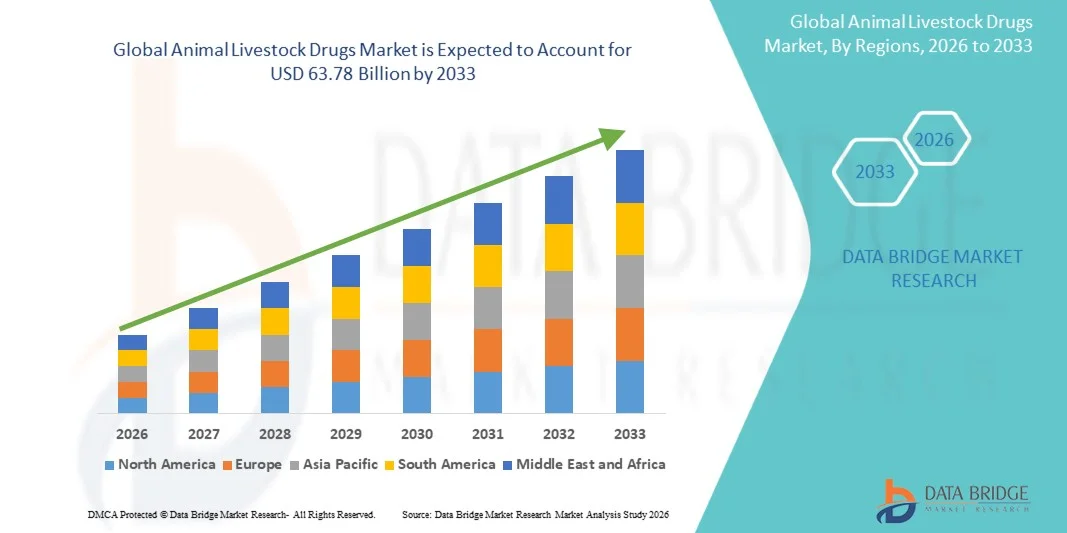
The Animal Livestock Drugs Market was valued at USD 41.88 billion in 2025 and is projected to reach USD 63.78 billion by 2033, growing at a CAGR of 5.40% from 2026 to 2033. The market is witnessing steady expansion driven by rising global demand for animal protein, increasing livestock population, and growing focus on preventive veterinary healthcare, including vaccines, antibiotics, and parasiticides. Advancements in veterinary pharmaceuticals and biologics, along with expanding commercial livestock farming practices, are further supporting market growth.
The increasing prevalence of infectious and zoonotic diseases in livestock, combined with stricter government regulations on food safety and animal welfare, is compelling farmers, veterinary institutions, and food producers to adopt advanced animal health solutions. Growing investments in veterinary R&D, rising awareness of herd health management, and expanding access to veterinary services in emerging economies are accelerating the adoption of innovative livestock drugs, ensuring higher productivity, improved animal health outcomes, and safer food supply chains.
Key Market Trends & Insights
- North America dominated the Animal Livestock Drugs Market with the largest revenue share of 35.12% in 2025, supported by large-scale commercial livestock production, advanced veterinary healthcare infrastructure, and strong regulatory emphasis on animal health and food safety standards.
- The Cattle segment led the market with a 38.6% share in 2025, driven by high global demand for dairy and beef products and the extensive use of vaccines, antibiotics, and parasiticides in herd health management.
- Asia-Pacific is expected to be the fastest-growing region at a CAGR of 7.1% from 2026 to 2033, fueled by rapid growth in livestock population, increasing meat consumption, expanding veterinary service access, and government support for modern animal husbandry practices.
- Pigs are the fastest-growing type, projected to register a CAGR of 6.9%, reflecting the surge in global pork consumption and intensification of commercial swine farming.
- The Vaccines segment dominated the product category with a 43.2% revenue share in 2025, led by rising emphasis on preventive animal healthcare and disease control programs.
- Veterinary Hospitals accounted for 46.1% of the market, preferred by the availability of advanced diagnostic facilities and trained veterinary professionals.
- The Medicated Feed Additives segment is the fastest-growing product category, with a CAGR of 7.2%, driven by rising demand for efficient mass medication solutions in intensive livestock farming.
Market Size & Forecast
- Global Market Value (2025): USD 41.88 Billion
- Expected Market Value (2033): USD 63.78 Billion
- Forecast CAGR (2026–2033): 5.40%
- Leading Region in 2025: North America
- Fastest Growing Region: Asia Pacific
Report Scope and Animal Livestock Drugs Market Segmentation
|
Attributes |
Animal Livestock Drugs Key Market Insights |
|
Segments Covered |
|
|
Countries Covered |
North America · U.S. · Canada · Mexico Europe · Germany · France · U.K. · Netherlands · Switzerland · Belgium · Russia · Italy · Spain · Turkey · Rest of Europe Asia-Pacific · China · Japan · India · South Korea · Singapore · Malaysia · Australia · Thailand · Indonesia · Philippines · Rest of Asia-Pacific Middle East and Africa · Saudi Arabia · U.A.E. · South Africa · Egypt · Israel · Rest of Middle East and Africa South America · Brazil · Argentina · Rest of South America |
|
Key Market Players |
· Merck & Co., Inc. (U.S.) · Zoetis Inc. (U.S.) · Elanco Animal Health (U.S.) · Boehringer Ingelheim International GmbH (Germany) · Ceva Santé Animale (France) · Virbac S.A. (France) · Bayer Animal Health (Germany) · Dechra Pharmaceuticals PLC (U.K.) · Phibro Animal Health Corporation (U.S.) · Vetoquinol S.A. (France) · Huvepharma EOOD (Bulgaria) · Kemin Industries, Inc. (U.S.) · Neogen Corporation (U.S.) · Indian Immunologicals Limited (India) · Intas Pharmaceuticals Ltd (India) · Bimeda Animal Health Limited (Ireland) · Zoetis Services LLC (U.S.) · Elanco US Inc. (U.S.) · MSD Animal Health (U.S.) · Zydus Animal Health and Investments Ltd (India) |
|
Market Opportunities |
· Rising adoption of next-generation veterinary biologics such as mRNA and recombinant vaccines · Integration of precision livestock farming technologies with drug administration systems · Expanding livestock production in emerging economies |
|
Value Added Data Infosets |
In addition to the insights on market scenarios such as market value, growth rate, segmentation, geographical coverage, and major players, the market reports curated by the Data Bridge Market Research also include in-depth expert analysis, patient epidemiology, pipeline analysis, pricing analysis, and regulatory framework. |
Animal Livestock Drugs Market Trends
Trend: Growth in Preventive Livestock Healthcare & Vaccination Programs
Livestock producers are increasingly shifting from curative treatments to preventive healthcare strategies, with vaccines, parasiticides, and feed additives being widely adopted to reduce disease outbreaks and improve herd productivity. The integration of advanced biologics, including recombinant and combination vaccines, is improving disease coverage and treatment efficiency across large-scale farming systems. Digital livestock monitoring tools and precision farming practices are also enabling early disease detection and targeted drug administration, reducing overall medication costs and improving animal welfare outcomes across commercial operations, for instance large integrated poultry and dairy farming systems in Europe and North America deploying mass vaccination protocols with real-time herd health tracking technologies.
Animal Livestock Drugs Market Dynamics
Key Market Driver: Rising Global Demand for Animal Protein Consumption
The increasing global consumption of meat, milk, and eggs is driving the expansion of intensive livestock farming, which in turn is fueling demand for veterinary drugs to ensure animal health, productivity, and food safety compliance. Growing population levels, urbanization, and rising disposable incomes are further accelerating protein consumption patterns, particularly in emerging economies where livestock production is rapidly scaling up. This has led to higher usage of antibiotics, vaccines, and growth-promoting feed additives to maximize yield efficiency and reduce mortality rates in commercial farming operations, for instance large-scale swine and poultry production systems in China, India, and Brazil adopting structured veterinary drug programs to meet rising domestic and export demand.
Key Restraint/Challenge: Stringent Regulations on Antibiotic Usage in Livestock Farming
Increasing regulatory restrictions on the use of antibiotics in animal husbandry, driven by concerns over antimicrobial resistance and food safety risks, are limiting the overuse of certain livestock drugs and increasing compliance burdens for producers. Governments and international health organizations are enforcing stricter withdrawal periods, prescription controls, and bans on growth-promoting antibiotics, requiring farmers to adopt alternative therapeutic approaches. This regulatory pressure is increasing operational complexity and raising costs for livestock producers, particularly in regions with advanced food safety frameworks, for instance the European Union enforcing strict limits on antibiotic growth promoters under its veterinary medicinal products regulation, compelling farms to shift toward vaccines and non-antibiotic alternatives.
Key Market Opportunity: Expansion of Next-Generation Biologics and Antibiotic Alternatives
The growing shift toward sustainable livestock production is creating strong opportunities for advanced biologics, including recombinant vaccines, monoclonal antibodies, and immunomodulators that offer targeted disease protection with reduced resistance risks. Rising restrictions on antibiotic usage are accelerating demand for natural and non-antibiotic alternatives such as probiotics, phytogenics, enzymes, and immune-boosting feed additives that enhance animal health and productivity. Increasing investments in veterinary biotechnology and precision medicine are further supporting innovation in species-specific and disease-specific therapies across large-scale farming systems, for instance commercial livestock producers in the U.S. and Brazil adopting probiotic-enriched feed formulations and advanced vaccine platforms to improve herd performance while complying with stricter global antimicrobial regulations.
Animal Livestock Drugs Market Scope
The animal livestock drugs market is segmented on the basis of animal type, product, end-user, and distribution channel.
- By Type
On the basis of type, the Animal Livestock Drugs Market is segmented into cattle, sheep, pigs, goats, horses, and others. The Cattle segment dominated the market with a 38.6% share in 2025, owing to high global demand for dairy and beef products and the extensive use of vaccines, antibiotics, and parasiticides in herd health management. Cattle farming involves large-scale commercial operations where disease prevention is critical for productivity and economic stability. Increasing prevalence of bovine respiratory diseases and mastitis is further driving drug consumption in this segment. Advanced veterinary care infrastructure in developed regions supports routine immunization and therapeutic interventions. Rising export-oriented dairy production is also strengthening the dominance of this segment. High per-animal treatment value further contributes to its leading market share.
The Pigs (Swine) segment is projected to register the fastest growth at a CAGR of 6.9% from 2026 to 2033, driven by rising global pork consumption and intensification of commercial swine farming. Swine are highly susceptible to infectious diseases, requiring frequent vaccination and preventive drug administration. Increasing outbreaks of African Swine Fever have significantly boosted demand for biosecurity and veterinary pharmaceutical solutions. Expansion of large-scale pig farming in Asia-Pacific is further accelerating growth. Rising adoption of feed-based medication and herd-wide treatment programs is improving efficiency. Government support for food security and livestock modernization is also enhancing segment expansion.
- By Product
On the basis of product, the market is segmented into drugs, vaccines, and medicated feed additives. The Vaccines segment dominated the market with a 43.2% share in 2025, driven by rising emphasis on preventive animal healthcare and disease control programs. Vaccination reduces mortality, improves productivity, and minimizes dependency on antibiotics in livestock farming. Increasing prevalence of zoonotic and infectious diseases is further accelerating vaccine adoption. Government-led immunization campaigns for livestock are strongly supporting demand. Technological advancements in recombinant and multivalent vaccines are improving efficacy and coverage. Large-scale commercial farms rely heavily on vaccination schedules to maintain herd health stability.
The Medicated Feed Additives segment is expected to witness the fastest growth at a CAGR of 7.2% from 2026 to 2033, driven by rising demand for efficient mass medication solutions in intensive livestock farming. These additives improve growth performance, immunity, and feed conversion efficiency across large herds. Increasing restrictions on antibiotic growth promoters are accelerating the shift toward alternative feed-based therapeutics. Growing adoption in poultry and swine production is further supporting expansion. Rising awareness of animal nutrition and gut health is strengthening demand for functional feed additives. The segment also benefits from cost-effective large-scale administration in commercial farming systems.
- By End-User
On the basis of end-user, the market is segmented into veterinary hospitals, veterinary specialty clinics, and others. The Veterinary Hospitals segment dominated the market with a 46.1% share in 2025, driven by the availability of advanced diagnostic facilities and trained veterinary professionals. These hospitals handle large volumes of livestock cases requiring vaccination, emergency treatment, and disease management. Increasing livestock population and rising incidence of infectious diseases are supporting patient inflow. Government and private investments in veterinary healthcare infrastructure are strengthening hospital-based treatment systems. Veterinary hospitals also play a key role in disease surveillance and outbreak control. Their centralized services make them a primary channel for drug administration in large farming regions.
The Veterinary Specialty Clinics segment is expected to register the fastest growth at a CAGR of 6.8% from 2026 to 2033, driven by rising demand for specialized treatment services for complex livestock diseases. These clinics offer advanced reproductive care, surgical procedures, and targeted disease management solutions. Increasing commercialization of livestock farming is driving demand for specialized veterinary expertise. Growing awareness among farmers regarding animal health optimization is boosting clinic visits. Expansion of private veterinary practices in emerging economies is further accelerating growth. The segment is also benefiting from adoption of advanced diagnostic and therapeutic technologies.
- By Distribution Channel
On the basis of distribution channel, the market is segmented into veterinary hospital pharmacy, retail pharmacy, veterinary research institute, and others. The Veterinary Hospital Pharmacy segment dominated the market with a 44.5% share in 2025, due to direct linkage between diagnosis and drug dispensing within veterinary care facilities. This channel ensures accurate prescription-based drug administration and better treatment compliance among livestock owners. Increasing hospital-based treatment adoption is further strengthening this segment. It also supports emergency medication supply and bulk livestock treatment programs. Strong integration with veterinary professionals ensures controlled and effective drug usage. The convenience and reliability of hospital pharmacies make them the leading distribution channel.
The Retail Pharmacy segment is expected to witness the fastest growth at a CAGR of 6.7% from 2026 to 2033, driven by expanding access to veterinary medicines in rural and semi-urban areas. Retail pharmacies provide convenient availability of over-the-counter livestock drugs and preventive care products. Rising livestock population in emerging economies is increasing dependence on local supply channels. Growth in organized veterinary retail chains is further supporting market expansion. Increasing awareness of animal health management among farmers is boosting retail purchases. The segment benefits from affordability and widespread geographical reach.
Animal Livestock Drugs Market Regional Analysis
North America dominated the Animal Livestock Drugs Market with the largest revenue share of 35.12% in 2025, supported by large-scale commercial livestock production, advanced veterinary healthcare infrastructure, and strong regulatory emphasis on animal health and food safety standards. The region also benefits from high adoption of vaccines, antibiotics, and parasiticides, strong presence of leading animal health companies, and widespread use of preventive healthcare practices across cattle, poultry, and swine farming. Increasing focus on zoonotic disease control, herd productivity optimization, and technological advancements in veterinary pharmaceuticals continues to strengthen North America’s leadership position in the global market.
U.S. Animal Livestock Drugs Market Insight
The U.S. animal livestock drugs market is witnessing strong growth due to rising demand for animal protein, advanced veterinary healthcare infrastructure, and large-scale commercial livestock farming operations. The country’s well-established animal health industry, along with increasing adoption of vaccines, antibiotics, and parasiticides, is driving demand across cattle, poultry, and swine production systems. In addition, growing focus on zoonotic disease prevention, stringent food safety regulations, and rising investments in veterinary R&D are accelerating the adoption of advanced livestock drugs across production and healthcare applications.
Europe Animal Livestock Drugs Market Insight
Europe animal livestock drugs market remains a major contributor to global revenue, driven by strict animal welfare regulations, strong government-led disease control programs, and high adoption of preventive veterinary healthcare solutions. The widespread use of vaccines, feed additives, and biologics across intensive livestock farming systems is supporting market expansion across the region. Increasing investments in sustainable livestock production, rising concerns over antimicrobial resistance, and growing emphasis on reducing antibiotic usage continue to enhance adoption of advanced animal health solutions throughout Europe.
U.K. Animal Livestock Drugs Market Insight
The U.K. animal livestock drugs market is experiencing steady growth, supported by strong veterinary healthcare infrastructure, rising demand for livestock productivity enhancement, and increasing focus on disease prevention programs. Growing adoption of vaccines and alternative feed-based therapeutics is contributing to market expansion across cattle and poultry farming. Furthermore, integration of digital livestock monitoring systems and increasing awareness of antimicrobial resistance are improving treatment efficiency, positioning the U.K. as a key contributor in the European animal livestock drugs industry.
Germany Animal Livestock Drugs Market Insight
The Germany animal livestock drugs market is expanding steadily due to its advanced livestock farming systems, strong pharmaceutical manufacturing base, and increasing focus on animal health innovation. Veterinary hospitals, research institutes, and commercial farms are increasingly adopting biologics, vaccines, and precision livestock medications for improved productivity and disease control. Continuous advancements in veterinary biotechnology, along with strict regulatory standards on food safety and antibiotic usage, are further driving market growth in Germany.
Asia-Pacific Animal Livestock Drugs Market Insight
The Asia-Pacific animal livestock drugs market is expected to witness rapid growth, driven by rising livestock population, increasing meat consumption, and expanding veterinary healthcare access across countries such as China, India, and Southeast Asia. Growing awareness regarding animal disease prevention, rising adoption of vaccines and feed additives, and increasing government support for livestock modernization are supporting regional market expansion. In addition, rapid industrialization of animal farming and rising investments in veterinary pharmaceuticals are accelerating adoption of advanced livestock drug solutions across commercial production systems.
Japan Animal Livestock Drugs Market Insight
The Japan animal livestock drugs market is witnessing consistent growth due to advanced veterinary research capabilities, high standards of animal health management, and increasing adoption of preventive healthcare solutions. Livestock producers and veterinary institutions are increasingly utilizing vaccines, biologics, and medicated feed additives to ensure productivity and disease control. Moreover, growing focus on food safety, precision livestock farming, and technological integration in veterinary practices is further contributing to steady market growth in Japan.
China Animal Livestock Drugs Market Insight
The China animal livestock drugs market is growing rapidly, driven by large-scale livestock production, rising demand for protein-rich food products, and increasing government focus on animal disease control and food security. Expanding adoption of vaccines, antibiotics, and feed-based therapeutics across poultry, swine, and cattle farming is significantly boosting market demand. In addition, rapid modernization of livestock farming practices, increasing investments in veterinary pharmaceuticals, and strong emphasis on controlling major outbreaks such as swine diseases are positioning China as one of the fastest-growing markets globally.
Animal Livestock Drugs Market Share
The animal livestock drugs industry is primarily led by well-established companies, including:
- Merck & Co., Inc. (U.S.)
- Zoetis Inc. (U.S.)
- Elanco Animal Health (U.S.)
- Boehringer Ingelheim International GmbH (Germany)
- Ceva Santé Animale (France)
- Virbac S.A. (France)
- Bayer Animal Health (Germany)
- Dechra Pharmaceuticals PLC (U.K.)
- Phibro Animal Health Corporation (U.S.)
- Vetoquinol S.A. (France)
- Huvepharma EOOD (Bulgaria)
- Kemin Industries, Inc. (U.S.)
- Neogen Corporation (U.S.)
- Indian Immunologicals Limited (India)
- Intas Pharmaceuticals Ltd (India)
- Bimeda Animal Health Limited (Ireland)
- Zoetis Services LLC (U.S.)
- Elanco US Inc. (U.S.)
- MSD Animal Health (U.S.)
- Zydus Animal Health and Investments Ltd (India)
Latest Developments in Animal Livestock Drugs Market
- In March 2024, DSM-Firmenich and Elanco announced U.S. FDA acceptance of Bovaer feed additive for dairy cattle, marking a major regulatory milestone for methane-reducing livestock nutrition solutions. The development enables broader use of the 3-NOP-based feed additive to reduce enteric methane emissions in dairy production without impacting milk safety or productivity. This innovation supports the shift toward sustainable livestock farming and climate-focused animal nutrition strategies, strengthening the role of feed additives in modern livestock drug systems. It also reflects growing regulatory support for environmentally responsible veterinary solutions in intensive dairy farming systems
- In May 2023, Boehringer Ingelheim expanded its poultry vaccine portfolio with enhanced adoption of advanced immunization platforms such as Vaxxitek HVT+IBD across global markets. The expansion focuses on protecting poultry against multiple viral diseases, improving flock health, survival rates, and production efficiency in intensive farming systems. This development supports the global shift toward preventive healthcare and reduced antibiotic dependency in livestock production. It further strengthens Boehringer Ingelheim’s position in veterinary biologics and next-generation animal health solutions
- In September 2022, Zoetis advanced its livestock health portfolio through expanded adoption of cattle vaccines and respiratory disease prevention solutions across key global markets. These solutions are widely used to reduce bovine respiratory disease incidence and improve herd productivity in commercial cattle operations. The development highlights increasing demand for preventive veterinary medicines over curative treatments in large-scale livestock farming. It reinforces Zoetis’s leadership in biologics and innovative animal health pharmaceuticals
- In June 2022, Elanco announced strategic expansion initiatives in livestock biologics and alternative disease control solutions targeting swine and cattle segments. The development focuses on reducing antibiotic dependence through advanced immunology-based and microbial animal health platforms. It reflects increasing regulatory pressure on antimicrobial usage and rising demand for sustainable livestock production practices. The initiative strengthens Elanco’s pipeline in next-generation veterinary therapeutics and precision animal health solutions
- In November 2021, Merck Animal Health expanded its livestock vaccine portfolio with enhanced disease prevention solutions for cattle and swine populations. The development focuses on improving herd immunity against respiratory and infectious diseases, reducing economic losses in intensive livestock farming systems. It reflects growing global emphasis on preventive veterinary care and advanced biologics adoption. This expansion strengthens Merck’s position in the global animal health and livestock pharmaceutical market

- Interactive Data Analysis Dashboard
- Company Analysis Dashboard for high growth potential opportunities
- Research Analyst Access for customization & queries
- Competitor Analysis with Interactive dashboard
- Latest News, Updates & Trend analysis
- Harness the Power of Benchmark Analysis for Comprehensive Competitor Tracking
Data collection and base year analysis are done using data collection modules with large sample sizes. The stage includes obtaining market information or related data through various sources and strategies. It includes examining and planning all the data acquired from the past in advance. It likewise envelops the examination of information inconsistencies seen across different information sources. The market data is analysed and estimated using market statistical and coherent models. Also, market share analysis and key trend analysis are the major success factors in the market report. To know more, please request an analyst call or drop down your inquiry.
The key research methodology used by DBMR research team is data triangulation which involves data mining, analysis of the impact of data variables on the market and primary (industry expert) validation. Data models include Vendor Positioning Grid, Market Time Line Analysis, Market Overview and Guide, Company Positioning Grid, Patent Analysis, Pricing Analysis, Company Market Share Analysis, Standards of Measurement, Global versus Regional and Vendor Share Analysis. To know more about the research methodology, drop in an inquiry to speak to our industry experts.
Data Bridge Market Research is a leader in advanced formative research. We take pride in servicing our existing and new customers with data and analysis that match and suits their goal. The report can be customized to include price trend analysis of target brands understanding the market for additional countries (ask for the list of countries), clinical trial results data, literature review, refurbished market and product base analysis. Market analysis of target competitors can be analyzed from technology-based analysis to market portfolio strategies. We can add as many competitors that you require data about in the format and data style you are looking for. Our team of analysts can also provide you data in crude raw excel files pivot tables (Fact book) or can assist you in creating presentations from the data sets available in the report.












