


Anionic Surfactants Market Overview
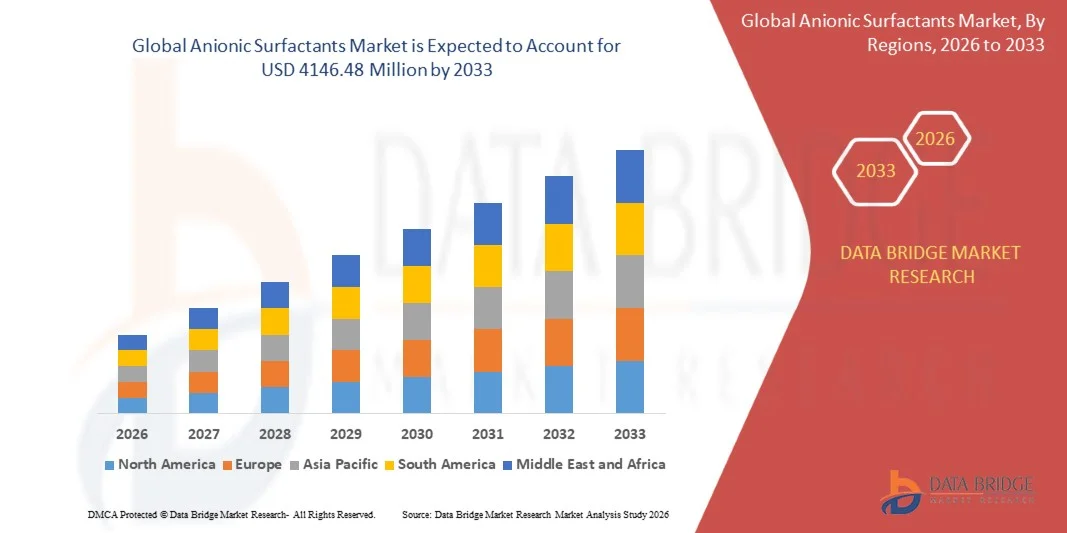
As per Data Bridge Market Research Analysis the Anionic Surfactants Market was valued at USD 3001.97 million in 2025 and is projected to reach USD 4146.48 million by 2033, growing at a CAGR of 4.12% from 2026 to 2033. The market is experiencing steady growth driven by rising demand for effective cleaning and personal care solutions, rapid advancements in surfactant chemistry, and expanding applications across household detergents, personal care products, and industrial sectors.
The increasing global focus on hygiene and sanitation, combined with stricter government regulations on chemical safety and environmental impact, is compelling manufacturers, cleaning product companies, and personal care brands to adopt advanced anionic surfactant technologies. Linear Alkylbenzene Sulfonate (LAS) and Alcohol Ether Sulfates (AES) remain dominant in many markets, offering cost-effective, high-performance, and versatile solutions for soil removal, foaming, and emulsification in both consumer and industrial applications.
Key Market Trends & Insights
- North America remains the largest market for anionic surfactants, primarily due to its robust home care segment.
- Asia-Pacific is the fastest-growing region, reflecting increasing demand in personal care applications.
- The Home Care segment led the market in 2025, driven by heightened hygiene consciousness, sustained demand for effective cleaning solutions, and the widespread use of anionic surfactants in laundry detergents, dishwashing liquids, and surface cleaners.
- The Personal Care segment is the fastest-growing application area, projected to register strong growth, reflecting the surge in demand for mild, sulfate-free, and skin-compatible formulations in shampoos, body washes, and facial cleansers.
- Linear Alkylbenzene Sulfonate (LAS) remained the dominant type within the market due to its efficiency, cost-effectiveness, and extensive use in household and industrial cleaning products.
- Alpha Olefin Sulfonates (AOS) and Alcohol Ether Sulfates (AES) are emerging as fast-growing segments, gaining traction owing to their superior skin compatibility, biodegradable nature, and suitability for premium personal care and eco-friendly formulations.
- The shift towards bio-based and sulfate-free anionic surfactants is accelerating, with industry leaders increasing the share of renewable raw materials in their product portfolios in response to stringent regulations and evolving consumer preferences.
Market Size & Forecast
- Global Market Value (2025): USD
Report Scope and Anionic Surfactants Market Segmentation
|
Attributes |
Anionic Surfactants MarketInsights |
|
Segments Covered |
|
|
Countries Covered |
North America · U.S. · Canada · Mexico Europe · Germany · France · U.K. · Netherlands · Switzerland · Belgium · Russia · Italy · Spain · Turkey · Rest of Europe Asia-Pacific · China · Japan · India · South Korea · Singapore · Malaysia · Australia · Thailand · Indonesia · Philippines · Rest of Asia-Pacific Middle East and Africa · Saudi Arabia · U.A.E. · South Africa · Egypt · Israel · Rest of Middle East and Africa South America · Brazil · Argentina · Rest of South America |
|
Key Market Players |
· BASF SE (Germany) · Dow Inc. (U.S.) · Clariant AG (Switzerland) · Evonik Industries AG (Germany) · Stepan Company (U.S.) · Solvay S.A. (Belgium) · AkzoNobel N.V. (Netherlands) · Huntsman Corporation (U.S.) · Kao Corporation (Japan) · Croda International Plc (U.K.) · Galaxy Surfactants (India) · Kraton Corporation (U.S.) |
|
Market Opportunities |
· Development of bio-based and sustainable anionic surfactants · Growing demand for sulfate-free, mild personal care formulations · Expansion into emerging markets with tailored formulations |
|
Value Added Data Infosets |
In addition to the insights on market scenarios such as market value, growth rate, segmentation, geographical coverage, and major players, the market reports curated by the Data Bridge Market Research also include import export analysis, production capacity overview, production consumption analysis, price trend analysis, climate change scenario, supply chain analysis, value chain analysis, raw material/consumables overview, vendor selection criteria, PESTLE Analysis, Porter Analysis, and regulatory framework. |
Anionic Surfactants Market Trends
Trend: Growth in Sustainable and Bio-Based Surfactants
The anionic surfactants market is experiencing a significant shift towards sustainability. Manufacturers are increasingly focusing on developing eco-friendly and bio-based surfactants derived from renewable feedstocks such as plant oils and sugars to meet consumer demand for greener alternatives and comply with stringent environmental regulations. This trend is driving innovation in formulation and sourcing, with industry leaders increasing the share of renewable raw materials and launching products with improved biodegradability and lower aquatic toxicity profiles. The growing consumer preference for "green" and "clean-label" products, particularly in the personal care and household cleaning sectors, is accelerating this transition.
Anionic Surfactants Market Dynamics
Key Market Driver: Rising Demand in Personal Care and Household Cleaning Products
A primary driver for the anionic surfactants market is the increasing global demand for personal care and household cleaning products. In the personal care sector, anionic surfactants are essential ingredients in shampoos, body washes, facial cleansers, and toothpastes, valued for their superior foaming, cleansing, and emulsifying properties. This demand is fueled by a growing global population, rising disposable incomes, and increasing urbanization in developing regions, which have led to a surge in the consumption of personal care products. Similarly, in household cleaning, heightened hygiene consciousness and the need for effective, high-performance detergents for laundry, dishwashing, and surface cleaning continue to drive significant consumption of anionic surfactants.
In April 2025, BASF announced the expansion of its Trilon G sustainable chelating agent solutions for manufacturers of personal care and household cleaning products. The company stated that demand for sustainable ingredients from detergent, cleaner, and cosmetics manufacturers continues to increase, driving innovation across the sector.
Key Restraint/Challenge: Stringent Government Regulations on Toxic Chemicals
A significant restraint in the global anionic surfactant market is the stringent government regulations concerning the safety and environmental impact of chemical products. Regulatory frameworks such as REACH in Europe and the TSCA in the U.S. impose strict guidelines on the production, use, and disposal of surfactants, pushing manufacturers to comply with evolving safety and biodegradability standards. This regulatory pressure, while driving innovation towards safer alternatives, also increases compliance costs and can limit the market for certain conventional petrochemical-based surfactants. The challenge is particularly acute for smaller manufacturers and organizations in cost-sensitive markets who may struggle to meet these rigorous standards.
In April 2024, the U.S. Environmental Protection Agency (EPA) designated PFOA and PFOS as hazardous substances under the CERCLA (Superfund) law. The regulation increases legal liability for manufacturers and requires reporting, cleanup, and stricter management of these toxic chemicals widely used in industrial and consumer products.
Key Market Opportunity: Integration of Bio-Based and Mild Surfactant Technologies
The integration of bio-based and mild surfactant technologies presents a significant market opportunity. The shift towards sulfate-free and skin-compatible formulations, driven by consumer demand for gentle yet effective personal care products, is creating a robust market for milder anionic surfactants like Sodium Cocoyl Isethionate and Alpha Olefin Sulfonates. Furthermore, the development of bio-based surfactants from renewable feedstocks such as plant oils, sugars, and wood-based lignin is opening new avenues for sustainable growth. This trend is particularly evident in Europe and North America, where regulatory incentives and strong consumer preference for eco-friendly products are driving investment in green chemistry and advanced manufacturing technologies, presenting opportunities across cost-sensitive and premium market segments
In May 2025, During NYSCC Suppliers' Day 2025, BASF highlighted its alkyl polyglucoside (APG) biosurfactants, produced from 100% renewable raw materials. The company demonstrated how these bio-based surfactants improve foam quality and formulation performance while meeting sustainability requirements for personal care products.
Anionic Surfactants Market Scope
The anionic surfactants market is segmented on the basis of type, application, form, and end-use industry.
- By Type
On the basis of type, the Anionic Surfactants Market is segmented into Linear Alkylbenzene Sulfonate, Lignosulfonate, Alcohol Ether Sulfates/Fatty Alcohol Sulfates, Alkyl Sulfates/Ether Sulfates, Sarcosinates, Alpha Olefin Sulfonates, Phosphate Esters, and Others. The Linear Alkylbenzene Sulfonate (LAS) segment dominated the market in 2025, owing to its widespread use in household and industrial cleaning products, cost-effectiveness, and strong detergency properties.
The Alpha Olefin Sulfonates (AOS) and Alcohol Ether Sulfates (AES) segments are projected to register the fastest growth, driven by rising demand for mild, biodegradable, and skin-compatible formulations in personal care and premium cleaning applications.
- By Application
On the basis of application, the Anionic Surfactants Market is segmented into Home Care, Personal Care, Oil & Gas, Construction, and Others. The Home Care segment dominated the market in 2025 due to sustained demand for effective cleaning solutions, heightened hygiene awareness, and widespread use in laundry detergents, dishwashing liquids, and surface cleaners.
The Personal Care segment is expected to experience the fastest growth, driven by increasing consumer preference for mild, sulfate-free, and eco-friendly formulations in shampoos, body washes, and facial cleansers.
- By Form
On the basis of form, the Anionic Surfactants Market is segmented into Liquid, Powder, and Paste. The Liquid segment dominated the market in 2025 due to its ease of formulation in detergents and cleaning products, making it the preferred choice for both industrial and consumer segments.
The Powder segment is expected to witness significant growth, driven by higher shelf life and lower transportation costs, particularly in emerging markets.
- By End-Use Industry
On the basis of end-use industry, the Anionic Surfactants Market is segmented into Household Cleaning, Cosmetics & Personal Care, Agriculture, Textile, Industrial & Institutional Cleaning, and Oilfield Chemicals. The Household Cleaning segment dominated the market in 2025, driven by the universal demand for effective detergents and cleaning agents.
The Cosmetics & Personal Care segment is anticipated to witness robust growth, fueled by rising consumer spending on hygiene and personal grooming products, as well as the trend towards premium, sustainable formulations.
Anionic Surfactants Market Regional Analysis
North America dominated the anionic surfactants market and accounted for the largest revenue share in 2025, supported by a well-established industrial base, stringent environmental regulations promoting sustainable and bio-based surfactants, and advanced manufacturing infrastructure. The region benefits from high consumer awareness regarding eco-friendly products, strong demand for premium personal care and household cleaning formulations, and the presence of major market players such as Stepan Company, Dow Inc., and Huntsman Corporation. Increasing investments in R&D for innovative surfactant technologies and the growing preference for sulfate-free and biodegradable products continue to strengthen North America's leadership position in the global market.
Asia Pacific is expected to be the fastest-growing region in the anionic surfactants market, driven by rapid urbanization, rising disposable incomes, and increasing domestic consumption of cleaning and personal care products in countries such as China and India. The region's growth is further fueled by expanding manufacturing infrastructure, favorable government policies supporting production and exports, and the availability of cost-effective raw materials. Growing awareness regarding hygiene standards and the increasing adoption of advanced surfactant technologies are accelerating market expansion across commercial, industrial, and consumer sectors, positioning Asia Pacific as a key growth hub in the global anionic surfactants industry.
U.S. Anionic Surfactants Market Insight
The U.S. anionic surfactants market is witnessing steady growth, supported by a mature industrial base, stringent environmental regulations, and high adoption of sustainable and bio-based surfactant technologies. The country leads in the adoption of sulfate-free and biodegradable surfactants, driven by strong consumer preference for eco-conscious products and regulatory incentives. Investments in R&D and the presence of major players like Stepan Company and Dow Inc. are driving innovation and market expansion across commercial, industrial, and research applications.
China Anionic Surfactants Market Insight
The China anionic surfactants market is growing rapidly, driven by increasing urbanization, expanding manufacturing infrastructure, and rising domestic consumption of cleaning and personal care products. The country is both the largest producer and a major consumer of anionic surfactants, with integrated petrochemical and oleochemical plants feeding its domestic detergent and personal care industries. Growing government focus on environmental compliance and the increasing adoption of bio-based technologies are further driving market growth, positioning China as a pivotal player in the global anionic surfactants industry.
Europe Anionic Surfactants Market Insight
Europe represents a mature and significant market for anionic surfactants, driven by a well-established home care sector and one of the world's most rigorous regulatory frameworks for chemical products . Regulations such as REACH and the EU Green Deal are powerful catalysts, compelling manufacturers to innovate and shift towards sustainable, bio-based, and biodegradable surfactants . This regulatory pressure, combined with strong consumer preference for environmentally friendly products, makes the region a global leader in the adoption of green chemistry within the surfactant industry. Key markets such as Germany, France, and the UK are at the forefront of this transition
Latin America Anionic Surfactants Market Insight
The Latin American anionic surfactants market is on a growth trajectory, spurred by economic development, urbanization, and rising demand in key end-use sectors . Brazil and Mexico are the dominant countries in the region, with Mexico emerging as a strategic nearshoring hub due to its proximity to the U.S. market and participation in the USMCA trade agreement, which encourages investment in chemical and formulation facilities . The market is characterized by increasing demand for household detergents and personal care products, driven by a growing middle class and improving living standards .
Middle East and Africa Anionic Surfactants Market Insight
The Middle East and Africa (MEA) region presents a dynamic market landscape with significant growth potential. The Middle East, particularly Saudi Arabia and the UAE, is a major player due to its vast hydrocarbon resources, which provide cost-advantaged feedstocks for surfactant production . The region is actively investing in downstream chemical diversification, as seen in Saudi Arabia's National Industry Strategy to boost chemical output . This positions the MEA not just as a consumer market, but as an emerging production and export hub. In Africa, markets like South Africa and Nigeria are showing gradual growth, driven by increasing industrialization and demand for cleaning and personal care products in urban centers.
Anionic Surfactants Market Share
The anionic surfactants industry is primarily led by well-established companies, including:
- BASF SE (Germany)
- Dow Inc. (U.S.)
- Clariant AG (Switzerland)
- Evonik Industries AG (Germany)
- Stepan Company (U.S.)
- Solvay S.A. (Belgium)
- AkzoNobel N.V. (Netherlands)
- Huntsman Corporation (U.S.)
- Kao Corporation (Japan)
- Croda International Plc (U.K.)
- Galaxy Surfactants (India)
- Kraton Corporation (U.S.)
Latest Developments in Anionic Surfactants Market
- In October 2023, Stepan Company partnered with BASF to develop and commercialize new sustainable anionic surfactants for various applications, including personal care, household care, and industrial cleaning.
- In April 2023, Solvay S.A. partnered with AkzoNobel N.V. to explore the use of sustainable raw materials in the production of anionic surfactants, aiming to reduce their environmental footprint.
- In March 2022, BASF launched Plantapon® Soy, a mild, bio-based anionic surfactant derived from soy protein and coconut oil, developed for gentle rinse-off products such as shampoos and body washes.
- In June 2024, Kaffe Bueno launched upcycled anionic surfactants derived from spent coffee grounds, targeting eco-friendly skin and hair care formulations, supporting circular bioeconomy principles.
- In April 2025, BASF announced the expansion of its Trilon G sustainable chelating agent solutions for manufacturers of personal care and household cleaning products. The company stated that demand for sustainable ingredients from detergent, cleaner, and cosmetics manufacturers continues to increase, driving innovation across the sector.

- Interactive Data Analysis Dashboard
- Company Analysis Dashboard for high growth potential opportunities
- Research Analyst Access for customization & queries
- Competitor Analysis with Interactive dashboard
- Latest News, Updates & Trend analysis
- Harness the Power of Benchmark Analysis for Comprehensive Competitor Tracking
Global Anionic Surfactants Market, Supply Chain Analysis and Ecosystem Framework
To support market growth and help clients navigate the impact of geopolitical shifts, DBMR has integrated in-depth supply chain analysis into its Global Anionic Surfactants Market research reports. This addition empowers clients to respond effectively to global changes affecting their industries. The supply chain analysis section includes detailed insights such as Global Anionic Surfactants Market consumption and production by country, price trend analysis, the impact of tariffs and geopolitical developments, and import and export trends by country and HSN code. It also highlights major suppliers with data on production capacity and company profiles, as well as key importers and exporters. In addition to research, DBMR offers specialized supply chain consulting services backed by over a decade of experience, providing solutions like supplier discovery, supplier risk assessment, price trend analysis, impact evaluation of inflation and trade route changes, and comprehensive market trend analysis.
Data collection and base year analysis are done using data collection modules with large sample sizes. The stage includes obtaining market information or related data through various sources and strategies. It includes examining and planning all the data acquired from the past in advance. It likewise envelops the examination of information inconsistencies seen across different information sources. The market data is analysed and estimated using market statistical and coherent models. Also, market share analysis and key trend analysis are the major success factors in the market report. To know more, please request an analyst call or drop down your inquiry.
The key research methodology used by DBMR research team is data triangulation which involves data mining, analysis of the impact of data variables on the market and primary (industry expert) validation. Data models include Vendor Positioning Grid, Market Time Line Analysis, Market Overview and Guide, Company Positioning Grid, Patent Analysis, Pricing Analysis, Company Market Share Analysis, Standards of Measurement, Global versus Regional and Vendor Share Analysis. To know more about the research methodology, drop in an inquiry to speak to our industry experts.
Data Bridge Market Research is a leader in advanced formative research. We take pride in servicing our existing and new customers with data and analysis that match and suits their goal. The report can be customized to include price trend analysis of target brands understanding the market for additional countries (ask for the list of countries), clinical trial results data, literature review, refurbished market and product base analysis. Market analysis of target competitors can be analyzed from technology-based analysis to market portfolio strategies. We can add as many competitors that you require data about in the format and data style you are looking for. Our team of analysts can also provide you data in crude raw excel files pivot tables (Fact book) or can assist you in creating presentations from the data sets available in the report.













