What is the Anti-Aging Hair Products Market Size and Growth Rate?
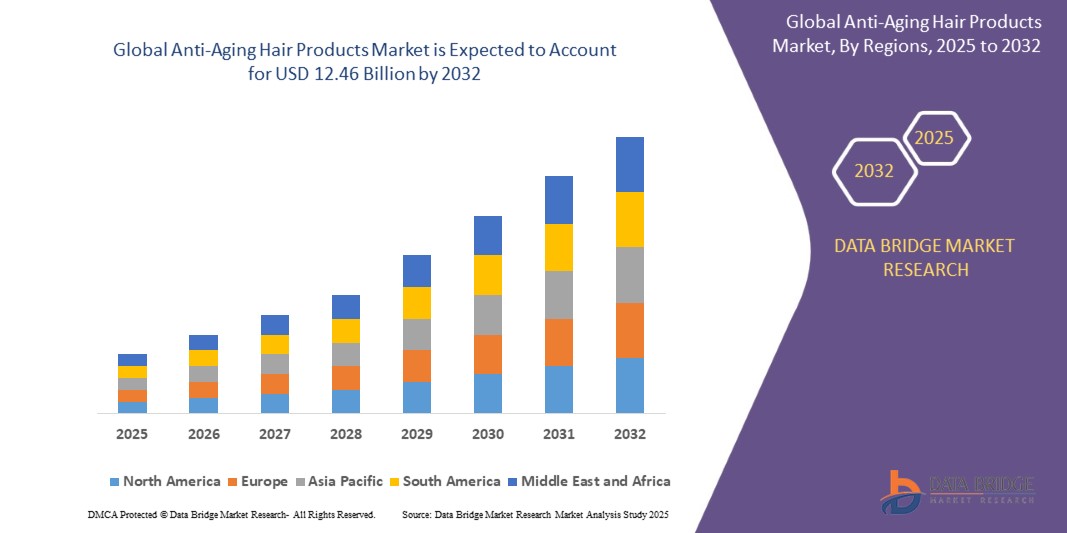
- As per Data Bridge Market Research Analysis the global Anti-Aging Hair Products market size was valued at USD 8.40 billion in 2024 and is expected to reach USD 12.46 billion by 2032, at a CAGR of 5.05% during the forecast period
- The market growth is largely fueled by the rising awareness about hair health and age-related hair concerns, including thinning, graying, and hair loss, which are prompting consumers to seek targeted anti-aging hair solutions
- Furthermore, increased R&D investments and product innovations, such as serums, shampoos, and treatments enriched with bioactive ingredients like peptides, antioxidants, and botanical extracts, are enhancing product efficacy and appeal. These converging factors are accelerating the uptake of Anti-Aging Hair Products solutions, thereby significantly boosting the industry's growth
Market Size & Forecast
Global Market Value (2024): USD 8.40 billion
Expected Market Value (2032): USD 12.46 billion
Forecast CAGR (2025–2032): 5.05%
What are the Major Takeaways of Anti-Aging Hair Products Market?
- Anti-Aging Hair Products, offering targeted solutions to combat signs of hair aging such as thinning, graying, dryness, and breakage, are becoming essential components of modern personal care routines due to their rejuvenating benefits, advanced formulations, and alignment with holistic wellness trends.
- The escalating demand for Anti-Aging Hair Products is primarily fueled by the aging global population, increasing consumer awareness about age-related hair issues, and the growing influence of beauty and wellness trends across digital platforms and social media.
- North America dominates the Anti-Aging Hair Products market with the largest revenue share of 38.11% in 2025, characterized by high consumer spending on premium personal care products, a strong culture of aesthetic consciousness, and a robust presence of key market players. The U.S. leads in product adoption, particularly in specialized anti-aging shampoos, conditioners, and scalp treatments, driven by a growing preference for clean-label and clinically-backed formulations.
- Asia-Pacific is expected to be the fastest growing region in the Anti-Aging Hair Products market during the forecast period due to increasing urbanization, rising disposable incomes, and a heightened interest in personal grooming, particularly in markets such as China, Japan, South Korea, and India.
- Shampoo segment is expected to dominate the Anti-Aging Hair Products market with a market share of 41.56% in 2025, driven by its widespread use, ease of application, and innovation in anti-aging ingredients such as collagen, biotin, and caffeine that help in strengthening hair and restoring youthful texture.
Report Scope and Anti-Aging Hair Products Market Segmentation
|
Attributes |
Anti-Aging Hair Products Key Market Insights |
|
Segments Covered |
|
|
Countries Covered |
North America
Europe
Asia-Pacific
Middle East and Africa
South America
|
|
Key Market Players |
|
|
Market Opportunities |
|
|
Value Added Data Infosets |
In addition to the insights on market scenarios such as market value, growth rate, segmentation, geographical coverage, and major players, the market reports curated by the Data Bridge Market Research also include in-depth expert analysis, pricing analysis, brand share analysis, consumer survey, demography analysis, supply chain analysis, value chain analysis, raw material/consumables overview, vendor selection criteria, PESTLE Analysis, Porter Analysis, and regulatory framework. |
What is the Key Trend in the Anti-Aging Hair Products Market?
Personalized Hair Care Through AI and Data-Driven Formulation
- A significant and accelerating trend in the global Anti-Aging Hair Products market is the integration of artificial intelligence (AI) and data-driven technologies to deliver personalized hair care solutions tailored to individual hair conditions, scalp health, and aging concerns. This innovation is revolutionizing the consumer experience by offering products that adapt to specific needs based on digital diagnostics.
- For instance, brands like Function of Beauty and L’Oréal’s Perso system are leveraging AI and machine learning to recommend or even formulate personalized anti-aging hair products, taking into account factors like hair type, age, climate, and user behavior. These tools assess user input and real-time environmental data to craft highly customized products.
- AI integration allows for scalp and hair diagnostics via apps or smart devices that analyze parameters such as hair density, porosity, oiliness, and scalp condition, and then recommend optimal anti-aging routines. Some tools even track hair aging over time to optimize future product recommendations.
- Additionally, digital platforms and virtual consultations powered by AI offer real-time guidance to consumers, eliminating guesswork and reducing dissatisfaction with generic products. This fosters brand loyalty and positions companies as technology-forward in the beauty space.
- This trend toward hyper-personalized, tech-enabled haircare is transforming consumer expectations. It is prompting major players like L’Oréal, Procter & Gamble, and Unilever to invest in digital infrastructure and R&D for adaptive and personalized solutions that meet the growing demand for efficacy, transparency, and convenience.
- The demand for AI-driven personalization in anti-aging hair products is rapidly growing across all age groups, as consumers seek more targeted, intelligent, and results-driven hair care solutions that align with wellness and self-care values.
Anti-Aging Hair Products Market Dynamics
Driver
Growing Demand Driven by Aging Population and Beauty Consciousness
- The increasing prevalence of security concerns among homeowners and businesses, The increasing global aging population, combined with rising consumer awareness of age-related hair concerns such as thinning, graying, dryness, and loss of volume, is a significant driver for the growing demand for anti-aging hair products.
- For instance, in March 2024, L’Oréal announced the expansion of its anti-aging haircare line under the Kérastase brand, introducing advanced formulations targeting scalp aging and hormonal hair thinning. Such strategic product launches by leading companies are expected to drive the growth of the Anti-Aging Hair Products industry during the forecast period.
- As consumers become more beauty- and wellness-conscious, especially those in the 35+ age bracket, they are actively seeking solutions that restore hair vitality, improve texture, and delay visible signs of aging.
- Furthermore, the increasing social media influence, growth of digital beauty platforms, and availability of product information are enhancing consumer knowledge and accelerating demand for high-performance, scientifically backed anti-aging hair solutions.
- The growing trend of premiumization in personal care, along with rising disposable incomes and a shift toward self-care routines, is propelling the adoption of anti-aging haircare products globally. The expansion of gender-neutral and male-focused product lines is also broadening the consumer base and further supporting market growth.
Restraint/Challenge
High Product Cost and Limited Awareness in Emerging Markets
- The relatively high cost of premium anti-aging hair products, particularly those with advanced formulations or clinically tested ingredients, poses a significant challenge to broader market penetration, especially in price-sensitive regions. Consumers in developing markets may prioritize basic hair care over specialized anti-aging treatments due to budget constraints.
- For instance, brands such as Kérastase, Alterna, and MONAT offer luxury anti-aging hair care lines that can be cost-prohibitive for a large segment of the population, limiting their accessibility and adoption in lower-income demographics.
- Limited awareness and education regarding the importance of early intervention for age-related hair issues further restrict market growth in certain regions. Many consumers remain unaware of the benefits of using targeted anti-aging hair products, often associating hair aging with irreversible natural processes rather than manageable conditions.
- Additionally, cultural factors and the presence of strong traditional or herbal haircare practices in regions like Asia and Africa may reduce demand for Western-style anti-aging hair solutions, further slowing adoption.
- Overcoming these challenges through consumer education campaigns, the development of cost-effective product variants, and strategic localization of marketing and product messaging will be essential for expanding reach and sustaining long-term market growth in emerging economies.
How is the Anti-Aging Hair Products Market Segmented?
The market is segmented on the basis of product, and end-user.
- By Product
On the basis of product type, the Anti-Aging Hair Products market is segmented into Shampoo, Conditioner, Oil, Serums, Color, and Others. Shampoo dominates, accounting for the largest revenue share of about 41.55% in 2025 Its leadership stems from regular, high-frequency use and the surge of “anti-aging” scalp-care shampoos that promise follicle detox, collagen support, and grey-delay benefits. Brand activity—from Kérastase’s “Première” bonds-repair range to L’Oréal Paris’ Glycolic Gloss line—continues to reinforce the segment’s mass-plus-premium reach and science-backed positioning.
Serums are poised for the fastest CAGR of 4.7% from 2025 – 2032 as consumers seek leave-on, high-potency formats with peptides, caffeine, and biomimetic growth factors. The rise of micro-dose ampoules and droppers—often coupled with scalp-massaging applicators—caters to the trend for concentrated, measurable results.
- By End-User
On the basis of end-user (sales channel), the market is bifurcated into Offline Sales (hypermarkets & supermarkets, specialty beauty stores, pharmacies, salons) and Online Sales (e-commerce marketplaces, brand DTC sites, social commerce). Offline channels remain dominant, representing well over 60.11% of global sales in 2025, thanks to in-store product discovery, professional salon guidance, and the tactile evaluation of premium textures and fragrances
Online Sales are the fastest-growing channel, forecast to log a CAGR of 5.03% through 2032, fuelled by livestream tutorials, influencer bundles, and AI-powered scalp-diagnosis apps that convert consultation into one-click purchase Mobile-first markets such as China, India, and Indonesia are leading this shift, while in North America brands rely on Amazon Premium Beauty and DTC subscriptions to drive repeat sales.
Which Region Holds the Largest Share of the Anti-Aging Hair Products Market?
- North America dominates the Anti-Aging Hair Products market, holding the largest revenue share of approximately 38.11% in 2024.
- This dominance is attributed to high consumer awareness, a large aging population, and a strong focus on personal grooming and appearance.
- The presence of leading hair care brands, advanced distribution channels, and high disposable income further contribute to market growth in the region.
U.S. Anti-Aging Hair Products Market Insight
The U.S. market accounts for a significant portion of North America's share, driven by technological advancements and a growing aging population. Consumers are increasingly seeking solutions to mitigate signs of aging, leading to a surge in demand for anti-aging hair products.
Europe Anti-Aging Hair Products Market Insight
Europe holds a substantial share of the Anti-Aging Hair Products market, with a strong emphasis on personal care and grooming. The aging population across European countries, particularly in Western Europe, has fueled a growing demand for anti-aging solutions targeting hair health and aesthetics. Strict regulations around cosmetic ingredients and manufacturing practices ensure high standards of safety and efficacy, fostering consumer trust in the market.
U.K. Anti-Aging Hair Products Market Insight
The U.K. market is experiencing growth due to the escalating trend of home automation and a desire for heightened security and convenience. Concerns regarding burglary and safety are encouraging both homeowners and businesses to choose keyless entry solutions.
Germany Anti-Aging Hair Products Market Insight
Germany's market is expanding, fueled by increasing awareness of digital security and the demand for technologically advanced, eco-conscious solutions. The integration of smart locks with home automation systems is becoming increasingly prevalent, aligning with local consumer expectations..
Asia-Pacific Anti-Aging Hair Products Market Insight
he Asia-Pacific region is the fastest-growing market for Anti-Aging Hair Products, driven by rising disposable incomes, urbanization, and an increasing focus on personal grooming and appearance. Countries like China, Japan, South Korea, and India are witnessing rapid growth in demand for anti-aging hair care solutions. The region's younger population is also showing interest in anti-aging products as preventative measures to maintain hair health, expanding the market base beyond older demographics.
Japan Anti-Aging Hair Products Market Insight
Japan's market is gaining momentum due to the country's high-tech culture, rapid urbanization, and demand for convenience. The adoption of smart locks is driven by the increasing number of smart homes and connected buildings.
China Anti-Aging Hair Products Market Insight
China accounted for the largest market revenue share in Asia-Pacific in 2025, attributed to the country's expanding middle class, rapid urbanization, and high rates of technological adoption. The push towards smart cities and the availability of affordable Anti-Aging Hair Products options, alongside strong domestic manufacturers, are key factors propelling the market in China.
Which are the Top Companies in Anti-Aging Hair Products Market?
The Anti-Aging Hair Products industry is primarily led by well-established companies, including:
- AMOREPACIFIC CORPORATION (South Korea)
- Essential (Italy)
- LVMH (France)
- Living Proof (U.S.)
- Kérastase (France)
- Alterna (U.S.)
- Les Laboratoires Phytosolba (France)
- Developlus (U.S.)
- Keranique (U.S.)
- COTY INC (U.S.)
- Henkel Adhesives Technologies India Private Limited (India)
- L'Oréal (France)
- Procter & Gamble (U.S.)
- Unilever (U.K.)
- Kao Corporation (Japan)
- MONAT GLOBAL CORP (U.S.)
- Leonor Greyl USA (U.S.)
- SUNDIAL BRANDS LLC (U.S.)
- Peter Thomas Roth Labs LLC (U.S.)
- Hairburst (U.K.)
- AVEDA CORP (U.S.)
What are Latest Developments in Anti-Aging Hair Products Market?
- In February 2025, Estée Lauder Companies (ELC) announced a collaboration with Serpin Pharma to develop next-generation skincare ingredients centered on longevity. Serpin Pharma is known for its expertise in anti-inflammatory research, particularly focusing on Serine Protease Inhibitors—proteins that aid in the repair of inflamed cells, supporting healthier skin regeneration
- In February 2025, NIVEA MEN launched the Age Defense skincare line, specifically formulated to target common aging concerns such as wrinkles, dryness, rough texture, dullness, and loss of firmness. The collection incorporates key ingredients like Thiamidol and Hyaluronic Acid to provide effective results while keeping the skincare routine simple. It features an advanced serum to diminish dark spots and fine lines, a hydrating face serum enriched with Pro-Retinol for lasting moisture, an eye cream to reduce puffiness and dark circles, and a daily moisturizer with SPF 30 that offers both sun protection and hydration
- In June 2024, The Man Company introduced its latest addition to their innovative grooming range—the Anti-Graying Hair & Beard Cream. This product is specially formulated to combat hair and beard graying, catering to individuals looking to prevent or even reverse the visible signs of aging
- In October 2023, RENEE Cosmetics launched the RENEE Cover-Up Hair Powder, strengthening its product lineup while responding to the evolving needs of consumers seeking solutions for graying hair and beards. This introduction highlights RENEE Cosmetics' dedication to continuous innovation and high quality, as well as its ability to effectively meet the rapidly growing demand for modern grooming products
- In January 2019, Gryphon Investors acquired RoC Skincare, a prominent anti-aging skincare brand. This acquisition opened new avenues for RoC’s brand expansion by leveraging Gryphon’s extensive distribution network, which includes pharmacies, specialty stores, e-commerce platforms, and more.

- Interactive Data Analysis Dashboard
- Company Analysis Dashboard for high growth potential opportunities
- Research Analyst Access for customization & queries
- Competitor Analysis with Interactive dashboard
- Latest News, Updates & Trend analysis
- Harness the Power of Benchmark Analysis for Comprehensive Competitor Tracking
Data collection and base year analysis are done using data collection modules with large sample sizes. The stage includes obtaining market information or related data through various sources and strategies. It includes examining and planning all the data acquired from the past in advance. It likewise envelops the examination of information inconsistencies seen across different information sources. The market data is analysed and estimated using market statistical and coherent models. Also, market share analysis and key trend analysis are the major success factors in the market report. To know more, please request an analyst call or drop down your inquiry.
The key research methodology used by DBMR research team is data triangulation which involves data mining, analysis of the impact of data variables on the market and primary (industry expert) validation. Data models include Vendor Positioning Grid, Market Time Line Analysis, Market Overview and Guide, Company Positioning Grid, Patent Analysis, Pricing Analysis, Company Market Share Analysis, Standards of Measurement, Global versus Regional and Vendor Share Analysis. To know more about the research methodology, drop in an inquiry to speak to our industry experts.
Data Bridge Market Research is a leader in advanced formative research. We take pride in servicing our existing and new customers with data and analysis that match and suits their goal. The report can be customized to include price trend analysis of target brands understanding the market for additional countries (ask for the list of countries), clinical trial results data, literature review, refurbished market and product base analysis. Market analysis of target competitors can be analyzed from technology-based analysis to market portfolio strategies. We can add as many competitors that you require data about in the format and data style you are looking for. Our team of analysts can also provide you data in crude raw excel files pivot tables (Fact book) or can assist you in creating presentations from the data sets available in the report.