What is the Global Anti-Fatigue Mats Market Size and Growth Rate?
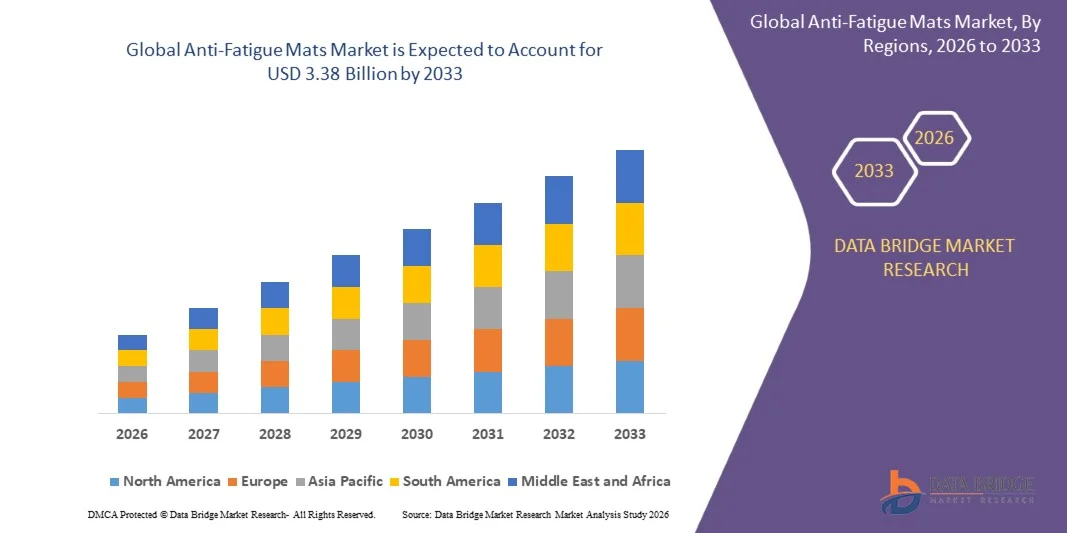
- The global anti-fatigue mats market size was valued at USD 2.28 billion in 2025 and is expected to reach USD 3.38 billion by 2033, at a CAGR of 5.0% during the forecast period
- The market growth is largely fueled by the increasing focus on workplace ergonomics, employee health, and safety, driving widespread adoption of anti-fatigue mats in commercial, industrial, and household environments
- Furthermore, rising awareness among employers and consumers about the benefits of reducing fatigue, improving productivity, and preventing musculoskeletal disorders is establishing anti-fatigue mats as an essential ergonomic solution. These converging factors are accelerating market adoption, thereby significantly boosting industry growth
What are the Major Takeaways of Anti-Fatigue Mats Market?
- Anti-fatigue mats, designed to reduce discomfort and fatigue from prolonged standing, are increasingly vital in offices, industrial workstations, healthcare facilities, kitchens, and retail spaces due to their ergonomic support, slip resistance, and durability
- The escalating demand for anti-fatigue mats is primarily fueled by growing workplace safety regulations, increased adoption of standing workstations, rising awareness of employee wellness, and the need for durable, hygienic, and ergonomically designed flooring solutions across multiple sectors
- North America dominated anti-fatigue mats market with a share of 39.5% in 2025, due to growing awareness of workplace ergonomics and employee health, as well as increasing adoption in commercial, industrial, and household environments
- Asia-Pacific is expected to be the fastest growing region in the anti-fatigue mats market during the forecast period due to rapid industrialization, urbanization, and rising awareness of occupational health in countries such as China, Japan, and India
- Industrial segment dominated the market with a market share of 52.2% in 2025, due to widespread usage in manufacturing plants, warehouses, and production facilities where workers stand for prolonged periods. Industrial mats provide essential cushioning to reduce leg, back, and foot fatigue, enhancing productivity and safety. For instance, Cactus Mat’s industrial solutions are highly preferred for assembly lines and heavy-duty workstations due to durability, chemical resistance, and ergonomic support. The growing emphasis on occupational health and safety regulations across industries reinforces their adoption. Industrial mats also offer anti-slip surfaces, drainage, and custom size options to meet diverse operational requirements. Continuous innovation in material technology and ergonomic design contributes to the segment’s sustained market leadership
Report Scope and Anti-Fatigue Mats Market Segmentation
|
Attributes |
Anti-Fatigue Mats Key Market Insights |
|
Segments Covered |
|
|
Countries Covered |
North America
Europe
Asia-Pacific
Middle East and Africa
South America
|
|
Key Market Players |
|
|
Market Opportunities |
|
|
Value Added Data Infosets |
In addition to the insights on market scenarios such as market value, growth rate, segmentation, geographical coverage, and major players, the market reports curated by the Data Bridge Market Research also include in-depth expert analysis, pricing analysis, brand share analysis, consumer survey, demography analysis, supply chain analysis, value chain analysis, raw material/consumables overview, vendor selection criteria, PESTLE Analysis, Porter Analysis, and regulatory framework. |
Anti-Fatigue Mats Market Trends
“Rising Adoption of Ergonomic Workplace Solutions”
- A significant trend in the anti-fatigue mats market is the growing adoption of ergonomic solutions across workplaces, commercial kitchens, industrial facilities, and healthcare environments, driven by increasing awareness of the benefits of reducing fatigue, enhancing productivity, and preventing musculoskeletal disorders. Ergonomic mats are being recognized as essential components for maintaining employee health and comfort during prolonged standing activities
- For instance, companies such as Cintas Corporation and NoTrax are providing specialized anti-fatigue mats for industrial, commercial, and healthcare settings, which help minimize strain on workers while improving operational efficiency. These mats are designed with features such as cushioned surfaces, anti-slip backing, and durable materials that address the specific ergonomic needs of various environments
- The increasing incorporation of standing desks and adjustable workstations in offices and corporate environments is fueling the demand for anti-fatigue mats that complement modern ergonomic setups. This adoption supports employee wellness initiatives and encourages long-term use of standing solutions
- The food processing and hospitality sectors are integrating anti-fatigue mats into kitchens and service areas to enhance comfort and reduce fatigue for staff working long hours on hard surfaces. Mats designed for hygiene, such as First Mats’ hygienic range, are gaining traction in these environments due to their easy cleaning and slip-resistant properties
- Industrial facilities are deploying anti-fatigue mats in assembly lines, production floors, and laboratories to improve worker efficiency while reducing injury risks associated with prolonged standing. Customized and modular mats are being adopted to cover extensive work areas and optimize comfort across diverse operational spaces
- The market is witnessing increased innovation in mat materials and designs, including antimicrobial surfaces, ESD-protective mats, and sustainable options using recycled or natural materials. This trend is reinforcing the overall transition toward safer, healthier, and more productive work environments globally
Anti-Fatigue Mats Market Dynamics
Driver
“Increasing Focus on Employee Health and Safety”
- The growing emphasis on occupational health and safety across commercial, industrial, and healthcare sectors is driving demand for anti-fatigue mats, which reduce stress on the lower back, legs, and feet during prolonged standing. Employers are increasingly investing in ergonomic solutions to comply with workplace safety regulations and enhance overall productivity
- For instance, Cintas Corporation’s anti-fatigue mats are widely adopted in offices, retail, and industrial facilities to improve worker comfort and reduce fatigue-related incidents. Similarly, NoTrax provides mats with cushioned, anti-slip, and durable designs that align with OSHA recommendations and corporate wellness programs
- Rising awareness among employees and employers regarding the health implications of standing on hard surfaces for long durations is encouraging broader adoption of ergonomic mats. This includes integration in hospitals, kitchens, laboratories, and manufacturing floors where safety and comfort are paramount
- The industrial and manufacturing sectors are leveraging anti-fatigue mats to prevent fatigue-induced errors and reduce the risk of injuries, thereby ensuring higher efficiency and operational reliability. Customized solutions for specific workstation layouts further enhance workplace ergonomics
- Sustained focus on employee wellness programs in both corporate and commercial environments is expected to continue driving growth, as organizations recognize that investing in anti-fatigue solutions reduces absenteeism, improves morale, and enhances productivity
Restraint/Challenge
“High Initial Cost of Premium Anti-Fatigue Mats”
- The anti-fatigue mats market faces challenges due to the high upfront costs associated with premium ergonomic mats, which can limit adoption among small-scale businesses and budget-conscious organizations. These mats, while offering superior cushioning, durability, and hygiene features, are priced higher than standard flooring solutions
- For instance, premium offerings from companies such as First Mats and Wearwell incorporate antimicrobial surfaces, ESD protection, or sustainable materials, which increase manufacturing complexity and retail prices. The elevated cost may restrict widespread adoption in small offices, retail stores, or start-ups with limited budgets
- High-quality materials such as PU, nitrile, EPDM rubber, and recycled cork, combined with advanced ergonomic designs, contribute to the higher production and procurement costs. Organizations may face challenges in justifying these investments despite long-term benefits
- Scaling the production of specialized mats while maintaining consistent quality, hygiene, and ergonomic effectiveness also adds to operational costs, impacting overall market pricing strategies
- The market continues to experience resistance in price-sensitive regions where basic anti-fatigue solutions are preferred, limiting the penetration of high-performance mats. Overcoming cost barriers through innovative material sourcing, modular designs, and awareness campaigns remains a critical challenge for manufacturers
How is the Anti-Fatigue Mats Market Segmented?
The market is segmented on the basis of product, material, size, shape, application, and distribution channel.
• By Product
On the basis of product, the anti-fatigue mats market is segmented into dry area anti-fatigue mats and wet area anti-fatigue mats. The dry area segment dominated the market with the largest revenue share in 2025, driven by its widespread use in offices, kitchens, and retail environments where moisture levels are low. Dry area mats are often preferred for their durability, ease of cleaning, and ergonomic support, which reduces fatigue during prolonged standing. Their compatibility with various flooring types and resistance to wear and tear enhance their adoption across residential and commercial spaces. The segment also benefits from growing awareness of workplace health and safety standards that encourage prolonged standing comfort. Manufacturers are increasingly introducing designs with cushioned surfaces, anti-slip backing, and aesthetic finishes, further strengthening demand. The availability of modular and customizable dry area mats also contributes to their dominance in the market.
The wet area segment is anticipated to witness the fastest growth rate from 2026 to 2033, fueled by rising adoption in commercial kitchens, industrial processing units, and healthcare facilities where slip resistance and moisture protection are critical. For instance, 3M’s wet area mats have gained traction due to enhanced drainage and anti-microbial properties, making them suitable for hygiene-sensitive environments. The growing focus on occupational safety and reducing workplace accidents in wet conditions also drives demand. Wet area mats are increasingly integrated with ergonomic designs that minimize leg and back strain for workers standing on slippery floors for extended hours. The trend toward premium, water-resistant, and anti-fatigue flooring solutions further accelerates adoption in this segment.
• By Material
On the basis of material, the anti-fatigue mats market is segmented into rubber, vinyl, wood, and others. The rubber segment dominated the market with the largest revenue share in 2025, driven by its high durability, resilience, and ability to provide superior comfort under prolonged standing conditions. Rubber mats are widely used in industrial and commercial spaces due to their slip-resistant properties, ease of cleaning, and resistance to oils and chemicals. For instance, Rubber-Cal’s mats are popular in factories and kitchens where durability and worker safety are priorities. The natural flexibility of rubber allows for customization in size and thickness, which further enhances adoption. Rising awareness of workplace ergonomics and demand for sustainable materials contribute to the continued preference for rubber-based solutions. Rubber mats also support weight distribution, reducing fatigue and enhancing productivity, which strengthens their leadership in the segment.
The vinyl segment is expected to witness the fastest growth from 2026 to 2033, driven by increasing adoption in residential and commercial settings for their lightweight nature and easy maintenance. Vinyl mats offer cost-effective anti-fatigue solutions while providing adequate cushioning and comfort for prolonged standing tasks. For instance, Imprint’s vinyl anti-fatigue mats are gaining popularity in offices and retail counters due to their design versatility and non-slip surfaces. The growing trend of aesthetically pleasing flooring and ergonomic interior design in workplaces and homes further drives vinyl mat adoption. Vinyl mats’ water-resistant and stain-proof features make them suitable for kitchens, laundry areas, and laboratories. Manufacturers are innovating with textured surfaces and multi-layered vinyl constructions to combine comfort and durability.
• By Size
On the basis of size, the anti-fatigue mats market is segmented into small, medium, large, and customizable. The large-size segment dominated the market with the largest revenue share in 2025, driven by its suitability for industrial workstations, assembly lines, and commercial kitchens where workers require extended coverage. Large mats reduce fatigue across broader areas, allowing workers to move freely without stepping off the mat, which enhances productivity and safety. For instance, Fatigue Science’s large mats are preferred in manufacturing and warehousing environments to provide ergonomic support across entire work zones. Their durability and ease of integration with modular flooring systems further strengthen adoption. Large mats also help in compliance with occupational health and safety regulations, which increasingly recommend anti-fatigue solutions for prolonged standing areas. The ability to pair them with anti-slip and drainage features enhances their appeal in demanding work environments.
The customizable segment is expected to witness the fastest growth from 2026 to 2033, driven by rising demand for tailored anti-fatigue solutions in offices, commercial kitchens, and industrial spaces. For instance, Custom Comfort Mats offers mats designed to fit irregular spaces or specific workstation layouts, providing ergonomic benefits without gaps. Growing trends in personalized workplace comfort and safety, combined with flexible manufacturing technologies, encourage adoption of customizable mats. These mats can be adjusted for thickness, material, and surface texture, allowing for optimal fatigue reduction and safety. Rising investments in ergonomic office setups and industrial workplace modernization further fuel demand for customized solutions. The versatility and adaptability of these mats make them increasingly preferred across different sectors.
• By Shape
On the basis of shape, the anti-fatigue mats market is segmented into rectangular, half round, round, and others. The rectangular segment dominated the market with the largest revenue share in 2025, driven by its ease of installation, maximum coverage, and suitability for most commercial, industrial, and household environments. Rectangular mats are widely used in kitchens, assembly lines, cashier counters, and office spaces because they cover straight-line work areas efficiently. For instance, Sky Solutions’ rectangular mats are popular for both ergonomic comfort and anti-slip safety in prolonged standing areas. The standard shape allows easy combination with modular matting systems, enhancing workplace customization. The design versatility, durability, and ability to incorporate cushioning and anti-fatigue features make rectangular mats highly preferred. Growing awareness of occupational health and safety norms also reinforces their leadership in the segment.
The half-round segment is anticipated to witness the fastest growth from 2026 to 2033, fueled by rising use in specialized workstations, counters, and reception areas where aesthetics and ergonomic contouring are valued. For instance, Rubber-Cal’s half-round mats offer rounded edges that reduce tripping hazards while providing comfort and support at front-facing workstations. The increasing trend of ergonomic and visually appealing workplace setups drives demand for these mats. Half-round mats are particularly suitable for compact spaces, allowing for strategic placement in high-traffic zones. Their ability to combine safety, comfort, and aesthetic appeal encourages adoption across commercial and hospitality environments. The focus on minimizing workplace fatigue and injury risk further boosts their popularity.
• By Application
On the basis of application, the anti-fatigue mats market is segmented into commercial, household, and industrial. The industrial segment dominated the market with the largest revenue share of 52.2% in 2025, driven by widespread usage in manufacturing plants, warehouses, and production facilities where workers stand for prolonged periods. Industrial mats provide essential cushioning to reduce leg, back, and foot fatigue, enhancing productivity and safety. For instance, Cactus Mat’s industrial solutions are highly preferred for assembly lines and heavy-duty workstations due to durability, chemical resistance, and ergonomic support. The growing emphasis on occupational health and safety regulations across industries reinforces their adoption. Industrial mats also offer anti-slip surfaces, drainage, and custom size options to meet diverse operational requirements. Continuous innovation in material technology and ergonomic design contributes to the segment’s sustained market leadership.
The commercial segment is expected to witness the fastest growth from 2026 to 2033, driven by increasing adoption in offices, retail counters, and hospitality spaces aimed at improving worker comfort and efficiency. For instance, Imprint’s commercial anti-fatigue mats are gaining traction in office reception areas and cashier stations due to their ergonomic design and stylish aesthetics. Rising trends in employee wellness, workplace ergonomics, and long hours of standing in service sectors boost demand. These mats are designed to reduce fatigue, enhance posture, and provide non-slip surfaces for safe operation. Growth in the hospitality and retail sectors, combined with modern office design trends emphasizing ergonomic furniture, accelerates commercial mat adoption.
• By Distribution Channel
On the basis of distribution channel, the anti-fatigue mats market is segmented into online and offline. The offline segment dominated the market with the largest revenue share in 2025, driven by the availability of mats through specialty stores, distributors, and retail outlets where customers can physically assess quality, size, and cushioning. Offline sales remain crucial for commercial and industrial buyers who prioritize durability and warranty options. For instance, Uline’s anti-fatigue mats are widely purchased through industrial supply stores, ensuring immediate availability and support. The ability to consult experts, explore different materials, and verify ergonomic comfort encourages offline purchases. Brand reputation and after-sales service also support the dominance of offline channels. Growing industrial and commercial demand, coupled with trust in traditional purchasing methods, sustains the market leadership of offline distribution.
The online segment is expected to witness the fastest growth from 2026 to 2033, driven by the convenience of e-commerce, wide product variety, and doorstep delivery. For instance, Amazon and Walmart online stores offer extensive options for anti-fatigue mats, enabling customers to compare materials, sizes, and prices with ease. The rise of digital shopping, coupled with increasing awareness of ergonomics and home-office setups, accelerates online adoption. Customer reviews, detailed product descriptions, and customization options make online platforms highly attractive. The trend toward remote work and small business setups requiring efficient and comfortable flooring solutions further fuels growth. Online sales provide scalability, brand visibility, and easy access to premium and specialty products, ensuring rapid market expansion.
Anti-Fatigue Mats Market Regional Analysis
- North America dominated the anti-fatigue mats market with the largest revenue share of 39.5% in 2025, driven by growing awareness of workplace ergonomics and employee health, as well as increasing adoption in commercial, industrial, and household environments
- Consumers and businesses in the region highly value the comfort, fatigue-reducing properties, and slip-resistant features offered by anti-fatigue mats, which enhance productivity and safety in prolonged standing areas
- This widespread adoption is further supported by strict occupational safety regulations, high disposable incomes, and the growing preference for ergonomic solutions across industries, establishing anti-fatigue mats as a favored solution for both commercial and residential applications
U.S. Anti-Fatigue Mats Market Insight
The U.S. anti-fatigue mats market captured the largest revenue share in 2025 within North America, fueled by increasing demand for ergonomic workplace solutions and employee wellness programs. Businesses are investing in mats to improve productivity, reduce fatigue-related injuries, and comply with OSHA regulations. The rising use of standing desks in offices, retail counters, and healthcare facilities, combined with innovative materials such as rubber and vinyl and customizable designs, is significantly contributing to market expansion.
Europe Anti-Fatigue Mats Market Insight
The Europe anti-fatigue mats market is projected to expand at a substantial CAGR during the forecast period, primarily driven by stringent workplace safety regulations and growing focus on occupational health. Increasing industrialization, urbanization, and demand for ergonomic solutions in offices, healthcare, and manufacturing sectors are fostering adoption. European consumers and businesses are drawn to high-quality mats that provide comfort, durability, and slip resistance. Growth is observed across commercial, industrial, and household applications, with mats being incorporated into new constructions, renovations, and workplace modernization initiatives.
U.K. Anti-Fatigue Mats Market Insight
The U.K. anti-fatigue mats market is anticipated to grow at a noteworthy CAGR during the forecast period, driven by rising adoption of ergonomic workplace solutions and health-focused office designs. Concerns regarding employee safety, comfort, and productivity are encouraging businesses to invest in anti-fatigue mats for prolonged standing tasks. The U.K.’s robust retail and e-commerce infrastructure, coupled with growing awareness of ergonomics in commercial and industrial settings, is expected to continue stimulating market growth.
Germany Anti-Fatigue Mats Market Insight
The Germany anti-fatigue mats market is expected to expand at a considerable CAGR during the forecast period, fueled by increasing awareness of workplace ergonomics and demand for durable, eco-friendly mats. Germany’s advanced industrial infrastructure and emphasis on employee well-being promote adoption, particularly in factories, warehouses, and commercial kitchens. The integration of anti-fatigue mats into industrial workstations and office environments is becoming increasingly common, with a preference for solutions that combine safety, comfort, and long-term durability aligning with local expectations.
Asia-Pacific Anti-Fatigue Mats Market Insight
The Asia-Pacific anti-fatigue mats market is poised to grow at the fastest CAGR during the forecast period of 2026 to 2033, driven by rapid industrialization, urbanization, and rising awareness of occupational health in countries such as China, Japan, and India. The region’s expanding manufacturing base and increase in commercial and industrial workplaces are boosting adoption. APAC’s emergence as a hub for cost-effective ergonomic solutions enhances affordability and accessibility, enabling a wider consumer base to adopt anti-fatigue mats.
Japan Anti-Fatigue Mats Market Insight
The Japan anti-fatigue mats market is gaining momentum due to the country’s high emphasis on workplace safety, technological adoption, and employee wellness programs. Increasing use of standing desks, commercial kitchen workstations, and industrial assembly lines is driving demand. Integration with ergonomic office setups and focus on fatigue reduction, comfort, and safety further fuels growth.
China Anti-Fatigue Mats Market Insight
The China anti-fatigue mats market accounted for the largest revenue share in Asia-Pacific in 2025, attributed to rapid industrial growth, urbanization, and rising awareness of occupational health. Growing commercial, industrial, and retail sectors are adopting anti-fatigue mats for employee comfort and productivity. Domestic manufacturers offering affordable, high-quality solutions, along with initiatives promoting ergonomic workplaces, are key factors propelling market expansion.
Anti-Fatigue Mats Market Share
The anti-fatigue mats industry is primarily led by well-established companies, including:
- 3M (U.S.)
- American Floor Mats (U.S.)
- Euronics Industries Private Ltd. (India)
- Cintas Corporation (U.S.)
- Crown Matting Technologies (U.S.)
- Eagle Mat and Floor Products (U.S.)
- Forbo Flooring India Private Limited (India)
- Bardwell Matting (U.S.)
- UniFirst Corporation (U.S.)
- NoTrax (U.S.)
- Apache Mills (U.S.)
- BIRRUS Matting Systems (U.S.)
- KLEEN-TEX Industries Inc. (U.S.)
- PromoMatting (U.S.)
- Unimat Industries, LLC (U.S.)
- Wearwell, LLC (U.S.)
- Melmat Inc. (U.S.)
- Mat Tech (U.S.)
- DURABLE Corp (U.S.)
Latest Developments in Global Anti-Fatigue Mats Market
- In March 2024, Endeavour Group launched ReCORK, a large-scale natural cork recycling program in collaboration with partners to produce sustainable anti-fatigue mats. This initiative promotes eco-friendly product innovation by repurposing waste cork into durable, reusable mats, appealing to sustainability-focused buyers and corporate procurement policies, and enhancing demand for green ergonomic solutions in industrial and commercial segments
- In January 2024, NoTrax introduced an antimicrobial mat series incorporating copper-ion technology designed to continuously sanitize surface areas without compromising durability or comfort. This innovation is expected to boost adoption in hygiene-critical sectors such as healthcare, expanding the application scope of anti-fatigue mats from basic ergonomic relief to include sanitation benefits
- In November 2022, First Mats announced the launch of hygienic anti-fatigue mats specifically engineered for sterile environments such as food production facilities and hospitals. These mats support sterilization processes and resist oil and slip hazards, enhancing workplace safety and comfort in environments where cleanliness and employee well-being are critical
- In October 2020, Antistat Inc. introduced a new ESD anti-fatigue matting range constructed from a blend of PU, nitrile, and high-quality EPDM rubber, with durability and safety central to the design. This range strengthened offerings for electronics and production environments by combining static control with ergonomic comfort, meeting industry needs for both safety and prolonged standing relief
- In February 2020, a survey commissioned by Cintas Corporation revealed that 91% of U.S. adults believe employers should supply anti-fatigue floor mats for employees who work long hours on their feet. This finding highlights the growing workforce demand for ergonomic workplace benefits, encouraging employers to invest in health-focused equipment and driving broader market adoption

- Interactive Data Analysis Dashboard
- Company Analysis Dashboard for high growth potential opportunities
- Research Analyst Access for customization & queries
- Competitor Analysis with Interactive dashboard
- Latest News, Updates & Trend analysis
- Harness the Power of Benchmark Analysis for Comprehensive Competitor Tracking
Data collection and base year analysis are done using data collection modules with large sample sizes. The stage includes obtaining market information or related data through various sources and strategies. It includes examining and planning all the data acquired from the past in advance. It likewise envelops the examination of information inconsistencies seen across different information sources. The market data is analysed and estimated using market statistical and coherent models. Also, market share analysis and key trend analysis are the major success factors in the market report. To know more, please request an analyst call or drop down your inquiry.
The key research methodology used by DBMR research team is data triangulation which involves data mining, analysis of the impact of data variables on the market and primary (industry expert) validation. Data models include Vendor Positioning Grid, Market Time Line Analysis, Market Overview and Guide, Company Positioning Grid, Patent Analysis, Pricing Analysis, Company Market Share Analysis, Standards of Measurement, Global versus Regional and Vendor Share Analysis. To know more about the research methodology, drop in an inquiry to speak to our industry experts.
Data Bridge Market Research is a leader in advanced formative research. We take pride in servicing our existing and new customers with data and analysis that match and suits their goal. The report can be customized to include price trend analysis of target brands understanding the market for additional countries (ask for the list of countries), clinical trial results data, literature review, refurbished market and product base analysis. Market analysis of target competitors can be analyzed from technology-based analysis to market portfolio strategies. We can add as many competitors that you require data about in the format and data style you are looking for. Our team of analysts can also provide you data in crude raw excel files pivot tables (Fact book) or can assist you in creating presentations from the data sets available in the report.