


What is the Global Anti fouling Coating Market Size and Growth Rate?
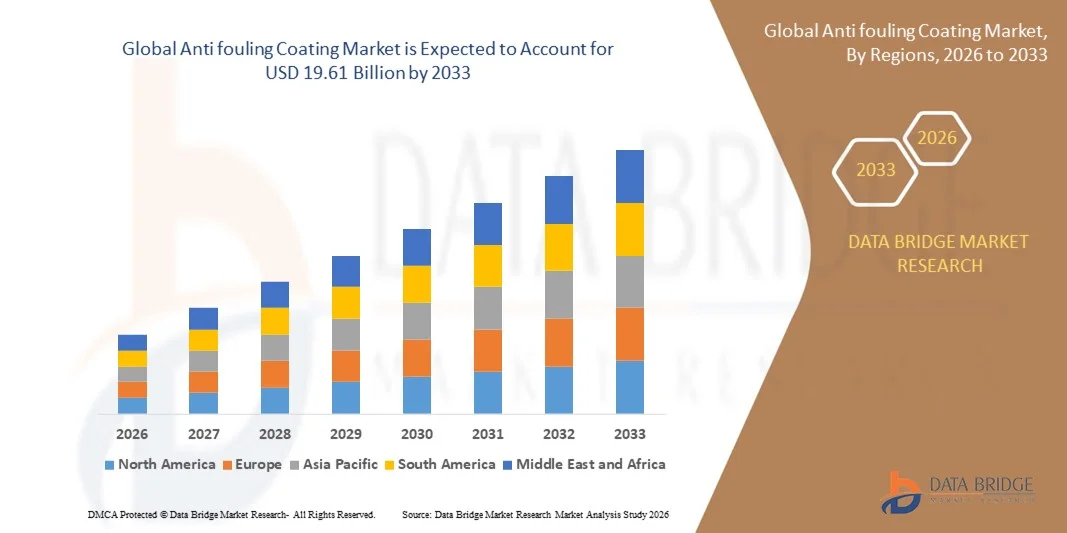
- As per Data Bridge Market Research Analysis the global anti fouling coating market size was valued at USD 11.41 billion in 2025 and is expected to reach USD 19.61 billion by 2033, at a CAGR of 7.00% during the forecast period
- The market growth is largely fueled by the increasing focus on vessel efficiency, rising demand for marine protection solutions, and technological progress in coating formulations such as copper-free, biocide-free, and self-polishing systems, which help reduce fuel consumption and operational costs across commercial and naval fleets
- Furthermore, growing environmental regulations, shifting preference toward sustainable hull protection technologies, and expanding shipbuilding and maintenance activities are accelerating the adoption of advanced antifouling coatings, thereby strengthening overall market growth
Market Size & Forecast
- Global Market Value (2025): USD 11.41 billion
- Expected Market Value (2033): USD 19.61 billion
- Forecast CAGR (2026–2033): 7.00%
Anti fouling Coating Market Analysis
- Anti-fouling coatings, designed to prevent marine organism accumulation on vessel hulls, play a crucial role in improving fuel efficiency, reducing drag, and extending maintenance intervals, making them essential for commercial ships, naval vessels, and offshore structures
- The rising demand for antifouling solutions is primarily driven by expanding maritime trade, growing emphasis on operational efficiency, and increasing regulatory pressure to adopt environmentally compliant coatings such as copper-free and biocide-free alternatives
- Asia-Pacific dominated the anti fouling coating market with a share of 70.8% in 2025, due to rapid expansion in shipbuilding, increasing maritime trade volumes, and strong presence of coating manufacturers
- North America is expected to be the fastest growing region in the anti fouling coating market during the forecast period due to increasing offshore exploration, expansion of naval programs, and rising demand for long-lasting and environmentally compliant coatings
- Copper based segment dominated the market with a market share of 46.3% in 2025, due to its longstanding effectiveness in preventing marine organism accumulation on hull surfaces. Copper formulations provide reliable protection for long operational durations, reducing fuel consumption and maintenance downtime for commercial fleets. The industry’s preference for copper-based coatings is further driven by their wide compatibility with various vessel categories, from cargo carriers to offshore support vessels. Strong regulatory acceptance in many regions and proven field performance reinforce their continued dominance. As shipping companies prioritize cost-efficient protection with predictable outcomes, demand for copper-based anti-fouling coatings remains consistently high
Report Scope and Anti fouling Coating Market Segmentation
|
Attributes |
Anti fouling Coating Key Market Insights |
|
Segments Covered |
|
|
Countries Covered |
North America
Europe
Asia-Pacific
Middle East and Africa
South America
|
|
Key Market Players |
|
|
Market Opportunities |
|
|
Value Added Data Infosets |
In addition to the insights on market scenarios such as market value, growth rate, segmentation, geographical coverage, and major players, the market reports curated by the Data Bridge Market Research also include import export analysis, production capacity overview, production consumption analysis, price trend analysis, climate change scenario, supply chain analysis, value chain analysis, raw material/consumables overview, vendor selection criteria, PESTLE Analysis, Porter Analysis, and regulatory framework. |
What is the Key Trend in the Anti fouling Coating Market?
Adoption of Eco-Friendly and Biocide-Free Antifouling Technologies
- The shift towards sustainable marine coatings is a defining trend in the global antifouling coating market, as stricter environmental regulations and awareness regarding marine ecosystem health drive innovation. Manufacturers are focusing on developing non-toxic, biocide-free antifouling solutions that minimize ecological harm while maintaining protective performance against marine biofouling
- For instance, AkzoNobel’s Intersleek and Hempel’s Hempasil X3 provide high-performance biocide-free coatings using advanced silicone and fluoropolymer technology. These coatings create an ultra-smooth surface to prevent organism attachment and improve fuel efficiency, representing key progress in sustainable antifouling coating innovation
- The growing preference for silicone- and fluoropolymer-based fouling-release coatings is strengthening, as these materials deliver long-term durability and reduce hull drag. Such coatings contribute to significant fuel savings and carbon emission reduction, aligning with global shipping decarbonization goals. Companies are increasingly promoting these eco-friendly formulations to meet both performance and sustainability demands
- Manufacturers are investing heavily in R&D to develop hybrid antifouling coatings that merge physical surface properties with advanced polymer chemistries. These innovations aim to provide consistent performance across diverse marine environments and extend maintenance intervals for vessels operating under varying fouling pressures
- Increasing adoption of nanotechnology and polymer-based fouling release coatings is further revolutionizing the market. Nanostructured surfaces minimize organism adhesion, while polymer layers provide flexibility and durability under dynamic sea conditions, ensuring extended service life and efficiency gains for vessel operators
- The accelerating demand for environmentally compliant, biocide-free antifouling coatings reflects a broader industry transition toward sustainability-focused maritime operations. As shipping companies prioritize ecological responsibility and fuel efficiency, such eco-friendly coatings are anticipated to dominate future product portfolios and set new standards for marine surface protection
Anti fouling Coating Market Dynamics
Driver
Increasing Global Shipbuilding and Fleet Maintenance Activities
- The growth in global shipbuilding activities and fleet maintenance requirements is a major driver for antifouling coating market expansion. Rising international trade volumes and the expansion of commercial shipping routes are increasing the need for durable coatings that can protect vessel hulls from biofouling and enhance performance over longer operational cycles
- For instance, Nippon Paint Marine introduced its latest low-friction antifouling coating, FASTAR, designed to improve sailing efficiency and reduce maintenance costs across expanding ship fleets. The rise of large-scale shipbuilding hubs in China, South Korea, and Japan is driving demand for high-performance coatings during both newbuild and dry-docking phases
- With fleet owners emphasizing operational efficiency, antifouling coatings play a crucial role in minimizing fouling-induced drag and maintaining optimal fuel consumption. By preventing marine organism accumulation, these coatings contribute directly to improved vessel speed and reduced greenhouse gas emissions
- In addition, increased naval modernization programs and fleet maintenance activities across defense sectors are expanding the use of specialized antifouling coatings. These applications require extended protection under harsh sea conditions, further widening the coating market potential across both commercial and military vessel categories
- The growing interplay between operational cost efficiency and sustainability goals positions antifouling coatings as key enablers of long-term fleet optimization. As shipbuilders and operators adopt performance-driven maintenance strategies, the demand for high-quality, fuel-saving coatings is expected to strengthen globally, reinforcing industry growth trajectories
Restraint/Challenge
Stringent Environmental Regulations
- Stringent environmental regulations concerning the composition and ecological impact of antifouling coatings present a major challenge to market players. International bodies such as the International Maritime Organization (IMO) and European regulatory frameworks have enforced strict limits on biocide use and harmful chemical emissions, compelling manufacturers to reformulate their product lines
- For instance, the IMO’s ban on organotin-based paints, including tributyltin (TBT), has significantly restricted the use of traditional antifouling products. Companies such as Jotun and PPG Industries have since shifted toward environmentally friendly and low-toxicity coating solutions to maintain regulatory compliance and market presence
- Compliance with complex and region-specific environmental laws increases R&D and production costs for manufacturers. The necessity to phase out effective yet environmentally damaging compounds drives the pursuit of alternative chemistries, often involving longer testing cycles and higher formulation investments
- In addition, uneven enforcement of environmental standards across countries can disrupt global market stability. Differences in national adoption timelines and certification requirements may slow international product rollouts and complicate supply chain logistics for coating producers
- As environmental scrutiny and sustainability expectations continue to intensify, producing performance-equivalent yet eco-safe alternatives becomes essential for maintaining competitiveness. Success in navigating regulatory pressures will depend on continuous innovation, close collaboration with maritime authorities, and market adaptation to evolving global emission and biocide compliance norms
Anti fouling Coating Market Scope
The market is segmented on the basis of type and application.
- By Type
On the basis of type, the anti-fouling coating market is segmented into Copper Based, Biocides, Self-Polishing Copolymer (SPC), and Hybrid. The copper-based segment dominated the market with the largest share of 46.3% in 2025, supported by its longstanding effectiveness in preventing marine organism accumulation on hull surfaces. Copper formulations provide reliable protection for long operational durations, reducing fuel consumption and maintenance downtime for commercial fleets. The industry’s preference for copper-based coatings is further driven by their wide compatibility with various vessel categories, from cargo carriers to offshore support vessels. Strong regulatory acceptance in many regions and proven field performance reinforce their continued dominance. As shipping companies prioritize cost-efficient protection with predictable outcomes, demand for copper-based anti-fouling coatings remains consistently high.
The self-polishing copolymer (SPC) segment is projected to witness the fastest growth from 2026 to 2033, propelled by increasing adoption of advanced polymer technologies that enable controlled biocide release and smoother hull surfaces. SPC coatings significantly enhance fuel efficiency through hydrodynamic optimization, making them highly attractive amid tightening emission regulations and rising fuel prices. Their longer lifecycle, reduced dry-dock frequency, and compatibility with eco-friendly formulations accelerate fleet modernization trends. Growing interest from naval, offshore, and high-performance vessel operators further boosts their market expansion. As industry shifts toward sustainability and long-term operational savings, SPC emerges as the preferred next-generation anti-fouling solution.
- By Application
On the basis of application, the anti-fouling coating market is segmented into Shipping Vessels, Drilling Rigs, Fishing Boats, Yachts & Boats, Mooring Lines, and Inland Water Transportation. The shipping vessels segment dominated the market in 2025, driven by the massive global merchant fleet that relies heavily on anti-fouling coatings to minimize biofouling and maintain operational efficiency. Commercial vessels such as tankers, bulk carriers, and container ships operate continuously in high-fouling waters, making robust coatings essential for reducing drag and improving fuel economy. Regulatory pressure to cut carbon emissions enhances demand for high-performance coatings that help achieve measurable fuel savings. Expanding global trade volumes and rising fleet renewal activities keep shipping vessels the primary consumer of anti-fouling products. The segment’s need for frequent maintenance cycles further contributes to sustained market share dominance.
The yachts and boats segment is anticipated to record the fastest growth rate during 2026 to 2033, supported by rising recreational boating activities and the growing luxury marine tourism sector. Owners of leisure boats increasingly prefer premium anti-fouling coatings that offer aesthetic appeal, easier cleaning, and long-term hull protection. Technological advancements enabling eco-friendly, low-toxicity formulations also drive adoption within this segment, aligned with marine environmental regulations in coastal regions. The expanding marina infrastructure and higher disposable income across several regions promote strong demand for yacht maintenance solutions. As recreational marine markets continue expanding, anti-fouling coating demand for yachts and boats is set to accelerate rapidly.
Anti fouling Coating Market Regional Analysis
- Asia-Pacific dominated the anti fouling coating market with the largest revenue share of 70.8% in 2025, driven by rapid expansion in shipbuilding, increasing maritime trade volumes, and strong presence of coating manufacturers
- The region’s cost-effective production environment, rising investments in marine infrastructure, and growing demand for advanced hull-protection technologies are accelerating market expansion
- Availability of skilled labor, supportive government initiatives for marine sector growth, and increasing offshore exploration activities are contributing to higher adoption of anti-fouling coatings across commercial and industrial fleets
China Anti-fouling Coating Market Insight
China held the largest share in the Asia-Pacific anti-fouling coating market in 2025 due to its leadership in shipbuilding, large commercial fleet size, and continuous investments in marine maintenance and repair facilities. Strong manufacturing capabilities, favorable policies supporting naval and commercial vessel construction, and high demand for durable coatings to enhance operational efficiency are driving market growth. Expanding exports of marine coatings and increasing offshore exploration activity further strengthen the country’s market position.
India Anti-fouling Coating Market Insight
India is witnessing the fastest growth in the Asia-Pacific region, propelled by rising coastal trade, expansion of shipyards, and increasing adoption of marine coatings by fishing and inland water transport segments. Government initiatives such as Sagarmala, along with growing investments in port modernization, are boosting the demand for anti-fouling solutions. Expansion of maritime logistics, increasing vessel maintenance activities, and rising focus on fuel efficiency are contributing to rapid market acceleration.
Europe Anti-fouling Coating Market Insight
The Europe anti-fouling coating market is expanding steadily, supported by stringent environmental regulations, high demand for eco-friendly and biocide-free formulations, and strong presence of leading marine coating manufacturers. The region emphasizes sustainability, performance efficiency, and compliance with maritime emission standards, driving adoption across commercial, leisure, and naval vessels. Increasing focus on clean shipping and advanced hull protection technologies is contributing to consistent market growth.
Germany Anti-fouling Coating Market Insight
Germany’s market is driven by its advanced shipbuilding capabilities, strong marine engineering ecosystem, and continuous innovation in high-performance coatings. Well-established R&D frameworks and collaboration between marine institutes and coating manufacturers support the development of environmentally compliant anti-fouling solutions. Demand is strengthened by the country’s commercial fleet, inland water transport requirements, and focus on long-lasting hull protection.
U.K. Anti-fouling Coating Market Insight
The U.K. market is supported by a mature marine services industry, increasing focus on ship repair and maintenance, and rising demand for high-performance coatings across commercial and naval fleets. Growing emphasis on sustainability, local supply chain development, and adoption of advanced coating technologies in maritime hubs strengthens market traction. Continued investments in R&D and port infrastructure contribute to the country’s notable role in the European market.
North America Anti-fouling Coating Market Insight
North America is projected to grow at the fastest CAGR from 2026 to 2033, driven by increasing offshore exploration, expansion of naval programs, and rising demand for long-lasting and environmentally compliant coatings. Strong focus on fleet modernization, advancements in marine coating technologies, and emphasis on operational efficiency are boosting adoption. Growing collaboration between coating manufacturers and shipyards further supports market development.
U.S. Anti-fouling Coating Market Insight
The U.S. accounted for the largest share in the North America market in 2025, supported by its large commercial and naval fleet, advanced maritime infrastructure, and significant investments in sustainable coating technologies. Strong R&D capabilities, emphasis on high-performance marine protection, and presence of leading coating manufacturers enhance the country’s market leadership. Increasing offshore wind and exploration projects further drive demand for anti-fouling coatings.
Which are the Top Companies in Anti fouling Coating Market?
The anti fouling coating industry is primarily led by well-established companies, including:
- Hempel A/S (Denmark)
- Jotun (Norway)
- Ashland Inc. (U.S.)
- RPM International Inc. (U.S.)
- Kansai Paint Co., Ltd. (Japan)
- Nycote Laboratories, Inc. (U.S.)
- Diamond Vogel (U.S.)
- Nippon Paint Co., Ltd. (Japan)
- DuPont (U.S.)
- DOW (U.S.)
- Koninklijke DSM N.V. (Netherlands)
- 3M (U.S.)
- Heubach Color (Germany)
- The Magni Group (U.S.)
- Wacker Chemie AG (Germany)
- SK Formulations India (India)
- Bluechem Group (Germany)
- Ancatt Inc. (U.S.)
- S.M. Adhesives (India)
- Renner Herrmann (Brazil)
- PPG Industries, Inc. (U.S.)
- AkzoNobel N.V. (Netherlands)
- The Sherwin-Williams Company (U.S.)
- Axalta Coating Systems Ltd. (U.S.)
- BASF SE (Germany)
Latest Developments in Global Anti fouling Coating Market
- In December 2025, Kansai Paint launched a next-generation graphene-enhanced antifouling coating designed to improve durability, reduce biofouling accumulation, and extend vessel maintenance cycles. This innovation strengthens the company’s competitive position in high-performance marine coatings and supports increasing global demand for long-lasting, fuel-efficient solutions. The product’s advanced material integration also gives shipowners a cost-effective alternative to traditional formulations while aligning with sustainability mandates
- In October 2025, Hempel A/S broadened its self-polishing copolymer antifouling product range across the Asia-Pacific region, significantly expanding its market footprint. This strategic action enhances availability of long-interval coatings for commercial fleets, strengthening adoption among regional shipowners seeking reduced dry-dock frequency and improved operational efficiency. The expansion supports rising demand in APAC’s rapidly growing shipbuilding and repair hubs
- In May 2025, Jotun introduced an AI-powered hull performance technology integrated into its antifouling coating portfolio, enabling real-time monitoring that lowers fuel consumption and reduces carbon emissions. The development elevates Jotun’s role in data-driven marine optimization while supporting the industry’s transition toward sustainable and intelligent fleet management. This advancement also positions the company strongly in emission-compliance markets where performance transparency is becoming essential
- In February 2025, AkzoNobel launched a biocide-free antifouling coating tailored for yachts and leisure vessels in response to tightening EU sustainability and green-chemistry regulations. The product strengthens AkzoNobel’s environmentally focused portfolio and addresses increasing market demand for non-toxic marine coatings. This launch positions the company favorably as regulatory pressures accelerate the shift away from harmful marine biocide
- In March 2024, PPG Industries introduced PPG NEXEON 810, an ultra-low-friction, copper-free antifouling coating that provides enhanced efficiency for the marine sector. The innovation arrives at a crucial time amid discussions around future restrictions on copper-based products, offering the market a viable, regulation-resilient alternative. The launch boosts PPG’s competitiveness and supports customer transitions to high-performance and compliant coating technologies

- Interactive Data Analysis Dashboard
- Company Analysis Dashboard for high growth potential opportunities
- Research Analyst Access for customization & queries
- Competitor Analysis with Interactive dashboard
- Latest News, Updates & Trend analysis
- Harness the Power of Benchmark Analysis for Comprehensive Competitor Tracking
Global Anti Fouling Coating Market, Supply Chain Analysis and Ecosystem Framework
To support market growth and help clients navigate the impact of geopolitical shifts, DBMR has integrated in-depth supply chain analysis into its Global Anti Fouling Coating Market research reports. This addition empowers clients to respond effectively to global changes affecting their industries. The supply chain analysis section includes detailed insights such as Global Anti Fouling Coating Market consumption and production by country, price trend analysis, the impact of tariffs and geopolitical developments, and import and export trends by country and HSN code. It also highlights major suppliers with data on production capacity and company profiles, as well as key importers and exporters. In addition to research, DBMR offers specialized supply chain consulting services backed by over a decade of experience, providing solutions like supplier discovery, supplier risk assessment, price trend analysis, impact evaluation of inflation and trade route changes, and comprehensive market trend analysis.
Data collection and base year analysis are done using data collection modules with large sample sizes. The stage includes obtaining market information or related data through various sources and strategies. It includes examining and planning all the data acquired from the past in advance. It likewise envelops the examination of information inconsistencies seen across different information sources. The market data is analysed and estimated using market statistical and coherent models. Also, market share analysis and key trend analysis are the major success factors in the market report. To know more, please request an analyst call or drop down your inquiry.
The key research methodology used by DBMR research team is data triangulation which involves data mining, analysis of the impact of data variables on the market and primary (industry expert) validation. Data models include Vendor Positioning Grid, Market Time Line Analysis, Market Overview and Guide, Company Positioning Grid, Patent Analysis, Pricing Analysis, Company Market Share Analysis, Standards of Measurement, Global versus Regional and Vendor Share Analysis. To know more about the research methodology, drop in an inquiry to speak to our industry experts.
Data Bridge Market Research is a leader in advanced formative research. We take pride in servicing our existing and new customers with data and analysis that match and suits their goal. The report can be customized to include price trend analysis of target brands understanding the market for additional countries (ask for the list of countries), clinical trial results data, literature review, refurbished market and product base analysis. Market analysis of target competitors can be analyzed from technology-based analysis to market portfolio strategies. We can add as many competitors that you require data about in the format and data style you are looking for. Our team of analysts can also provide you data in crude raw excel files pivot tables (Fact book) or can assist you in creating presentations from the data sets available in the report.













