


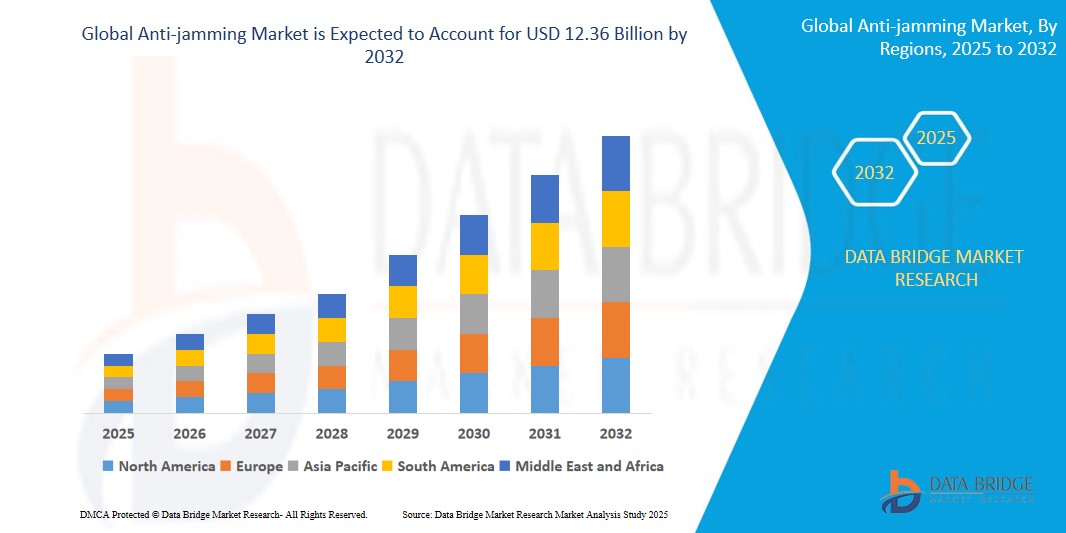
Anti-jamming Market Size
- The global anti-jamming market size was valued at USD 4.52 billion in 2024 and is expected to reach USD 12.36 billion by 2032, at a CAGR of 15.5% during the forecast period.
- This growth is driven by increasing threats of GPS and GNSS signal interference, rising adoption of anti-jamming technologies in defense and aerospace, and growing demand for secure communication systems in civilian applications.
Anti-jamming Market Analysis
- Anti-jamming systems protect GPS, GNSS, and other communication signals from intentional or unintentional interference, ensuring reliable navigation and communication in defense, aerospace, and civilian applications.
- The market is propelled by the growing need for secure navigation systems, integration of advanced signal processing technologies, and the shift toward software-defined anti-jamming solutions.
- North America holds a significant market share due to its advanced defense infrastructure, high adoption of anti-jamming technologies, and presence of key players like Raytheon Technologies and Lockheed Martin.
- Asia-Pacific is expected to register the fastest growth, fueled by rising defense budgets, increasing satellite-based navigation demands, and growing cybersecurity concerns in countries like China, India, and Japan.
- The defense segment is projected to account for a significant market share of approximately 40.1% in 2025, driven by the widespread adoption of anti-jamming systems in military operations and navigation.
Report Scope and Anti-jamming Market Segmentation
|
Attributes |
Anti-jamming Key Market Insights |
|
Segments Covered |
|
|
Countries Covered |
North America
Europe
Asia-Pacific
Middle East and Africa
South America
|
|
Key Market Players |
|
|
Market Opportunities |
|
|
Value Added Data Infosets |
In addition to the insights on market scenarios such as market value, growth rate, segmentation, geographical coverage, and major players, the market reports curated by the Data Bridge Market Research also include import export analysis, production capacity overview, production consumption analysis, price trend analysis, climate change scenario, supply chain analysis, value chain analysis, raw material/consumables overview, vendor selection criteria, PESTLE Analysis, Porter Analysis, and regulatory framework. |
Anti-jamming Market Trends
“Advancements in Software-Defined and AI-Based Anti-Jamming Technologies”
- The adoption of software-defined anti-jamming systems, which allow real-time adaptability to interference, is a key trend, offering robust protection for military and civilian applications.
- Integration of AI and machine learning enables predictive jamming detection and automated countermeasure deployment.
- For instance, in October 2024, Raytheon Technologies partnered with the U.S. Department of Defense to deploy AI-driven anti-jamming solutions for GPS-guided military systems, enhancing operational reliability.
- These innovations are accelerating the adoption of anti-jamming systems across defense, aerospace, and autonomous navigation sectors.
Anti-jamming Market Dynamics
Driver
“Rising Threats of GPS and GNSS Signal Interference”
- The increasing prevalence of jamming and spoofing attacks on GPS and GNSS signals drives demand for advanced anti-jamming systems to ensure secure navigation and communication.
- Stringent defense regulations, such as NATO’s cybersecurity standards and U.S. DoD mandates, require robust anti-jamming solutions for military applications.
- For instance, a 2024 Defense Report noted that 70% of NATO forces have adopted GPS anti-jamming systems to counter electronic warfare threats, highlighting their critical role.
- Growing reliance on satellite-based navigation in civilian sectors further propels market growth.
Opportunity
“Adoption of Anti-Jamming in Autonomous Vehicles and Civilian Applications”
- The integration of anti-jamming technologies in autonomous vehicles, drones, and civilian navigation systems offers enhanced reliability and security, making them ideal for smart transportation and logistics.
- These technologies enable cost-effective solutions, supporting growth in commercial and aerospace sectors.
- For instance, in March 2024, NovAtel Inc. launched a GNSS anti-jamming module for autonomous drones, targeting improved navigation accuracy in urban environments.
- The growing demand for secure navigation solutions presents significant growth opportunities.
Restraint/Challenge
“High Development Costs and Cybersecurity Risks”
- Developing advanced anti-jamming systems, such as AI-driven and software-defined solutions, involves high R&D and deployment costs, posing challenges for market scalability.
- Cybersecurity risks, including vulnerabilities in software-based systems, impact the reliability of anti-jamming solutions.
- For instance, a 2024 Cybersecurity Report highlighted a 60% rise in vulnerabilities in GNSS-based systems due to increased jamming attempts, underscoring security concerns.
- The shortage of skilled professionals in signal processing and cybersecurity further complicates market expansion.
Anti-jamming Market Scope
The market is segmented based on type, component, application, end user, and technology..
|
Segmentation |
Sub-Segmentation |
|
By Type |
|
|
By Component |
|
|
By Application |
|
|
By End User |
|
|
By Technology
|
|
In 2025, the defense segment is projected to dominate the end-user segment
The defense segment is expected to hold a market share of approximately 40.1% in 2025, driven by the widespread adoption of anti-jamming systems in military navigation and communication systems.
The military application segment is expected to account for the largest share during the forecast period in the application market
In 2025, the military application segment is projected to account for a market share of 40.1%, driven by global demand for secure navigation and communication systems in defense operations.
“North America Holds the Largest Share in the Anti-jamming Market”
- North America dominates the market due to its advanced defense infrastructure, widespread adoption of anti-jamming technologies, and presence of leading vendors like Raytheon Technologies and Lockheed Martin.
- The U.S. holds a significant share, driven by high demand for anti-jamming systems in military and aerospace applications, robust R&D investments, and stringent defense regulations.
- The region benefits from significant advancements in AI and software-defined technologies.
“Asia-Pacific is Projected to Register the Highest CAGR in the Anti-jamming Market”
- Asia-Pacific’s growth is driven by rising defense budgets, expanding aerospace and navigation sectors, and government initiatives for secure communication in countries like China, India, and Japan.
- India is projected to exhibit the highest CAGR due to its increasing investments in defense technology and satellite navigation systems.
- The region’s growing focus on cybersecurity and electronic warfare countermeasures further accelerates market growth.
Anti-jamming Market Share
The market competitive landscape provides details by competitor. Details included are company overview, company financials, revenue generated, market potential, investment in research and development, new market initiatives, global presence, production sites and facilities, production capacities, company strengths and weaknesses, product launch, product width and breadth, application dominance. The above data points provided are only related to the companies' focus related to market.
The Major Market Leaders Operating in the Market Are:
- Raytheon Technologies Corporation (U.S.)
- Lockheed Martin Corporation (U.S.)
- BAE Systems plc (U.K.)
- Thales Group (France)
- NovAtel Inc. (Canada)
- L3Harris Technologies, Inc. (U.S.)
- Cobham Limited (U.K.)
- Rockwell Collins (U.S.)
- Furuno Electric Co., Ltd. (Japan)
- Rohde & Schwarz GmbH & Co KG (Germany)
Latest Developments in Global Anti-jamming Market
- In June 2023, Raytheon Technologies partnered with a U.S. Air Force program to enhance GPS anti-jamming solutions. The collaboration integrated Raytheon’s AI-based systems, improving navigation reliability in contested environments.
- In August 2023, Thales Group launched a new software-defined anti-jamming receiver for military applications. The receiver offers real-time adaptability and cloud-based management, targeting defense operations.
- In January 2024, Lockheed Martin introduced a next-generation GNSS anti-jamming system for aerospace applications. The system features advanced signal processing and compliance with NATO standards.
- In April 2024, NovAtel Inc. unveiled a compact anti-jamming antenna for civilian drones. The antenna supports seamless integration with GNSS systems for enhanced navigation accuracy.
- In October 2024, BAE Systems announced a strategic partnership with a smart city project in Japan to deploy anti-jamming solutions for autonomous vehicle navigation, enhancing safety and reliability.

- Interactive Data Analysis Dashboard
- Company Analysis Dashboard for high growth potential opportunities
- Research Analyst Access for customization & queries
- Competitor Analysis with Interactive dashboard
- Latest News, Updates & Trend analysis
- Harness the Power of Benchmark Analysis for Comprehensive Competitor Tracking
Global Anti Jamming Market, Supply Chain Analysis and Ecosystem Framework
To support market growth and help clients navigate the impact of geopolitical shifts, DBMR has integrated in-depth supply chain analysis into its Global Anti Jamming Market research reports. This addition empowers clients to respond effectively to global changes affecting their industries. The supply chain analysis section includes detailed insights such as Global Anti Jamming Market consumption and production by country, price trend analysis, the impact of tariffs and geopolitical developments, and import and export trends by country and HSN code. It also highlights major suppliers with data on production capacity and company profiles, as well as key importers and exporters. In addition to research, DBMR offers specialized supply chain consulting services backed by over a decade of experience, providing solutions like supplier discovery, supplier risk assessment, price trend analysis, impact evaluation of inflation and trade route changes, and comprehensive market trend analysis.
Data collection and base year analysis are done using data collection modules with large sample sizes. The stage includes obtaining market information or related data through various sources and strategies. It includes examining and planning all the data acquired from the past in advance. It likewise envelops the examination of information inconsistencies seen across different information sources. The market data is analysed and estimated using market statistical and coherent models. Also, market share analysis and key trend analysis are the major success factors in the market report. To know more, please request an analyst call or drop down your inquiry.
The key research methodology used by DBMR research team is data triangulation which involves data mining, analysis of the impact of data variables on the market and primary (industry expert) validation. Data models include Vendor Positioning Grid, Market Time Line Analysis, Market Overview and Guide, Company Positioning Grid, Patent Analysis, Pricing Analysis, Company Market Share Analysis, Standards of Measurement, Global versus Regional and Vendor Share Analysis. To know more about the research methodology, drop in an inquiry to speak to our industry experts.
Data Bridge Market Research is a leader in advanced formative research. We take pride in servicing our existing and new customers with data and analysis that match and suits their goal. The report can be customized to include price trend analysis of target brands understanding the market for additional countries (ask for the list of countries), clinical trial results data, literature review, refurbished market and product base analysis. Market analysis of target competitors can be analyzed from technology-based analysis to market portfolio strategies. We can add as many competitors that you require data about in the format and data style you are looking for. Our team of analysts can also provide you data in crude raw excel files pivot tables (Fact book) or can assist you in creating presentations from the data sets available in the report.













