


Anti-Money Laundering Market Analysis
The global anti-money laundering market has witnessed growth due to an increase in demand for transaction monitoring systems that assess financial crime patterns. This can be used in various other applications for detecting financial crimes such as terrorist financing, fraud, drug trafficking, bribery, corruption, and identity theft, which can significantly affect the country's economy. In recent times, AML solutions are gaining popularity among various financial institutions such as insurance companies, commercial banks, internet banks, retail banking, insurance companies, and mortgage companies, among others. Moreover, its gaining popularity among various industries such as the gaming & gambling industry, real estate industry, currency exchange (MSB), payment industry, the investment industry, and government bodies across the globe.
Anti-Money Laundering Market Size
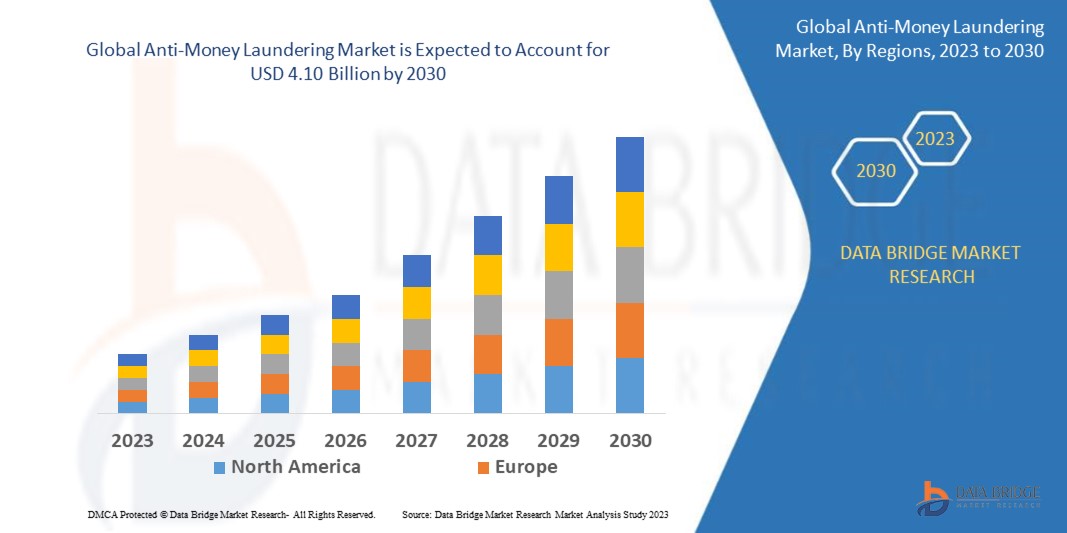
The global anti-money laundering market size was valued at USD 4.48 billion in 2024 and is projected to reach USD 13.56 billion by 2032, with a CAGR of 14.83% during the forecast period of 2025 to 2032. In addition to the market insights such as market value, growth rate, market segments, geographical coverage, market players, and market scenario, the market report curated by the Data Bridge Market Research team includes in-depth expert analysis, import/export analysis, pricing analysis, production consumption analysis, and pestle analysis.
Anti-Money Laundering Market Trends
“Increased Financial Crimes Detection Efforts”
Increased financial crimes detection efforts have intensified scrutiny on Anti-Money Laundering (AML) measures, focusing on enhancing compliance and monitoring systems trends. Financial institutions are implementing more rigorous procedures to identify suspicious transactions and patterns indicative of money laundering. These measures include strengthening internal controls, improving transaction reporting practices, and enhancing collaboration with regulatory bodies. The push for greater transparency and accountability aims to disrupt financial crime networks and reduce illicit financial flows. By adopting comprehensive AML frameworks, organizations seek to mitigate risks and protect the integrity of the financial system. This proactive approach reflects a broader commitment to combatting financial crime and maintaining regulatory compliance.
Report Scope and Anti-Money Laundering Market Segmentation
|
Attributes |
Anti-Money Laundering Key Market Insights |
|
Segments Covered |
|
|
Countries Covered |
U.S., Canada and Mexico in North America, Germany, France, U.K., Netherlands, Switzerland, Belgium, Russia, Italy, Spain, Turkey, Rest of Europe in Europe, China, Japan, India, South Korea, Singapore, Malaysia, Australia, Thailand, Indonesia, Philippines, Rest of Asia-Pacific (APAC) in the Asia-Pacific (APAC), Saudi Arabia, U.A.E., South Africa, Egypt, Israel, Rest of Middle East and Africa (MEA) as a part of Middle East and Africa (MEA), Brazil, Argentina and Rest of South America as part of South America |
|
Key Market Players |
BAE Systems, NICE, SAP SE, Open Text Corporation, ACI Worldwide, Accenture, Oracle, Cognizant, Intel Corporation, and IBM |
|
Market Opportunities |
|
|
Value Added Data Infosets |
In addition to the market insights such as market value, growth rate, market segments, geographical coverage, market players, and market scenario, the market report curated by the Data Bridge Market Research team includes in-depth expert analysis, import/export analysis, pricing analysis, production consumption analysis, and pestle analysis. |
Anti-Money Laundering Market Definition
Anti-Money Laundering (AML) solutions are used to detect and warn the institutions regarding money laundering, terrorist financing, fraud, electronic crime, bribery and corruption, tax evasion, embezzlement, information security, illegal cross border transactions, among others that hugely impact the economy of the country and can hamper its reputation. AML is a term that is generally used to depict the fight against money laundering & financial crimes. Anti-money Laundering (AML) solutions comply with various policies, laws, and regulations that help in preventing financial crimes. These guidelines, policies, and laws are set by global and local regulators present worldwide, which aims to strengthen the functioning of AML solutions.
Anti-Money Laundering Market Dynamics
Drivers
- Increased Financial Crimes Detection Efforts
Increased financial crimes detection efforts have intensified scrutiny on anti-money laundering (AML) measures, focusing on enhancing compliance and monitoring systems. Financial institutions are implementing more rigorous procedures to identify suspicious transactions and patterns indicative of money laundering. These measures include strengthening internal controls, improving transaction reporting practices, and enhancing collaboration with regulatory bodies. The push for greater transparency and accountability aims to disrupt financial crime networks and reduce illicit financial flows. By adopting comprehensive AML frameworks, organizations seek to mitigate risks and protect the integrity of the financial system.
For instance,
In August 2024, according to the blog Informa PLC, ThetaRay, an Israeli provider of AI-driven transaction monitoring, acquired Belgian fintech Screena. It offers an AI-powered AML screening solution for financial institutions (FIs). This acquisition aims to enhance ThetaRay’s ability to provide a comprehensive view of transactional and customer screening risks. It supports increased financial crime detection efforts, including gambling-related illegal activities, and strengthens ThetaRay's cloud-based, end-to-end financial crime detection platform
- Increasing Stringent Regulations and Compliance Related to AML
An anti-money laundering compliance program is a set of regulations or rules a financial institution must follow to prevent and detect money laundering and terrorist funding activities. Financial crime against financial institutions such as banks and credit unions has recently increased. There was a ~50- 60% increment in financial fraud cases in 2019 from 2018, and it is expected to grow in the coming years. The losses incurred by the banks across Europe are quite significant.
For instance,
In July 2024, according to the article published by The Good Returns, governments extended Anti-Money Laundering (AML) regulations beyond traditional financial institutions to include non-financial sectors such as real estate and virtual assets. This expansion aimed to address vulnerabilities in these sectors due to their high-value transactions and opacity. Stricter penalties for non-compliance were also introduced, enhancing the compliance culture and reducing the risk of financial exploitation. For gambling companies, these increased regulations foster a more robust AML framework, promoting integrity and reducing legal risks.
Opportunities
- Increasing Adoption of Advanced Analytics In AML
Advanced analytics is the autonomous or semi-autonomous system that analyzes data or content using sophisticated techniques and tools, which is quite different from traditional business intelligence. These analytics give a deeper analysis using which the system predicts and generates recommendations. Advanced analytics in AML solutions can play a vital role in detecting money laundering, financial crimes, identity theft, and cross-border transactions. Moreover, Advanced Analytics can play a vital role in advanced transaction monitoring.
According to the United Nations office on drugs and crime (UNODC), USD 2 trillion worth of illegal money is annual. Another survey conducted by Basel anti-money laundering (AML) in 2018 pointed out that 64% of countries in the 2018 ranking (83/129) have a risk score of 5.0 or above and can be loosely classified as having a significant risk of money laundering and terrorist financing.
For instance,
In May 2024, according to the article published by NDTV Profit, Pine Labs-owned Setu launched India's first large language model (LLM) application tailored for the BFSI sector. This LLM, trained on extensive datasets, can recognize and generate text. The introduction of this advanced analytics tool aims to enhance AML (anti-money laundering) efforts by improving text processing and analysis capabilities in financial services. For Setu, this move positions it as a leader in integrating cutting-edge AI into the BFSI sector, offering advanced solutions for compliance and risk management.
- Integration of Ai and ML in Developing AML Solutions
Money Laundering has become a very important financial issue that financial authorities are trying to stop. According to the survey, money laundering is estimated to be 2 to 5% of the Europe GDP, or a net worth of USD 2 trillion is being laundered. There are various other issues, such as identity theft and cross-border transactions.
In 2020 according to a survey, 1.4 million complaints about identity theft cases were registered. In 2020, Cross-border transactions across Europe were estimated at around USD 23.21 trillion. All financial crimes are happening because of weak AML solutions and hesitancy to follow the guidelines set by the regulators. According to Fenergo's research, Regulators/agencies hit banks with a near-record USD 10 billion worth of fines in 2019; it also pointed out that 60.5% of the penalties came from banks violating anti-money laundering rules.
For instance,
In March, ACI Worldwide, Inc. announced the launch of ACI fraud scoring for financial institutions. It is a platform launched for delivering next-generation machine learning capabilities. This launch will help the company expand its solution portfolio for its customer base. This solution will help financial institutions to protect their payment servers
Restraints/Challenges
- Privacy Concerns in Customer Data Monitoring
The rise in online gambling platforms has heightened privacy concerns regarding customer data monitoring. As operators implement advanced anti-money laundering (AML) measures, they collect and analyse extensive personal information to detect suspicious activities. This scrutiny raises significant privacy issues, as users’ sensitive data is increasingly subject to detailed tracking and examination. Balancing effective fraud prevention with robust data protection is crucial, as excessive monitoring can lead to breaches of privacy and erode customer trust.
For instance,
In October 2023, according to the article published by Mondaq Ltd., India's Digital Personal Data Protection Act, 2023, introduced new privacy regulations impacting the online gaming industry. The act emphasized stricter data protection measures, requiring gaming platforms to ensure explicit consent for data processing, provide rights to data access and correction, and enforce robust security practices. The regulations also addressed concerns related to targeted marketing, especially towards minors, and set higher compliance standards for platforms handling large volumes of user data.
- Deploying AML Software is Expensive
According to the survey conducted by the Government Accountability Office (GAO). U.K. banks spent between 0.4% and 2.4% of their total 2018 operating expenses on anti-money laundering software. Banks in the survey spent an average of USD 15 per new account on due diligence requirements, even though the actual cost ranged from USD 5 to USD 44 depending on the type of bank. It was observed that banks spend the most on CDD, 29%, and reporting costs of 28% on average. In comparison, 18% was associated with training, testing, internal controls, software, and third-party costs, which accounted for 17% of AML solutions on average. In Europe, a survey conducted by LexisNexis risk solution in 2019 stated the true cost of anti-money laundering (AML) software is very high in European countries as the demand for the product is high.
For instance,
In September 2023, according to the article published by The Investopedia, HSBC was fined USD 1.9 billion for severe lapses in its anti-money laundering (AML) controls, notably for laundering money for Mexican drug cartels. The scandal highlighted weaknesses in HSBC's compliance mechanisms and led to the imposition of additional $665 million in civil penalties. This case underscores the high cost of deploying effective AML software and compliance measures in banking. Investing in advanced AML solutions helps prevent costly penalties and maintains regulatory compliance, benefiting financial institutions by reducing legal risks and enhancing operational integrity.
This market report provides details of new recent developments, trade regulations, import-export analysis, production analysis, value chain optimization, market share, impact of domestic and localized market players, analyses opportunities in terms of emerging revenue pockets, changes in market regulations, strategic market growth analysis, market size, category market growths, application niches and dominance, product approvals, product launches, geographic expansions, technological innovations in the market. To gain more info on the market contact Data Bridge Market Research for an Analyst Brief, our team will help you take an informed market decision to achieve market growth.
Anti-Money Laundering Market Scope
The market is segmented on the basis of offering, function, deployment, enterprise size, and end use. The growth amongst these segments will help you analyse meagre growth segments in the industries and provide the users with a valuable market overview and market insights to help them make strategic decisions for identifying core market applications.
Offering
- Solution
- KYC/CDD and Watchlist
- Transaction Screening and Monitoring
- Case Management
- Regulatory Reporting
- Services
- Type
- Professional Service
- Managed Service
- Type
- Services
- Type
- Integration
- Support and Maintenance
- Training and Consulting
- Type
Function
- Supervisory Compliance Management
- Currency Transaction Reporting
- Customer Identity Management
- Transaction Monitoring
Deployment
- Cloud
- On-Premise
Enterprise Size
- Large Enterprises
- Small & Medium-Sized Enterprises
End Use
- Banks & Financial Institutions
- Insurance Providers
- Gaming & Gambling
- Gambling Type
- Casino
- Type
- Live Casinos
- Poker
- Blackjack
- Baccarat
- Slots
- Others
- Type
- Casino
- Application
- Live Entertainment/Online
- Type
- Hotels
- Multiple Dining Options
- Others
- Type
- Offline/Land Based
- Type
- Mobile
- Desktop
- Type
- Sports Betting
- Type
- Football
- E-sports
- Horse racing
- Others
- Type
- Lottery
- Bingo
- Raffles/Pools
- Live Entertainment/Online
- Gambling Type
- Government
- Others
Anti-Money Laundering Market Regional Analysis
The market is analysed and market size insights and trends are provided by offering, function, deployment, enterprise size, and end use as referenced above.
The countries covered in the market report are U.S., Canada and Mexico in North America, Germany, France, U.K., Netherlands, Switzerland, Belgium, Russia, Italy, Spain, Turkey, Rest of Europe in Europe, China, Japan, India, South Korea, Singapore, Malaysia, Australia, Thailand, Indonesia, Philippines, Rest of Asia-Pacific (APAC) in the Asia-Pacific (APAC), Saudi Arabia, U.A.E, South Africa, Egypt, Israel, Rest of Middle East and Africa (MEA) as a part of Middle East and Africa (MEA), Brazil, Argentina and Rest of South America as part of South America.
Europe region is expected to dominate and fastest growing region in the market due to its robust industrial base, stringent quality standards, and strong presence in various sectors.
The country section of the report also provides individual market impacting factors and changes in regulation in the market domestically that impacts the current and future trends of the market. Data points such as down-stream and upstream value chain analysis, technical trends and porter's five forces analysis, case studies are some of the pointers used to forecast the market scenario for individual countries. Also, the presence and availability of global brands and their challenges faced due to large or scarce competition from local and domestic brands, impact of domestic tariffs and trade routes are considered while providing forecast analysis of the country data.
Anti-Money Laundering Market Share
The market competitive landscape provides details by competitor. Details included are company overview, company financials, revenue generated, market potential, investment in research and development, new market initiatives, global presence, production sites and facilities, production capacities, company strengths and weaknesses, product launch, product width and breadth, application dominance. The above data points provided are only related to the companies' focus related to market.
Anti-Money Laundering Market Leaders Operating in the Market Are:
- NICE (Israel)
- IBM (U.S.)
- sanctions.io (U.S.)
- Intel Corporation (U.S.)
- Oracle (U.S.)
- SAP SE (Germany)
- Accenture (U.S.)
- Experian Information Solution
- Inc. (Ireland)
- Open Text Corporation (Canada)
- BAE Systems (U.K.)
- SAS Institute Inc (U.S.)
- ACI Worldwide (U.S.)
- Cognizant (U.S.)
- Trulioo (Canada)
- Temenos Headquarters SA (Switzerland)
- WorkFusion, Inc, (U.S.)
- Vixio Regulatory Intelligence (England)
Latest Developments in Anti-Money Laundering Market
- In September 2023, IBM announced that its Payments Center joined the Swift Partner Programme, creating new collaboration opportunities with over 11,000 Swift members worldwide. This partnership allowed IBM to offer enhanced payment solutions and end-to-end cloud-based Swift connectivity, reducing the need for clients to manage Swift hardware and software. The collaboration helped financial institutions modernize payment platforms, access AI technologies, and improve efficiency without high development and compliance costs
- In April 2024, Oracle introduced the Financial Services Compliance Agent, an AI-powered cloud service designed to help banks mitigate anti-money laundering (AML) risks. This service allows banks to conduct cost-effective scenario testing to adjust controls, identify suspicious transactions, and enhance compliance. It also helps banks assess and optimize transaction monitoring systems, evaluate new product risks, and proactively address high-risk typologies. This solution aims to reduce compliance costs and improve the effectiveness of AML programs
- In January, Oracle highlighted its comprehensive cloud solutions for banks through Oracle Financial Services. The company emphasized that banks are increasingly adopting cloud services driven by AI and ML advancements. Oracle provides a full suite of fintech solutions that are cloud-ready, scalable, and secure, offering banks a single vendor solution without the need for multiple fintech partnerships. Oracle's platform supports over 3,000 microservices and open APIs, helping banks transition from legacy systems and stay competitive
- In September, Oracle and Quantifind announced a strategic collaboration to enhance anti-money laundering (AML) processes. Quantifind’s SaaS solutions for investigations, customer due diligence, and alerts management integrated with Oracle's Financial Crime and Compliance Management platform. This partnership aimed to improve AML efficiency by up to 30% and streamline workflows with advanced AI and machine learning. The integration allowed Oracle clients to access comprehensive data and enhance their AML compliance capabilities through a unified platform

- Interactive Data Analysis Dashboard
- Company Analysis Dashboard for high growth potential opportunities
- Research Analyst Access for customization & queries
- Competitor Analysis with Interactive dashboard
- Latest News, Updates & Trend analysis
- Harness the Power of Benchmark Analysis for Comprehensive Competitor Tracking
Data collection and base year analysis are done using data collection modules with large sample sizes. The stage includes obtaining market information or related data through various sources and strategies. It includes examining and planning all the data acquired from the past in advance. It likewise envelops the examination of information inconsistencies seen across different information sources. The market data is analysed and estimated using market statistical and coherent models. Also, market share analysis and key trend analysis are the major success factors in the market report. To know more, please request an analyst call or drop down your inquiry.
The key research methodology used by DBMR research team is data triangulation which involves data mining, analysis of the impact of data variables on the market and primary (industry expert) validation. Data models include Vendor Positioning Grid, Market Time Line Analysis, Market Overview and Guide, Company Positioning Grid, Patent Analysis, Pricing Analysis, Company Market Share Analysis, Standards of Measurement, Global versus Regional and Vendor Share Analysis. To know more about the research methodology, drop in an inquiry to speak to our industry experts.
Data Bridge Market Research is a leader in advanced formative research. We take pride in servicing our existing and new customers with data and analysis that match and suits their goal. The report can be customized to include price trend analysis of target brands understanding the market for additional countries (ask for the list of countries), clinical trial results data, literature review, refurbished market and product base analysis. Market analysis of target competitors can be analyzed from technology-based analysis to market portfolio strategies. We can add as many competitors that you require data about in the format and data style you are looking for. Our team of analysts can also provide you data in crude raw excel files pivot tables (Fact book) or can assist you in creating presentations from the data sets available in the report.













