


Anti-Slip Optical Lens Edging Discs Market Overview
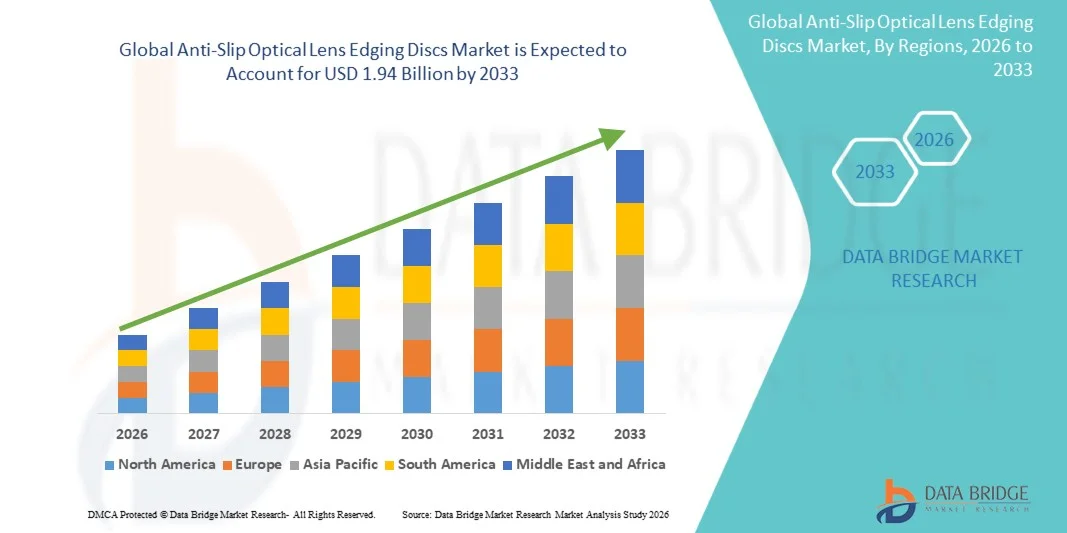
The Anti-Slip Optical Lens Edging Discs Market was valued at USD 1.27 billion in 2025 and is projected to reach USD 1.94 billion by 2033, growing at a CAGR of 5.50% from 2026 to 2033. The Anti-Slip Optical Lens Edging Discs Market is experiencing steady growth driven by rising demand for precision optical lens manufacturing, increasing adoption of advanced ophthalmic equipment, and growing demand for high-quality eyewear products across healthcare and consumer optical industries. Technological advancements in automated lens edging systems, integration of AI-enabled optical processing technologies, and increasing production of customized prescription lenses are further supporting market expansion globally.
The growing prevalence of vision disorders such as myopia, hyperopia, astigmatism, and presbyopia, along with increasing use of premium optical lenses and rising demand for efficient and damage-free lens processing solutions, are encouraging optical laboratories and eyewear manufacturers to adopt anti-slip optical lens edging discs. These discs provide enhanced grip stability, improved edging precision, reduced lens slippage, lower lens breakage rates, and better compatibility with high-speed automated edging machines, making them increasingly preferred over conventional optical processing accessories in modern ophthalmic manufacturing environments.
Key Market Trends & Insights
- North America dominated the Anti-Slip Optical Lens Edging Discs Market with the largest revenue share of 35.16% in 2025, supported by the strong presence of advanced optical manufacturing facilities, rising adoption of precision ophthalmic processing technologies, and increasing demand for premium eyewear products across the U.S. and Canada.
- The Polypropylene segment led the market with a 42.38% share in 2025, driven by its superior durability, anti-slip performance, chemical resistance, and widespread use in optical lens edging and finishing applications.
- Asia-Pacific is expected to be the fastest-growing region at a CAGR of 7.4% from 2026 to 2033, fueled by expanding eyewear manufacturing industries, rising prevalence of vision disorders, increasing consumer spending on optical products, and growing adoption of automated lens processing technologies in China, India, and Japan.
- The Round shape segment dominated the market with a 45.501% revenue share in 2025, owing to its high compatibility with automated edging machines, precise rotational balance, and extensive usage in RX optic lens finishing processes.
- The RX Optic Lens Finishing segment accounted for the largest market share of 40.84% in 2025, supported by increasing demand for customized prescription lenses and growing adoption of precision edging systems by optical laboratories and eyewear manufacturers.
- The Female segment is projected to witness significant growth, registering a CAGR of 6.9% from 2026 to 2033, driven by increasing demand for fashionable and premium eyewear products, rising awareness regarding vision care, and growing preference for customized optical lenses among female consumers globally.
- Polyester-based anti-slip optical lens edging discs are expected to be among the fastest-growing material categories, with a CAGR of 6.8%, driven by increasing demand for lightweight, high-friction, and precision-compatible materials in advanced optical lens processing applications.
- The male segment dominated the market with a 44% share in 2025 due to the high consumption of prescription eyewear, occupational safety glasses, and performance-oriented optical products among male consumers globally
Market Size & Forecast
- Global Market Value (2025): USD 1.27 Billion
- Expected Market Value (2033): USD 1.94 Billion
- Forecast CAGR (2026–2033): 5.50%
- Leading Region in 2025: North America
- Fastest Growing Region: Asia-Pacific
Report Scope and Anti-Slip Optical Lens Edging Discs Market Segmentation
|
Attributes |
Anti-Slip Optical Lens Edging Discs Key Market Insights |
|
Segments Covered |
|
|
Countries Covered |
North America · U.S. · Canada · Mexico Europe · Germany · France · U.K. · Netherlands · Switzerland · Belgium · Russia · Italy · Spain · Turkey · Rest of Europe Asia-Pacific · China · Japan · India · South Korea · Singapore · Malaysia · Australia · Thailand · Indonesia · Philippines · Rest of Asia-Pacific Middle East and Africa · Saudi Arabia · U.A.E. · South Africa · Egypt · Israel · Rest of Middle East and Africa South America · Brazil · Argentina · Rest of South America |
|
Key Market Players |
• 3M Company (U.S.) |
|
Market Opportunities |
· Rising demand for customized and premium prescription eyewear · Expansion of automated optical lens manufacturing facilities · Increasing prevalence of vision disorders and eyewear consumption |
|
Value Added Data Infosets |
In addition to the insights on market scenarios such as market value, growth rate, segmentation, geographical coverage, and major players, the market reports curated by the Data Bridge Market Research also include in-depth expert analysis, geographically represented company-wise production and capacity, network layouts of distributors and partners, detailed and updated price trend analysis and deficit analysis of supply chain and demand. |
Anti-Slip Optical Lens Edging Discs Market Trends
Trend: Increasing Adoption of Precision and Automated Optical Lens Processing Technologies
The Anti-Slip Optical Lens Edging Discs Market is witnessing strong growth due to the increasing adoption of automated optical lens edging systems and precision lens finishing technologies across ophthalmic laboratories and eyewear manufacturing facilities. Optical manufacturers are increasingly utilizing high-performance anti-slip edging discs to improve grip stability, reduce lens slippage, and minimize breakage during high-speed edging operations. In addition, the growing demand for customized prescription lenses, progressive lenses, and premium eyewear products is accelerating the use of advanced edging accessories. For instance, major optical equipment manufacturers in Japan, Germany, and the U.S. have expanded investments in automated lens processing systems integrated with precision anti-slip disc technologies to improve productivity and lens finishing accuracy. Furthermore, the integration of AI-enabled edging systems and digital optical workflows is supporting higher efficiency and consistency in lens manufacturing operations globally.
Anti-Slip Optical Lens Edging Discs Market Dynamics
Key Market Driver: Rising Demand for Customized Prescription Eyewear and Precision Lens Finishing
The increasing global prevalence of vision disorders such as myopia, hyperopia, astigmatism, and presbyopia is significantly driving demand for corrective eyewear products and advanced optical lens processing solutions. According to global ophthalmic industry trends, rising adoption of customized RX lenses and premium eyewear products has increased the need for highly accurate lens edging systems and anti-slip edging discs that ensure precision finishing without damaging delicate lenses.
Optical laboratories and eyewear manufacturers are increasingly adopting anti-slip edging discs to enhance lens processing efficiency, reduce wastage, and improve finishing quality. For instance, growing demand for high-index lenses, blue-light-blocking lenses, and progressive lenses across North America and Asia-Pacific has accelerated the deployment of automated edging machines that require stable and high-friction anti-slip disc systems. In addition, rising consumer spending on premium eyewear and expanding optical retail chains are further strengthening market growth globally.
Key Restraint/Challenge: High Cost of Advanced Optical Processing Equipment and Raw Material Volatility
A significant restraint in the Anti-Slip Optical Lens Edging Discs Market is the high capital investment associated with advanced optical lens edging and finishing systems. Modern ophthalmic processing equipment integrates automated calibration technologies, AI-assisted lens measurement systems, and high-speed precision edging platforms, requiring substantial investment from optical laboratories and eyewear manufacturers. Smaller optical processing centres and independent laboratories often face challenges in adopting advanced edging technologies due to high procurement and maintenance costs.
In addition, volatility in raw material prices, particularly polypropylene, polyester, and specialty polymer compounds used in anti-slip edging discs, is impacting manufacturing margins and production costs. Supply chain disruptions and fluctuations in petrochemical prices during 2023–2025 affected production costs for several optical component manufacturers across Asia-Pacific and Europe. Furthermore, the need to maintain strict quality standards and compatibility with advanced edging machines increases operational complexity for manufacturers.
Key Market Opportunity: Expansion of Smart Optical Manufacturing and Sustainable Lens Processing Solutions
The growing adoption of smart optical manufacturing technologies and sustainable processing materials presents a major growth opportunity for the market. Advanced optical laboratories are increasingly integrating AI-enabled edging systems, digital workflow automation, and cloud-connected lens processing platforms to improve production accuracy and operational efficiency. Anti-slip optical lens edging discs compatible with automated and robotic lens processing systems are gaining significant demand in large-scale eyewear manufacturing facilities.
For instance, leading ophthalmic equipment manufacturers in Japan and Germany are investing in next-generation automated edging technologies that combine real-time monitoring, digital calibration, and precision anti-slip processing systems to reduce lens wastage and improve throughput. In addition, growing environmental concerns are encouraging manufacturers to develop recyclable and eco-friendly edging disc materials, particularly polypropylene- and polyester-based solutions with lower environmental impact. Rising eyewear demand across emerging markets such as China, India, Brazil, and Southeast Asia is also creating substantial opportunities for manufacturers to expand production capacity and strengthen distribution networks globally.
Anti-Slip Optical Lens Edging Discs Market Scope
The Anti-Slip Optical Lens Edging Discs market is segmented on the basis of material, shape, gender, and application.
- By Material
On the basis of material, the Anti-Slip Optical Lens Edging Discs Market is segmented into polypropylene, polyester, and others. The polypropylene segment dominated the market with a 42.38% share in 2025 due to its superior durability, anti-slip efficiency, lightweight properties, and strong compatibility with automated optical lens edging systems. High adoption is driven by increasing demand from optical laboratories and eyewear manufacturers for stable and high-friction edging support during precision lens finishing processes. Additionally, polypropylene-based discs offer excellent chemical resistance, cost-effectiveness, and extended operational life, making them highly preferred across high-volume optical processing facilities globally. The widespread use of polypropylene in RX lens finishing and automated edging applications continues to reinforce the leading position of this segment in the market.
The polyester segment is expected to witness the fastest CAGR of 6.8% from 2026 to 2033, driven by increasing demand for lightweight, flexible, and high-performance edging materials. Polyester-based discs are gaining strong traction due to their enhanced grip stability, low wear rate, and suitability for precision lens processing operations. Growing adoption of advanced optical edging equipment and increasing demand for premium eyewear products are accelerating the use of polyester materials in optical manufacturing facilities. In addition, ongoing advancements in specialty polymer technologies and increasing preference for sustainable and recyclable materials are further supporting segment growth globally.
- By Shape
On the basis of shape, the Anti-Slip Optical Lens Edging Discs Market is segmented into round, oval, square, and others. The round segment dominated the market with a 45.501% share in 2025 due to its high compatibility with automated optical edging machines and superior rotational balance during lens processing applications. Round-shaped discs are widely preferred in RX optic lens finishing and precision lens cutting operations because they provide uniform pressure distribution and minimize lens slippage during high-speed edging processes. Increasing demand for precision optical manufacturing and rising adoption of automated edging systems in ophthalmic laboratories are further driving segment dominance. Additionally, the simplicity, operational efficiency, and consistent processing performance of round discs continue to strengthen their adoption across large-scale eyewear production facilities.
The oval segment is expected to witness the fastest CAGR of 6.7% from 2026 to 2033, driven by increasing demand for customized and specialty lens processing applications. Oval-shaped discs are increasingly used for processing non-standard lens geometries and premium eyewear products requiring enhanced grip and stability during edging operations. Growing consumer preference for designer eyewear and customized prescription lenses is supporting the expansion of this segment. Furthermore, advancements in lens edging technologies and increasing use of specialty optical processing systems are accelerating the adoption of oval-shaped edging discs globally.
- By Gender
On the basis of gender, the Anti-Slip Optical Lens Edging Discs Market is segmented into male and female. The male segment dominated the market with a 52.44% share in 2025 due to the high consumption of prescription eyewear, occupational safety glasses, and performance-oriented optical products among male consumers globally. Increasing prevalence of vision disorders and growing demand for precision optical lenses are supporting higher production volumes of optical lenses, thereby increasing demand for edging discs across male-oriented eyewear manufacturing applications. Additionally, rising adoption of premium eyewear products and technologically advanced lenses in commercial and industrial sectors is further reinforcing segment dominance.
The female segment is expected to witness the fastest CAGR of 6.9% from 2026 to 2033, driven by increasing consumer spending on fashionable and premium eyewear products. Rising awareness regarding eye health, increasing adoption of customized prescription lenses, and growing preference for lightweight and aesthetically designed eyewear are significantly boosting demand among female consumers. In addition, the rapid expansion of online eyewear retail platforms and premium optical brands is further accelerating the production of advanced optical lenses, thereby supporting demand for anti-slip optical lens edging discs in female-focused eyewear manufacturing applications.
- By Application
On the basis of application, the Anti-Slip Optical Lens Edging Discs Market is segmented into RX optic lens finishing, cutting eyeglass lenses, general optical lens processing, and others. The RX optic lens finishing segment dominated the market with a 40.84% share in 2025 due to rising demand for customized prescription lenses and increasing adoption of precision edging technologies in ophthalmic laboratories. High adoption is driven by the growing need for accurate lens finishing, reduced lens breakage, and improved edging efficiency during prescription lens manufacturing processes. In addition, increasing production of progressive lenses, blue-light-blocking lenses, and high-index lenses is reinforcing the importance of stable and high-performance anti-slip edging discs in optical processing environments.
The cutting eyeglass lenses segment is expected to witness the fastest CAGR of 7.0% from 2026 to 2033, driven by increasing global eyewear consumption and rapid expansion of automated lens manufacturing facilities. Rising prevalence of myopia, presbyopia, and other vision-related disorders is significantly increasing demand for high-volume lens cutting operations worldwide. Furthermore, advancements in digital lens edging technologies and increasing demand for high-precision optical products are accelerating the adoption of anti-slip edging discs in modern lens cutting applications across developed and emerging markets.
Anti-Slip Optical Lens Edging Discs Market Regional Analysis
North America dominated the Anti-Slip Optical Lens Edging Discs market and accounted for the largest revenue share of 35.16% in 2025, supported by the strong presence of advanced optical manufacturing facilities, rising adoption of precision ophthalmic processing technologies, and increasing demand for premium eyewear products across the U.S. and Canada. The region also benefits from a well-established optical healthcare infrastructure, high adoption of automated lens edging systems, and increasing demand for customized prescription lenses and high-performance optical products. Growing investments in digital optical processing technologies and rising consumer awareness regarding vision care continue to strengthen North America’s leadership position in the global market.
U.S. Anti-Slip Optical Lens Edging Discs Market Insight
The U.S. Anti-Slip Optical Lens Edging Discs market is witnessing strong growth due to rising demand for premium prescription eyewear, increasing adoption of automated lens edging technologies, and growing investments in advanced ophthalmic manufacturing systems. The country’s mature optical industry, along with increasing use of AI-enabled and digitally integrated lens processing equipment, is driving demand across commercial optical laboratories and eyewear manufacturing facilities. In addition, rising prevalence of vision disorders and growing consumer preference for customized and high-quality optical lenses are accelerating market expansion across the U.S. optical sector.
Europe Anti-Slip Optical Lens Edging Discs Market Insight
The Europe Anti-Slip Optical Lens Edging Discs market remains a major contributor to global revenue, driven by strong technological innovation, advanced optical manufacturing capabilities, and increasing demand for precision lens processing solutions. The widespread use of automated edging systems and high-performance ophthalmic equipment across Germany, France, and Italy is supporting market expansion throughout the region. Increasing investments in sustainable optical manufacturing technologies and rising demand for premium eyewear products are further enhancing the adoption of anti-slip optical lens edging discs across Europe.
U.K. Anti-Slip Optical Lens Edging Discs Market Insight
The U.K. Anti-Slip Optical Lens Edging Discs market is experiencing steady growth, supported by increasing adoption of digital optical processing systems and rising demand for customized prescription eyewear. Optical laboratories and eyewear manufacturers are increasingly investing in advanced edging technologies to improve lens finishing precision and operational efficiency. Furthermore, growing awareness regarding eye health and increasing consumer spending on premium eyewear products are contributing significantly to market growth across the country.
Germany Anti-Slip Optical Lens Edging Discs Market Insight
The Germany Anti-Slip Optical Lens Edging Discs market is expanding steadily due to the country’s strong ophthalmic equipment manufacturing base, advanced research capabilities, and increasing adoption of next-generation optical processing technologies. Optical manufacturers and lens processing laboratories are increasingly utilizing automated edging systems integrated with precision anti-slip discs to improve lens quality and reduce production errors. Continuous advancements in digital optical technologies and increasing focus on high-performance eyewear manufacturing are further driving market growth in Germany.
Asia-Pacific Anti-Slip Optical Lens Edging Discs Market Insight
The Asia-Pacific Anti-Slip Optical Lens Edging Discs market is expected to witness rapid growth at a CAGR of 7.4% from 2026 to 2033, driven by expanding eyewear manufacturing industries, rising prevalence of vision disorders, increasing consumer spending on optical products, and growing adoption of automated lens processing technologies across countries such as China, India, and Japan. Growing awareness regarding eye care and increasing demand for affordable and premium eyewear solutions are supporting regional market expansion. Additionally, rapid growth in optical retail chains and rising investments in ophthalmic manufacturing infrastructure are accelerating adoption across commercial optical laboratories and eyewear production facilities.
Japan Anti-Slip Optical Lens Edging Discs Market Insight
The Japan Anti-Slip Optical Lens Edging Discs market is witnessing consistent growth due to rising investments in advanced optical manufacturing technologies, increasing production of premium eyewear products, and strong demand for precision lens processing solutions. Optical equipment manufacturers and lens laboratories are increasingly adopting automated edging systems integrated with anti-slip disc technologies to enhance processing accuracy and productivity. Moreover, increasing focus on high-quality optical products and technological innovation is further contributing to market growth in Japan.
China Anti-Slip Optical Lens Edging Discs Market Insight
The China Anti-Slip Optical Lens Edging Discs market is growing rapidly, driven by expanding eyewear production capacity, increasing urbanization, and rising demand for prescription eyewear products. Growing adoption of automated optical lens processing systems and increasing investments in ophthalmic manufacturing technologies are significantly boosting market demand. In addition, rising awareness regarding vision correction, increasing prevalence of myopia, and rapid expansion of optical retail and manufacturing industries are positioning China as one of the fastest-growing markets for Anti-Slip Optical Lens Edging Discs globally.
Anti-Slip Optical Lens Edging Discs Market Share
The Anti-Slip Optical Lens Edging Discs industry is primarily led by well-established companies, including:
- 3M Company (U.S.)
- EssilorLuxottica SA (France)
- Satisloh AG (Germany)
- Schneider GmbH & Co. KG (Germany)
- Coburn Technologies Inc. (U.S.)
- Briot International (France)
- MEI System S.r.l. (Italy)
- Dia Optical Co., Ltd. (Japan)
- Nidek Co., Ltd. (Japan)
- Huvitz Co., Ltd. (South Korea)
- Fuji Gankyo Kikai Co., Ltd. (Japan)
- Shanghai Yanke Instrument Co., Ltd. (China)
- Qingdao Hantone Optical Co., Ltd. (China)
- Visionix Ltd. (Israel)
- Topcon Corporation (Japan)
- Wenzhou Zhantai Optical Equipment Co., Ltd. (China)
- Takubomatic Co., Ltd. (Japan)
- OptoTech Optikmaschinen GmbH (Germany)
- WECO Optical Systems (Germany)
- Ningbo FLO Optical Co., Ltd. (China)
- Jiangsu Green Stone Optical Co., Ltd. (China)
- Chemiglas Corporation (Taiwan)
- Dongguan Yongsheng Optical Products Co., Ltd. (China)
- Korea Optical Co., Ltd. (South Korea)
- Bharat Optical Works (India)
- GKB Ophthalmics Ltd. (India)
- Pricon Technologies Pvt. Ltd. (India)
- Tokai Optical Co., Ltd. (Japan)
- Luneau Technology Group (France)
- Shanghai Greens Optical Co., Ltd. (China)
Latest Developments in Anti-Slip Optical Lens Edging Discs Market
- In September 2021, Coburn Technologies announced the launch of its new HPE-910 Supreme automatic lens edger, designed to improve precision lens finishing and processing efficiency for ophthalmic laboratories. The system integrates advanced edging automation, enhanced lens shape accuracy, and compatibility with modern anti-slip optical lens edging accessories, supporting the growing demand for high-quality prescription eyewear manufacturing
- In October 2021, NIDEK Co., Ltd. introduced the ME-1500 high-speed lens edger equipped with enhanced processing technology for premium lens finishing applications. The development improved edging stability, reduced lens slippage during processing, and strengthened automation capabilities for optical laboratories handling high-volume prescription lens production
- In March 2022, Satisloh AG expanded its free-form and lens finishing technology portfolio with upgraded automation solutions for digital ophthalmic manufacturing. The company enhanced compatibility between automated edging systems and advanced anti-slip edging components to improve production efficiency and lens processing precision across industrial optical laboratories
- In September 2022, EssilorLuxottica announced continued investments in smart ophthalmic manufacturing and lens processing technologies across North America and Europe. The expansion included modernization of lens finishing facilities and deployment of automated optical edging equipment to support rising global demand for customized prescription lenses and premium eyewear products
- In February 2023, Briot International launched upgraded intelligent optical edging systems featuring enhanced digital measurement accuracy and automated lens processing capabilities. The development improved operational efficiency in RX lens finishing applications and supported greater adoption of precision anti-slip optical lens edging discs in ophthalmic laboratories globally
- In June 2023, Topcon Corporation strengthened its ophthalmic device and digital eye care solutions portfolio through investments in advanced lens processing and diagnostic technologies. The initiative supported increasing demand for integrated optical manufacturing workflows and high-precision edging solutions for premium eyewear production
- In January 2024, Schneider GmbH & Co. KG introduced advanced automation upgrades for ophthalmic lens production systems focused on improving digital lens edging precision and manufacturing efficiency. The company emphasized integration of smart processing technologies and automated edging support systems to reduce lens waste and enhance productivity in optical laboratories
- In May 2024, MEI System announced enhancements to its 4Racer and Bisphera lens processing platforms, incorporating higher-speed edging automation and precision optical finishing capabilities. The upgraded systems improved compatibility with advanced anti-slip edging solutions used in high-volume prescription lens manufacturing environments
- In August 2024, Huvitz Co., Ltd. expanded its optical laboratory equipment portfolio with next-generation lens edging and processing systems featuring enhanced automation, AI-assisted calibration, and digital workflow integration. The launch aimed to improve precision, reduce operational errors, and increase productivity for modern ophthalmic laboratories
- In February 2025, Coburn Technologies announced continued expansion of its automated ophthalmic lens processing solutions with upgraded digital edging technologies designed for advanced prescription lens manufacturing. The development focused on improving processing accuracy, supporting premium eyewear production, and enhancing compatibility with modern anti-slip optical lens edging disc systems used in automated optical laboratories

- Interactive Data Analysis Dashboard
- Company Analysis Dashboard for high growth potential opportunities
- Research Analyst Access for customization & queries
- Competitor Analysis with Interactive dashboard
- Latest News, Updates & Trend analysis
- Harness the Power of Benchmark Analysis for Comprehensive Competitor Tracking
Data collection and base year analysis are done using data collection modules with large sample sizes. The stage includes obtaining market information or related data through various sources and strategies. It includes examining and planning all the data acquired from the past in advance. It likewise envelops the examination of information inconsistencies seen across different information sources. The market data is analysed and estimated using market statistical and coherent models. Also, market share analysis and key trend analysis are the major success factors in the market report. To know more, please request an analyst call or drop down your inquiry.
The key research methodology used by DBMR research team is data triangulation which involves data mining, analysis of the impact of data variables on the market and primary (industry expert) validation. Data models include Vendor Positioning Grid, Market Time Line Analysis, Market Overview and Guide, Company Positioning Grid, Patent Analysis, Pricing Analysis, Company Market Share Analysis, Standards of Measurement, Global versus Regional and Vendor Share Analysis. To know more about the research methodology, drop in an inquiry to speak to our industry experts.
Data Bridge Market Research is a leader in advanced formative research. We take pride in servicing our existing and new customers with data and analysis that match and suits their goal. The report can be customized to include price trend analysis of target brands understanding the market for additional countries (ask for the list of countries), clinical trial results data, literature review, refurbished market and product base analysis. Market analysis of target competitors can be analyzed from technology-based analysis to market portfolio strategies. We can add as many competitors that you require data about in the format and data style you are looking for. Our team of analysts can also provide you data in crude raw excel files pivot tables (Fact book) or can assist you in creating presentations from the data sets available in the report.













