


Anti-Tank Missile Market Size
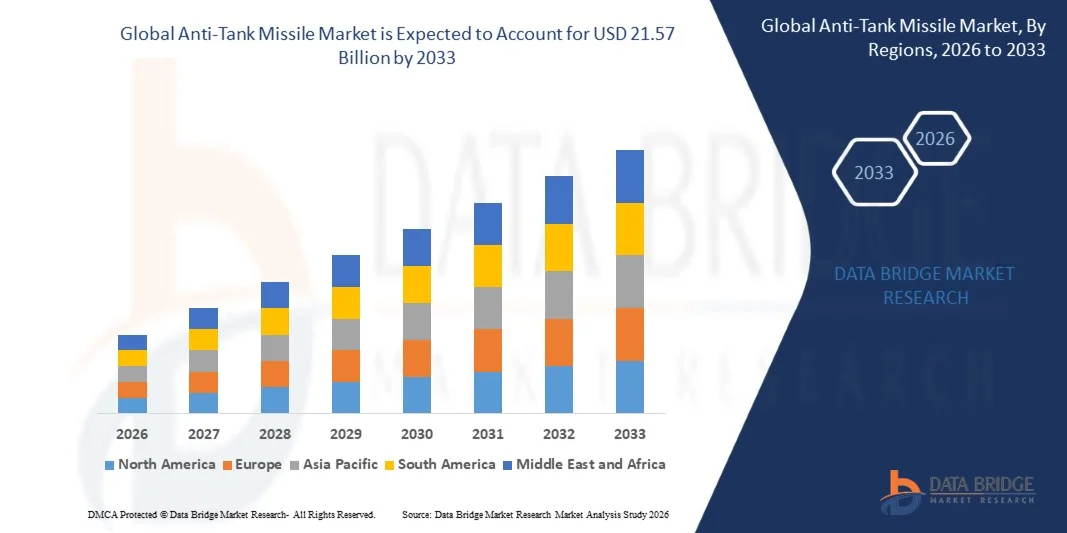
- The global anti-tank missile market size was valued at USD 15.72 billion in 2025 and is expected to reach USD 21.57 billion by 2033, at a CAGR of 4.03% during the forecast period
- The market growth is largely fueled by increasing defense modernization programs, rising geopolitical tensions, and the need for advanced anti-armor capabilities, driving demand for both man-portable and vehicle-mounted missile systems
- Furthermore, growing investments in indigenous missile development, technological advancements in guidance and targeting systems, and the integration of AI-driven features are establishing modern anti-tank missiles as essential components of contemporary military arsenals. These factors are accelerating procurement and deployment, thereby significantly boosting the market's growth
Anti-Tank Missile Market Analysis
- Anti-tank missiles, designed for neutralizing armored vehicles and fortifications, are increasingly vital components of modern warfare due to their precision, mobility, and adaptability across ground-based and airborne platforms
- The escalating demand for anti-tank missiles is primarily fueled by the modernization of military forces, rising investments in defense technologies, and the strategic need for rapid-response, high-accuracy weapon systems capable of enhancing operational effectiveness across diverse combat scenarios
- North America dominated the anti-tank missile market with a share of 39.87% in 2025, due to increasing defense modernization programs, rising geopolitical tensions, and advanced military capabilities
- Asia-Pacific is expected to be the fastest growing region in the anti-tank missile market during the forecast period due to increasing military modernization, regional security concerns, and rising defense budgets in countries such as India, Japan, and China
- Ground-based segment dominated the market with a market share of 62.5% in 2025, due to its widespread deployment, ease of installation, and compatibility with various operational doctrines. Ground-based systems are often preferred for defensive and tactical operations due to their stability, versatility, and ability to support multiple missile types. The segment also benefits from ongoing development in portable launch platforms, automated targeting, and integration with battlefield command systems, enhancing operational readiness
Report Scope and Anti-Tank Missile Market Segmentation
|
Attributes |
Anti-Tank Missile Key Market Insights |
|
Segments Covered |
|
|
Countries Covered |
North America
Europe
Asia-Pacific
Middle East and Africa
South America
|
|
Key Market Players |
|
|
Market Opportunities |
|
|
Value Added Data Infosets |
In addition to the market insights such as market value, growth rate, market segments, geographical coverage, market players, and market scenario, the market report curated by the Data Bridge Market Research team includes in-depth expert analysis, import/export analysis, pricing analysis, production consumption analysis, and pestle analysis. |
Anti-Tank Missile Market Trends
“Rising Integration of AI and Precision Guidance in Anti-Tank Missiles”
- A notable trend in the anti-tank missile market is the increasing incorporation of artificial intelligence and precision guidance systems to enhance targeting accuracy, improve threat detection, and reduce collateral damage during operations. This trend is driven by the need for advanced missile systems capable of engaging moving or concealed targets under complex battlefield conditions
- For instance, Raytheon Technologies and Rafael Advanced Defense Systems are supplying AI-enabled guided missiles with enhanced target recognition and autonomous navigation, enabling faster response times and improved mission success rates in modern military operations
- The integration of advanced seekers and imaging systems, such as infrared and electro-optical sensors, is enhancing missile guidance performance in diverse combat environments. These developments are positioning AI-guided anti-tank missiles as essential assets for modern armored warfare
- Defense forces are increasingly focusing on network-centric missile systems where anti-tank missiles are integrated with battlefield management systems to allow real-time targeting updates and coordinated strikes. This is reinforcing the importance of smart guidance technologies for operational efficiency and tactical advantage
- Emerging trends also include the miniaturization of missile components and improved propulsion systems that increase range and lethality while maintaining mobility for infantry and armored units. Such technological advancements are shaping procurement strategies and capability upgrades for armed forces worldwide
- The market is witnessing growing interest in modular missile designs that support multi-platform deployment, allowing armed forces to adapt missiles to different launch vehicles and combat scenarios. This trend highlights the strategic value of flexible and precise anti-tank missile systems in contemporary defense planning
Anti-Tank Missile Market Dynamics
Driver
“Increasing Defense Modernization Programs and Geopolitical Tensions”
- Rising geopolitical tensions and the continuous need for defense modernization programs are driving demand for advanced anti-tank missile systems that provide strategic superiority and rapid response capabilities. Nations are investing in state-of-the-art missiles to strengthen armored units and ensure battlefield readiness
- For instance, the U.S. Department of Defense has procured Javelin anti-tank missiles from Raytheon and Lockheed Martin to enhance precision strike capabilities in high-risk regions. Such acquisitions are fueling market growth and spurring innovation in missile technology
- The modernization of armored forces across Europe and the Asia-Pacific region is promoting the adoption of guided missiles with extended range and improved lethality. These initiatives aim to address evolving threats and maintain operational dominance
- Rising defense budgets in countries such as India and Saudi Arabia are supporting large-scale procurement of next-generation anti-tank systems to enhance both conventional and asymmetric warfare capabilities. This financial commitment strengthens market expansion and accelerates deployment of advanced missile platforms
- Continuous innovation in missile design, including tandem warheads and advanced countermeasure resistance, is motivating armed forces to upgrade existing arsenals. This sustained modernization trend is a key factor in propelling global anti-tank missile market growth
Restraint/Challenge
“High Development and Procurement Costs of Advanced Missile Systems”
- The anti-tank missile market faces challenges from the substantial development, testing, and production costs associated with advanced guided missiles. These high expenditures can limit procurement quantities and affect adoption rates, particularly in emerging economies
- For instance, the development and production of the Spike anti-tank missile by Rafael Advanced Defense Systems involves advanced seekers, propulsion, and guidance systems that significantly elevate program costs. Such financial demands may restrict wider deployment and strain defense budgets
- The complexity of integrating AI, precision guidance, and multi-sensor targeting systems increases research and engineering expenses. These factors further complicate scaling production while maintaining technological reliability
- High costs are compounded by long procurement cycles and extensive training requirements for personnel to operate sophisticated missile systems safely and effectively. This challenge affects both military readiness and market growth potential
- Budget constraints and cost-sensitive defense procurement policies continue to limit access to high-end anti-tank missiles for certain countries. These financial and logistical pressures collectively act as a barrier to rapid market expansion
Anti-Tank Missile Market Scope
The market is segmented on the basis of type, platform, and end-user.
• By Type
On the basis of type, the Anti-Tank Missile market is segmented into man-portable and vehicle-mounted. The man-portable segment dominated the market with the largest market revenue share in 2025, driven by its high mobility, ease of deployment, and cost-effectiveness. Infantry units often prefer man-portable missiles due to their ability to be operated in diverse terrains and rapid response scenarios. The segment also benefits from ongoing innovations in guidance systems, warhead efficiency, and lightweight materials, enhancing accuracy and lethality. In addition, man-portable systems can be integrated with modern battlefield communication networks, increasing operational flexibility and situational awareness.
The vehicle-mounted segment is anticipated to witness the fastest growth rate from 2026 to 2033, fueled by increasing mechanized warfare and the modernization of armored vehicles. Vehicle-mounted missiles offer higher payload capacity, extended range, and enhanced targeting precision, making them suitable for heavy combat operations. Integration with advanced targeting sensors and fire-control systems allows for rapid engagement of moving and fortified targets. Military forces are increasingly adopting these systems to improve combined arms effectiveness and reduce infantry exposure in high-risk zones. The segment’s growth is further supported by strategic defense investments in tank and armored vehicle upgrades.
• By Platform
On the basis of platform, the Anti-Tank Missile market is segmented into airborne and ground-based. The ground-based segment dominated the market with the largest share of 62.5% in 2025, driven by its widespread deployment, ease of installation, and compatibility with various operational doctrines. Ground-based systems are often preferred for defensive and tactical operations due to their stability, versatility, and ability to support multiple missile types. The segment also benefits from ongoing development in portable launch platforms, automated targeting, and integration with battlefield command systems, enhancing operational readiness. Ground-based missiles are particularly effective in ambush strategies and protective perimeter defense, making them a core component of modern military arsenals.
The airborne segment is expected to witness the fastest growth from 2026 to 2033, driven by its deployment on helicopters, drones, and fighter aircraft. For instance, companies such as Lockheed Martin have developed air-launched anti-tank missile systems that offer high speed, precision, and extended strike range. Airborne platforms enable rapid deployment over hostile terrains and the ability to engage targets beyond line-of-sight, increasing tactical flexibility. The growing adoption of unmanned aerial vehicles and attack helicopters in modern warfare also contributes to the increasing demand for airborne anti-tank missiles. The segment’s growth is supported by defense modernization programs emphasizing rapid strike capabilities and force projection.
• By End User
On the basis of end user, the Anti-Tank Missile market is segmented into military and commercial. The military segment dominated the market in 2025, driven by defense modernization programs, rising geopolitical tensions, and increasing demand for advanced anti-armor solutions. Military forces prioritize these systems for their strategic role in tank-neutralization, force multiplication, and battlefield dominance. For instance, Raytheon Technologies has supplied advanced anti-tank missiles to multiple armed forces, enhancing defensive and offensive capabilities. The segment also benefits from continuous R&D in precision guidance, warhead effectiveness, and integration with modern combat networks. Military adoption is further strengthened by national security policies and investment in high-tech defense infrastructure.
The commercial segment is anticipated to witness the fastest growth from 2026 to 2033, fueled by increasing demand for simulation, training, and defense contracting applications. Commercial users, including private defense contractors and training organizations, utilize anti-tank missile systems for realistic combat simulations and operator proficiency. These systems are often configured for safe training environments with reduced warhead capacity but accurate guidance features. The growth is further supported by expanding partnerships between defense firms and private organizations for simulation-based testing, tactical exercises, and advanced weapon system demonstrations. Commercial adoption provides an additional revenue stream while supporting the overall defense ecosystem.
Anti-Tank Missile Market Regional Analysis
- North America dominated the anti-tank missile market with the largest revenue share of 39.87% in 2025, driven by increasing defense modernization programs, rising geopolitical tensions, and advanced military capabilities
- Armed forces in the region prioritize anti-tank missiles for their precision, mobility, and rapid deployment in various terrains, enhancing both offensive and defensive operations
- This strong adoption is supported by high defense budgets, technologically advanced military infrastructure, and strategic investments in modern armored and mechanized warfare systems, establishing anti-tank missiles as a core component of military arsenals
U.S. Anti-Tank Missile Market Insight
The U.S. Anti-Tank Missile market captured the largest revenue share in 2025 within North America, fueled by extensive defense procurement programs and the modernization of ground and airborne military platforms. The U.S. military increasingly invests in advanced man-portable and vehicle-mounted systems for rapid response and precision strike capabilities. Moreover, integration with modern targeting, guidance, and communication systems further enhances operational efficiency. The U.S. market is also supported by domestic defense manufacturers such as Raytheon Technologies and Lockheed Martin, contributing to innovation and production scalability.
Europe Anti-Tank Missile Market Insight
The Europe Anti-Tank Missile market is projected to expand at a significant CAGR throughout the forecast period, primarily driven by increasing defense budgets and the need for modern armored combat solutions. Rising tensions in the region, coupled with advancements in missile technology and armored vehicle deployments, are promoting adoption. European military forces also prioritize mobility, precision, and long-range strike capabilities offered by modern anti-tank systems. The market is witnessing strong growth in countries such as Germany, France, and Italy, with collaborative defense programs supporting research and production of advanced missile platforms.
U.K. Anti-Tank Missile Market Insight
The U.K. Anti-Tank Missile market is anticipated to grow at a notable CAGR during the forecast period, fueled by modernization initiatives within the British Army and rising focus on rapid-response capabilities. Increasing adoption of vehicle-mounted and man-portable systems enhances battlefield flexibility and lethality. The U.K.’s commitment to upgrading armored forces and investing in precision-guided munitions drives market expansion. Domestic defense contractors, alongside collaborations with allied nations, support advanced system development and operational deployment.
Germany Anti-Tank Missile Market Insight
The Germany Anti-Tank Missile market is expected to expand at a considerable CAGR during the forecast period, driven by growing investments in mechanized and armored combat solutions and increased focus on European defense collaboration programs. Germany prioritizes technologically advanced, precision-guided missile systems compatible with both ground-based and airborne platforms. The integration of these systems with existing armored vehicles and defense networks enhances efficiency and readiness. Moreover, Germany’s well-established defense manufacturing infrastructure supports research, development, and domestic production, reinforcing market growth.
Asia-Pacific Anti-Tank Missile Market Insight
The Asia-Pacific Anti-Tank Missile market is poised to grow at the fastest CAGR during the forecast period of 2026 to 2033, driven by increasing military modernization, regional security concerns, and rising defense budgets in countries such as India, Japan, and China. The region’s armed forces are actively upgrading both man-portable and vehicle-mounted missile systems to enhance strategic capabilities and tactical readiness. Furthermore, government initiatives and domestic manufacturing of missile platforms are improving accessibility, reducing costs, and supporting wider adoption across military units.
Japan Anti-Tank Missile Market Insight
The Japan Anti-Tank Missile market is gaining momentum due to increasing defense modernization programs, strategic upgrades in ground and airborne platforms, and rising demand for rapid-response missile systems. Japanese defense forces focus on precision-guided and mobile anti-tank solutions to counter evolving regional threats. The integration of advanced guidance, targeting, and communication technologies enhances operational efficiency. Moreover, collaboration with international defense manufacturers supports technology transfer and system enhancements, promoting market growth.
China Anti-Tank Missile Market Insight
The China Anti-Tank Missile market accounted for the largest market revenue share in Asia-Pacific in 2025, attributed to the country’s rapid military modernization, expansion of mechanized forces, and increased production of domestic missile systems. China continues to strengthen both man-portable and vehicle-mounted anti-tank capabilities to enhance deterrence and regional strategic influence. The push for self-reliance in defense technology and growing investments in missile research and production are key factors propelling the market in China. Strong government support and defense infrastructure further accelerate adoption across multiple military platforms.
Anti-Tank Missile Market Share
The anti-tank missile industry is primarily led by well-established companies, including:
- Rafael Advanced Defence Systems (Israel)
- MBDA (France)
- Raytheon Company (U.S.)
- Saab AB (Sweden)
- Elbit Systems Ltd. (Israel)
- Denel Dynamics (South Africa)
- General Dynamics Corporation (U.S.)
- Lockheed Martin Corporation (U.S.)
- ROKETSAN A.S. (Turkey)
- Northrop Grumman Corporation (U.S.)
- BAE Systems plc (U.K.)
- Thales Group (France)
- Kongsberg Defence & Aerospace AS (Norway)
- Bharat Dynamics Limited (India)
Latest Developments in Global Anti-Tank Missile Market
- In November 2021, Lockheed Martin announced a strategic partnership with a European defense contractor to co-develop a new anti-tank missile system. This collaboration is poised to significantly enhance Lockheed Martin’s market presence in Europe while aligning with NATO’s focus on interoperability among allied nations. The initiative is likely to drive increased adoption of advanced missile systems in collaborative defense operations and expand Lockheed’s sales opportunities across multiple European markets, strengthening its competitive positioning in the global anti-tank missile market
- In October 2021, Raytheon Technologies unveiled a new variant of its anti-tank missile system that incorporates artificial intelligence (AI) for enhanced targeting precision. This innovation reflects a broader market trend toward AI-driven defense solutions, offering improved operational effectiveness in complex combat scenarios. The introduction of AI-enabled capabilities is expected to attract defense customers seeking next-generation technologies, potentially increasing Raytheon’s market share and setting new benchmarks for technological advancement in the anti-tank missile industry
- In September 2021, Rafael Advanced Defense Systems secured a contract with a Southeast Asian nation for the supply of advanced anti-tank missile systems. This agreement highlights Rafael’s strategic expansion into emerging defense markets, where rising military expenditures are creating new growth opportunities. The deal strengthens Rafael’s revenue base and also enhances its reputation as a reliable supplier of sophisticated missile technology, reinforcing its competitive edge in regions with increasing demand for advanced anti-armor solutions
- In March 2021, the Indian Army announced it would receive 4,960 anti-tank guided missiles from state-run Bharat Dynamics Ltd (BDL) at a cost of Rs 1,188 crore, featuring a range of 1,850 metres and compatibility with both ground and vehicle launchers. This procurement demonstrates strong domestic market demand in India and supports the nation’s broader defense modernization programs. The large-scale supply is expected to boost BDL’s production capabilities and market share in the indigenous anti-tank missile segment, while meeting operational requirements for rapid deployment and enhanced battlefield effectiveness
- In February 2021, four HELINA anti-tank missiles were successfully launched from an ALH Dhruv helicopter during collaborative testing by the Indian Army and Air Force in the Rajasthan sector. Missions tested capabilities at minimum and maximum ranges of seven kilometres, culminating in a successful target destruction of a derelict tank. These trials reflect growing confidence in India’s domestically developed missile systems, signaling a strong push toward indigenous solutions and strengthening market acceptance of HELINA missiles in both tactical and strategic military applications

- Interactive Data Analysis Dashboard
- Company Analysis Dashboard for high growth potential opportunities
- Research Analyst Access for customization & queries
- Competitor Analysis with Interactive dashboard
- Latest News, Updates & Trend analysis
- Harness the Power of Benchmark Analysis for Comprehensive Competitor Tracking
Data collection and base year analysis are done using data collection modules with large sample sizes. The stage includes obtaining market information or related data through various sources and strategies. It includes examining and planning all the data acquired from the past in advance. It likewise envelops the examination of information inconsistencies seen across different information sources. The market data is analysed and estimated using market statistical and coherent models. Also, market share analysis and key trend analysis are the major success factors in the market report. To know more, please request an analyst call or drop down your inquiry.
The key research methodology used by DBMR research team is data triangulation which involves data mining, analysis of the impact of data variables on the market and primary (industry expert) validation. Data models include Vendor Positioning Grid, Market Time Line Analysis, Market Overview and Guide, Company Positioning Grid, Patent Analysis, Pricing Analysis, Company Market Share Analysis, Standards of Measurement, Global versus Regional and Vendor Share Analysis. To know more about the research methodology, drop in an inquiry to speak to our industry experts.
Data Bridge Market Research is a leader in advanced formative research. We take pride in servicing our existing and new customers with data and analysis that match and suits their goal. The report can be customized to include price trend analysis of target brands understanding the market for additional countries (ask for the list of countries), clinical trial results data, literature review, refurbished market and product base analysis. Market analysis of target competitors can be analyzed from technology-based analysis to market portfolio strategies. We can add as many competitors that you require data about in the format and data style you are looking for. Our team of analysts can also provide you data in crude raw excel files pivot tables (Fact book) or can assist you in creating presentations from the data sets available in the report.













