


What is the Antibiotics in Aquaculture Market Size and Growth Rate?
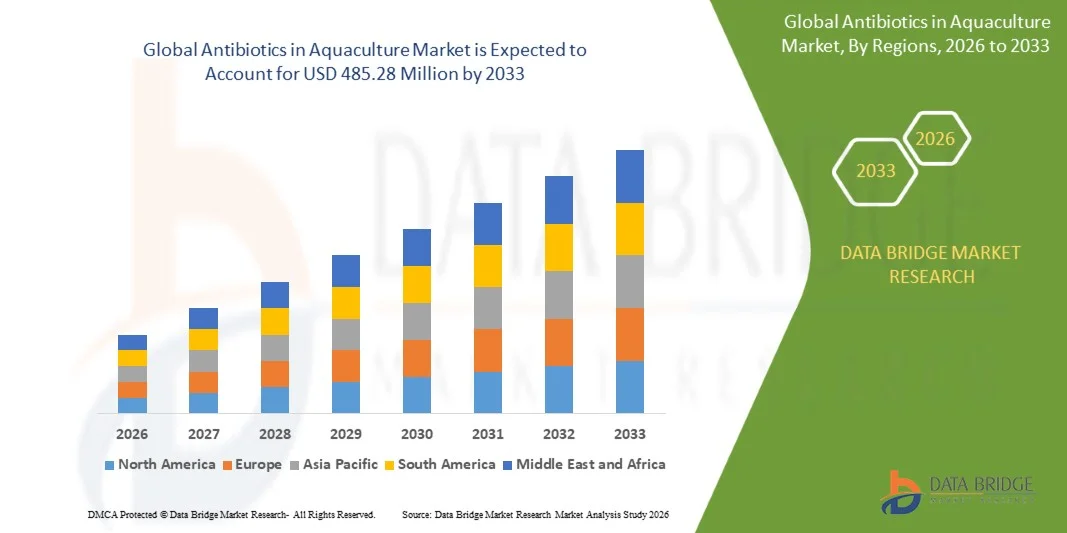
- As per Data Bridge Market Research analysis that the global antibiotics in aquaculture market size was valued at USD 354.59 million in 2025 and is expected to reach USD 485.28 million by 2033, at a CAGR of 4.00% during the forecast period
- The market growth is largely fueled by the increasing prevalence of bacterial infections in aquaculture systems, which is driving the need for effective disease control solutions to maintain fish health and productivity in intensive farming environments
- Furthermore, rising global demand for seafood and expansion of commercial aquaculture production is increasing the dependency on antibiotics to reduce mortality rates and ensure consistent yield output across fish and shrimp farming operations. These converging factors are accelerating the adoption of antibiotics in aquaculture, thereby significantly boosting the industry’s growth
Market Size & Forecast
- Global Market Value (2025): USD 354.59 million
- Expected Market Value (2033): USD 485.28 million
- Forecast CAGR (2026–2033): 4.00%
What are the Major Takeaways of Antibiotics in Aquaculture Market?
- Antibiotics in aquaculture, used for the prevention and treatment of bacterial diseases in fish, shrimp, and other aquatic species, play a crucial role in maintaining farm productivity and minimizing economic losses in high-density aquaculture systems due to rapid disease transmission risks
- The escalating demand for antibiotics in aquaculture is primarily driven by increasing disease outbreaks in farmed fish species, expanding seafood consumption worldwide, and the need for efficient health management practices to support large-scale aquaculture production systems
- Asia-Pacific dominated the antibiotics in aquaculture market in 2025, due to large-scale aquaculture production in China, India, Vietnam, and Indonesia and high dependence on antibiotics for disease control in intensive fish farming systems
- North America is expected to be the fastest growing region in the antibiotics in aquaculture market during the forecast period due to aquaculture production in the U.S. and Canada and increasing focus on fish health management
- Oxytetracycline segment dominated the market with a market share of around 50% in 2025, due to its broad-spectrum effectiveness against a wide range of bacterial pathogens in aquaculture species. Its relatively lower cost and established usage history make it a preferred first-line treatment in many fish farming operations. Farmers rely on oxytetracycline due to its availability and proven efficacy in controlling common infections across freshwater and marine environments
Report Scope and Antibiotics in Aquaculture Market Segmentation
|
Attributes |
Antibiotics in Aquaculture Key Market Insights |
|
Segments Covered |
|
|
Countries Covered |
North America
Europe
Asia-Pacific
Middle East and Africa
South America
|
|
Key Market Players |
|
|
Market Opportunities |
|
|
Value Added Data Infosets |
In addition to the insights on market scenarios such as market value, growth rate, segmentation, geographical coverage, and major players, the market reports curated by the Data Bridge Market Research also include in-depth expert analysis, pricing analysis, brand share analysis, consumer survey, demography analysis, supply chain analysis, value chain analysis, raw material/consumables overview, vendor selection criteria, PESTLE Analysis, Porter Analysis, and regulatory framework. |
What is the Key Trend in the Antibiotics in Aquaculture Market?
“Rising Shift Toward Controlled Antibiotic Use in Aquaculture”
- A significant trend in the antibiotics in aquaculture market is the increasing shift toward controlled and regulated antibiotic application in fish and shrimp farming, driven by growing concerns over antimicrobial resistance and food safety standards in global seafood production. This transition is reshaping treatment practices by encouraging responsible usage patterns and improving monitoring of antibiotic administration across aquaculture systems
- For instance, the Food and Agriculture Organization (FAO) and World Organisation for Animal Health (WOAH) have been actively promoting antimicrobial stewardship guidelines that influence antibiotic usage practices in aquaculture-producing countries such as China, India, and Norway. These regulatory frameworks are pushing producers to adopt controlled dosing and improve disease management protocols
- The growing integration of vaccination programs and preventive health strategies in aquaculture is reducing dependency on antibiotics while supporting disease resistance in farmed species. This shift is encouraging farmers to adopt biosecurity measures and alternative treatments to minimize infection risks
- The expansion of certification programs in seafood exports is further influencing antibiotic usage patterns, as international buyers demand residue-free and responsibly farmed seafood products. This is pushing producers to comply with stricter antibiotic regulations to maintain market access
- The increasing focus on sustainable aquaculture practices is also promoting improved water quality management and farm hygiene systems to reduce bacterial outbreaks. This is gradually transforming disease control strategies from reactive antibiotic use to preventive health management approaches
- The market is witnessing a structural shift toward regulated and traceable antibiotic application systems supported by government policies and industry standards. This evolving landscape is reinforcing responsible antibiotic usage while maintaining productivity in global aquaculture production systems
Antibiotics in Aquaculture Market Dynamics
Driver
“Rising Bacterial Disease Incidence in Fish Farming”
- The increasing prevalence of bacterial infections in aquaculture species such as fish, shrimp, and shellfish is a major driver for antibiotic demand, as intensive farming conditions create favorable environments for disease outbreaks and rapid pathogen transmission. These infections significantly impact yield, survival rates, and overall farm profitability, making antibiotics essential for disease control
- For instance, the Food and Agriculture Organization (FAO) has reported frequent bacterial outbreaks such as vibriosis and streptococcosis in major aquaculture-producing regions including Southeast Asia and Latin America, leading to higher antibiotic usage in commercial fish farming operations. Such disease pressures are compelling farmers to rely on antimicrobial treatments to stabilize production
- The expansion of high-density aquaculture systems is further increasing the risk of disease transmission, as overcrowded farming environments accelerate bacterial spread among aquatic species. This is driving consistent demand for therapeutic antibiotic applications across large-scale farms
- Climate variability and changing water quality conditions are also contributing to higher susceptibility of aquatic species to infections, increasing the need for effective disease management solutions. This is reinforcing the role of antibiotics in maintaining production stability
- The growing importance of seafood as a global protein source continues to intensify production pressures, further increasing the need for reliable disease control measures. This sustained demand is reinforcing antibiotics as a critical component in aquaculture health management systems
Restraint/Challenge
“Regulatory Restrictions on Antibiotic Usage in Aquaculture”
- The antibiotics in aquaculture market faces significant challenges due to increasingly strict regulatory frameworks governing antibiotic usage, aimed at preventing antimicrobial resistance and ensuring food safety in seafood products. These regulations are limiting the type, dosage, and application methods of antibiotics in aquaculture operations across major producing regions
- For instance, the European Medicines Agency (EMA) and U.S. Food and Drug Administration (FDA) have implemented stringent guidelines restricting the use of certain antibiotics in aquaculture, requiring withdrawal periods and residue monitoring in seafood exports. These compliance requirements are increasing operational complexity for producers
- The enforcement of maximum residue limits (MRLs) in international seafood trade is creating barriers for exporters who must ensure antibiotic-free or compliant products to access global markets. This is increasing pressure on aquaculture producers to adopt alternative disease management practices
- The growing global focus on antimicrobial resistance (AMR) reduction is encouraging governments to restrict non-therapeutic antibiotic usage in aquaculture systems. This is reducing routine prophylactic use and limiting market expansion potential
- The tightening regulatory landscape is ultimately reshaping the market toward controlled and judicious antibiotic usage, which while improving sustainability, is also restricting unrestricted market growth and increasing reliance on alternative solutions
How is the Antibiotics in Aquaculture Market Segmented?
The market is segmented on the basis of application, drug type, and mode of administration.
- By Application
On the basis of application, the antibiotics in aquaculture market is segmented into food safety hazards, environmental issues, bacterial infections, animal growth, and others. The bacterial infections segment dominated the market with the largest revenue share in 2025, driven by the high prevalence of infectious diseases in aquaculture species such as fish and shrimp. Intensive farming practices and high stocking densities further increase disease transmission risks, leading to frequent antibiotic usage for treatment and control. Farmers prioritize antibiotics to reduce mortality rates and maintain production stability. The strong dependency on infection management continues to reinforce demand across major aquaculture-producing regions. Regulatory frameworks allowing controlled antibiotic use also support this segment’s dominance.
The animal growth segment is anticipated to witness the fastest growth rate from 2026 to 2033, driven by increasing demand for improved yield efficiency and faster production cycles in aquaculture farming. Farmers are adopting antibiotics in controlled doses to enhance feed conversion efficiency and overall biomass growth under monitored conditions. Rising global seafood consumption is encouraging producers to optimize output within shorter farming cycles. In addition, technological advancements in precision aquaculture practices are supporting more targeted and efficient application strategies. This shift toward productivity enhancement is accelerating the adoption of growth-focused antibiotic applications.
- By Drug Type
On the basis of drug type, the market is segmented into oxytetracycline, florfenicol, sulfamerazine, and others. The oxytetracycline segment dominated the market with the largest revenue share of around 50% in 2025, driven by its broad-spectrum effectiveness against a wide range of bacterial pathogens in aquaculture species. Its relatively lower cost and established usage history make it a preferred first-line treatment in many fish farming operations. Farmers rely on oxytetracycline due to its availability and proven efficacy in controlling common infections across freshwater and marine environments. Its widespread regulatory acceptance in controlled dosage forms further strengthens its dominant position. Continuous demand from large-scale aquaculture production systems supports sustained consumption.
The florfenicol segment is expected to witness the fastest growth rate from 2026 to 2033, driven by its higher efficacy against resistant bacterial strains and improved safety profile compared to traditional antibiotics. Increasing concerns regarding antimicrobial resistance are encouraging farmers to shift toward more advanced therapeutic options. Florfenicol is gaining preference in intensive aquaculture systems where disease outbreaks require rapid and effective intervention. Expanding commercial aquaculture operations are also contributing to higher adoption rates. Its strong performance against gram-negative pathogens further enhances its market penetration.
- By Mode of Administration
On the basis of mode of administration, the market is segmented into oral and immersion. The oral segment dominated the market with the largest revenue share in 2025, driven by its ease of application through medicated feed and cost-effective large-scale usage. This method ensures direct intake of antibiotics by farmed species, making it efficient for treating systemic infections. Farmers prefer oral administration due to its practicality in high-density aquaculture systems where individual treatment is not feasible. It also allows controlled dosage delivery over extended periods, improving treatment outcomes. The compatibility of oral antibiotics with automated feeding systems further strengthens its dominance.
The immersion segment is anticipated to witness the fastest growth rate from 2026 to 2033, driven by its effectiveness in treating external infections and early-stage disease outbreaks. Immersion allows rapid absorption of antibiotics through gills and skin, making it suitable for juvenile and hatchery-stage aquatic animals. Increasing adoption in hatcheries and nursery systems is supporting segment expansion. It is also gaining traction in regions with small-scale aquaculture farms where feed-based medication is less efficient. The ability to treat large populations quickly during outbreak conditions is accelerating its demand growth.
Which Region Holds the Largest Share of the Antibiotics in Aquaculture Market?
- Asia-Pacific dominated the antibiotics in aquaculture market with the largest revenue share in 2025, driven by large-scale aquaculture production in China, India, Vietnam, and Indonesia and high dependence on antibiotics for disease control in intensive fish farming systems
- The region benefits from strong aquaculture infrastructure, cost-efficient production systems, and widespread availability of antibiotics supporting both preventive and therapeutic applications in fish and shrimp farming
- Rising seafood consumption, export-oriented aquaculture production, and increasing outbreaks of bacterial infections are accelerating the adoption of antibiotics across major producing countries in the region
China Antibiotics in Aquaculture Market Insight
China held the largest share in the Asia-Pacific antibiotics in aquaculture market in 2025, supported by its dominant position in global aquaculture production, particularly in freshwater fish and shrimp farming. The country has extensive use of antibiotics such as oxytetracycline and florfenicol to manage bacterial infections and ensure production stability. Strong domestic demand for seafood along with export-oriented aquaculture activities further strengthens antibiotic usage. In addition, well-established aquaculture farming systems and veterinary pharmaceutical supply chains reinforce China’s leadership in the regional market.
India Antibiotics in Aquaculture Market Insight
India is witnessing the fastest growth in the Asia-Pacific region, driven by expanding shrimp farming, inland fisheries, and increasing seafood export demand. Rising incidence of bacterial infections in aquaculture species is increasing the need for effective antibiotic treatments. Government support for fisheries development and modernization of aquaculture practices is further boosting market adoption. In addition, growing investment in aquaculture health management and disease prevention systems is accelerating long-term market expansion.
Europe Antibiotics in Aquaculture Market Insight
The Europe antibiotics in aquaculture market is expanding at a moderate pace, supported by aquaculture activities in countries such as Norway, Spain, and Greece. Strict regulatory frameworks governing antibiotic usage are influencing controlled and targeted application in fish farming systems. The region emphasizes sustainable aquaculture practices and disease prevention strategies to reduce antibiotic dependency. In addition, advancements in aquaculture health management and vaccination programs are shaping market growth across Europe.
Norway Antibiotics in Aquaculture Market Insight
Norway accounted for the largest share in the Europe antibiotics in aquaculture market in 2025, driven by its large-scale salmon farming industry. The country uses antibiotics under strict regulatory supervision to manage bacterial diseases in marine aquaculture systems. Strong aquaculture infrastructure and advanced monitoring practices support controlled antibiotic application. In addition, continuous innovation in fish health management and disease prevention strategies reinforces Norway’s leadership position in the regional market.
Spain Antibiotics in Aquaculture Market Insight
Spain is witnessing steady growth in the Europe antibiotics in aquaculture market, supported by its Mediterranean aquaculture activities and fish farming industry. Increasing focus on controlling bacterial infections in seabass and seabream farming is driving antibiotic usage. Regulatory compliance and sustainable aquaculture practices are shaping controlled adoption patterns. In addition, rising investments in aquaculture health management systems are supporting market expansion in the country.
North America Antibiotics in Aquaculture Market Insight
North America is projected to grow at the fastest CAGR from 2026 to 2033, driven by aquaculture production in the U.S. and Canada and increasing focus on fish health management. Controlled antibiotic usage regulations are shaping market dynamics across the region. Strong emphasis on sustainable aquaculture practices and alternative disease control methods is influencing adoption trends. In addition, technological advancements in aquaculture monitoring systems are supporting responsible antibiotic use.
U.S. Antibiotics in Aquaculture Market Insight
The U.S. accounted for the largest share in the North America antibiotics in aquaculture market in 2025, supported by growing aquaculture production in freshwater fish farming and controlled use of antibiotics for disease management. Regulatory oversight by food safety authorities ensures monitored and restricted antibiotic application. Increasing demand for seafood and expansion of aquaculture farms are supporting market growth. In addition, rising focus on fish health management and biosecurity measures is shaping antibiotic usage patterns in the country.
Which are the Top Companies in Antibiotics in Aquaculture Market?
The antibiotics in aquaculture industry is primarily led by well-established companies, including:
- Fengchen Group Co.,Ltd (China)
- Bayer AG (Germany)
- Merck KGaA (Germany)
- Century Pharmaceuticals Ltd. (India)
- HangZhou Think Chemical Co.,Ltd (China)
- Zoetis Services LLC (U.S.)
- LG Chem (South Korea)
- American Regent, Inc (U.S.)
- Novartis AG (Switzerland)
- Virbac (France)
- Eli Lilly and Company (U.S.)
- Pfizer Inc (U.S.)
What are Latest Developments in Global Antibiotics in Aquaculture Market?
- In July 2025, ICAR-CIBA entered into a strategic partnership with V.K. Aqua Feeds for the technology transfer of CIBA EHP Cura Gro Plus, a specialized aquaculture health solution designed to manage bacterial and parasitic infections in shrimp farming. This development is strengthening disease prevention capabilities in intensive aquaculture systems, where bacterial outbreaks often lead to significant production losses. By enabling wider commercial adoption of advanced health management solutions, this initiative is reducing dependency on traditional antibiotics and improving overall farm productivity. It is also supporting more sustainable aquaculture practices by promoting early-stage disease control and improving shrimp survival rates across key farming regions
- In April 2025, Phibro Animal Health received U.S. FDA approval for Paqflor, a florfenicol-based antibiotic formulated for the treatment of bacterial infections in aquaculture species. This product launch is strengthening the availability of regulated and effective antibiotic treatments in fish farming, particularly for managing respiratory and systemic bacterial diseases. The approval enhances treatment reliability for aquaculture producers, supporting improved fish health outcomes and reducing mortality rates in commercial operations. It is also expanding access to standardized antibiotic solutions, reinforcing regulatory compliance and encouraging responsible antibiotic usage in aquaculture systems
- In July 2024, Merck Animal Health completed the acquisition of Elanco’s aquaculture business, significantly expanding its global aquaculture portfolio, including antibiotics, vaccines, and fish health solutions. This acquisition is enhancing its competitive position in the aquaculture healthcare market by integrating advanced disease management technologies and strengthening its research and development capabilities. The expanded portfolio enables more comprehensive solutions for bacterial disease control, improving efficiency in aquaculture production systems. It is also accelerating innovation in fish health management and increasing global market reach across major aquaculture-producing regions
- In April 2024, Peptobiotics secured Series A funding to accelerate the commercialization of its antimicrobial peptide-based technologies designed as alternatives to conventional antibiotics in aquaculture. This development is driving innovation in reducing antibiotic dependency by introducing bio-based solutions that target bacterial infections without contributing to antimicrobial resistance. The funding is supporting research, scaling of production, and commercialization efforts, thereby strengthening the company’s position in next-generation aquaculture health solutions. It is also contributing to the long-term sustainability of the industry by promoting safer and more environmentally friendly disease control methods
- In March 2024, Zoetis expanded its aquaculture product portfolio through increased commercialization of fish health antibiotics and injectable treatment solutions across major Asian aquaculture markets. This expansion is improving access to effective disease management tools in high-density farming systems where bacterial infections are a persistent challenge. The broader availability of its antibiotic solutions is enhancing fish survival rates and improving production efficiency for aquaculture farmers. It is also reinforcing Zoetis’s presence in emerging aquaculture markets while supporting improved health outcomes and productivity in commercial fish farming operations

- Interactive Data Analysis Dashboard
- Company Analysis Dashboard for high growth potential opportunities
- Research Analyst Access for customization & queries
- Competitor Analysis with Interactive dashboard
- Latest News, Updates & Trend analysis
- Harness the Power of Benchmark Analysis for Comprehensive Competitor Tracking
Global Antibiotics In Aquaculture Market, Supply Chain Analysis and Ecosystem Framework
To support market growth and help clients navigate the impact of geopolitical shifts, DBMR has integrated in-depth supply chain analysis into its Global Antibiotics In Aquaculture Market research reports. This addition empowers clients to respond effectively to global changes affecting their industries. The supply chain analysis section includes detailed insights such as Global Antibiotics In Aquaculture Market consumption and production by country, price trend analysis, the impact of tariffs and geopolitical developments, and import and export trends by country and HSN code. It also highlights major suppliers with data on production capacity and company profiles, as well as key importers and exporters. In addition to research, DBMR offers specialized supply chain consulting services backed by over a decade of experience, providing solutions like supplier discovery, supplier risk assessment, price trend analysis, impact evaluation of inflation and trade route changes, and comprehensive market trend analysis.
Data collection and base year analysis are done using data collection modules with large sample sizes. The stage includes obtaining market information or related data through various sources and strategies. It includes examining and planning all the data acquired from the past in advance. It likewise envelops the examination of information inconsistencies seen across different information sources. The market data is analysed and estimated using market statistical and coherent models. Also, market share analysis and key trend analysis are the major success factors in the market report. To know more, please request an analyst call or drop down your inquiry.
The key research methodology used by DBMR research team is data triangulation which involves data mining, analysis of the impact of data variables on the market and primary (industry expert) validation. Data models include Vendor Positioning Grid, Market Time Line Analysis, Market Overview and Guide, Company Positioning Grid, Patent Analysis, Pricing Analysis, Company Market Share Analysis, Standards of Measurement, Global versus Regional and Vendor Share Analysis. To know more about the research methodology, drop in an inquiry to speak to our industry experts.
Data Bridge Market Research is a leader in advanced formative research. We take pride in servicing our existing and new customers with data and analysis that match and suits their goal. The report can be customized to include price trend analysis of target brands understanding the market for additional countries (ask for the list of countries), clinical trial results data, literature review, refurbished market and product base analysis. Market analysis of target competitors can be analyzed from technology-based analysis to market portfolio strategies. We can add as many competitors that you require data about in the format and data style you are looking for. Our team of analysts can also provide you data in crude raw excel files pivot tables (Fact book) or can assist you in creating presentations from the data sets available in the report.













