


Antifouling Yacht Coatings Market Size
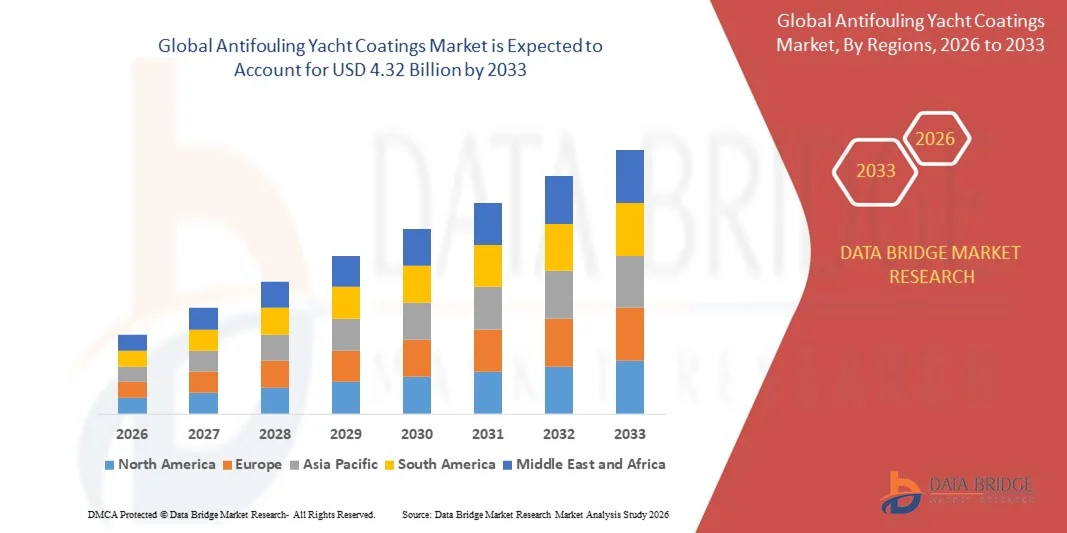
- The global antifouling yacht coatings market size was valued at USD 2.72 billion in 2025 and is expected to reach USD 4.32 billion by 2033, at a CAGR of 5.95% during the forecast period
- The market growth is largely fueled by the increasing adoption of recreational and luxury yachts, rising investments in marina infrastructure, and growing awareness of hull maintenance and operational efficiency. These factors are driving yacht owners and operators to prioritize high-performance antifouling coatings that prevent biofouling and enhance vessel longevity
- Furthermore, the rising focus on eco-friendly and regulatory-compliant coating solutions is encouraging the adoption of advanced bio-based and self-polishing copolymer coatings. Companies offering sustainable and high-performance formulations are gaining a competitive edge, accelerating market uptake and supporting overall growth in the antifouling yacht coatings industry
Antifouling Yacht Coatings Market Analysis
- Antifouling yacht coatings, designed to prevent the accumulation of marine organisms on hulls, are increasingly essential for both recreational and commercial vessels due to their ability to improve fuel efficiency, maintain speed, and reduce maintenance costs
- The escalating demand for antifouling coatings is primarily driven by growth in global yacht ownership, rising luxury and flybridge yacht launches, increasing regulatory emphasis on low-toxicity and eco-friendly coatings, and technological advancements in high-performance formulations that extend maintenance intervals and enhance vessel protection
- Asia-Pacific dominated the antifouling yacht coatings market with a share of over 70% in 2025, due to increasing yacht ownership, rising recreational boating activities, and strong presence of coating manufacturers in the region
- North America is expected to be the fastest growing region in the antifouling yacht coatings market during the forecast period due to strong yacht ownership, growing luxury cruising, and high adoption of advanced coatings
- Copper based segment dominated the market with a market share of 41.7% in 2025, due to its proven effectiveness, durability, and compatibility with various yacht hulls. High-performance formulations reduce maintenance frequency, comply with regulations, and are offered by established global manufacturers. Their reliability across diverse marine environments strengthens adoption among luxury yacht owners
Report Scope and Antifouling Yacht Coatings Market Segmentation
|
Attributes |
Antifouling Yacht Coatings Key Market Insights |
|
Segments Covered |
|
|
Countries Covered |
North America
Europe
Asia-Pacific
Middle East and Africa
South America
|
|
Key Market Players |
|
|
Market Opportunities |
|
|
Value Added Data Infosets |
In addition to the insights on market scenarios such as market value, growth rate, segmentation, geographical coverage, and major players, the market reports curated by the Data Bridge Market Research also include import export analysis, production capacity overview, production consumption analysis, price trend analysis, climate change scenario, supply chain analysis, value chain analysis, raw material/consumables overview, vendor selection criteria, PESTLE Analysis, Porter Analysis, and regulatory framework. |
Antifouling Yacht Coatings Market Trends
Growing Adoption of Eco-Friendly and High-Performance Antifouling Coatings
- A significant trend in the antifouling yacht coatings market is the increasing adoption of eco-friendly, low-toxicity, and high-performance coatings that prevent marine biofouling while reducing environmental impact. This trend is driven by rising environmental regulations, yacht owners’ preference for sustainable solutions, and technological innovations in coating formulations that enhance hull protection and operational efficiency
- For instance, AkzoNobel (NL) launched a bio-based antifouling coating line in 2025, designed to provide long-lasting protection with minimal ecological footprint. Such developments enable yacht operators to comply with strict maritime environmental standards while maintaining high-performance hull protection
- The integration of self-polishing copolymer and hybrid formulations is gaining momentum as these coatings improve fuel efficiency by reducing hull drag and require less frequent reapplication. This is strengthening their adoption in both super and flybridge yachts, positioning advanced coatings as essential for modern yacht maintenance
- Growing awareness of hull maintenance and operational costs is further driving the shift toward premium antifouling coatings. Yacht owners increasingly seek coatings that extend service intervals, reduce fuel consumption, and maintain vessel aesthetics over longer periods
- Manufacturers are also responding with innovations in environmentally compliant formulations that meet regional maritime regulations, particularly in Europe and North America. This is accelerating adoption and reinforcing the market’s shift toward sustainable high-performance solutions
- The trend is supported by the expansion of recreational boating and luxury yacht markets in Asia-Pacific, where companies such as Hempel (DK) and Jotun (NO) are enhancing their regional presence to supply advanced antifouling solutions. Such initiatives reflect the growing global demand for coatings that balance environmental safety and operational performance
Antifouling Yacht Coatings Market Dynamics
Driver
Increasing Global Yacht Ownership and Recreational Boating Activities
- The rising number of recreational and luxury yachts worldwide is a major driver for antifouling coatings, as vessel owners prioritize long-term hull protection and operational efficiency. This growth is fueled by increasing disposable incomes, expansion of marina infrastructure, and rising interest in coastal tourism
- For instance, Hempel (DK) expanded its manufacturing capabilities in Asia in 2025 to meet growing demand from recreational boating markets. Such expansions improve supply chain efficiency and ensure availability of advanced coatings to high-growth regions
- The trend toward larger and more sophisticated yachts, including super yachts and flybridge designs, is increasing the need for high-performance coatings that reduce biofouling, maintain hull aesthetics, and optimize fuel efficiency
- Furthermore, technological innovations in coating formulations, including self-polishing copolymers and hybrid solutions, are expanding the range of applications and enabling yacht owners to comply with regional environmental regulations without compromising performance
- The growing awareness of environmental compliance combined with enhanced operational efficiency continues to reinforce the adoption of advanced antifouling coatings, positioning them as essential investments for yacht owners worldwide
Restraint/Challenge
Stringent Environmental Regulations and Compliance Requirements
- The antifouling yacht coatings market faces challenges due to stringent environmental regulations governing the use of biocides and toxic compounds in marine coatings. Compliance with frameworks such as the International Maritime Organization’s (IMO) guidelines increases formulation complexity and costs for manufacturers
- For instance, companies such as Jotun (NO) and AkzoNobel (NL) invest heavily in research and development to produce low-toxicity, eco-friendly coatings that meet both performance and regulatory requirements. Such regulatory pressures can slow product launches and increase operational expenditure
- The need for coatings that provide effective biofouling protection while adhering to strict environmental standards limits the range of permissible chemical compounds, creating technical and commercial challenges
- Manufacturers must balance performance, environmental compliance, and cost-effectiveness, often requiring specialized production processes and testing, which increase overall production costs
- These regulatory constraints continue to challenge market growth by requiring constant innovation, rigorous testing, and adaptation of coatings to meet both local and international environmental standards
Antifouling Yacht Coatings Market Scope
The market is segmented on the basis of application and type.
- By Application
On the basis of application, the antifouling yacht coatings market is segmented into super yacht, flybridge yacht, sport yacht, long range yacht, sailing yacht, and motor yacht. The super yacht segment dominated the market in 2025, driven by high-value maintenance investments and the need for durable hull protection against biofouling. Owners prioritize premium coatings for their long-lasting performance, resistance to marine growth, and fuel efficiency benefits. Regulatory compliance and the availability of advanced coatings from leading manufacturers also support adoption. The segment benefits from new yacht launches in Europe and North America and growing awareness about reducing long-term maintenance costs.
The flybridge yacht segment is expected to witness the fastest growth from 2026 to 2033, driven by rising recreational boating and popularity of flybridge designs. For instance, AkzoNobel offers specialized coatings that provide long-lasting protection against barnacles and algae. Eco-friendly formulations and reduced drag performance attract yacht owners, while growth in Asia-Pacific leisure boating further fuels demand. In addition, coatings that enhance cruising efficiency and reduce maintenance are increasingly preferred.
- By Type
On the basis of type, the antifouling yacht coatings market is segmented into copper-based, biocides, self-polishing copolymer, and hybrid. The copper-based segment dominated with the largest market share of 41.7% in 2025 due to its proven effectiveness, durability, and compatibility with various yacht hulls. High-performance formulations reduce maintenance frequency, comply with regulations, and are offered by established global manufacturers. Their reliability across diverse marine environments strengthens adoption among luxury yacht owners.
The self-polishing copolymer segment is expected to witness the fastest growth from 2026 to 2033, driven by continuous hull surface renewal and sustained antifouling performance. For instance, International Paint (AkzoNobel) provides coatings that reduce drag, improve fuel efficiency, and require fewer reapplications. Eco-friendly solutions and customization for different water conditions further boost adoption. The segment’s efficiency and versatility make it attractive for both new and retrofit yachts.
Antifouling Yacht Coatings Market Regional Analysis
- Asia-Pacific dominated the antifouling yacht coatings market with the largest revenue share of over 70% in 2025, driven by increasing yacht ownership, rising recreational boating activities, and strong presence of coating manufacturers in the region
- The region’s cost-effective manufacturing, growing investments in marine infrastructure, and expanding luxury tourism sector are accelerating market growth
- The availability of skilled labor, supportive government initiatives for marine industries, and rapid growth in leisure and commercial yachting are contributing to higher consumption of antifouling coatings
China Antifouling Yacht Coatings Market Insight
China held the largest share in the Asia-Pacific market in 2025, owing to its expanding yacht manufacturing sector and active adoption of high-performance coatings. The country’s strong industrial base, growing luxury yacht production, and rising focus on marine tourism are major growth drivers. Demand is further supported by increasing imports of advanced coating solutions and growing investments in eco-friendly antifouling technologies.
India Antifouling Yacht Coatings Market Insight
India is witnessing the fastest growth in the Asia-Pacific region, fueled by rising recreational boating, growing marina development, and increasing luxury yacht ownership. Government initiatives promoting coastal tourism, along with rising disposable income and lifestyle spending, are strengthening the demand for antifouling coatings. The market is also boosted by increasing imports of high-performance coatings and rising awareness of hull maintenance for operational efficiency.
Europe Antifouling Yacht Coatings Market Insight
The Europe market is expanding steadily, supported by stringent environmental regulations, high demand for eco-friendly coatings, and growing investments in yacht maintenance and refit services. The region emphasizes quality, durability, and low-toxicity solutions, particularly for luxury and super yachts. Increasing use of antifouling coatings for commercial and recreational yachts in the Mediterranean and Northern Europe is further driving growth.
Germany Antifouling Yacht Coatings Market Insight
Germany’s market is driven by its established yacht manufacturing industry, advanced coating R&D, and strong export-oriented marine sector. The country’s emphasis on precision engineering and environmental compliance is encouraging the adoption of premium antifouling coatings. Demand is particularly high for high-performance and self-polishing formulations used in both leisure and commercial yachts.
U.K. Antifouling Yacht Coatings Market Insight
The U.K. market is supported by a mature boating culture, growing marina infrastructure, and rising demand for high-quality coatings for both domestic and charter yachts. Focus on eco-friendly and durable solutions, along with collaborations between coating manufacturers and yacht service providers, is fostering growth. Increasing yacht refurbishments and seasonal maintenance demand continue to drive the consumption of advanced antifouling coatings.
North America Antifouling Yacht Coatings Market Insight
North America is projected to grow at the fastest CAGR from 2026 to 2033, driven by strong yacht ownership, growing luxury cruising, and high adoption of advanced coatings. Increasing investments in marinas, yacht maintenance services, and regulatory compliance for environmentally safe coatings are supporting market expansion. Rising focus on performance efficiency, reduced fuel consumption, and hull protection is further encouraging the use of antifouling coatings.
U.S. Antifouling Yacht Coatings Market Insight
The U.S. accounted for the largest share in the North America market in 2025, underpinned by its extensive recreational boating industry, high disposable income, and strong demand for super and flybridge yachts. The country’s focus on eco-friendly, long-lasting, and high-performance coatings is driving adoption among yacht owners. Presence of key coating manufacturers and a well-established distribution network solidify the U.S.’s leading position in the region.
Antifouling Yacht Coatings Market Share
The antifouling yacht coatings industry is primarily led by well-established companies, including:
- Hempel A/S (Denmark)
- Jotun (Norway)
- Ashland Inc. (U.S.)
- RPM International Inc. (U.S.)
- Kansai Paint Co., Ltd (Japan)
- Nycote Laboratories, Inc. (U.S.)
- Diamond Vogel (U.S.)
- Nippon Paint Co., Ltd. (Japan)
- DuPont (U.S.)
- DOW (U.S.)
- 3M (U.S.)
- Heubach Color (Germany)
- The Magni Group (U.S.)
- Wacker Chemie AG (Germany)
- PPG Industries, Inc. (U.S.)
- AkzoNobel N.V. (Netherlands)
- The Sherwin-Williams Company (U.S.)
- Axalta Coating Systems Ltd. (U.S.)
- BASF SE (Germany)
Latest Developments in Global Antifouling Yacht Coatings Market
- In September 2025, PPG Industries (US) entered into a strategic partnership with a leading marine technology firm to develop smart antifouling coatings integrated with IoT capabilities. This initiative highlights PPG’s focus on digital innovation, enabling real-time monitoring of coating performance and predictive maintenance. The move is likely to enhance customer engagement, reduce operational costs for yacht owners, and strengthen PPG’s position in a market increasingly prioritizing technological integration and performance tracking
- In August 2025, AkzoNobel (NL) launched a new line of bio-based antifouling coatings designed to minimize environmental impact while maintaining high-performance protection. This development emphasizes AkzoNobel’s commitment to sustainability and eco-friendly solutions, appealing to environmentally conscious yacht owners. The introduction of these coatings is expected to differentiate the company from competitors yet to adopt bio-based technologies, thereby boosting its market share in regions with stringent environmental regulations
- In July 2025, Hempel (DK) expanded its manufacturing capabilities in Asia to meet growing demand for antifouling coatings in the region. This strategic expansion improves Hempel’s production capacity, reduces supply chain constraints, and enables faster delivery to local markets. The move strengthens Hempel’s competitive stance against other global players and supports its ability to capitalize on Asia-Pacific’s rapidly growing recreational and commercial boating sector
- In June 2025, Sherwin-Williams (US) introduced a next-generation self-polishing copolymer antifouling coating with enhanced fuel efficiency properties. This product allows yachts to maintain optimal hull performance while reducing drag and fuel consumption, providing tangible operational benefits to owners. The innovation reinforces Sherwin-Williams’ market leadership in performance-driven coatings and aligns with the increasing demand for solutions that improve both sustainability and operational efficiency
- In May 2025, Jotun (NO) launched an eco-friendly hybrid antifouling coating tailored for super and flybridge yachts, combining long-lasting protection with reduced biocide content. This development positions Jotun to capture environmentally conscious segments of the market, particularly in Europe and North America, where regulatory pressure and sustainability awareness are high. The move is expected to enhance brand differentiation and strengthen adoption among luxury yacht operators seeking high-performance, low-toxicity solutions

- Interactive Data Analysis Dashboard
- Company Analysis Dashboard for high growth potential opportunities
- Research Analyst Access for customization & queries
- Competitor Analysis with Interactive dashboard
- Latest News, Updates & Trend analysis
- Harness the Power of Benchmark Analysis for Comprehensive Competitor Tracking
Global Antifouling Yacht Coatings Market, Supply Chain Analysis and Ecosystem Framework
To support market growth and help clients navigate the impact of geopolitical shifts, DBMR has integrated in-depth supply chain analysis into its Global Antifouling Yacht Coatings Market research reports. This addition empowers clients to respond effectively to global changes affecting their industries. The supply chain analysis section includes detailed insights such as Global Antifouling Yacht Coatings Market consumption and production by country, price trend analysis, the impact of tariffs and geopolitical developments, and import and export trends by country and HSN code. It also highlights major suppliers with data on production capacity and company profiles, as well as key importers and exporters. In addition to research, DBMR offers specialized supply chain consulting services backed by over a decade of experience, providing solutions like supplier discovery, supplier risk assessment, price trend analysis, impact evaluation of inflation and trade route changes, and comprehensive market trend analysis.
Data collection and base year analysis are done using data collection modules with large sample sizes. The stage includes obtaining market information or related data through various sources and strategies. It includes examining and planning all the data acquired from the past in advance. It likewise envelops the examination of information inconsistencies seen across different information sources. The market data is analysed and estimated using market statistical and coherent models. Also, market share analysis and key trend analysis are the major success factors in the market report. To know more, please request an analyst call or drop down your inquiry.
The key research methodology used by DBMR research team is data triangulation which involves data mining, analysis of the impact of data variables on the market and primary (industry expert) validation. Data models include Vendor Positioning Grid, Market Time Line Analysis, Market Overview and Guide, Company Positioning Grid, Patent Analysis, Pricing Analysis, Company Market Share Analysis, Standards of Measurement, Global versus Regional and Vendor Share Analysis. To know more about the research methodology, drop in an inquiry to speak to our industry experts.
Data Bridge Market Research is a leader in advanced formative research. We take pride in servicing our existing and new customers with data and analysis that match and suits their goal. The report can be customized to include price trend analysis of target brands understanding the market for additional countries (ask for the list of countries), clinical trial results data, literature review, refurbished market and product base analysis. Market analysis of target competitors can be analyzed from technology-based analysis to market portfolio strategies. We can add as many competitors that you require data about in the format and data style you are looking for. Our team of analysts can also provide you data in crude raw excel files pivot tables (Fact book) or can assist you in creating presentations from the data sets available in the report.













