Antimicrobial Hospital Curtains Market Size
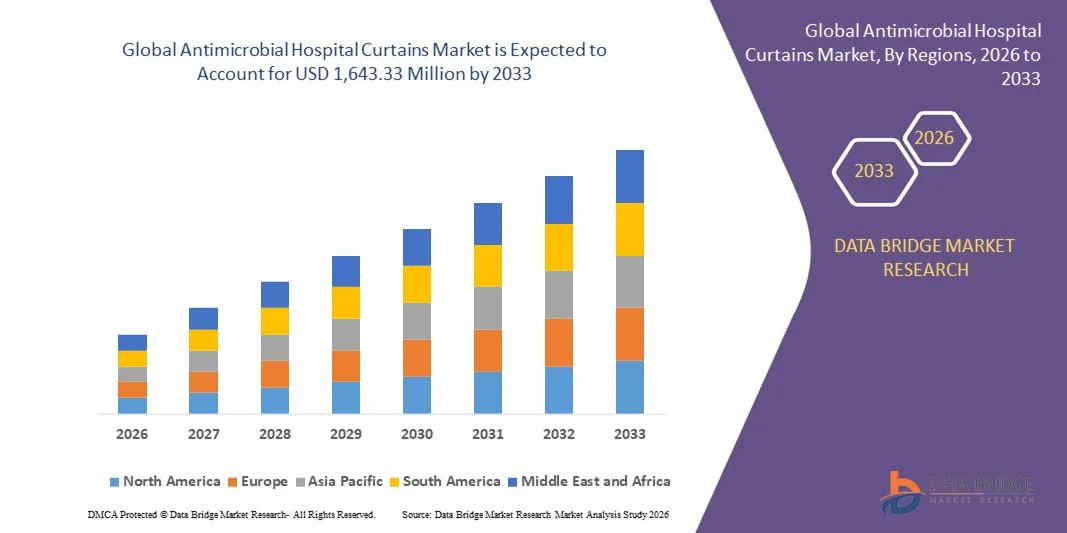
- The global antimicrobial hospital curtains market size was valued at USD 813.32 million in 2025 and is expected to reach USD 1,643.33 million by 2033, at a CAGR of 9.19% during the forecast period
- The market growth is largely fuelled by the increasing focus on infection control and hospital-acquired infection (HAI) prevention, rising adoption of advanced healthcare textiles, and growing demand for safer hospital environments
- The rising awareness among healthcare providers about antimicrobial surfaces, combined with stringent hygiene regulations, is further driving market expansion
Antimicrobial Hospital Curtains Market Analysis
- The market is witnessing a strong shift towards functional and high-performance hospital textiles that prevent microbial growth and contamination
- Growing healthcare expenditure, rising patient safety concerns, and the need to comply with regulatory guidelines for infection control are supporting the adoption of antimicrobial curtains
- North America dominated the antimicrobial hospital curtains market with the largest revenue share of 38.75% in 2025, driven by rising awareness of hospital-acquired infections (HAIs) and stringent healthcare hygiene regulations
- Asia-Pacific region is expected to witness the highest growth rate in the global antimicrobial hospital curtains market, driven by rapid healthcare expansion, increasing hospital beds, and rising demand for hygiene and safety solutions
- The polyester segment held the largest market revenue share in 2025, driven by its durability, ease of cleaning, and long-lasting antimicrobial properties. Polyester curtains are widely preferred in hospitals and healthcare facilities for their ability to withstand frequent laundering while maintaining hygiene standards, making them a popular choice for high-contact patient areas
Report Scope and Antimicrobial Hospital Curtains Market Segmentation
|
Attributes |
Antimicrobial Hospital Curtains Key Market Insights |
|
Segments Covered |
|
|
Countries Covered |
North America
Europe
Asia-Pacific
Middle East and Africa
South America
|
|
Key Market Players |
|
|
Market Opportunities |
|
|
Value Added Data Infosets |
In addition to the insights on market scenarios such as market value, growth rate, segmentation, geographical coverage, and major players, the market reports curated by the Data Bridge Market Research also include in-depth expert analysis, pricing analysis, brand share analysis, consumer survey, demography analysis, supply chain analysis, value chain analysis, raw material/consumables overview, vendor selection criteria, PESTLE Analysis, Porter Analysis, and regulatory framework. |
Antimicrobial Hospital Curtains Market Trends
Rise of Infection-Control Curtains in Healthcare Facilities
- The increasing adoption of antimicrobial hospital curtains is transforming infection prevention in healthcare facilities by reducing surface-borne pathogen transmission. The use of these curtains helps lower hospital-acquired infection (HAI) rates, improve patient safety, and enhance overall hygiene standards, ultimately reducing healthcare costs and boosting operational efficiency
- The high demand for antimicrobial textiles in hospitals, clinics, and long-term care facilities is accelerating the adoption of curtains with built-in antimicrobial agents. These products are particularly effective in high-contact areas such as patient wards and ICU units, helping minimize cross-contamination and supporting stringent infection control protocols
- The ease of maintenance, durability, and compliance with hospital hygiene regulations make antimicrobial curtains an attractive choice for healthcare providers. Regular replacement cycles are simplified, and the curtains’ long-lasting antimicrobial properties ensure continuous protection, enhancing overall facility safety and patient confidence
- For instance, in 2023, several hospitals across Europe reported a reduction in HAI rates after integrating antimicrobial curtains in patient rooms and common areas. This led to improved patient outcomes, reduced hospital stay durations, and lower costs associated with infection management
- While antimicrobial hospital curtains are gaining traction, their effectiveness depends on proper installation, adherence to cleaning protocols, and ongoing innovation. Manufacturers must focus on advanced fabric treatments, customization, and staff training to maximize market adoption
Antimicrobial Hospital Curtains Market Dynamics
Driver
Rising Incidence of Hospital-Acquired Infections and Growing Focus on Patient Safety
- The increase in hospital-acquired infections (HAIs) is driving healthcare facilities to prioritize infection-control solutions such as antimicrobial curtains. These measures are critical in reducing pathogen spread, enhancing patient safety, and meeting regulatory standards
- Healthcare administrators are increasingly aware of the financial and reputational risks associated with HAIs, including prolonged patient stays and higher treatment costs. This awareness is encouraging the broader implementation of antimicrobial textiles across hospital environments
- Government initiatives and international health organizations are supporting infection-prevention programs by promoting antimicrobial textiles, issuing guidelines, and providing incentives for compliance. These efforts are helping healthcare providers adopt effective infection-control measures consistently
- For instance, in 2022, several hospitals in the U.K. implemented antimicrobial curtain programs in ICUs and high-risk wards, resulting in significant reductions in infection rates and improved staff confidence in infection control practices
- As healthcare systems continue to prioritize patient safety and regulatory compliance, demand for antimicrobial hospital curtains is expected to sustain strong growth, particularly in North America and Europe
Restraint/Challenge
High Cost of Advanced Antimicrobial Curtains and Limited Awareness in Small Healthcare Facilities
- The high price point of antimicrobial curtains, especially those with specialized fabrics and long-lasting antimicrobial properties, limits adoption in small clinics and budget-constrained healthcare facilities. Cost remains a primary barrier to widespread usage
- In many regions, limited awareness of the benefits and proper use of antimicrobial curtains reduces market penetration. Smaller healthcare facilities may rely on conventional curtains or standard cleaning practices, delaying adoption of advanced solutions
- Supply chain limitations and inconsistent product availability in remote or underfunded healthcare facilities further restrict access to high-quality antimicrobial curtains. Delays in procurement or limited distribution networks can compromise infection control efforts and patient safety
- For instance, in 2023, several rural healthcare centers in Sub-Saharan Africa reported difficulty sourcing antimicrobial curtains, leading to continued reliance on standard textile solutions with higher HAI risks
- While antimicrobial curtain technologies continue to advance, addressing cost, accessibility, and awareness remains critical. Market stakeholders must focus on cost-effective solutions, local distribution, and training programs to drive sustained adoption and improve infection control outcomes
Antimicrobial Hospital Curtains Market Scope
The antimicrobial hospital curtains market is segmented into three notable segments based on material type, usability, and end user.
- By Material Type
On the basis of material type, the market is segmented into polyester, polypropylene, and others. The polyester segment held the largest market revenue share in 2025, driven by its durability, ease of cleaning, and long-lasting antimicrobial properties. Polyester curtains are widely preferred in hospitals and healthcare facilities for their ability to withstand frequent laundering while maintaining hygiene standards, making them a popular choice for high-contact patient areas.
The polypropylene segment is expected to witness the fastest growth rate from 2026 to 2033, driven by its cost-effectiveness, lightweight nature, and suitability for disposable applications. Polypropylene curtains are particularly popular in short-term and emergency care settings, offering reliable infection control without heavy investment, and serving as an efficient alternative to reusable fabrics.
- By Usability
On the basis of usability, the market is segmented into reusable and disposable curtains. Reusable curtains held the largest share in 2025 due to their long lifespan, ability to undergo repeated sanitization, and compliance with hospital hygiene protocols. They are extensively used in ICUs, patient wards, and surgical units, providing sustained antimicrobial protection over time.
Disposable curtains are expected to witness the fastest growth rate from 2026 to 2033, driven by the need for infection control in high-risk, temporary, and emergency care scenarios. These curtains reduce the risk of cross-contamination, require minimal maintenance, and are increasingly adopted in ambulatory surgical centers, outbreak zones, and short-stay facilities.
- By End User
On the basis of end user, the market is segmented into hospitals, private clinics, emergency settings, short stay settings, nursing homes, ambulatory surgical centers, and others. Hospitals accounted for the largest revenue share in 2025, driven by high patient footfall, strict infection control requirements, and regulatory mandates. Hospital settings extensively use antimicrobial curtains across ICUs, wards, and common areas to prevent hospital-acquired infections.
Emergency settings and short-stay facilities are expected to witness the fastest growth rate from 2026 to 2033, owing to the rising need for temporary infection control solutions. These end users prioritize disposable or rapidly deployable antimicrobial curtains to manage high patient turnover and maintain hygiene standards efficiently, thereby contributing to market expansion.
Antimicrobial Hospital Curtains Market Regional Analysis
- North America dominated the antimicrobial hospital curtains market with the largest revenue share of 38.75% in 2025, driven by rising awareness of hospital-acquired infections (HAIs) and stringent healthcare hygiene regulations
- Hospitals and healthcare facilities in the region prioritize infection prevention and patient safety, leading to the widespread adoption of antimicrobial curtains in patient rooms, operating theaters, and emergency wards
- This adoption is further supported by advanced healthcare infrastructure, high hospital spending, and government initiatives promoting infection control, making antimicrobial curtains a preferred solution for both public and private healthcare facilities
U.S. Antimicrobial Hospital Curtains Market Insight
The U.S. antimicrobial hospital curtains market captured the largest revenue share in 2025 within North America, fueled by increasing incidences of HAIs and strict regulatory standards for hospital hygiene. Hospitals and clinics are investing in durable, antimicrobial textiles to reduce bacterial growth and improve patient safety. The growing trend of hospital renovations and expansions, combined with heightened focus on infection control protocols, is further driving market adoption. Moreover, ongoing technological advancements in antimicrobial treatments for fabrics are significantly contributing to market growth.
Europe Antimicrobial Hospital Curtains Market Insight
The Europe antimicrobial hospital curtains market is expected to witness the fastest growth rate from 2026 to 2033, primarily driven by strict healthcare regulations and rising emphasis on infection prevention. Increasing hospital infrastructure development and the adoption of advanced patient care solutions are fostering market growth. European healthcare facilities are also prioritizing patient safety and hygiene, incorporating antimicrobial curtains across hospitals, surgical centers, and care units. The trend is further supported by government initiatives and funding for infection control programs.
U.K. Antimicrobial Hospital Curtains Market Insight
The U.K. antimicrobial hospital curtains market is expected to witness rapid growth from 2026 to 2033, driven by growing awareness about HAIs and the need for enhanced patient safety. Hospitals and private clinics are increasingly implementing antimicrobial curtains as part of standard hygiene protocols. In addition, government healthcare programs promoting infection control and the modernization of hospital facilities are accelerating adoption. The UK’s strong healthcare infrastructure and emphasis on quality care are key factors supporting market expansion.
Germany Antimicrobial Hospital Curtains Market Insight
The Germany antimicrobial hospital curtains market is expected to witness significant growth from 2026 to 2033, fueled by stringent hygiene standards and rising adoption of advanced infection prevention measures. Hospitals are increasingly using antimicrobial fabrics to reduce bacterial contamination in patient rooms and operating areas. Germany’s well-developed healthcare system, focus on patient safety, and preference for durable and eco-friendly curtain solutions are driving market adoption. Integration with other hospital hygiene protocols further supports market growth.
Asia-Pacific Antimicrobial Hospital Curtains Market Insight
The Asia-Pacific antimicrobial hospital curtains market is expected to witness the fastest growth rate from 2026 to 2033, driven by expanding healthcare infrastructure, rising hospital investments, and increasing awareness of HAIs in countries such as China, India, and Japan. The region’s growing inclination toward modern healthcare facilities and patient safety is driving adoption. Furthermore, rising government initiatives and funding for infection control measures, combined with the increasing prevalence of private hospitals, are fueling market expansion.
Japan Antimicrobial Hospital Curtains Market Insight
The Japan antimicrobial hospital curtains market is expected to witness strong growth from 2026 to 2033 due to the country’s advanced healthcare system, high standards of patient care, and focus on infection prevention. Hospitals are increasingly deploying antimicrobial curtains in patient rooms, operating theaters, and ICU settings. The integration of antimicrobial solutions with hospital hygiene protocols, along with technological advancements in durable fabrics, is driving demand. In addition, Japan’s aging population is likely to increase healthcare facility usage, further supporting market growth.
China Antimicrobial Hospital Curtains Market Insight
The China antimicrobial hospital curtains market accounted for the largest market revenue share in Asia-Pacific in 2025, attributed to rapid expansion of healthcare infrastructure, rising hospital admissions, and increasing awareness of HAIs. Hospitals and clinics are adopting antimicrobial curtains to maintain hygiene standards and enhance patient safety. Government initiatives promoting infection control, coupled with the availability of cost-effective antimicrobial textile solutions, are key factors propelling market growth in China.
Antimicrobial Hospital Curtains Market Share
The Antimicrobial Hospital Curtains industry is primarily led by well-established companies, including:
• Endurocide (U.K.)
• ELERS MEDICAL (U.S.)
• Hospital Curtain Solutions, Inc (U.S.)
• HANGZHOU XIANG JUN (China)
• National Surgical Corporation (U.S.)
• ANGLO MIDDLE EAST LLC (U.A.E.)
• Jiangsu Saikang Medical Equipment Co., Ltd. (China)
• Hygenica Ltd (U.K.)
• RT Dressings (U.K.)
• Marlux Medical Ltd (U.K.)
• Imperial Fastener Company, Inc. (U.S.)
• MANCORP (U.S.)
• Microban International (U.S.)
• KA International (U.K.)
• Cube Care Company, Inc. (U.S.)
• RD Plast (U.K.)
• OSHO INTERNATIONAL (India)
• Amratlal & Dhirajlal & Company (India)
• Tracks2Curtains (U.K.)
• EcoMed Technologie (U.S.)
Latest Developments in Global Antimicrobial Hospital Curtains Market
- In September 2024, Standard Textile Co., Inc., a global leader in healthcare and hospitality textiles, launched AMY, an all-fabric privacy curtain designed to transform curtain management in hospitals. The product simplifies handling, reduces contamination risks, and enhances patient privacy, contributing to improved operational efficiency and infection control. This innovation is expected to drive adoption of advanced curtain solutions across healthcare facilities and set a new standard in hospital textile management
- In November 2023, researchers developed long-lasting antimicrobial coatings for textiles, including hospital curtains, enabling them to actively kill viruses and bacteria. This advancement enhances hygiene, minimizes cross-contamination, and supports infection prevention protocols, thereby boosting patient safety. The development is anticipated to accelerate demand for antimicrobial textile solutions in healthcare settings globally

- Interactive Data Analysis Dashboard
- Company Analysis Dashboard for high growth potential opportunities
- Research Analyst Access for customization & queries
- Competitor Analysis with Interactive dashboard
- Latest News, Updates & Trend analysis
- Harness the Power of Benchmark Analysis for Comprehensive Competitor Tracking
Data collection and base year analysis are done using data collection modules with large sample sizes. The stage includes obtaining market information or related data through various sources and strategies. It includes examining and planning all the data acquired from the past in advance. It likewise envelops the examination of information inconsistencies seen across different information sources. The market data is analysed and estimated using market statistical and coherent models. Also, market share analysis and key trend analysis are the major success factors in the market report. To know more, please request an analyst call or drop down your inquiry.
The key research methodology used by DBMR research team is data triangulation which involves data mining, analysis of the impact of data variables on the market and primary (industry expert) validation. Data models include Vendor Positioning Grid, Market Time Line Analysis, Market Overview and Guide, Company Positioning Grid, Patent Analysis, Pricing Analysis, Company Market Share Analysis, Standards of Measurement, Global versus Regional and Vendor Share Analysis. To know more about the research methodology, drop in an inquiry to speak to our industry experts.
Data Bridge Market Research is a leader in advanced formative research. We take pride in servicing our existing and new customers with data and analysis that match and suits their goal. The report can be customized to include price trend analysis of target brands understanding the market for additional countries (ask for the list of countries), clinical trial results data, literature review, refurbished market and product base analysis. Market analysis of target competitors can be analyzed from technology-based analysis to market portfolio strategies. We can add as many competitors that you require data about in the format and data style you are looking for. Our team of analysts can also provide you data in crude raw excel files pivot tables (Fact book) or can assist you in creating presentations from the data sets available in the report.