


What is the Antimicrobial Medical Textiles Market Size and Growth Rate?
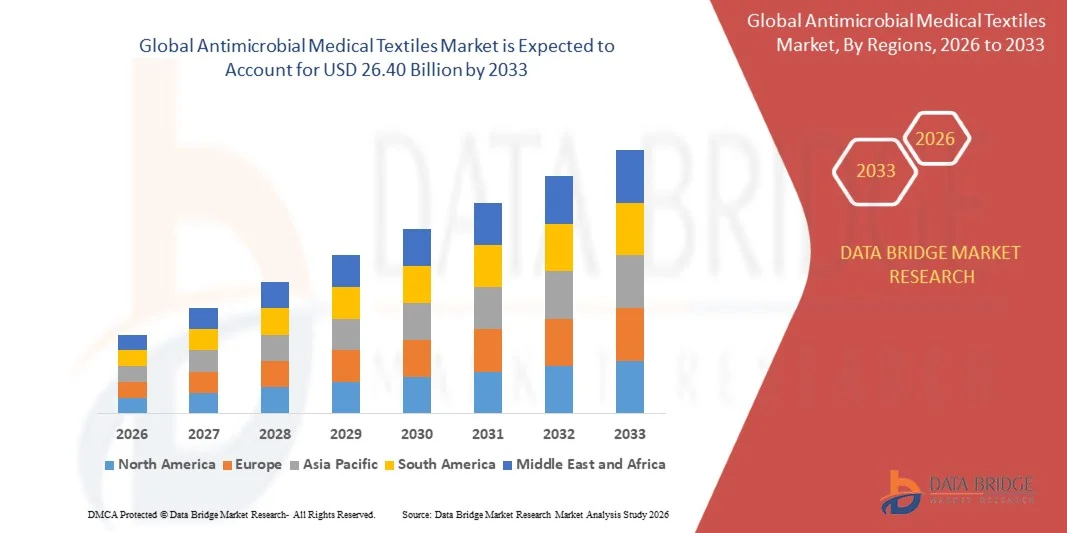
- As per market analysis, the global antimicrobial medical textiles was valued at approximately USD 13.80 billion in 2025 and is projected to reach USD 26.40 billion by 2033, growing at a CAGR of 7.5% from 2026 to 2033.
- The market is witnessing strong growth driven by the increasing prevalence of healthcare-associated infections (HAIs), rising healthcare expenditure, growing emphasis on infection prevention and hospital hygiene, and increasing adoption of antimicrobial fabrics across healthcare facilities. Antimicrobial medical textiles are increasingly used in hospital gowns, surgical drapes, bed linens, privacy curtains, wound dressings, and other healthcare products to inhibit microbial growth and support hygienic environments.
- Increasing demand for non-woven antimicrobial textiles, silver- and metal-based antimicrobial agents, reusable medical fabrics, and textiles capable of withstanding repeated washing and sterilization is creating further growth opportunities. Healthcare and hygiene products and non-implantable goods are gaining traction as hospitals increasingly use antimicrobial textiles for patient protection, surgical applications, wound care, bedding, and other infection-control applications. Technological advancements in antimicrobial finishes, nanotechnology, and the development of durable antimicrobial treatments are further supporting market expansion.
Market Size & Forecast
- Market Value (2025): USD 13.80 billion
- Expected Market Value (2033): USD 26.40 Million
- Forecast CAGR (2026–2033): 7.5%
- Leading Region in 2025: North America
- Fastest Growing Region: Asia-Pacific
What are the Major Takeaways of the Antimicrobial Medical Textiles Market?
- North America dominated the Antimicrobial Medical Textiles Market, accounting for 41.2% revenue share in 2025, supported by advanced healthcare infrastructure, stringent infection-control requirements, high healthcare expenditure, and increasing adoption of antimicrobial textiles across hospitals and healthcare facilities. Strong demand for infection-prevention products, including antimicrobial bedding, surgical textiles, gowns, and drapes, further supported the region's leading market position.
- Asia Pacific is expected to witness the fastest growth in the Antimicrobial Medical Textiles Market, registering a CAGR of more than 5.5% during the forecast period, supported by expanding healthcare infrastructure, increasing healthcare expenditure, rising awareness of infection-control practices, and growing demand for hygienic medical textiles across China, India, Japan, and South Korea.
- Silver and metallic salts dominated the market by active agent, accounting for 47.8% revenue share in 2025, supported by the broad-spectrum antimicrobial properties of silver-based treatments and their application across hospital gowns, drapes, linens, and other healthcare textiles. The segment is also expected to maintain strong growth during the forecast period as healthcare providers continue to prioritize durable antimicrobial protection.
- Surgical gowns and drapes dominated the market by product type, accounting for 34.6% revenue share in 2025, driven by increasing emphasis on infection prevention during surgical procedures and the need for medical textiles that combine antimicrobial protection with fluid-barrier performance. Wound care dressings are expected to witness strong growth during the forecast period due to increasing demand for infection-control solutions in wound management.
- Nonwoven fabrics dominated the market by fabric type, accounting for 58.3% revenue share in 2025, supported by their extensive use in disposable and limited-use medical textiles, including surgical drapes, gowns, wipes, and other infection-control products. The segment is also positioned for strong growth as healthcare facilities increasingly adopt single-use products to support infection prevention and simplify sterilization and laundering requirements.
- Hospitals and clinics dominated the market by end use, accounting for 61.7% revenue share in 2025, supported by high patient volumes, stringent infection-prevention protocols, and extensive use of antimicrobial gowns, surgical drapes, bedding, linens, and wound-care products. Long-term care facilities are expected to witness faster growth as antimicrobial textiles expand beyond acute-care hospitals into nursing and long-term patient-care environments.
Report Scope and Antimicrobial Medical Textiles Market Segmentation
|
Attributes |
Antimicrobial Medical Textiles Key Market Insights |
|
Segments Covered |
|
|
Countries Covered |
North America
Europe
Asia-Pacific
Middle East and Africa
South America
|
|
Key Market Players |
|
|
Market Opportunities |
|
|
Value Added Data Infosets |
In addition to the insights on market scenarios such as market value, growth rate, segmentation, geographical coverage, and major players, the market reports curated by the Data Bridge Market Research also include import export analysis, production capacity overview, production consumption analysis, price trend analysis, climate change scenario, supply chain analysis, value chain analysis, raw material/consumables overview, vendor selection criteria, PESTLE Analysis, Porter Analysis, and regulatory framework. |
What is the Key Trend in the Antimicrobial Medical Textiles Market?
- Antimicrobial medical textile manufacturers are increasingly focusing on durable antimicrobial treatments and advanced nanotechnology, integrating silver, copper oxide, zinc oxide, and other antimicrobial agents into fibers, coatings, and textile finishes to provide long-lasting protection against bacteria, fungi, and other microorganisms.
- The development of sustainable and multifunctional antimicrobial medical textiles is gaining traction, as manufacturers and researchers seek alternatives that combine antimicrobial performance with biocompatibility, environmental compatibility, self-cleaning properties, and durability.
- For instance, in September 2025, ICAR-CIRCOT signed an MoU with Mega Bags, Pune, for licensing nanosilver-finished antimicrobial cotton textile technology. The technology provides antimicrobial properties to cotton fabrics through nanosilver finishing, demonstrating the increasing commercialization and technology-transfer activity surrounding antimicrobial textile treatments. Although the initial application announced under the agreement was flower packaging, the development demonstrates the broader movement toward commercial-scale antimicrobial textile technologies.
- Antimicrobial medical textile development is also moving toward evidence-based infection prevention and clinical validation, with manufacturers and researchers evaluating the effectiveness of treated textiles under real healthcare conditions rather than relying only on laboratory antimicrobial testing.
What are the Key Drivers of the Antimicrobial Medical Textiles Market?
- Increasing prevalence of healthcare-associated infections (HAIs) and growing emphasis on infection prevention are driving demand for antimicrobial medical textiles across hospitals, clinics, ambulatory surgical centers, and long-term care facilities. Surgical gowns, drapes, bed linens, privacy curtains, patient gowns, and staff uniforms are increasingly incorporating antimicrobial treatments to inhibit microbial growth and support safer healthcare environments.
- Growing healthcare expenditure and modernization of healthcare infrastructure are encouraging healthcare facilities to adopt advanced medical textiles that provide antimicrobial protection while maintaining durability, comfort, and wash resistance.
- Advances in antimicrobial agents, nanotechnology, and durable textile-finishing technologies are creating higher-performance medical textiles with improved antimicrobial efficacy and durability. Manufacturers are increasingly developing silver-based, metallic, bio-based, and other antimicrobial treatments, while research is also shifting toward non-leaching and more sustainable antimicrobial technologies to maintain protection while addressing environmental considerations.
- For instance, in June 2025, Heraeus Precious Metals and RUDOLF entered into a strategic partnership to bring AGXX antimicrobial technology to the textile industry. The technology uses a catalytic reaction involving two precious metals to generate reactive oxygen species in the presence of air humidity, providing antimicrobial activity through a continuously regenerating mechanism.
- Growing demand for sustainable and long-lasting antimicrobial solutions is also influencing product development, with manufacturers focusing on antimicrobial agents that can maintain performance after repeated laundering while reducing environmental impact.
Which Factors are Challenging the Growth of the Antimicrobial Medical Textiles Market?
- High costs associated with antimicrobial treatment, advanced finishing technologies, and specialized medical-grade fabrics can challenge market expansion, particularly for cost-sensitive healthcare providers and manufacturers. The need to maintain antimicrobial efficacy while also meeting requirements for durability, comfort, wash resistance, and biocompatibility can increase product-development and manufacturing costs.
- Regulatory requirements and concerns regarding the safety and durability of antimicrobial agents remain important challenges for manufacturers. Products using silver, zinc oxide, nanoparticles, and other antimicrobial substances need to demonstrate effective microbial protection while addressing potential concerns related to chemical migration, skin exposure, environmental impact, and performance after repeated washing and sterilization.
- For instance, on 19 September 2025, ICAR-CIRCOT signed an MoU with Mega Bags, Pune, for licensing nanosilver-finished antimicrobial cotton textile technology. The technology provides antimicrobial properties to cotton fabrics through nanosilver finishing, demonstrating continued development and commercialization of advanced antimicrobial textile technologies. The need to validate antimicrobial performance and translate laboratory technologies into scalable commercial production highlights the technical and commercialization challenges within the market.
- Maintaining antimicrobial performance after repeated laundering and prolonged use remains a key technical challenge for medical textile manufacturers. Healthcare textiles such as bed sheets, gowns, drapes, and curtains undergo frequent washing, sterilization, and mechanical wear, which can reduce the effectiveness of surface-applied antimicrobial treatments.
How is the Antimicrobial Medical Textiles Market Segmented?
The market is segmented on the basis of Fabric, Agents, and Application.
- By Fabric
On the basis of fabric, the antimicrobial medical textiles market is segmented into Cotton, Polyamide, Polyester, and Others. The Cotton segment held the largest market revenue share of 48.23% in 2025, supported by its relevant properties and medical-textile applications. The segment is further supported by increasing demand for antimicrobial fabrics across hospital apparel, surgical textiles, wound-care products, and other healthcare applications.
The Polyester segment is expected to witness the fastest growth during the forecast period, registering a CAGR of 7.98% from 2026 to 2033, driven by increasing demand for [durability/moisture management/breathability/antimicrobial performance] in medical and healthcare textile applications.
- By Agents
On the basis of agents, the antimicrobial medical textiles market is segmented into Metal & Metallic Salts, Synthetic Organic Compounds, and Bio-Based Agents. The Metal & Metallic Salts segment held the largest market revenue share of 38.73% in 2025, supported by the widespread use of silver, copper, zinc, and other metallic antimicrobial agents due to their broad-spectrum antimicrobial properties and application across medical textiles.
The Bio-Based Agents segment is expected to witness the fastest growth during the forecast period, registering a CAGR of 6.37% from 2026 to 2033, driven by increasing demand for sustainable antimicrobial solutions, growing environmental concerns associated with conventional antimicrobial chemicals, and rising interest in naturally derived and biodegradable textile treatments.
- By Application
On the basis of application, the antimicrobial medical textiles market is segmented into Medical Uniform & Apparels, Upholstery, Surgical Textiles, Incontinence Care Garments, Wound Treatment, and Others. The Medical Uniform & Apparels segment held the largest market revenue share of 65.98% in 2025, supported by increasing emphasis on infection prevention, hygiene, and microbial protection across healthcare facilities.
The Surgical Textiles segment is expected to witness the fastest growth during the forecast period, registering a CAGR of 6.75% from 2026 to 2033, driven by increasing healthcare expenditure, rising prevalence of chronic wounds and incontinence-related conditions, and growing adoption of antimicrobial textile products for patient care and infection-control applications.
Which Region Holds the Largest Share of the Antimicrobial Medical Textiles Market?
- North America dominated the antimicrobial medical textiles market with the largest revenue share of 38.50% in 2025, supported by strong healthcare infrastructure, increasing focus on infection prevention, stringent hospital hygiene standards, and rising adoption of antimicrobial textiles across surgical gowns, drapes, hospital linens, uniforms, and other medical applications. The region is further supported by high healthcare expenditure, established hospital networks, increasing awareness regarding healthcare-associated infections, and demand for durable and reusable antimicrobial textile solutions.
- Asia-Pacific is expected to witness the fastest growth during the forecast period, supported by rapid healthcare infrastructure development, expanding hospital networks, rising healthcare expenditure, increasing awareness of infection prevention, and growing adoption of antimicrobial fabrics across hospitals and healthcare facilities. China, India, Japan, South Korea, and other emerging Asian economies are contributing to regional growth through healthcare modernization, increasing hospital capacity, and rising demand for hygienic and infection-control textile solutions.
U.S. Antimicrobial Medical Textiles Market Insight
The U.S. antimicrobial medical textiles market is experiencing strong growth, driven by increasing healthcare-associated infection prevention efforts, advanced hospital infrastructure, and rising adoption of antimicrobial fabrics across surgical gowns, drapes, bedding, curtains, uniforms, and wound-care applications. Demand is further supported by growing awareness of infection-control practices and technological advancements in silver-, copper-, and other antimicrobial-treated textiles. Clinical research has also reported reductions in certain healthcare-associated infection indicators with copper oxide-impregnated textiles. However, CDC guidance emphasizes that antimicrobial textiles should complement, rather than replace, established cleaning, laundering, and infection-control practices.
Europe Antimicrobial Medical Textiles Market Insight
Europe represents a significant market for antimicrobial medical textiles, supported by the region’s well-developed healthcare infrastructure, stringent hygiene standards, and increasing focus on preventing healthcare-associated infections. Demand is supported by growing healthcare expenditure, an aging population, and increasing adoption of antimicrobial textiles in surgical clothing, wound dressings, hospital linens, bedsheets, curtains, and other healthcare applications. Germany remains an important market within Europe due to its established healthcare system and technical textile manufacturing capabilities, while the U.K., France, and Italy continue to support regional demand through investments in healthcare facilities and infection-control practices.
U.K. Antimicrobial Medical Textiles Market Insight
The U.K. antimicrobial medical textiles market is supported by strong healthcare infrastructure, increasing emphasis on infection prevention, and growing adoption of hygienic textile solutions across hospitals and healthcare facilities. The country’s healthcare sector continues to focus on reducing healthcare-associated infections, creating demand for antimicrobial textiles used in surgical gowns, medical uniforms, wound-care products, bed linens, curtains, and other healthcare applications. The U.K. also maintains evidence-based evaluation mechanisms for innovative infection prevention products through the NHS-focused Rapid Review Panel, supporting the assessment of new technologies and materials.
Germany Antimicrobial Medical Textiles Market Insight
Germany represents a significant market for antimicrobial medical textiles in Europe, supported by its advanced healthcare infrastructure, strong hospital procurement systems, and emphasis on infection prevention and patient safety. The adoption of antimicrobial textiles is increasing across surgical garments, hospital bedding, upholstery, curtains, wound-care products, and other healthcare applications where microbial control is important. Germany’s established textile and materials industry also supports innovation in durable antimicrobial finishes, functional fibers, and sustainable textile solutions. Strict European regulatory requirements are encouraging manufacturers to focus on safe, effective, and environmentally responsible antimicrobial treatments.
Asia-Pacific Antimicrobial Medical Textiles Market Insight
Asia-Pacific is expected to witness significant growth in the antimicrobial medical textiles market, driven by expanding healthcare infrastructure, rising healthcare expenditure, and increasing emphasis on infection prevention across hospitals and healthcare facilities. Countries such as China, India, Japan, and South Korea are supporting regional demand through the development of hospitals, clinics, long-term care facilities, and advanced healthcare centers. Growing awareness regarding healthcare-associated infections is encouraging healthcare providers to adopt antimicrobial textiles in surgical gowns, drapes, medical uniforms, bed linens, wound-care products, and other healthcare applications. In addition, advancements in silver-based, metallic salt, bio-based, and other antimicrobial treatments are improving the functional performance and durability of medical textiles.
Japan Antimicrobial Medical Textiles Market Insight
Japan’s antimicrobial medical textiles market is supported by the country’s advanced healthcare infrastructure, strong emphasis on hospital hygiene, and increasing focus on healthcare-associated infection prevention. Medical textiles used in hospital bedding, patient gowns, medical uniforms, surgical textiles, and other healthcare applications are gaining importance as healthcare providers seek effective measures to control microbial contamination. Japan’s continued focus on antimicrobial resistance and infection-control practices also supports demand for functional textile technologies. The Japanese healthcare sector is increasingly exploring antimicrobial agents such as silver, copper, zinc oxide, and other advanced treatments for healthcare textiles, while durability and performance after repeated washing remain important considerations.
China Antimicrobial Medical Textiles Market Insight
The China antimicrobial medical textiles market is experiencing increasing demand, supported by expanding healthcare infrastructure, rising awareness of infection prevention, and growing adoption of hospital hygiene standards. Antimicrobial textiles are increasingly utilized across surgical settings, patient apparel, hospital bedding, upholstery, and other healthcare applications where microbial contamination is a concern. Government initiatives focused on healthcare quality and infection control, together with the expansion of hospitals and healthcare facilities, are supporting market development.
Which are the Top Companies in Antimicrobial Medical Textiles Market?
The Antimicrobial Medical Textiles industry is primarily led by well-established companies, including:
- Milliken & Company (U.S.)
- DuPont de Nemours, Inc. (U.S.)
- Dow Inc. (U.S.)
- Herculite Products Inc. (U.S.)
- BioCote Limited (U.K.)
- PurThread Technologies, Inc. (U.S.)
- Noble Biomaterials, Inc. (U.S.)
- Microban International (U.S.)
- Sanitized AG (Switzerland)
- Sciessent LLC (U.S.)
- Indorama Ventures Public Company Limited (Thailand)
- Smith+Nephew plc (U.K.)
- Unitika Ltd. (Japan)
- Toyobo Co., Ltd. (Japan)
- Sinanen Zeomic Co., Ltd. (Japan)
What are Latest Developments in Antimicrobial Medical Textiles Market?
- In June 2025, Microban International introduced H2O Shield, a PFAS-free water-resistant and performance-finishing technology designed for protective and medical textiles. The technology is positioned to provide moisture protection while addressing environmental and regulatory requirements for technical fabrics and medical textile applications.
- In September 2025, ICAR-CIRCOT signed an MoU with Mega Bags to license its nanosilver-finished antimicrobial cotton textile technology. The agreement provides Mega Bags access to ICAR-CIRCOT's nanosilver finishing technology for producing antimicrobial cotton textiles, supporting commercialization of advanced antimicrobial textile treatments.
- In June 2025, Microban International expanded its antimicrobial textile technology portfolio, with developments focused on healthcare and hospitality textiles and improved durability across repeated washing cycles. The development reflects increasing industry focus on maintaining antimicrobial performance throughout the useful life of reusable medical fabrics.
- In October 2025, Microban International presented a bio-based antimicrobial platform for healthcare textiles Medica 2025. The technology emphasized renewable sourcing and recyclability while targeting antimicrobial performance comparable with conventional metal-based treatments, highlighting the shift toward more sustainable antimicrobial solutions for healthcare textiles.
- In May 2025, Research published advanced biodegradable antimicrobial textile materials for healthcare applications. Recent work has focused on polyhydroxyalkanoate-based fibers and other bio-derived materials that can provide antimicrobial functionality while improving the sustainability profile of medical textiles. These developments are relevant to wound-care textiles and other healthcare textile applications requiring both antimicrobial performance and biodegradability.

- Interactive Data Analysis Dashboard
- Company Analysis Dashboard for high growth potential opportunities
- Research Analyst Access for customization & queries
- Competitor Analysis with Interactive dashboard
- Latest News, Updates & Trend analysis
- Harness the Power of Benchmark Analysis for Comprehensive Competitor Tracking
Global Antimicrobial Medical Textiles Market, Supply Chain Analysis and Ecosystem Framework
To support market growth and help clients navigate the impact of geopolitical shifts, DBMR has integrated in-depth supply chain analysis into its Global Antimicrobial Medical Textiles Market research reports. This addition empowers clients to respond effectively to global changes affecting their industries. The supply chain analysis section includes detailed insights such as Global Antimicrobial Medical Textiles Market consumption and production by country, price trend analysis, the impact of tariffs and geopolitical developments, and import and export trends by country and HSN code. It also highlights major suppliers with data on production capacity and company profiles, as well as key importers and exporters. In addition to research, DBMR offers specialized supply chain consulting services backed by over a decade of experience, providing solutions like supplier discovery, supplier risk assessment, price trend analysis, impact evaluation of inflation and trade route changes, and comprehensive market trend analysis.
Data collection and base year analysis are done using data collection modules with large sample sizes. The stage includes obtaining market information or related data through various sources and strategies. It includes examining and planning all the data acquired from the past in advance. It likewise envelops the examination of information inconsistencies seen across different information sources. The market data is analysed and estimated using market statistical and coherent models. Also, market share analysis and key trend analysis are the major success factors in the market report. To know more, please request an analyst call or drop down your inquiry.
The key research methodology used by DBMR research team is data triangulation which involves data mining, analysis of the impact of data variables on the market and primary (industry expert) validation. Data models include Vendor Positioning Grid, Market Time Line Analysis, Market Overview and Guide, Company Positioning Grid, Patent Analysis, Pricing Analysis, Company Market Share Analysis, Standards of Measurement, Global versus Regional and Vendor Share Analysis. To know more about the research methodology, drop in an inquiry to speak to our industry experts.
Data Bridge Market Research is a leader in advanced formative research. We take pride in servicing our existing and new customers with data and analysis that match and suits their goal. The report can be customized to include price trend analysis of target brands understanding the market for additional countries (ask for the list of countries), clinical trial results data, literature review, refurbished market and product base analysis. Market analysis of target competitors can be analyzed from technology-based analysis to market portfolio strategies. We can add as many competitors that you require data about in the format and data style you are looking for. Our team of analysts can also provide you data in crude raw excel files pivot tables (Fact book) or can assist you in creating presentations from the data sets available in the report.













