


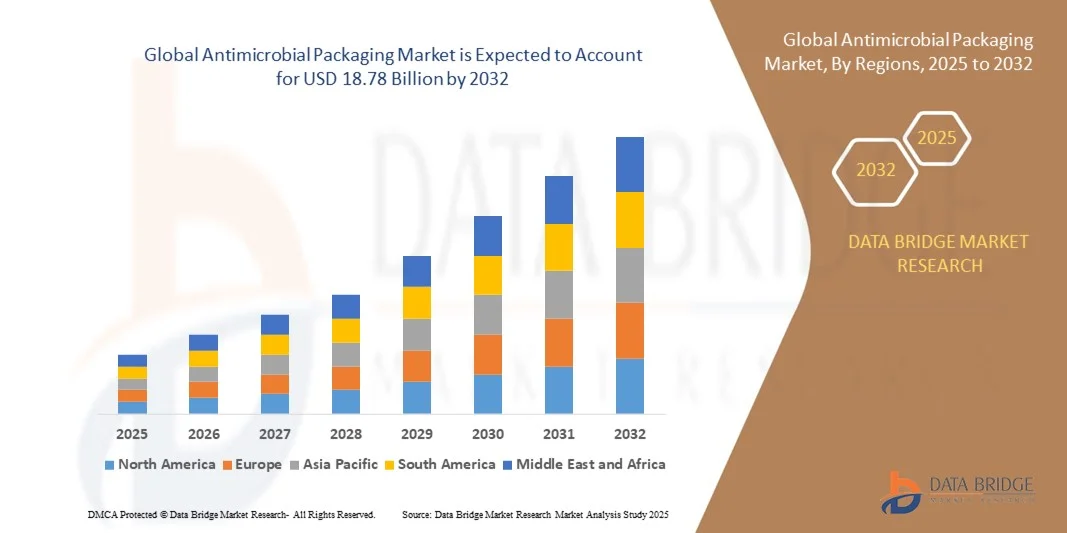
Antimicrobial Packaging Market Size
- The global antimicrobial packaging market size was valued at USD 12.36 billion in 2024 and is expected to reach USD 18.78 billion by 2032, at a CAGR of 5.37% during the forecast period
- The market growth is largely fuelled by the rising demand for packaged food with extended shelf life, increasing awareness regarding food safety, and the growing use of antimicrobial materials in healthcare and pharmaceutical packaging
- The expansion of the e-commerce and food delivery sectors, coupled with the development of eco-friendly antimicrobial packaging materials, is further contributing to market growth
Antimicrobial Packaging Market Analysis
- The global antimicrobial packaging market is experiencing steady growth driven by advancements in material science and the increasing focus on preventing microbial contamination in packaged products
- The use of active packaging technologies incorporating agents such as silver ions, essential oils, and organic acids is gaining traction across food and beverage, personal care, and healthcare industries
- North America dominated the antimicrobial packaging market with the largest revenue share of 38.65% in 2024, driven by rising concerns over food safety, extended shelf life, and strict regulatory standards for packaging materials. The strong presence of major food processing and pharmaceutical companies in the region has further accelerated the adoption of antimicrobial solutions to ensure product integrity and hygiene
- Asia-Pacific region is expected to witness the highest growth rate in the global antimicrobial packaging market, driven by rapid urbanization, growing population, and increasing investments in food safety and sustainable packaging technologies
- The plastics segment held the largest market revenue share in 2024 due to its versatility, cost-effectiveness, and compatibility with a wide range of antimicrobial additives. Plastic-based packaging offers superior barrier protection, lightweight properties, and high adaptability across multiple end-use industries, particularly food and healthcare
Report Scope and Antimicrobial Packaging Market Segmentation
|
Attributes |
Antimicrobial Packaging Key Market Insights |
|
Segments Covered |
|
|
Countries Covered |
North America
Europe
Asia-Pacific
Middle East and Africa
South America
|
|
Key Market Players |
• BASF SE (Germany) |
|
Market Opportunities |
|
|
Value Added Data Infosets |
In addition to the insights on market scenarios such as market value, growth rate, segmentation, geographical coverage, and major players, the market reports curated by the Data Bridge Market Research also include import export analysis, production capacity overview, production consumption analysis, price trend analysis, climate change scenario, supply chain analysis, value chain analysis, raw material/consumables overview, vendor selection criteria, PESTLE Analysis, Porter Analysis, and regulatory framework. |
Antimicrobial Packaging Market Trends
Growing Demand for Sustainable and Bio-Based Antimicrobial Packaging
- The global shift toward sustainability is transforming the antimicrobial packaging market, with manufacturers increasingly focusing on biodegradable and bio-based materials infused with natural antimicrobial agents. This trend aligns with regulatory pressures and consumer preferences for eco-friendly solutions, reducing reliance on traditional plastic-based packaging. Governments worldwide are introducing policies to minimize plastic usage, compelling companies to explore sustainable alternatives that combine environmental responsibility with microbial protection
- The use of natural compounds such as essential oils, chitosan, and silver nanoparticles is gaining traction due to their effectiveness in inhibiting microbial growth while maintaining product safety. These innovations not only extend shelf life but also reduce food waste, driving adoption across food and beverage sectors. Such bioactive components are being tailored to target specific microorganisms, providing customized protection for different food types and improving packaging functionality
- Brands are integrating antimicrobial features into recyclable and compostable materials to meet green packaging standards without compromising on performance. The push for clean-label and sustainable products is expected to further accelerate innovation in this segment. Leading players are investing in hybrid materials that merge barrier performance with biodegradability, thereby appealing to both sustainability-conscious consumers and regulatory authorities
- For instance, in 2024, several European food packaging companies launched compostable antimicrobial film solutions using plant-derived materials, significantly reducing microbial contamination in packaged foods while meeting EU sustainability regulations. These solutions are expected to influence global packaging practices, promoting a shift toward natural antimicrobial ingredients and eco-friendly material compositions. Such initiatives are also strengthening brand image and consumer trust in sustainable packaging solutions
- While sustainability remains a key growth driver, continuous R&D investment is required to enhance material durability and compatibility with various packaging applications. Companies focusing on balancing eco-friendliness with cost efficiency are poised to gain a competitive advantage. Long-term success will depend on the scalability of bio-based packaging solutions and their ability to perform under diverse environmental and storage conditions
Antimicrobial Packaging Market Dynamics
Driver
Increasing Focus on Food Safety and Shelf-Life Extension
- Rising global concern over foodborne illnesses and spoilage has intensified the demand for antimicrobial packaging solutions that ensure product freshness and safety throughout the supply chain. These materials inhibit microbial growth, reducing the risk of contamination and extending shelf life. Manufacturers are also integrating smart indicators that detect spoilage, combining antimicrobial action with real-time freshness monitoring to ensure better food security
- The growing preference for ready-to-eat, perishable, and minimally processed food has heightened the need for packaging that provides active protection against bacteria and fungi. This has encouraged food manufacturers to adopt antimicrobial packaging as part of their quality assurance strategy. As consumer lifestyles shift toward convenience foods, demand for longer-lasting and safer packaging materials continues to surge across retail and e-commerce channels
- Regulatory bodies across North America, Europe, and Asia are emphasizing food safety compliance, which has driven packaging producers to develop advanced antimicrobial films, coatings, and containers. This shift supports brand reputation and consumer trust. Industry collaborations are also increasing between food producers and material scientists to create packaging solutions that adhere to both safety and sustainability standards
- For instance, in 2023, the U.S. FDA approved new bioactive packaging additives designed to prevent Listeria and E. coli contamination in meat and dairy products, boosting adoption among major food processors. These regulatory endorsements are setting new benchmarks for hygiene compliance and encouraging global players to upgrade their packaging portfolios accordingly. Such developments are fostering innovation in antimicrobial film coatings and multi-layer packaging systems
- As awareness regarding food safety continues to grow, antimicrobial packaging technologies are expected to become a standard requirement across multiple end-use industries, driving steady market expansion. The integration of nanotechnology and controlled-release antimicrobial systems is expected to define the next phase of product innovation, ensuring both safety and cost efficiency
Restraint/Challenge
High Production Cost and Limited Consumer Awareness in Developing Regions
- The high cost of manufacturing antimicrobial packaging, particularly those incorporating bioactive agents or nanomaterials, remains a significant challenge for small and mid-scale producers. Advanced formulations often require expensive raw materials and specialized equipment, limiting scalability. This cost disparity makes it difficult for emerging players to compete with established manufacturers, thereby restraining market penetration in cost-sensitive regions
- In developing countries, limited consumer awareness regarding the benefits of antimicrobial packaging and a preference for low-cost traditional materials hinder widespread adoption. Cost sensitivity remains a major barrier, especially in price-driven markets. Many consumers are still unaware of the role antimicrobial packaging plays in preventing contamination and extending shelf life, necessitating greater educational initiatives from both public and private sectors
- Supply chain constraints, coupled with inadequate cold storage infrastructure, also reduce the effectiveness of antimicrobial packaging solutions, leading to slower penetration in emerging economies. Poor logistics and temperature management can compromise the functional properties of these materials, undermining their intended benefits and reducing product performance consistency
- For instance, in 2023, small packaging firms across Southeast Asia cited a 25% higher production cost for antimicrobial materials compared to conventional packaging, restricting their use to premium product segments. This cost barrier also limits technology adoption among smaller producers, widening the innovation gap between developed and developing markets
- To overcome these challenges, industry players are focusing on localized manufacturing, material cost optimization, and consumer education campaigns to enhance market reach and make antimicrobial packaging more accessible and affordable globally. Collaborative efforts with regional suppliers and governments are also being explored to create cost-effective raw material sourcing networks and facilitate technology transfer to developing economies
Antimicrobial Packaging Market Scope
The antimicrobial packaging market is segmented on the basis of base material, pack type, antimicrobial agents, technology, and end-user.
- By Base Material
On the basis of base material, the antimicrobial packaging market is segmented into plastics, biopolymers, paperboard & paper, aluminium foil, non-woven fabrics, and glass. The plastics segment held the largest market revenue share in 2024 due to its versatility, cost-effectiveness, and compatibility with a wide range of antimicrobial additives. Plastic-based packaging offers superior barrier protection, lightweight properties, and high adaptability across multiple end-use industries, particularly food and healthcare.
The biopolymers segment is expected to witness the fastest growth rate from 2025 to 2032, driven by increasing demand for sustainable and eco-friendly materials. Rising environmental concerns and stringent regulatory standards are encouraging manufacturers to shift toward biodegradable antimicrobial packaging solutions derived from renewable resources such as starch, cellulose, and polylactic acid.
- By Pack Type
On the basis of pack type, the market is segmented into bags, pouches, trays, carton packages, cups & lids, cans, and blister packs. The pouches segment held the largest market share in 2024, primarily due to their flexibility, lightweight nature, and cost-effectiveness in food and beverage applications. Pouches are also well-suited for antimicrobial coatings and films, enhancing shelf life and hygiene.
The trays segment is expected to witness the fastest growth rate from 2025 to 2032, supported by rising usage in ready-to-eat and perishable food packaging. Trays provide structural integrity and surface area suitable for antimicrobial layering, making them a preferred option for meat, dairy, and bakery products.
- By Antimicrobial Agents
On the basis of antimicrobial agents, the antimicrobial packaging market is segmented into organic acid, bacteriocins, enzymes, essential oil, metal ions & oxidizers, gas, fungicides, natural extract, and antibiotics. The metal ions & oxidizers segment held the largest market revenue share in 2024, owing to their strong and broad-spectrum antimicrobial properties. Silver, copper, and zinc-based ions are widely incorporated into packaging materials due to their long-lasting activity and safety profile.
The essential oil segment is expected to witness the fastest growth rate from 2025 to 2032, driven by increasing demand for natural and bio-based antimicrobial agents. Essential oils such as thyme, oregano, and cinnamon are gaining traction as effective, eco-friendly alternatives to synthetic chemicals, aligning with the clean-label movement in food packaging.
- By Technology
On the basis of technology, the market is segmented into controlled release packaging and active packaging. The active packaging segment held the largest share in 2024, supported by its ability to inhibit microbial growth and maintain product freshness through continuous interaction with the packaged goods. Active packaging technologies are widely used in perishable food, pharmaceutical, and personal care products.
The controlled release packaging segment is expected to witness the fastest growth rate from 2025 to 2032, fuelled by advancements that allow the gradual release of antimicrobial compounds over time. This technology enhances product protection and longevity, offering a promising solution for extended shelf-life applications.
- By End-User
On the basis of end-user, the antimicrobial packaging market is segmented into food and beverages, healthcare, personal care and consumer goods, and agricultural products. The food and beverages segment held the dominant share in 2024, attributed to rising concerns about foodborne diseases and increasing demand for safe, fresh, and long-lasting food products. Major food brands are adopting antimicrobial packaging to ensure product safety and reduce spoilage rates.
The healthcare segment is expected to witness the fastest growth rate from 2025 to 2032, driven by the increasing adoption of antimicrobial packaging in medical devices, pharmaceutical products, and surgical instruments. The need to minimize infection risks and maintain sterility across the supply chain is propelling demand in hospitals, clinics, and diagnostic laboratories.
Antimicrobial Packaging Market Regional Analysis
- North America dominated the antimicrobial packaging market with the largest revenue share of 38.65% in 2024, driven by rising concerns over food safety, extended shelf life, and strict regulatory standards for packaging materials. The strong presence of major food processing and pharmaceutical companies in the region has further accelerated the adoption of antimicrobial solutions to ensure product integrity and hygiene
- Consumers in the region are increasingly demanding sustainable, safe, and long-lasting packaging options that align with their health-conscious lifestyles. The high rate of innovation, coupled with government initiatives to curb foodborne diseases, continues to support the widespread use of antimicrobial technologies across various packaging formats
- This regional dominance is also fuelled by advanced R&D infrastructure, robust supply chains, and the presence of leading packaging manufacturers integrating bio-based and nanotechnology-driven antimicrobial agents to enhance functionality and performance
U.S. Antimicrobial Packaging Market Insight
The U.S. antimicrobial packaging market captured the largest revenue share in 2024 within North America, driven by the growing emphasis on food safety, pharmaceutical quality, and consumer protection. The country’s well-established regulatory framework and rising demand for packaged and ready-to-eat foods are contributing significantly to market growth. Moreover, the increasing integration of sustainable antimicrobial materials, such as biodegradable polymers and natural extracts, reflects the industry’s shift toward eco-conscious innovation. The expansion of the healthcare sector and the increasing use of sterile packaging in medical applications are also key contributors to market expansion in the U.S.
Europe Antimicrobial Packaging Market Insight
The Europe antimicrobial packaging market is expected to witness the fastest growth rate from 2025 to 2032, primarily fuelled by stringent environmental regulations and the growing demand for sustainable packaging alternatives. The region’s food and beverage industry is rapidly adopting antimicrobial films and coatings to ensure product safety and reduce waste. European consumers are particularly drawn to recyclable and compostable packaging materials enhanced with natural antimicrobial properties. Furthermore, ongoing R&D initiatives across Germany, France, and the U.K. are strengthening the innovation landscape for green packaging technologies in the region
U.K. Antimicrobial Packaging Market Insight
The U.K. antimicrobial packaging market is projected to witness substantial growth from 2025 to 2032, driven by increased awareness of food hygiene and the transition toward sustainable packaging solutions. Rising demand for processed foods and pharmaceuticals is encouraging manufacturers to adopt active packaging that extends shelf life and minimizes contamination risks. The government’s sustainability policies, alongside growing collaborations between packaging firms and biotech innovators, are expected to boost market adoption. This trend is further supported by the country’s strong retail and e-commerce infrastructure, which increasingly demands safer and more durable packaging
Germany Antimicrobial Packaging Market Insight
The Germany antimicrobial packaging market is projected to register the fastest growth rate from 2025 to 2032, driven by the country’s advanced manufacturing ecosystem and strong focus on product innovation. German companies are at the forefront of developing smart antimicrobial solutions incorporating nanotechnology and biodegradable polymers. The country’s emphasis on food export quality and healthcare safety standards is also accelerating demand for advanced packaging materials. Moreover, increased investment in sustainable packaging production and strong consumer preference for eco-friendly, functional packaging options are shaping Germany’s market trajectory
Asia-Pacific Antimicrobial Packaging Market Insight
The Asia-Pacific antimicrobial packaging market is projected to register the fastest growth rate from 2025 to 2032, fuelled by rapid urbanization, expanding food processing industries, and rising health awareness across countries such as China, India, and Japan. The growing middle-class population and shift toward packaged food consumption are creating significant opportunities for antimicrobial solutions. Government initiatives promoting hygiene, sustainability, and reduced food waste are further stimulating adoption. In addition, the presence of low-cost raw materials and expanding local manufacturing capabilities are helping make antimicrobial packaging more affordable and accessible across the region
Japan Antimicrobial Packaging Market Insight
The Japan antimicrobial packaging market is anticipated to witness robust growth from 2025 to 2032, supported by technological advancements and high standards for food and healthcare safety. Japanese consumers prefer premium packaging that ensures both freshness and sustainability, driving demand for antimicrobial materials infused with natural and bio-based agents. The increasing aging population and the expanding pharmaceutical sector are boosting the need for sterile and long-lasting packaging solutions. Moreover, the country’s innovation-driven economy and emphasis on eco-friendly technologies are fostering continued development in the antimicrobial packaging domain
China Antimicrobial Packaging Market Insight
The China antimicrobial packaging market accounted for the largest share in the Asia-Pacific region in 2024, attributed to rapid industrialization, strong government support for sustainable manufacturing, and the expansion of the packaged food and healthcare industries. The country’s rising focus on food safety and hygiene has led to increased adoption of antimicrobial films and coatings across major packaging applications. In addition, the availability of affordable raw materials and the presence of leading domestic producers are strengthening China’s market position. The growing demand for convenient, safe, and sustainable packaging solutions continues to make China a key growth hub for the global antimicrobial packaging market
Antimicrobial Packaging Market Share
The Antimicrobial Packaging industry is primarily led by well-established companies, including:
• BASF SE (Germany)
• DOW (U.S.)
• LINPAC Senior Holdings Limited (U.K.)
• Oplon Pure Science Ltd (Israel)
• PreScouter (U.S.)
• Foodtouch (U.S.)
• Biomaster (U.K.)
• Saniconcentrate (Spain)
• Mondi (U.K.)
• MicrobeGuard Corporation (U.S.)
• Avient (U.S.)
• BioCote Limited (U.K.)
• DUNMORE (U.S.)
• Microban (U.S.)
• Clariant (Switzerland)
• King Plastic Corporation (U.S.)
Latest Developments in Global Antimicrobial Packaging Market
- In January 2024, Amcor launched an innovative antimicrobial packaging film for fresh produce aimed at extending the shelf life of fruits and vegetables. The film incorporates proprietary antimicrobial agents that inhibit bacterial growth and enhance food safety. This innovation aligns with the rising demand for sustainable and hygienic packaging solutions, strengthening Amcor’s leadership in the global packaging industry
- In February 2024, Berry Global partnered with Parx Materials to co-develop packaging solutions with built-in antimicrobial properties for food and healthcare applications. The collaboration focuses on reducing contamination risks and improving hygiene across product categories. This partnership enhances Berry Global’s product portfolio and supports the growing trend toward advanced, safe packaging technologies
- In March 2024, AptarGroup completed the acquisition of ProAmpac, a startup specializing in antimicrobial packaging technologies. The acquisition expands AptarGroup’s capabilities in developing innovative materials that ensure product safety and shelf-life extension. This move strengthens the company’s foothold in the food safety and healthcare packaging markets
- In April 2024, Sealed Air inaugurated a new research and development facility focused on antimicrobial packaging innovation. The facility aims to advance materials designed for food and medical sectors, enhancing product longevity and safety. This investment underscores Sealed Air’s commitment to R&D and positions it at the forefront of packaging innovation
- In May 2024, BioCote secured Series B funding to expand and commercialize its antimicrobial additives for packaging manufacturers worldwide. The funding will accelerate large-scale production and integration of antimicrobial technologies in diverse packaging materials. This initiative is expected to strengthen BioCote’s global presence and drive adoption of hygienic packaging solutions
- In January 2025, Mondi introduced recyclable antimicrobial paper packaging for bakery products to reduce spoilage and waste. The packaging integrates natural antimicrobial agents into paper-based materials, combining sustainability with active protection. This innovation supports the industry’s shift toward eco-friendly and food-safe packaging alternatives
- In April 2025, BASF received U.S. FDA approval for its new antimicrobial packaging material intended for use in meat products. The material offers superior microbial resistance and extended shelf life while ensuring compliance with food safety standards. This approval enhances BASF’s position as a leading provider of high-performance, regulatory-approved packaging solutions
- In February 2024, Dow and Microban International entered a strategic partnership to co-develop advanced antimicrobial packaging solutions for consumer goods. The collaboration merges Dow’s expertise in materials science with Microban’s antimicrobial technologies. This alliance aims to deliver packaging that provides superior protection, longer freshness, and enhanced consumer safety
- In July 2024, Smurfit Kappa launched a new range of antimicrobial carton packaging tailored for pharmaceutical products. The packaging is designed to prevent microbial contamination and maintain product integrity during storage and transport. This development reinforces Smurfit Kappa’s role in supporting safety-focused innovations in healthcare packaging
- In March 2025, Avery Dennison opened a cutting-edge manufacturing facility dedicated to antimicrobial labels for food and healthcare packaging applications. The facility enhances production capacity and supports the rising demand for hygienic labeling solutions. This expansion positions Avery Dennison as a leader in next-generation labeling technologies
- In January 2025, Plastipak Packaging secured a major contract to supply antimicrobial bottles to a leading dairy producer. The bottles are designed to minimize spoilage and improve product safety throughout the supply chain. This partnership highlights Plastipak’s growing presence in the antimicrobial food packaging market
- In December 2024, Tetra Pak introduced antimicrobial packaging solutions for liquid food products across Asian markets. The innovation aims to improve food safety and extend product shelf life while maintaining recyclability. This launch supports Tetra Pak’s commitment to sustainable, high-performance packaging technologies in emerging regions

- Interactive Data Analysis Dashboard
- Company Analysis Dashboard for high growth potential opportunities
- Research Analyst Access for customization & queries
- Competitor Analysis with Interactive dashboard
- Latest News, Updates & Trend analysis
- Harness the Power of Benchmark Analysis for Comprehensive Competitor Tracking
Global Antimicrobial Packaging Market, Supply Chain Analysis and Ecosystem Framework
To support market growth and help clients navigate the impact of geopolitical shifts, DBMR has integrated in-depth supply chain analysis into its Global Antimicrobial Packaging Market research reports. This addition empowers clients to respond effectively to global changes affecting their industries. The supply chain analysis section includes detailed insights such as Global Antimicrobial Packaging Market consumption and production by country, price trend analysis, the impact of tariffs and geopolitical developments, and import and export trends by country and HSN code. It also highlights major suppliers with data on production capacity and company profiles, as well as key importers and exporters. In addition to research, DBMR offers specialized supply chain consulting services backed by over a decade of experience, providing solutions like supplier discovery, supplier risk assessment, price trend analysis, impact evaluation of inflation and trade route changes, and comprehensive market trend analysis.
Data collection and base year analysis are done using data collection modules with large sample sizes. The stage includes obtaining market information or related data through various sources and strategies. It includes examining and planning all the data acquired from the past in advance. It likewise envelops the examination of information inconsistencies seen across different information sources. The market data is analysed and estimated using market statistical and coherent models. Also, market share analysis and key trend analysis are the major success factors in the market report. To know more, please request an analyst call or drop down your inquiry.
The key research methodology used by DBMR research team is data triangulation which involves data mining, analysis of the impact of data variables on the market and primary (industry expert) validation. Data models include Vendor Positioning Grid, Market Time Line Analysis, Market Overview and Guide, Company Positioning Grid, Patent Analysis, Pricing Analysis, Company Market Share Analysis, Standards of Measurement, Global versus Regional and Vendor Share Analysis. To know more about the research methodology, drop in an inquiry to speak to our industry experts.
Data Bridge Market Research is a leader in advanced formative research. We take pride in servicing our existing and new customers with data and analysis that match and suits their goal. The report can be customized to include price trend analysis of target brands understanding the market for additional countries (ask for the list of countries), clinical trial results data, literature review, refurbished market and product base analysis. Market analysis of target competitors can be analyzed from technology-based analysis to market portfolio strategies. We can add as many competitors that you require data about in the format and data style you are looking for. Our team of analysts can also provide you data in crude raw excel files pivot tables (Fact book) or can assist you in creating presentations from the data sets available in the report.













