


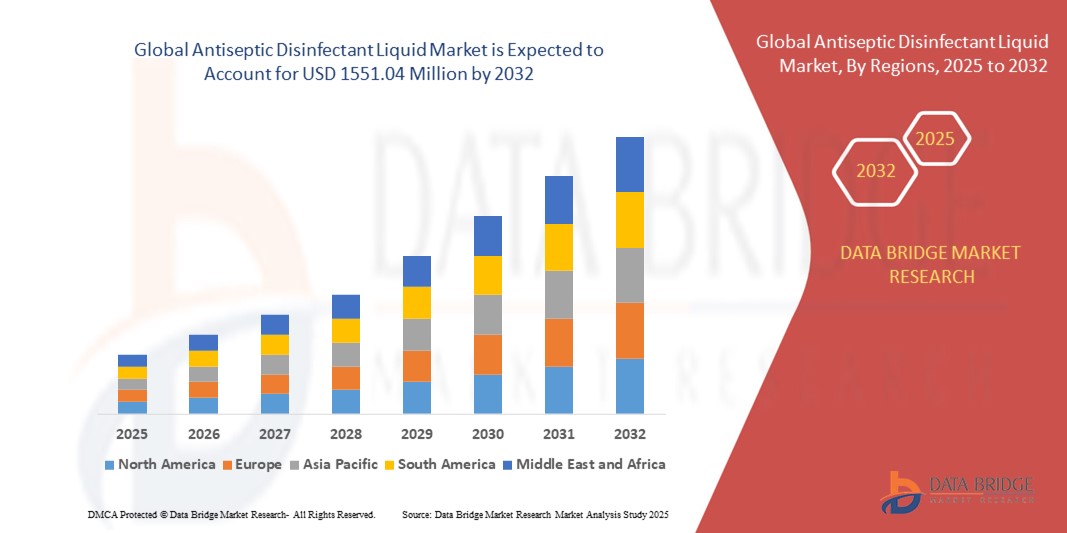
Antiseptic Disinfectant Liquid Market Size
- The global antiseptic disinfectant liquid market size was valued at USD 987.96 million in 2024 and is expected to reach USD 1551.04 million by 2032, at a CAGR of 5.80% during the forecast period
- The market growth is largely fuelled by the rising demand for effective infection control solutions in healthcare, increasing awareness of hygiene and sanitation, and the expansion of healthcare facilities across both developed and emerging economies
- In addition, the growing adoption of antiseptic disinfectants in the food, pharmaceutical, and personal care industries for surface and equipment sterilization is further driving market demand
Antiseptic Disinfectant Liquid Market Analysis
- Growing adoption of antiseptic disinfectant liquids in hospitals, clinics, and household settings is driving market expansion
- Rising incidences of hospital-acquired infections (HAIs) and communicable diseases are boosting demand for reliable disinfectant solutions
- North America dominated the antiseptic disinfectant liquid market with the largest revenue share of 38.5% in 2024, driven by growing awareness of hygiene, infection control, and stringent regulatory standards across healthcare and food industries
- Asia-Pacific region is expected to witness the highest growth rate in the global antiseptic disinfectant liquid market, driven by expanding healthcare facilities, rising disposable incomes, growing adoption of antiseptic products, and increasing industrial and residential demand for effective hygiene solutions
- The alcohol-based segment held the largest market revenue share in 2024, driven by its rapid microbial inactivation, widespread availability, and suitability for hand and surface disinfection. Alcohol-based disinfectants are particularly preferred in healthcare and household applications due to their fast-acting and broad-spectrum effectiveness
Report Scope and Antiseptic Disinfectant Liquid Market Segmentation
|
Attributes |
Antiseptic Disinfectant Liquid Key Market Insights |
|
Segments Covered |
|
|
Countries Covered |
North America
Europe
Asia-Pacific
Middle East and Africa
South America
|
|
Key Market Players |
|
|
Market Opportunities |
|
|
Value Added Data Infosets |
In addition to the insights on market scenarios such as market value, growth rate, segmentation, geographical coverage, and major players, the market reports curated by the Data Bridge Market Research also include import export analysis, production capacity overview, production consumption analysis, price trend analysis, climate change scenario, supply chain analysis, value chain analysis, raw material/consumables overview, vendor selection criteria, PESTLE Analysis, Porter Analysis, and regulatory framework. |
Antiseptic Disinfectant Liquid Market Trends
Increasing Use of Antiseptic Disinfectant Liquids in Healthcare and Personal Hygiene
• The rising adoption of antiseptic disinfectant liquids is transforming the hygiene and healthcare landscape by enabling effective microbial control and infection prevention. Their rapid action and ease of use allow for immediate sanitation, reducing the risk of disease transmission in hospitals, households, and public spaces. This contributes to improved public health outcomes and operational efficiency
• Growing demand in remote healthcare facilities, clinics, and homecare settings is accelerating the use of portable disinfectant solutions. These liquids are particularly effective where access to advanced sterilization equipment is limited, helping maintain hygiene standards and prevent outbreaks. The trend is further supported by government regulations and public awareness campaigns promoting infection control
• The affordability and availability of multipurpose antiseptic disinfectants make them attractive for routine cleaning, personal hygiene, and surface disinfection. Users benefit from convenient application without requiring specialized training, enhancing overall safety and compliance in healthcare and residential environments
• For instance, in 2023, several hospitals across Southeast Asia reported a significant reduction in hospital-acquired infections after implementing standardized antiseptic disinfectant liquid protocols for both staff and patient use. This resulted in improved patient safety and reduced operational costs
• While antiseptic disinfectant liquids are essential for infection control, their sustained impact depends on formulation efficacy, user compliance, and continuous innovation. Manufacturers must focus on product development, widespread distribution, and awareness initiatives to fully capitalize on this growing demand
Antiseptic Disinfectant Liquid Market Dynamics
Driver
Rising Awareness of Infection Control and Hygiene Practices
• Increasing awareness about microbial infections, pandemic preparedness, and personal hygiene is driving the demand for antiseptic disinfectant liquids across healthcare, industrial, and household settings. These liquids ensure rapid and effective disinfection, contributing to reduced transmission of pathogens. Growing concerns over seasonal outbreaks, antibiotic-resistant bacteria, and virus spread in communal spaces are further intensifying adoption, particularly in hospitals, schools, and offices
• Regulatory standards and government mandates in healthcare and food service sectors are encouraging the adoption of antiseptic disinfectants to meet stringent safety protocols. This has strengthened market demand for reliable and compliant formulations. In addition, accreditation programs for hospitals and food processors often require documented use of approved disinfectants, creating a consistent and recurring demand for high-quality solutions
• Growing consumer preference for safe and effective hygiene solutions is pushing manufacturers to offer multipurpose, fast-acting disinfectant liquids that cater to various applications, including hand sanitization, surface cleaning, and wound care. Rising interest in home-based health and wellness routines, alongside online awareness campaigns, has further driven adoption among households seeking preventive measures against everyday pathogens
• For instance, in 2022, hospitals and clinics in North America adopted alcohol-based and alcohol-free antiseptic disinfectant liquids for routine sanitation, boosting overall hygiene compliance and patient safety. Many corporate offices and schools simultaneously implemented disinfectant protocols, which helped strengthen infection control standards and minimize absenteeism due to illness
• While rising awareness and regulation drive market growth, scalability, affordability, and the introduction of eco-friendly formulations remain critical for sustained adoption. The development of user-friendly, fragrance-free, and skin-safe options is increasingly seen as a differentiating factor in highly competitive markets, ensuring wider acceptance across diverse consumer segments
Restraint/Challenge
High Cost of Premium Formulations and Limited Access in Emerging Regions
• Advanced antiseptic disinfectant liquids, especially those with alcohol-free or organic compositions, often come with higher price points, limiting adoption among price-sensitive consumers and small healthcare providers. Cost remains a major barrier for widespread usage, particularly in developing nations where healthcare budgets are constrained. In addition, the higher production costs of eco-friendly or specialty formulations make them less accessible in mass-market retail
• In many emerging regions, lack of distribution infrastructure, limited supply chains, and restricted availability reduce access to quality antiseptic disinfectants, particularly in rural healthcare centers and households. This hinders effective hygiene implementation. Many remote areas rely on local, less effective solutions, leaving gaps in infection control and elevating the risk of disease spread
• Some formulations may also cause skin irritation or sensitivity, limiting their universal acceptance and requiring careful labeling and user education to ensure safe usage. Continuous education about correct dilution, application, and storage of antiseptic liquids is necessary to prevent misuse or reduced efficacy, particularly among non-professional users
• For instance, in 2023, healthcare agencies in Sub-Saharan Africa reported that over 60% of rural clinics relied on basic soap or low-quality disinfectants due to high costs and limited availability of advanced antiseptic liquids. This scenario contributed to inconsistent hygiene practices and highlighted the need for government intervention and NGO-led distribution programs
• While technological improvements and sustainable formulations continue to emerge, addressing pricing, distribution, and accessibility challenges remains essential to ensure long-term market growth. Investment in local manufacturing, subsidized distribution, and low-cost yet effective alternatives is critical to bridge the gap between urban and rural adoption, ensuring consistent global market expansion
Antiseptic Disinfectant Liquid Market Scope
The market is segmented on the basis of product, form, and application.
- By Product
On the basis of product, the antiseptic disinfectant liquid market is segmented into alcohol-based antiseptic disinfectants, chlorine-based disinfectants, and iodine-based disinfectants. The alcohol-based segment held the largest market revenue share in 2024, driven by its rapid microbial inactivation, widespread availability, and suitability for hand and surface disinfection. Alcohol-based disinfectants are particularly preferred in healthcare and household applications due to their fast-acting and broad-spectrum effectiveness.
The chlorine-based segment is expected to witness the fastest growth rate from 2025 to 2032, fueled by its cost-effectiveness, strong oxidizing properties, and suitability for large-scale sanitation in industrial and municipal settings. Chlorine-based disinfectants are increasingly adopted for water treatment, food processing, and surface sanitation, supporting the growth of various end-use sectors.
- By Form
On the basis of form, the antiseptic disinfectant liquid market is segmented into liquid, spray, gel, and wipes. The liquid form held the largest market share in 2024, driven by its versatile usage in healthcare facilities, households, and industrial sanitation. Liquid disinfectants are easy to apply over large surfaces and in bulk, making them the preferred choice for routine cleaning.
The spray form is expected to witness the fastest growth rate from 2025 to 2032, owing to its convenience, portability, and targeted application on high-touch surfaces. Spray disinfectants are increasingly adopted in educational institutions, offices, and public spaces for rapid disinfection.
- By Application
On the basis of application, the antiseptic disinfectant liquid market is segmented into healthcare, food industry, educational institutions, residential consumers, government & municipal agencies, industrial facilities, and agriculture & animal care. The healthcare segment held the largest market revenue share in 2024, driven by stringent infection control protocols, rising awareness of hospital-acquired infections, and frequent disinfection requirements.
The food industry segment is expected to witness the fastest growth rate from 2025 to 2032, fueled by the growing demand for hygiene in food processing, storage, and transportation. Advanced disinfectants ensure compliance with safety standards and prevent contamination of packaged and fresh foods.
Antiseptic Disinfectant Liquid Market Regional Analysis
- North America dominated the antiseptic disinfectant liquid market with the largest revenue share of 38.5% in 2024, driven by growing awareness of hygiene, infection control, and stringent regulatory standards across healthcare and food industries
- Consumers and institutions in the region highly value the effectiveness, safety, and rapid action of antiseptic disinfectants, supporting widespread adoption in hospitals, clinics, households, and industrial facilities
- This strong demand is further bolstered by well-established distribution networks, high healthcare expenditure, and proactive government initiatives, establishing antiseptic disinfectant liquids as a preferred solution for infection prevention
U.S. Antiseptic Disinfectant Liquid Market Insight
The U.S. antiseptic disinfectant liquid market captured the largest revenue share in North America in 2024, fueled by the heightened focus on sanitation, pandemic preparedness, and adoption of alcohol-based and chlorine-based formulations. Increasing use in healthcare, food processing, and household sectors, combined with innovations in eco-friendly and multipurpose disinfectants, further drives market growth. The integration of regulatory compliance with sustainable solutions also significantly contributes to market expansion.
Europe Antiseptic Disinfectant Liquid Market Insight
The Europe antiseptic disinfectant liquid market is expected to witness the fastest growth rate from 2025 to 2032, primarily driven by strict hygiene regulations, food safety mandates, and high adoption in healthcare facilities. Rising awareness about infection control, coupled with increasing demand for multifunctional and eco-friendly formulations, is encouraging market growth across residential, commercial, and industrial applications. The region is witnessing significant expansion due to innovations in alcohol-free and biodegradable disinfectants.
U.K. Antiseptic Disinfectant Liquid Market Insight
The U.K. antiseptic disinfectant liquid market is expected to witness the fastest growth rate from 2025 to 2032, fueled by increasing awareness of hygiene, pandemic response measures, and rising use in hospitals, schools, and households. Growing demand for environmentally friendly and skin-safe formulations, combined with robust e-commerce and retail distribution channels, is driving adoption across multiple sectors. Government initiatives promoting infection control are further accelerating market growth.
Germany Antiseptic Disinfectant Liquid Market Insight
The Germany antiseptic disinfectant liquid market is expected to witness the fastest growth rate from 2025 to 2032, driven by strict healthcare and food safety regulations, technological innovations, and rising awareness of hygiene and infection prevention. The country’s focus on sustainable, non-toxic disinfectants and well-developed healthcare infrastructure supports the adoption of advanced antiseptic liquids in residential, commercial, and industrial applications. Integration of multipurpose and eco-friendly formulations is further enhancing market acceptance.
Asia-Pacific Antiseptic Disinfectant Liquid Market Insight
The Asia-Pacific antiseptic disinfectant liquid market is expected to witness the fastest growth rate from 2025 to 2032, driven by increasing healthcare infrastructure, rising awareness of infection control, and rapid urbanization in countries such as China, India, and Japan. The region’s expanding food processing and healthcare sectors, combined with growing demand for affordable, multipurpose, and eco-friendly disinfectants, is boosting adoption. In addition, government initiatives promoting sanitation and hygiene are supporting market penetration.
Japan Antiseptic Disinfectant Liquid Market Insight
The Japan antiseptic disinfectant liquid market is expected to witness the fastest growth rate from 2025 to 2032 due to the country’s advanced healthcare system, high hygiene standards, and increasing adoption of alcohol-based and eco-friendly disinfectants. Rising use in households, hospitals, and industrial facilities, along with innovations in user-friendly formulations such as sprays and wipes, is fueling growth. Japan’s aging population is also driving demand for safer, easy-to-use disinfectant solutions across residential and commercial settings.
China Antiseptic Disinfectant Liquid Market Insight
The China antiseptic disinfectant liquid market accounted for the largest revenue share in the Asia-Pacific region in 2024, attributed to rapid urbanization, rising hygiene awareness, and increasing government initiatives in healthcare and food safety. High adoption of alcohol-based, chlorine-based, and multipurpose disinfectants in hospitals, food processing units, and households, coupled with domestic manufacturing capabilities and cost-effective solutions, are key factors propelling market growth. The emphasis on infection prevention in public and private sectors further strengthens market expansion.
Antiseptic Disinfectant Liquid Market Share
The Antiseptic Disinfectant Liquid industry is primarily led by well-established companies, including:
- Johnson & Johnson Services, Inc. (U.S.)
- Reckitt Benckiser Group plc (U.K.)
- 3M (U.S.)
- KCWW (U.S.)
- STERIS. (U.S.)
- BD (U.S.)
- Neogen Corporation (U.S.)
- Cosmos Health Inc. (U.S.)
- Cardinal Health, Inc. (U.S.)
- Bio-Cide International, Inc. (U.S.)
Latest Developments in Global Antiseptic Disinfectant Liquid Market
- In February 2024, Neogen Corporation launched a new product, Neogen Farm Fluid MAX, under its Pathogen Program in the U.K., targeting the livestock and poultry sectors. The product is designed to combat challenging farm conditions, enhance biosecurity, and improve overall animal health. By providing an effective solution for pathogen control, it supports farm productivity and reduces disease-related losses, strengthening Neogen’s position in the agricultural hygiene market
- In June 2023, Cosmos Health expanded its C-Sept brand by introducing C-Scrub Wash 4% CHG, a biocide product aimed at improving sanitation and infection control. The launch enhances hygiene standards in healthcare and industrial settings, offering effective microbial reduction and supporting compliance with safety protocols. This development helps Cosmos Health meet growing demand for reliable disinfectants and reinforces its market presence in antiseptic solutions

- Interactive Data Analysis Dashboard
- Company Analysis Dashboard for high growth potential opportunities
- Research Analyst Access for customization & queries
- Competitor Analysis with Interactive dashboard
- Latest News, Updates & Trend analysis
- Harness the Power of Benchmark Analysis for Comprehensive Competitor Tracking
Global Antiseptic Disinfectant Liquid Market, Supply Chain Analysis and Ecosystem Framework
To support market growth and help clients navigate the impact of geopolitical shifts, DBMR has integrated in-depth supply chain analysis into its Global Antiseptic Disinfectant Liquid Market research reports. This addition empowers clients to respond effectively to global changes affecting their industries. The supply chain analysis section includes detailed insights such as Global Antiseptic Disinfectant Liquid Market consumption and production by country, price trend analysis, the impact of tariffs and geopolitical developments, and import and export trends by country and HSN code. It also highlights major suppliers with data on production capacity and company profiles, as well as key importers and exporters. In addition to research, DBMR offers specialized supply chain consulting services backed by over a decade of experience, providing solutions like supplier discovery, supplier risk assessment, price trend analysis, impact evaluation of inflation and trade route changes, and comprehensive market trend analysis.
Data collection and base year analysis are done using data collection modules with large sample sizes. The stage includes obtaining market information or related data through various sources and strategies. It includes examining and planning all the data acquired from the past in advance. It likewise envelops the examination of information inconsistencies seen across different information sources. The market data is analysed and estimated using market statistical and coherent models. Also, market share analysis and key trend analysis are the major success factors in the market report. To know more, please request an analyst call or drop down your inquiry.
The key research methodology used by DBMR research team is data triangulation which involves data mining, analysis of the impact of data variables on the market and primary (industry expert) validation. Data models include Vendor Positioning Grid, Market Time Line Analysis, Market Overview and Guide, Company Positioning Grid, Patent Analysis, Pricing Analysis, Company Market Share Analysis, Standards of Measurement, Global versus Regional and Vendor Share Analysis. To know more about the research methodology, drop in an inquiry to speak to our industry experts.
Data Bridge Market Research is a leader in advanced formative research. We take pride in servicing our existing and new customers with data and analysis that match and suits their goal. The report can be customized to include price trend analysis of target brands understanding the market for additional countries (ask for the list of countries), clinical trial results data, literature review, refurbished market and product base analysis. Market analysis of target competitors can be analyzed from technology-based analysis to market portfolio strategies. We can add as many competitors that you require data about in the format and data style you are looking for. Our team of analysts can also provide you data in crude raw excel files pivot tables (Fact book) or can assist you in creating presentations from the data sets available in the report.













