




Global Antivirus Software Market
Market Size in USD Billion
CAGR :
% 
 USD
3.46 Billion
USD
3.93 Billion
2025
2033
USD
3.46 Billion
USD
3.93 Billion
2025
2033
 Forecast Period Forecast Period |
2026 –2033 |
 Market Size (Base Year) Market Size (Base Year) |
USD 3.46 Billion |
 Market Size (Forecast Year) Market Size (Forecast Year) |
USD 3.93 Billion |
 CAGR CAGR |
% |
| Major Markets Players |
|
Antivirus Software Market Size
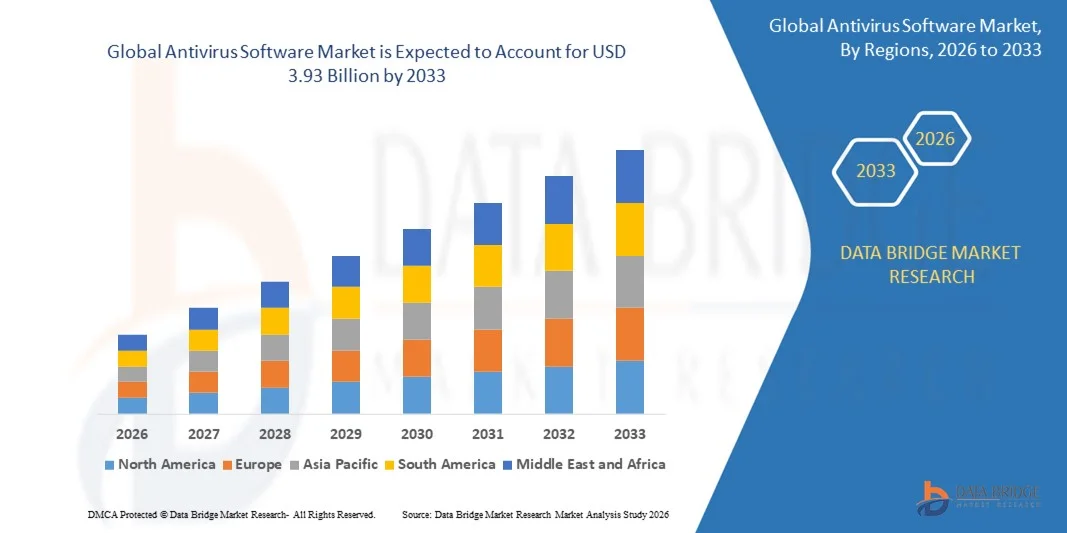
- The global antivirus software market size was valued at USD 3.46 billion in 2025 and is expected to reach USD 3.93 billion by 2033, at a CAGR of 1.6% during the forecast period
- The market growth is largely fueled by the increasing frequency of cyber threats, ransomware attacks, and malware targeting both individuals and enterprises, driving widespread adoption of antivirus solutions across all sectors
- Furthermore, the rising demand for advanced, real-time, and AI-enabled security solutions that provide comprehensive protection across devices, networks, and cloud environments is establishing antivirus software as a critical component of modern digital infrastructure. These factors are accelerating the adoption of antivirus solutions, thereby significantly boosting the industry's growth
Antivirus Software Market Analysis
- Antivirus software, providing protection against malware, ransomware, phishing, and other cyber threats, is becoming an essential element of IT security strategies for both personal and enterprise users due to its ability to safeguard sensitive data and maintain operational continuity
- The escalating demand for antivirus solutions is primarily fueled by growing digitalization, the proliferation of internet-connected devices, increasing regulatory compliance requirements, and heightened awareness among users regarding the importance of cybersecurity and data protection
- North America dominated the antivirus software market with a share of around 48% in 2025, due to high cybersecurity awareness, strong enterprise IT spending, and the widespread adoption of connected devices across residential and corporate environments
- Asia-Pacific is expected to be the fastest growing region in the antivirus software market during the forecast period due to rapid digital transformation, expanding internet penetration, and rising cybercrime incidents in emerging economies
- Paid antivirus segment dominated the market with a market share of 62.9% in 2025, due to rising demand for advanced threat protection, ransomware defense, firewall integration, and real-time monitoring features. Enterprises and security-conscious individual users prefer paid solutions due to comprehensive security suites, regular updates, and dedicated customer support that enhance overall cybersecurity posture
Report Scope and Antivirus Software Market Segmentation
|
Attributes |
Antivirus Software Key Market Insights |
|
Segments Covered |
|
|
Countries Covered |
North America
Europe
Asia-Pacific
Middle East and Africa
South America
|
|
Key Market Players |
|
|
Market Opportunities |
|
|
Value Added Data Infosets |
In addition to the market insights such as market value, growth rate, market segments, geographical coverage, market players, and market scenario, the market report curated by the Data Bridge Market Research team includes in-depth expert analysis, import/export analysis, pricing analysis, production consumption analysis, and pestle analysis. |
Antivirus Software Market Trends
Growing Adoption of AI-Powered Antivirus Solutions
- A prominent trend in the antivirus software market is the increasing deployment of AI-powered solutions that leverage machine learning and behavioral analysis to detect and prevent evolving cyber threats. These advanced solutions enhance protection against zero-day attacks, ransomware, and polymorphic malware, improving enterprise and consumer cybersecurity resilience
- For instance, companies such as McAfee and CrowdStrike integrate AI-driven threat intelligence into their antivirus suites, enabling real-time detection of suspicious activity and automated response to attacks. These implementations strengthen endpoint security and reduce the reliance on signature-based approaches that struggle with novel threats
- The rise of cloud-based antivirus solutions is accelerating, providing organizations with centralized threat monitoring, automated updates, and scalable protection across multiple devices. This trend is positioning cloud antivirus as a critical component in modern IT security strategies
- Consumer demand for lightweight, resource-efficient antivirus solutions is shaping product development, as users seek protection without impacting system performance. This is driving vendors to optimize AI algorithms for faster scanning, lower memory usage, and seamless background operation
- Integration with broader cybersecurity platforms is expanding, where antivirus software now interacts with endpoint detection and response (EDR) systems, firewalls, and SIEM tools. This interoperability is enhancing holistic threat visibility and streamlining incident response workflows
- Regulatory and compliance requirements are influencing adoption patterns, particularly in industries such as finance and healthcare, where data protection standards demand robust antivirus measures. The focus on compliance is motivating enterprises to upgrade traditional antivirus solutions to AI-enabled platforms
Antivirus Software Market Dynamics
Driver
Rising Frequency of Cyberattacks and Malware Threats
- The growing prevalence of cyberattacks, ransomware incidents, and sophisticated malware campaigns is driving enterprises and consumers to invest in advanced antivirus solutions. Continuous threats across multiple sectors are emphasizing the need for proactive and automated cybersecurity measures
- For instance, Symantec reported increased demand for its endpoint protection products following global ransomware attacks targeting corporate networks, highlighting organizations’ urgency to strengthen defenses. This rising awareness of malware risks is directly boosting antivirus market growth
- The expansion of remote work and BYOD policies has increased endpoint vulnerability, requiring more comprehensive antivirus coverage across diverse devices and networks. This scenario is motivating IT teams to adopt solutions that can protect endpoints beyond traditional office environments
- Government agencies and critical infrastructure operators are investing heavily in antivirus software to secure sensitive data and ensure operational continuity. Heightened cybersecurity mandates are supporting the growth of AI-integrated antivirus deployments
- The growing interconnectivity of IoT devices and cloud-based applications creates additional attack vectors, further emphasizing the importance of antivirus solutions capable of detecting multi-layered threats. Enterprises are responding with advanced protection tools to mitigate risks across complex IT environments
Restraint/Challenge
Integration Complexity with Legacy Systems
- Integrating modern antivirus solutions into existing IT infrastructure poses challenges due to compatibility issues with legacy systems, outdated operating environments, and heterogeneous networks. These complexities can hinder seamless deployment and reduce operational efficiency
- For instance, organizations using older Windows Server environments face difficulties implementing AI-powered antivirus solutions from vendors such as Trend Micro, requiring additional configuration and system updates. Such integration hurdles can delay adoption and increase implementation costs
- Antivirus software often needs to interoperate with other security tools such as firewalls, EDR platforms, and SIEM solutions, which may have varied protocols and data formats. Ensuring cohesive functionality without performance degradation remains a persistent challenge
- Resource-intensive scanning and AI processing can strain older hardware, impacting performance and end-user experience. Organizations may need to invest in infrastructure upgrades to fully leverage advanced antivirus capabilities
- Ensuring continuous updates, real-time threat intelligence, and minimal downtime while integrating with legacy applications adds operational complexity. These factors collectively create barriers that vendors and IT teams must address to achieve optimal antivirus performance
Antivirus Software Market Scope
The market is segmented on the basis of type, devices, operating system, and end user.
- By Type
On the basis of type, the antivirus software market is segmented into Free Antivirus and Paid Antivirus. The Paid Antivirus segment dominated the market with the largest revenue share of 62.9% in 2025, driven by rising demand for advanced threat protection, ransomware defense, firewall integration, and real-time monitoring features. Enterprises and security-conscious individual users prefer paid solutions due to comprehensive security suites, regular updates, and dedicated customer support that enhance overall cybersecurity posture. The growing frequency of sophisticated cyberattacks has further strengthened demand for premium subscription-based antivirus platforms.
The Free Antivirus segment is anticipated to witness the fastest growth rate from 2026 to 2033, supported by increasing digital adoption among price-sensitive users and small businesses. Many vendors offer freemium models that provide basic malware detection while promoting upgrades to premium tiers, expanding their user base rapidly. The rising penetration of internet-connected devices in emerging economies also contributes to the growing adoption of free antivirus solutions.
- By Devices
On the basis of devices, the antivirus software market is segmented into Desktop, Laptop, Smartphones, Tablet, Servers, and Others. The Desktop segment dominated the market in 2025 owing to its extensive use in corporate environments and legacy enterprise infrastructures. Organizations continue to rely on desktops for mission-critical operations, making endpoint protection essential to prevent malware intrusions, phishing attacks, and unauthorized access. Strong enterprise spending on endpoint security solutions has sustained the segment’s leading position.
The Smartphones segment is projected to register the fastest CAGR from 2026 to 2033, driven by increasing mobile internet usage, digital payments, and app-based services. The surge in mobile malware, spyware, and data theft incidents has encouraged users to install antivirus applications for real-time scanning and secure browsing. Expanding 5G connectivity and remote work trends further accelerate demand for mobile device protection.
- By Operating System
On the basis of operating system, the antivirus software market is segmented into Windows, MAC, and Android/IOS/Linux. The Windows segment held the largest market share in 2025 due to its widespread global adoption across enterprise and consumer systems. As a primary target for malware developers, Windows devices require continuous security updates and robust antivirus integration to mitigate cyber threats. High dependency on Windows-based enterprise networks sustains demand for dedicated antivirus solutions.
The Android/IOS/Linux segment is expected to witness the fastest growth from 2026 to 2033, supported by expanding smartphone usage and increasing adoption of Linux-based cloud servers. The rising number of mobile applications and open-source deployments has broadened the attack surface, prompting stronger demand for cross-platform antivirus solutions. Growing awareness regarding mobile and server security strengthens this segment’s growth trajectory.
- By End User
On the basis of end user, the antivirus software market is segmented into Individual Users, Enterprise Users, Government Users, and Others. The Enterprise Users segment dominated the market in 2025 driven by strict regulatory compliance requirements and rising cybersecurity investments. Businesses increasingly deploy centralized antivirus management systems to secure endpoints, networks, and sensitive corporate data against advanced persistent threats. The shift toward hybrid work models further reinforces enterprise-level antivirus adoption.
The Government Users segment is anticipated to grow at the fastest rate from 2026 to 2033, fueled by increasing national cybersecurity initiatives and protection of critical infrastructure. Governments are investing heavily in advanced security frameworks to safeguard confidential information and public service systems from cyber espionage and ransomware attacks. Expanding digital governance platforms further amplify demand for high-grade antivirus solutions.
Antivirus Software Market Regional Analysis
- North America dominated the antivirus software market with the largest revenue share of around 48% in 2025, driven by high cybersecurity awareness, strong enterprise IT spending, and the widespread adoption of connected devices across residential and corporate environments
- Organizations in the region prioritize advanced endpoint protection, ransomware defense, and cloud-based security solutions to safeguard sensitive data and maintain regulatory compliance
- The presence of leading cybersecurity vendors, rapid digital transformation, and increasing incidents of sophisticated cyberattacks continue to reinforce antivirus software adoption across industries, establishing the region as a mature and innovation-driven market
U.S. Antivirus Software Market Insight
The U.S. antivirus software market captured the largest revenue share within North America in 2025, fueled by the growing frequency of data breaches and strong investments in enterprise cybersecurity infrastructure. Businesses are increasingly deploying advanced antivirus and endpoint detection solutions to protect hybrid work environments. The rising adoption of cloud computing, IoT devices, and digital payment platforms further accelerates demand for comprehensive antivirus protection across sectors.
Europe Antivirus Software Market Insight
The Europe antivirus software market is projected to expand at a substantial CAGR throughout the forecast period, primarily driven by stringent data protection regulations and increasing cyber threat incidents. The enforcement of cybersecurity compliance frameworks across industries is encouraging organizations to adopt robust antivirus solutions. Growing digitalization of public services and enterprise operations is further contributing to regional market growth.
U.K. Antivirus Software Market Insight
The U.K. antivirus software market is anticipated to grow at a noteworthy CAGR during the forecast period, supported by rising awareness regarding ransomware attacks and phishing threats. Enterprises and government institutions are strengthening cybersecurity frameworks to protect critical infrastructure and confidential information. The expansion of remote working models and digital banking services is further stimulating antivirus software adoption.
Germany Antivirus Software Market Insight
The Germany antivirus software market is expected to expand at a considerable CAGR during the forecast period, driven by strong emphasis on data privacy and secure IT infrastructure. German enterprises are investing in advanced endpoint protection platforms to comply with strict regulatory standards and mitigate cyber risks. Increasing adoption of Industry 4.0 technologies is also contributing to sustained demand for reliable antivirus solutions.
Asia-Pacific Antivirus Software Market Insight
The Asia-Pacific antivirus software market is poised to grow at the fastest CAGR during the forecast period of 2026 to 2033, driven by rapid digital transformation, expanding internet penetration, and rising cybercrime incidents in emerging economies. Growing adoption of smartphones, e-commerce platforms, and digital payment systems is accelerating the need for robust security software. Government-led digitalization initiatives and expanding small and medium enterprise sectors further support market expansion across the region.
Japan Antivirus Software Market Insight
The Japan antivirus software market is gaining momentum due to increasing reliance on connected devices and strong awareness of cybersecurity risks. Businesses are actively investing in advanced threat detection systems to secure corporate networks and cloud environments. The country’s technologically advanced ecosystem and focus on data protection are key contributors to antivirus software adoption.
China Antivirus Software Market Insight
The China antivirus software market accounted for the largest revenue share in Asia-Pacific in 2025, attributed to rapid urbanization, expanding digital ecosystems, and increasing cyber threat incidents. The country’s strong base of internet users and growing enterprise IT infrastructure create substantial demand for endpoint and network security solutions. Rising investments in cloud services and domestic cybersecurity development further propel market growth in China.
Antivirus Software Market Share
The antivirus software industry is primarily led by well-established companies, including:
- Avast Software s.r.o. (Czech Republic)
- Microsoft (U.S.)
- NortonLifeLock Inc. (U.S.)
- Avira Operations GmbH & Co. KG. (Germany)
- McAfee, LLC (U.S.)
- F-Secure (Finland)
- Trend Micro Incorporated (Japan)
- ESET, spol. s r.o. (Slovakia)
- Fortinet, Inc. (U.S.)
- G DATA CyberDefense AG (Germany)
- AO Kaspersky Lab (Russia)
- Panda Security (Spain)
- Quick Heal Technologies Limited (India)
- Comodo Security Solutions, Inc. (U.S.)
- Sophos Ltd. (U.K.)
- Malwarebytes (U.S.)
- Bitdefender (Romania)
- Cisco Systems, Inc. (U.S.)
Latest Developments in Global Antivirus Software Market
- In February 2024, McAfee expanded its McAfee+ portfolio with the launch of Social Privacy Manager, a tool designed to give consumers greater control over the personal information they share on social media. This development addresses the rising concerns over digital privacy and online identity theft, strengthening McAfee’s brand positioning in consumer security and enhancing customer loyalty. By integrating social media data protection into its existing antivirus suite, McAfee broadens its appeal among privacy-conscious users and reinforces its competitive advantage in the global cybersecurity and antivirus software market
- In January 2024, McAfee released insights from its Global Small Business Study, surveying IT decision-makers and business owners across six countries. The study highlighted small businesses’ growing awareness of cybersecurity threats and gaps in current protections, providing McAfee with actionable insights to tailor solutions for this segment. This initiative strengthens McAfee’s market positioning among SMEs, promotes adoption of its antivirus and endpoint protection products, and underlines its thought leadership in cybersecurity for smaller enterprises
- In September 2023, Sybari Software and Trend Micro announced a major merger aimed at combining their threat detection capabilities and enterprise antivirus solutions. The merger enhances scalability, expands their global presence, and allows the companies to offer more comprehensive cybersecurity services to enterprise clients. This consolidation strengthens their competitive position against other major cybersecurity players, improves market share in enterprise antivirus solutions, and accelerates the development of advanced threat detection and response technologies
- In June 2023, Trend Micro introduced Trend Vision One, a next-generation enterprise security platform integrating complete attack surface risk management, unified protection across hybrid environments, and XDR enhanced with generative AI. This launch significantly advances the way organizations manage cybersecurity, enabling faster threat detection and response across cloud, on-premises, and hybrid infrastructures. By positioning itself as a pioneer in AI-driven enterprise cybersecurity, Trend Micro strengthens its market leadership and meets the increasing demand for advanced, integrated antivirus and threat protection solutions
- In 2023, Bitdefender launched Bitdefender 2024, featuring enhanced ransomware mitigation tools and improved anti-phishing modules. This release reinforces Bitdefender’s commitment to delivering comprehensive protection for both consumers and enterprises, responding to the growing sophistication of cyber threats. The updated software strengthens user confidence, supports market expansion in key regions, and helps Bitdefender maintain a competitive edge in the antivirus software landscape
SKU-
Get online access to the report on the World's First Market Intelligence Cloud

- Interactive Data Analysis Dashboard
- Company Analysis Dashboard for high growth potential opportunities
- Research Analyst Access for customization & queries
- Competitor Analysis with Interactive dashboard
- Latest News, Updates & Trend analysis
- Harness the Power of Benchmark Analysis for Comprehensive Competitor Tracking
Research Methodology
Data collection and base year analysis are done using data collection modules with large sample sizes. The stage includes obtaining market information or related data through various sources and strategies. It includes examining and planning all the data acquired from the past in advance. It likewise envelops the examination of information inconsistencies seen across different information sources. The market data is analysed and estimated using market statistical and coherent models. Also, market share analysis and key trend analysis are the major success factors in the market report. To know more, please request an analyst call or drop down your inquiry.
The key research methodology used by DBMR research team is data triangulation which involves data mining, analysis of the impact of data variables on the market and primary (industry expert) validation. Data models include Vendor Positioning Grid, Market Time Line Analysis, Market Overview and Guide, Company Positioning Grid, Patent Analysis, Pricing Analysis, Company Market Share Analysis, Standards of Measurement, Global versus Regional and Vendor Share Analysis. To know more about the research methodology, drop in an inquiry to speak to our industry experts.
Customization Available
Data Bridge Market Research is a leader in advanced formative research. We take pride in servicing our existing and new customers with data and analysis that match and suits their goal. The report can be customized to include price trend analysis of target brands understanding the market for additional countries (ask for the list of countries), clinical trial results data, literature review, refurbished market and product base analysis. Market analysis of target competitors can be analyzed from technology-based analysis to market portfolio strategies. We can add as many competitors that you require data about in the format and data style you are looking for. Our team of analysts can also provide you data in crude raw excel files pivot tables (Fact book) or can assist you in creating presentations from the data sets available in the report.












