


Applicant Tracking Systems Market Overview
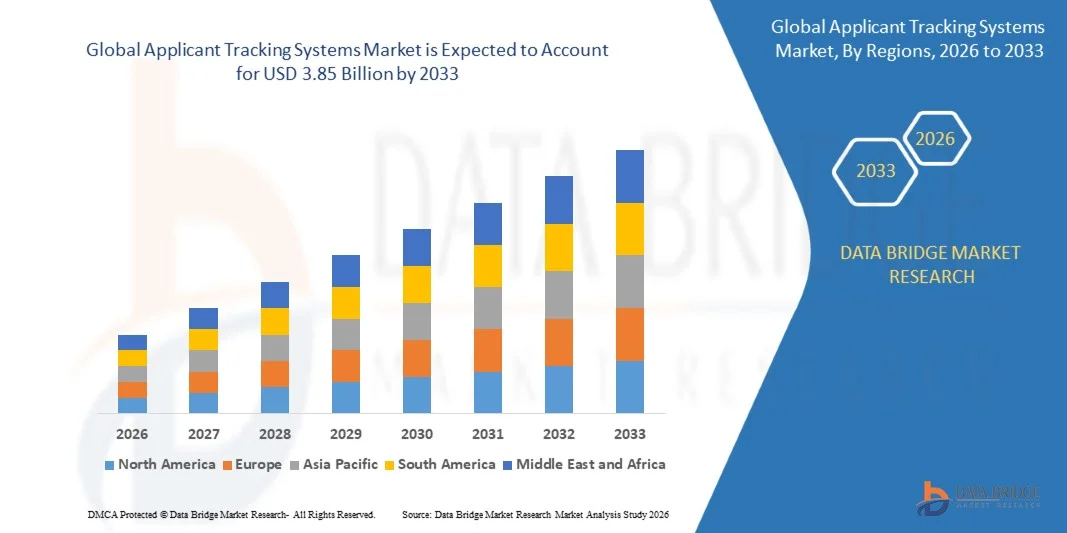
The Applicant Tracking Systems Market was valued at USD 1.99 billion in 2025 and is projected to reach USD 3.85 billion by 2033, growing at a CAGR of 8.62% from 2026 to 2033. The market is witnessing steady growth driven by increasing digital transformation in human resource management, rising adoption of cloud-based recruitment platforms, and growing demand for automation in hiring processes across enterprises of all sizes. Organizations are increasingly shifting toward AI-enabled applicant tracking solutions to improve recruitment efficiency, reduce time-to-hire, and enhance candidate experience across competitive job markets
The rapid expansion of remote and hybrid work models, combined with increasing volume of job applications across industries, is compelling companies to adopt advanced applicant tracking systems for streamlined talent acquisition. Integration of artificial intelligence, machine learning, and data analytics into recruitment workflows is enabling automated resume screening, candidate matching, and predictive hiring insights. In addition, growing focus on diversity hiring, compliance management, and workforce optimization is further accelerating the adoption of applicant tracking systems across corporate, government, and staffing organizations globally
Key Market Trends & Insights
- North America dominated the applicant tracking systems market with the largest revenue share of 2025, supported by strong presence of leading HR technology providers, early adoption of advanced recruitment software, and high investment in AI-driven workforce solutions. Enterprises in the region are heavily focused on automation and data-driven hiring decisions. Moreover, widespread use of cloud HR platforms and mature digital infrastructure further strengthens regional dominance.
- Asia-Pacific is expected to be the fastest-growing region, recording a CAGR of from 2026 to 2033. Growth is driven by rapid digitalization of HR processes, expansion of IT and service industries, and increasing adoption of recruitment technologies among SMEs. Countries in the region are also witnessing rising demand for scalable and cost-effective hiring solutions. Government initiatives supporting digital workforce transformation are further contributing to market acceleration.
- The Software segment held the largest market revenue share of approximately 71.4% in 2025 driven by widespread adoption of cloud based recruitment platforms, AI powered resume screening tools, and integrated talent acquisition systems across enterprises. Software solutions are preferred due to their scalability, automation capabilities, and seamless integration with HR management systems, enabling organizations to streamline end to end recruitment workflows.
- The Services segment is projected to register the fastest growth at a CAGR of 10.2% from 2026 to 2033, driven by increasing demand for implementation support, system customization, consulting, and ongoing maintenance services. Rising complexity of AI enabled recruitment platforms and growing enterprise need for optimized deployment strategies are accelerating service adoption.
- The Large Enterprises segment held the largest market revenue share of approximately 66.8% in 2025 driven by high recruitment volumes, global hiring operations, and strong adoption of advanced HR technologies. Large organizations increasingly rely on applicant tracking systems to manage talent pipelines, improve hiring efficiency, and support data driven workforce planning.
- The Small and Medium Sized Enterprises segment is projected to register the fastest growth at a CAGR of 9.6% from 2026 to 2033, driven by increasing availability of affordable cloud based ATS solutions and rising digital transformation among SMEs. Growing awareness of recruitment automation benefits is supporting rapid adoption across emerging businesses.
- The Cloud segment held the largest market revenue share of approximately 74.5% in 2025 driven by increasing adoption of remote hiring, scalability advantages, and lower infrastructure costs. Cloud based ATS platforms enable real time access, seamless updates, and integration with AI driven recruitment tools.
- The On Premise segment is projected to register steady growth at a CAGR of 6.8% from 2026 to 2033, primarily driven by organizations with strict data security requirements and regulatory compliance needs. Industries such as banking and government continue to prefer on premise deployment for greater control over sensitive candidate data.
- The IT and Telecommunications segment held the largest market revenue share of approximately 28.9% in 2025 driven by high demand for skilled talent, frequent hiring cycles, and strong reliance on digital recruitment platforms.
- The Banking Financial Services and Insurance segment is projected to register the fastest growth at a CAGR of 9.8% from 2026 to 2033, driven by increasing digital hiring transformation and demand for compliance driven recruitment processes. Growing need for skilled professionals in fintech and digital banking is further accelerating ATS adoption.
- The LinkedIn segment held the largest market revenue share of approximately 62.3% in 2025 driven by its strong professional networking ecosystem and widespread use for talent sourcing and employer branding.
- The Facebook segment is projected to register the fastest growth at a CAGR of 8.5% from 2026 to 2033, driven by increasing use of social recruiting strategies targeting broader candidate pools. Expanding digital hiring campaigns across social platforms is enhancing recruitment reach and engagement capabilities.
Market Size & Forecast
- Global Market Value (2025): USD 1.99 Billion
- Expected Market Value (2033): USD 3.85 Billion
- Forecast CAGR (2026–2033): 8.62%
- Leading Region in 2025: North America
- Fastest Growing Region: Asia-Pacific
Report Scope and Applicant Tracking Systems Market Segmentation
|
Attributes |
Applicant Tracking Systems Key Market Insights |
|
Segments Covered |
· By Component: Software and Services · By Organisation Size: Small and Medium-Sized Enterprises and Large Enterprises · By Deployment Type: Cloud and On-Premise · By Vertical: Banking, Financial Services, and Insurance, IT and Telecommunications, Government and Public Sector, Retail and Consumer Goods, Manufacturing, Healthcare and Life Sciences, and Others · By Social Media Integration: Facebook, LinkedIn, and Twitter |
|
Countries Covered |
North America · U.S. · Canada · Mexico Europe · Germany · France · U.K. · Netherlands · Switzerland · Belgium · Russia · Italy · Spain · Turkey · Rest of Europe Asia-Pacific · China · Japan · India · South Korea · Singapore · Malaysia · Australia · Thailand · Indonesia · Philippines · Rest of Asia-Pacific Middle East and Africa · Saudi Arabia · U.A.E. · South Africa · Egypt · Israel · Rest of Middle East and Africa South America · Brazil · Argentina · Rest of South America |
|
Key Market Players |
• ADP, Inc. (U.S.) |
|
Market Opportunities |
· AI Driven Recruitment Automation · Cloud Based HR Software Expansion |
|
Value Added Data Infosets |
In addition to the market insights such as market value, growth rate, market segments, geographical coverage, market players, and market scenario, the market report curated by the Data Bridge Market Research team includes in-depth expert analysis, import/export analysis, pricing analysis, production consumption analysis, and pestle analysis. |
Applicant Tracking Systems Market Trends
Trend: Growth In AI Driven Recruitment Automation And Cloud Based Hiring Platforms
Increasing demand for intelligent, data driven, and automated recruitment solutions across enterprises, staffing agencies, and government organizations is transforming the global hiring ecosystem. Traditional manual recruitment processes are becoming inefficient due to rising job application volumes, skill shortages, and the need for faster hiring cycles, encouraging organizations to adopt AI enabled applicant tracking systems with advanced automation capabilities.
In modern enterprise hiring workflows, companies are integrating applicant tracking systems with AI based resume screening, For instance for candidate shortlisting and skill matching, to reduce hiring time and improve recruitment accuracy while minimizing human bias. Large organizations such as Unilever have implemented AI driven recruitment tools to evaluate thousands of applications in a structured and automated manner, significantly improving hiring efficiency and candidate experience.
The rapid expansion of remote and hybrid work models is also increasing demand for cloud based recruitment platforms capable of managing distributed hiring processes across multiple regions. In addition, integration of machine learning algorithms is enabling predictive hiring analytics, helping HR teams identify high quality candidates based on historical hiring data and performance trends. The growing use of digital recruitment ecosystems in 2025 across North America and Europe has demonstrated reduction in time to hire by nearly 25–40% in organizations adopting advanced applicant tracking systems.
Applicant Tracking Systems Market Dynamics
Key Market Driver: Rising Demand For AI Enabled Recruitment And Hiring Automation
Organizations worldwide are under increasing pressure to optimize recruitment efficiency, reduce hiring costs, and improve candidate quality in highly competitive labor markets. Large enterprises and staffing firms are increasingly deploying AI powered applicant tracking systems to automate resume screening, job matching, and interview scheduling, improving overall recruitment productivity and reducing manual workload.
Companies such as IBM and Deloitte are actively integrating intelligent recruitment platforms into their HR operations to streamline talent acquisition and enhance workforce planning. AI driven systems are also being used to analyze candidate behavior, predict job fit, and improve hiring decisions, enabling organizations to reduce time to hire and improve employee retention outcomes.
Similarly, the growth of digital HR transformation initiatives in industries such as IT, healthcare, and financial services is accelerating adoption of cloud based recruitment platforms. Real world deployments in 2024 across large enterprises in the U.S. and U.K. reported up to 30–50% improvement in recruitment cycle efficiency after implementing AI enabled applicant tracking systems.
Key Restraint/Challenge: Data Privacy Concerns And Integration Complexity
Despite rapid adoption, applicant tracking systems face challenges related to data privacy regulations, sensitive candidate information management, and compliance with global labor laws such as GDPR. Organizations must ensure secure handling of personal data, which increases implementation complexity and operational costs.
In addition, integrating applicant tracking systems with existing HR software, payroll systems, and enterprise resource planning platforms can be technically challenging, particularly for large organizations with legacy infrastructure. Limited interoperability between different recruitment technologies also creates inefficiencies in data synchronization and workflow automation.
Commercial adoption studies indicate that nearly 35–45% of enterprises face integration delays when deploying advanced AI based recruitment systems, highlighting the complexity of aligning multiple digital HR tools within a unified ecosystem.
Key Market Opportunity: Expansion Of Cloud Based HR Ecosystems And Predictive Hiring Solutions
Modern organizations are increasingly adopting cloud based HR platforms that support scalable, remote, and data driven recruitment processes across global talent pools. Applicant tracking systems integrated with predictive analytics and AI capabilities are enabling organizations to forecast hiring needs, improve talent acquisition strategies, and enhance workforce planning efficiency.
Companies are increasingly deploying advanced recruitment platforms, For instance for automated candidate sourcing, virtual interviewing, and talent pipeline management, to improve hiring speed and reduce operational costs while enhancing candidate engagement.
In addition, advancements in natural language processing and machine learning are enabling more intelligent resume parsing and job matching capabilities. Expansion of cloud infrastructure in regions such as Asia-Pacific and North America is further supporting widespread adoption of scalable applicant tracking systems, with 2025 enterprise deployments reporting up to 40% improvement in hiring efficiency and significantly reduced recruitment cycle times.
Applicant Tracking Systems Market Scope
The market is segmented on the basis of model, type, functionality, offering, and end-use application.
- By Component
On the basis of component, the applicant tracking systems market is segmented into Software and Services. The Software segment held the largest market revenue share of approximately 71.4% in 2025 driven by widespread adoption of cloud based recruitment platforms, AI powered resume screening tools, and integrated talent acquisition systems across enterprises. Software solutions are preferred due to their scalability, automation capabilities, and seamless integration with HR management systems, enabling organizations to streamline end to end recruitment workflows.
The Services segment is projected to register the fastest growth at a CAGR of 10.2% from 2026 to 2033, driven by increasing demand for implementation support, system customization, consulting, and ongoing maintenance services. Rising complexity of AI enabled recruitment platforms and growing enterprise need for optimized deployment strategies are accelerating service adoption.
- By Organisation Size
On the basis of organisation size, the market is segmented into Small and Medium Sized Enterprises and Large Enterprises. The Large Enterprises segment held the largest market revenue share of approximately 66.8% in 2025 driven by high recruitment volumes, global hiring operations, and strong adoption of advanced HR technologies. Large organizations increasingly rely on applicant tracking systems to manage talent pipelines, improve hiring efficiency, and support data driven workforce planning.
The Small and Medium Sized Enterprises segment is projected to register the fastest growth at a CAGR of 9.6% from 2026 to 2033, driven by increasing availability of affordable cloud based ATS solutions and rising digital transformation among SMEs. Growing awareness of recruitment automation benefits is supporting rapid adoption across emerging businesses.
- By Deployment Type
On the basis of deployment type, the market is segmented into Cloud and On Premise. The Cloud segment held the largest market revenue share of approximately 74.5% in 2025 driven by increasing adoption of remote hiring, scalability advantages, and lower infrastructure costs. Cloud based ATS platforms enable real time access, seamless updates, and integration with AI driven recruitment tools.
The On Premise segment is projected to register steady growth at a CAGR of 6.8% from 2026 to 2033, primarily driven by organizations with strict data security requirements and regulatory compliance needs. Industries such as banking and government continue to prefer on premise deployment for greater control over sensitive candidate data.
- By Vertical
On the basis of vertical, the market is segmented into Banking Financial Services and Insurance, IT and Telecommunications, Government and Public Sector, Retail and Consumer Goods, Manufacturing, Healthcare and Life Sciences, and Others. The IT and Telecommunications segment held the largest market revenue share of approximately 28.9% in 2025 driven by high demand for skilled talent, frequent hiring cycles, and strong reliance on digital recruitment platforms.
The Banking Financial Services and Insurance segment is projected to register the fastest growth at a CAGR of 9.8% from 2026 to 2033, driven by increasing digital hiring transformation and demand for compliance driven recruitment processes. Growing need for skilled professionals in fintech and digital banking is further accelerating ATS adoption.
- By Social Media Integration
On the basis of social media integration, the market is segmented into Facebook, LinkedIn, and Twitter. The LinkedIn segment held the largest market revenue share of approximately 62.3% in 2025 driven by its strong professional networking ecosystem and widespread use for talent sourcing and employer branding.
The Facebook segment is projected to register the fastest growth at a CAGR of 8.5% from 2026 to 2033, driven by increasing use of social recruiting strategies targeting broader candidate pools. Expanding digital hiring campaigns across social platforms is enhancing recruitment reach and engagement capabilities.
Applicant Tracking Systems Market Regional Analysis
North America Applicant Tracking Systems Market Insight
North America dominated the applicant tracking systems market with the largest revenue share of 39.8% in 2025, supported by strong adoption of cloud based HR technologies, high digital transformation across enterprises, and increasing demand for AI driven recruitment solutions. Organizations in the region are increasingly deploying ATS platforms to streamline hiring workflows, improve candidate experience, and reduce time to hire through automated resume screening and intelligent job matching. The presence of major technology providers and large enterprises with global recruitment needs further strengthens market dominance and accelerates adoption across industries.
U.S. Applicant Tracking Systems Market Insight
The U.S. applicant tracking systems market captured the largest revenue share in North America in 2025, driven by widespread use of AI enabled recruitment platforms and rapid adoption of digital HR ecosystems. Companies across IT, healthcare, and financial services are leveraging ATS solutions to manage high application volumes and enhance hiring efficiency. The integration of advanced analytics, machine learning, and cloud based HR tools is further enabling predictive hiring and workforce planning, improving overall recruitment outcomes and organizational productivity.
Europe Applicant Tracking Systems Market Insight
The Europe applicant tracking systems market is expected to witness the fastest growth rate from 2026 to 2033, primarily driven by increasing digitalization of HR processes, rising demand for structured recruitment systems, and strong regulatory focus on fair hiring practices. Organizations across the region are adopting ATS platforms to ensure compliance, improve talent acquisition efficiency, and support cross border hiring. Growing adoption of cloud based HR technologies and expansion of multinational enterprises are further accelerating market growth.
U.K. Applicant Tracking Systems Market Insight
The U.K. applicant tracking systems market is expected to witness strong growth from 2026 to 2033, driven by increasing demand for automated recruitment solutions and growing adoption of remote hiring practices. Employers are increasingly using ATS platforms to manage large applicant pools and improve recruitment speed in competitive job markets. The expansion of digital HR infrastructure and strong presence of staffing agencies further support market penetration across corporate and public sector organizations.
Germany Applicant Tracking Systems Market Insight
The Germany applicant tracking systems market is expected to witness steady growth from 2026 to 2033, supported by increasing enterprise digitization and demand for efficient workforce management systems. German companies are adopting ATS solutions to improve structured hiring processes, ensure compliance with labor regulations, and enhance recruitment transparency. Growing integration of AI based recruitment tools and cloud HR platforms is further strengthening market adoption across manufacturing, automotive, and industrial sectors.
Asia-Pacific Applicant Tracking Systems Market Insight
The Asia-Pacific applicant tracking systems market is expected to witness the fastest growth rate from 2026 to 2033, driven by rapid expansion of IT services, increasing startup ecosystem, and rising adoption of cloud based HR solutions. Countries such as India, China, and Japan are experiencing strong demand for digital recruitment platforms due to large workforce pools and increasing hiring needs. Growing investment in HR technology infrastructure and AI enabled talent acquisition tools is significantly boosting regional market growth.
Japan Applicant Tracking Systems Market Insight
The Japan applicant tracking systems market is expected to witness strong growth from 2026 to 2033, driven by increasing labor shortages, aging workforce challenges, and rising adoption of automation in HR processes. Japanese enterprises are deploying ATS platforms to streamline recruitment efficiency and improve talent matching accuracy. Integration of AI based hiring tools and cloud HR systems is further enhancing recruitment effectiveness across corporate and manufacturing sectors.
China Applicant Tracking Systems Market Insight
The China applicant tracking systems market accounted for the largest revenue share in Asia Pacific in 2025, supported by rapid digital transformation, large scale hiring demand, and strong adoption of enterprise cloud platforms. Companies in China are increasingly using ATS solutions to manage high recruitment volumes and improve hiring efficiency across technology, manufacturing, and service sectors. Government support for digital workforce transformation and expansion of AI driven HR technologies is further accelerating market growth.
Applicant Tracking Systems Market Share
The Applicant Tracking Systems industry is primarily led by well-established companies, including:
• ADP, Inc. (U.S.)
• Oracle Corporation (U.S.)
• IBM (U.S.)
• SAP SE (Germany)
• Workday, Inc. (U.S.)
• UKG Inc. (U.S.)
• iCIMS (U.S.)
• Jobvite, Inc. (U.S.)
• Greenhouse Software, Inc. (U.S.)
• BambooHR LLC (U.S.)
• Paycor, Inc. (U.S.)
• Zoho Corporation Pvt. Ltd. (India)
• Infor (U.S.)
• JazzHR (U.S.)
• ClearCompany (U.S.)
• SilkRoad Technology (U.S.)
• Learning Technologies Group Inc. (U.K.)
• Trakstar (U.S.)
• Ascentis Corporation (U.S.)
• Racarie Software (U.S.)
Latest Developments in Applicant Tracking Systems Market
- In February 2026, Workday introduced AI Recruiter, an advanced automation solution designed to generate job descriptions and manage interview scheduling with minimal manual intervention. This development enhances recruitment efficiency by reducing time-to-hire and improving workflow automation across HR teams. It is expected to strengthen Workday’s position in AI-driven talent acquisition platforms. The feature improves candidate experience through faster communication and streamlined processes. Overall, it contributes to higher productivity and cost optimization in enterprise hiring systems.
- In January 2026, Oracle upgraded its Recruiting Cloud by integrating a skills-inference engine that recommends internal candidates based on role requirements and employee capabilities. This enhancement focuses on improving internal mobility and reducing external hiring dependency. It enables organizations to better utilize existing talent pools through data-driven matching. The development supports more strategic workforce planning and improved retention. It is likely to increase Oracle’s competitiveness in AI-based HR solutions.
- In December 2025, SAP SuccessFactors added sentiment analytics capabilities to identify disengaged or low-engagement candidates during the hiring process. This feature leverages behavioral and textual data to improve hiring decisions and candidate evaluation accuracy. It helps recruiters detect early signs of misalignment or disengagement. The innovation enhances decision-making quality and reduces poor hiring outcomes. It is expected to improve overall talent quality and strengthen SAP’s analytics-driven HR offerings.
- In November 2025, iCIMS integrated HireVue video analytics into its recruitment platform to enhance soft-skill assessment during candidate evaluation. This development allows employers to analyze communication patterns, facial cues, and behavioral indicators. It improves the accuracy of hiring decisions, especially for customer-facing and leadership roles. The feature reduces reliance on traditional resume-based screening. It strengthens iCIMS’ position in intelligent hiring and video-based recruitment technologies.
- In August 2023, RChilli introduced the RCR (RChilli Candidate Recharge) feature, enabling efficient reprocessing of applicant data within Applicant Tracking Systems. This development streamlines data enrichment and improves data accuracy for recruiters and ATS providers. It reduces manual data handling and enhances candidate profile quality. The feature supports faster recruitment cycles and better database utilization. It contributes to improved ATS performance and user experience.
- In March 2023, Jobvite launched the Evolve Talent Acquisition Suite, a unified solution designed to streamline complex recruitment workflows across the hiring lifecycle. This development integrates multiple recruiting functions into a single platform. It enhances collaboration between recruiters and hiring managers while improving candidate management efficiency. The suite reduces operational complexity and improves hiring speed. It strengthens Jobvite’s position in end-to-end talent acquisition solutions.

- Interactive Data Analysis Dashboard
- Company Analysis Dashboard for high growth potential opportunities
- Research Analyst Access for customization & queries
- Competitor Analysis with Interactive dashboard
- Latest News, Updates & Trend analysis
- Harness the Power of Benchmark Analysis for Comprehensive Competitor Tracking
Data collection and base year analysis are done using data collection modules with large sample sizes. The stage includes obtaining market information or related data through various sources and strategies. It includes examining and planning all the data acquired from the past in advance. It likewise envelops the examination of information inconsistencies seen across different information sources. The market data is analysed and estimated using market statistical and coherent models. Also, market share analysis and key trend analysis are the major success factors in the market report. To know more, please request an analyst call or drop down your inquiry.
The key research methodology used by DBMR research team is data triangulation which involves data mining, analysis of the impact of data variables on the market and primary (industry expert) validation. Data models include Vendor Positioning Grid, Market Time Line Analysis, Market Overview and Guide, Company Positioning Grid, Patent Analysis, Pricing Analysis, Company Market Share Analysis, Standards of Measurement, Global versus Regional and Vendor Share Analysis. To know more about the research methodology, drop in an inquiry to speak to our industry experts.
Data Bridge Market Research is a leader in advanced formative research. We take pride in servicing our existing and new customers with data and analysis that match and suits their goal. The report can be customized to include price trend analysis of target brands understanding the market for additional countries (ask for the list of countries), clinical trial results data, literature review, refurbished market and product base analysis. Market analysis of target competitors can be analyzed from technology-based analysis to market portfolio strategies. We can add as many competitors that you require data about in the format and data style you are looking for. Our team of analysts can also provide you data in crude raw excel files pivot tables (Fact book) or can assist you in creating presentations from the data sets available in the report.













