


What is the Application Lifecycle Management Market Size and Growth Rate?
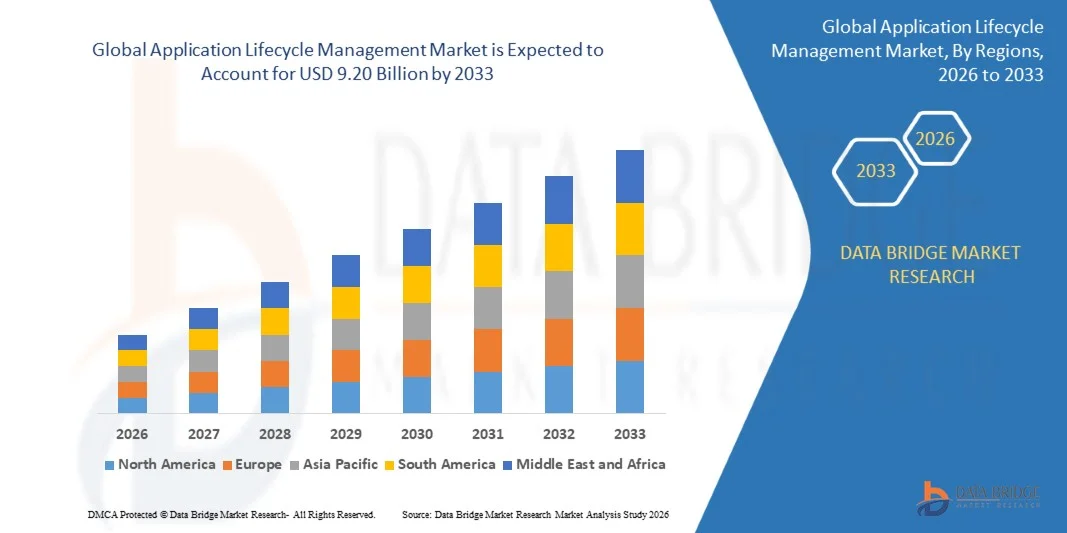
- As per Data Bridge Market Research Analysis the global application lifecycle management market size was valued at USD 4.60 billion in 2025 and is expected to reach USD 9.20 billion by 2033, at a CAGR of 9.05% during the forecast period
- The market growth is largely fueled by the rising adoption of digital development environments and rapid advancements in software engineering tools, leading to increased automation, collaboration, and workflow optimization across enterprises shifting toward agile and DevOps-driven operations
- Furthermore, the growing demand for integrated platforms that streamline software planning, development, testing, and deployment is positioning ALM solutions as essential frameworks for improving product quality, reducing release cycles, and enhancing cross-team visibility. These converging factors are accelerating the uptake of ALM platforms and strengthening overall market expansion
Market Size & Forecast
- Global Market Value (2025): USD 4.60 billion
- Expected Market Value (2033): USD 9.20 billion
- Forecast CAGR (2026–2033): 9.05%
Application Lifecycle Management Market Analysis
- Application lifecycle management solutions, supporting end-to-end management of software products from planning to deployment, are becoming indispensable across industries due to their ability to unify development workflows, strengthen governance, and improve release consistency in fast-paced software environments
- The escalating demand for ALM platforms is primarily fueled by the rising shift toward cloud-native development, increasing DevOps adoption, and the need for enhanced traceability, collaboration, and automation throughout the software lifecycle
- North America dominated the application lifecycle management market with a share of 32.7% in 2025, due to rising adoption of DevOps practices, increasing demand for integrated development tools, and strong enterprise focus on accelerating software delivery
- Asia-Pacific is expected to be the fastest growing region in the application lifecycle management market during the forecast period due to rising enterprise digitalization, increasing cloud adoption, and rapid technology modernization across countries such as China, India, and Japan
- Software segment dominated the market with a market share of 65.5% in 2025, due to its integral role in combining planning, development, testing, deployment, and maintenance into a unified workflow. Enterprises rely on ALM software to streamline DevOps collaboration and enhance real-time project visibility across distributed teams. Growing adoption of agile methodologies strengthens the need for centralized lifecycle platforms supporting automation and version control. The expansion of cloud-native development frameworks and microservices architecture further increases dependency on advanced ALM software. Its ability to reduce development inefficiencies and accelerate release cycles remains a major factor driving dominance
Report Scope and Application Lifecycle Management Market Segmentation
|
Attributes |
Application Lifecycle Management Key Market Insights |
|
Segments Covered |
|
|
Countries Covered |
North America
Europe
Asia-Pacific
Middle East and Africa
South America
|
|
Key Market Players |
|
|
Market Opportunities |
|
|
Value Added Data Infosets |
|
What is the Key Trend in the Application Lifecycle Management Market?
“Growing Integration of ALM with DevOps and AI-Driven Automation”
- The global Application Lifecycle Management (ALM) market is witnessing substantial growth driven by the increasing convergence of ALM platforms with DevOps methodologies and AI-based automation tools. This integration is enabling development teams to accelerate release cycles, improve collaboration, and enhance product quality throughout the software development lifecycle.
- For instance, Micro Focus has integrated its ALM Octane with CI/CD tools and AI-based analytics to streamline testing, defect management, and deployment automation. Such integrations demonstrate how AI and DevOps together are reshaping the traditional ALM paradigm toward continuous delivery and predictive insights
- The use of AI in ALM is growing, with capabilities such as intelligent bug prediction, auto-prioritization of tasks, and advanced test automation that reduce human effort and enhance precision during software development cycles. These features help organizations minimize errors, shorten development timelines, and improve product reliability
- Cloud-based ALM solutions are also becoming central to modern software engineering environments as they offer scalability, real-time collaboration, and simplified maintenance. This transition to cloud ALM is fostering multi-location team coordination and sustained productivity in hybrid work environments
- The increasing adoption of DevOps across enterprises aligns with the ALM focus on continuous improvement and feedback loops, creating unified workflows that integrate planning, development, testing, deployment, and maintenance
- Overall, the merging of ALM with AI and DevOps is transforming software engineering practices into more adaptive, automated, and data-driven ecosystems that elevate agility and innovation across industries
Application Lifecycle Management Market Dynamics
Driver
“Increasing Need for End-to-End Visibility Across Software Development Cycles”
- Enterprises are increasingly prioritizing full transparency and control over their software development processes due to rising complexity in managing dispersed teams and diverse tools. ALM platforms enable a unified workflow that connects planning, development, testing, and deployment activities under a single framework
- For instance, Atlassian’s Jira Align provides an integrated ALM approach to manage enterprise-wide software initiatives, offering dashboards that track progress, dependencies, and alignment with business goals. Such instances highlight the growing demand for real-time visibility and coordinated collaboration in software projects
- End-to-end visibility supports proactive issue detection and effective resource allocation, improving overall project efficiency and reducing rework rates. Development managers gain actionable insights through dashboards and analytics, allowing them to make informed decisions throughout the lifecycle
- The rise of remote and hybrid development environments further amplifies the need for platforms that maintain workflow coherence and ensure that teams remain synchronized despite geographical dispersion
- As organizations continue pushing towards digital transformation, adopting ALM systems that provide complete traceability and seamless integration across the development ecosystem is becoming essential for sustaining software quality and timely delivery
Restraint/Challenge
“Complexity in Integrating ALM Tools with Legacy Systems”
- Integrating modern ALM tools with existing legacy infrastructure remains a major challenge for enterprises dependent on traditional software management solutions. Such integration often requires customization, additional middleware, and extensive data migration efforts that can hinder implementation timelines and drive up costs
- For instance, IBM’s Rational Suite integration with newer cloud-native ALM platforms often demands complex reconfigurations to ensure compatibility with older development models. This illustrates how legacy dependencies slow adoption and limit the efficiency gains ALM integration can deliver
- Legacy systems frequently lack standardized APIs or interoperability features required to connect with modern ALM tools, resulting in fragmented workflows and redundant data management processes
- In addition, differences in data formats, development methodologies, and tool architectures further complicate the synchronization between legacy infrastructure and ALM environments, increasing operational complexity and maintenance burdens
- Addressing these integration challenges will require enterprises to modernize their IT infrastructure gradually through modular approaches and vendor partnerships, ensuring smoother transition toward unified and integrated ALM ecosystems that support both existing and next-generation software initiatives
Application Lifecycle Management Market Scope
The market is segmented on the basis of component, deployment type, enterprise size, and end-use.
• By Component
On the basis of component, the Application Lifecycle Management market is segmented into software and services. The software segment dominated the market with a share of 65.5% in 2025 due to its integral role in combining planning, development, testing, deployment, and maintenance into a unified workflow. Enterprises rely on ALM software to streamline DevOps collaboration and enhance real-time project visibility across distributed teams. Growing adoption of agile methodologies strengthens the need for centralized lifecycle platforms supporting automation and version control. The expansion of cloud-native development frameworks and microservices architecture further increases dependency on advanced ALM software. Its ability to reduce development inefficiencies and accelerate release cycles remains a major factor driving dominance.
The services segment is expected to witness the fastest growth rate from 2026 to 2033 due to rising demand for consulting, integration support, and customized workflow optimization. Organizations modernizing legacy development environments increasingly require professional services to align ALM platforms with CI/CD pipelines and regulatory standards. Service providers enable smoother digital transformation by offering tailored deployment, migration support, and lifecycle automation expertise. The growing complexity of hybrid and multi-cloud development environments further drives service adoption. This segment benefits from increasing need for training, managed support, and ongoing optimization across diverse enterprise-scale development ecosystems.
• By Deployment Type
On the basis of deployment type, the market is divided into cloud and on-premises. The cloud segment dominated the ALM market in 2025 due to its scalability, rapid onboarding, and ability to support distributed development teams. Cloud-based ALM tools provide centralized access, seamless integration with cloud-native CI/CD pipelines, and automated updates that reduce IT workload. Organizations adopting agile and DevOps frameworks increasingly prefer cloud deployment to improve collaboration speed and development transparency. The shift toward SaaS platforms strengthens long-term cloud adoption, particularly among businesses undergoing digital transformation. Cost efficiency and flexible subscription pricing also enhance cloud-based ALM usage across industries.
The on-premises segment is anticipated to record the fastest growth from 2026 to 2033, driven by demand from industries requiring strict data control and secure code management. Sectors such as aerospace & defense, BFSI, and government prioritize on-prem ALM to maintain full regulatory compliance and local data governance. These environments often involve sensitive application workflows that cannot be transferred to public cloud infrastructure. The availability of advanced on-prem ALM platforms supporting private cloud integration strengthens growth momentum. Increasing need for customization, low-latency performance, and internal security controls contributes to the segment’s accelerating adoption.
• By Enterprise Size
On the basis of enterprise size, the market is segmented into large enterprises and small & medium enterprises. The large enterprises segment dominated the market in 2025 due to their complex development ecosystems requiring high-level governance and multi-team coordination. These organizations rely on ALM platforms to manage large-scale project portfolios, maintain development visibility, and ensure quality assurance across multiple release cycles. Large enterprises adopt ALM tools to reduce operational inefficiencies and support advanced automation within DevOps pipelines. With substantial IT budgets and ongoing modernization initiatives, this segment continues to lead ALM adoption. Their need for compliance tracking and high-level analytics further strengthens dominance.
The small & medium enterprises segment is projected to experience the fastest CAGR from 2026 to 2033 due to increasing adoption of affordable cloud-based ALM solutions. SMEs prioritize lightweight, scalable platforms that support rapid development workflows without requiring heavy infrastructure investment. Cloud-native ALM systems allow smaller teams to streamline project planning, automate testing, and improve release management with minimal administrative overhead. As SMEs accelerate digital product innovation, ALM tools help enhance developer productivity and reduce time-to-market. The growth of subscription-based ALM offerings enables widespread adoption across expanding SME ecosystems.
• By End-Use
On the basis of end-use, the market covers automotive & transportation, manufacturing, aerospace & defense, BFSI, energy & utilities, retail & e-commerce, healthcare, IT & telecommunication, and others. The IT & telecommunication segment dominated the market in 2025 due to rapid software development cycles, high product innovation, and the need for reliable lifecycle governance across large codebases. ALM platforms support real-time collaboration across globally distributed development teams, enabling faster releases and improved quality control. Telecom providers increasingly rely on ALM tools to manage API-heavy environments and expanding digital service portfolios. Demand for automation, traceability, and continuous delivery further reinforces the segment’s leading market share.
The healthcare segment is expected to record the fastest growth from 2026 to 2033, driven by expanding digital health systems, clinical software platforms, and compliance-intensive application environments. Healthcare organizations adopt ALM solutions to maintain strict documentation, ensure regulatory adherence, and manage complex development workflows for medical software and devices. Demand for secure development frameworks increases as healthcare shifts toward cloud-based patient applications and data-driven platforms. ALM tools enable thorough testing, improved interoperability, and safer software releases within clinical environments. Growing digital transformation across hospitals and medical technology innovators accelerates segmental growth trajectory.
Application Lifecycle Management Market Regional Analysis
- North America dominated the application lifecycle management market with the largest revenue share of 32.7% in 2025, driven by rising adoption of DevOps practices, increasing demand for integrated development tools, and strong enterprise focus on accelerating software delivery
- Organizations in the region prioritize workflow automation, lifecycle visibility, and cloud-based development environments, leading to widespread adoption of ALM platforms across sectors such as IT, telecom, BFSI, and healthcare
- High digital maturity, extensive use of agile methodologies, and strong investments in cloud-native development strengthen ALM penetration, positioning the region as a leading hub for advanced software development and lifecycle optimization
U.S. Application Lifecycle Management Market Insight
The U.S. captured the largest revenue share within North America in 2025, fueled by rapid expansion of cloud adoption, increasing preference for integrated pipeline management, and growing emphasis on accelerating application delivery cycles. Enterprises in the U.S. prioritize automation, streamlined collaboration, and real-time analytics to support complex multi-team development ecosystems. The strong presence of major technology vendors and the high volume of software-intensive industries further drive ALM adoption across the country. Continuous growth in digital transformation programs and sustained demand for quality assurance frameworks continue to propel the U.S. ALM market.
Europe Application Lifecycle Management Market Insight
Europe is projected to exhibit substantial CAGR during the forecast period, driven by increasing digital transformation across enterprises, adoption of agile and DevOps models, and growing focus on improving software governance. The region’s emphasis on regulatory compliance, data security, and structured development workflows supports the adoption of ALM tools across sectors such as BFSI, manufacturing, and government. Rising modernization initiatives, increased cloud migration, and demand for automation in development processes contribute to growing ALM implementation across both large enterprises and SMEs
U.K. Application Lifecycle Management Market Insight
The U.K. is anticipated to grow at a noteworthy CAGR during the forecast period, driven by strong enterprise modernization efforts and the need for accelerated software delivery cycles. Organizations in the U.K. are increasingly adopting agile frameworks and cloud-based ALM solutions to improve collaboration and reduce project bottlenecks. The country’s expanding IT ecosystem and rising integration of digital platforms across industries further strengthen market growth.
Germany Application Lifecycle Management Market Insight
The Germany market is expected to expand at a considerable CAGR, fueled by the country’s focus on high-precision engineering, data governance, and enterprise-level digital transformation. German industries prioritize structured lifecycle management and strong documentation frameworks, supporting robust uptake of ALM platforms. The presence of advanced manufacturing, automotive, and industrial software environments further fuels consistent adoption of ALM systems.
Asia-Pacific Application Lifecycle Management Market Insight
The Asia-Pacific market is poised to grow at the fastest CAGR during the forecast period, driven by rising enterprise digitalization, increasing cloud adoption, and rapid technology modernization across countries such as China, India, and Japan. Growing investment in IT infrastructure, expanding startup ecosystems, and a rising preference for agile and DevOps development cultures contribute to higher regional adoption of ALM tools. The region’s emerging role as a global software development hub, combined with increasing demand for cost-efficient lifecycle management platforms, accelerates ALM expansion across both large enterprises and SMEs
Japan Application Lifecycle Management Market Insight
Japan is witnessing strong demand for ALM solutions due to its advanced technological culture, rising number of connected digital systems, and need for reliable software quality frameworks. Organizations in Japan emphasize security, precision, and structured development, supporting increased adoption of ALM tools in both commercial and industrial applications. The country’s rapid urbanization and adoption of cloud-integrated development environments further propel market growth.
China Application Lifecycle Management Market Insight
China accounted for the largest revenue share in Asia-Pacific in 2025, driven by massive digital transformation initiatives, expanding IT services sector, and high adoption of cloud-based development platforms. The country’s robust manufacturing and technology ecosystems create substantial demand for lifecycle optimization tools. Strong growth in local software development, combined with increasing preference for automation and integrated pipelines, continues to accelerate ALM adoption across enterprises.
Which are the Top Companies in Application Lifecycle Management Market?
The application lifecycle management industry is primarily led by well-established companies, including:
- Atlassian Corporation Plc (Australia)
- CollabNet, Inc. (U.S.)
- HP Development Company, L.P. (U.S.)
- Inflectra Corporation (U.S.)
- International Business Machines Corporation (IBM) (U.S.)
- Micro Focus International plc (U.K.)
- Microsoft (U.S.)
- NimbleWork, Inc. (U.S.)
- Parasoft Corporation (U.S.)
- Polarion Software GmbH (Germany)
- SAP SE (Germany)
- Broadcom Inc. (U.S.)
- Siemens Digital Industries Software (Germany)
- OpenText Corporation (Canada)
- JetBrains s.r.o. (Czech Republic)
- Perforce Software, Inc. (U.S.)
Latest Developments in Global Application Lifecycle Management Market
- In January 2025, Atlassian introduced an AI-powered release intelligence upgrade within Jira Software, strengthening its role in the ALM ecosystem by enhancing predictive risk assessment, automating dependency mapping, and improving cross-team visibility. This advancement underscores Atlassian’s commitment to optimizing software delivery pipelines, enabling enterprises to reduce deployment delays, improve decision-making, and increase overall release reliability, thereby reinforcing the company’s competitive position in the expanding application lifecycle management market
- In May 2024, Sonatype announced an integration of Sonatype Lifecycle with ServiceNow, embedding automated open-source vulnerability scanning directly into ServiceNow’s Application Vulnerability Response workflows. This collaboration highlights Sonatype’s focus on enhancing secure DevOps practices, allowing enterprises to streamline vulnerability identification, tracking, and remediation. By enabling seamless import of scan results into ServiceNow, the integration bolsters organizational security governance and strengthens Sonatype’s influence within the rapidly evolving ALM market
- In May 2024, Microsoft Power Platform launched the Block Unmanaged Customizations feature, enabling administrators to prevent unauthorized modifications and unmanaged solution imports in production environments. This development reflects Microsoft’s commitment to strengthening ALM governance by ensuring that all changes follow approved lifecycle processes. By enhancing system reliability, compliance, and auditability, Microsoft further solidifies its position as a key provider of ALM-centric enterprise tools
- In April 2024, IBM acquired HashiCorp for USD 6.4 billion in a strategic move to integrate HashiCorp’s multi-cloud infrastructure automation with IBM’s hybrid cloud and AI capabilities. This acquisition showcases IBM’s dedication to delivering unified infrastructure and application lifecycle automation across hybrid and multi-cloud environments. By expanding its automation and DevOps capabilities, IBM reinforces its leadership and competitive edge within the global application lifecycle management market
- In January 2024, Siemens Digital Industries Software and Salesforce launched the Teamcenter SLM app on Salesforce AppExchange, combining Siemens’ PLM expertise with Salesforce’s cloud-based service and manufacturing platforms. This integration strengthens lifecycle connectivity across service-centric business models, enabling organizations to unify product data, service operations, and customer workflows. The collaboration enhances digital lifecycle continuity and broadens both companies’ presence within the ALM landscape

- Interactive Data Analysis Dashboard
- Company Analysis Dashboard for high growth potential opportunities
- Research Analyst Access for customization & queries
- Competitor Analysis with Interactive dashboard
- Latest News, Updates & Trend analysis
- Harness the Power of Benchmark Analysis for Comprehensive Competitor Tracking
Data collection and base year analysis are done using data collection modules with large sample sizes. The stage includes obtaining market information or related data through various sources and strategies. It includes examining and planning all the data acquired from the past in advance. It likewise envelops the examination of information inconsistencies seen across different information sources. The market data is analysed and estimated using market statistical and coherent models. Also, market share analysis and key trend analysis are the major success factors in the market report. To know more, please request an analyst call or drop down your inquiry.
The key research methodology used by DBMR research team is data triangulation which involves data mining, analysis of the impact of data variables on the market and primary (industry expert) validation. Data models include Vendor Positioning Grid, Market Time Line Analysis, Market Overview and Guide, Company Positioning Grid, Patent Analysis, Pricing Analysis, Company Market Share Analysis, Standards of Measurement, Global versus Regional and Vendor Share Analysis. To know more about the research methodology, drop in an inquiry to speak to our industry experts.
Data Bridge Market Research is a leader in advanced formative research. We take pride in servicing our existing and new customers with data and analysis that match and suits their goal. The report can be customized to include price trend analysis of target brands understanding the market for additional countries (ask for the list of countries), clinical trial results data, literature review, refurbished market and product base analysis. Market analysis of target competitors can be analyzed from technology-based analysis to market portfolio strategies. We can add as many competitors that you require data about in the format and data style you are looking for. Our team of analysts can also provide you data in crude raw excel files pivot tables (Fact book) or can assist you in creating presentations from the data sets available in the report.













