


What is the Application Transformation Market Size and Growth Rate?
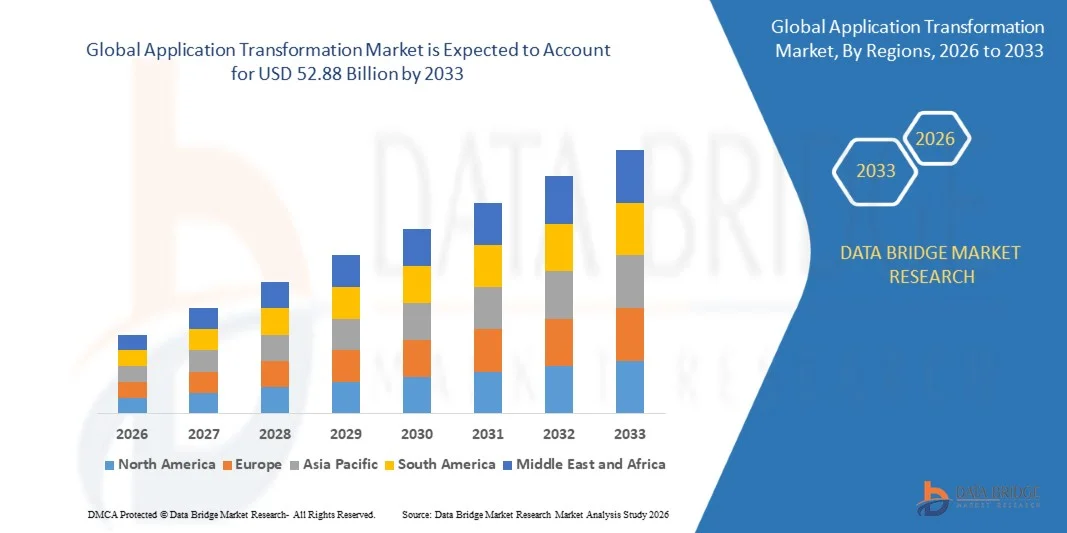
- As per Data Bridge Market Research analysis, the application transformation market was valued at USD 17.9 billion in 2025 and is projected to reach USD 52.88 billion by 2033, growing at a CAGR of 14.50% from 2026 to 2033.
- The market is experiencing robust growth as a result of accelerating digital transformation initiatives across industries, increasing complexity of legacy application environments, rising adoption of cloud computing and hybrid cloud strategies, and growing demand for business agility and operational efficiency.
- The global application transformation market has evolved significantly, with organizations shifting from isolated modernization projects toward continuous transformation supported by cloud-native platforms and AI-driven automation. Application transformation is the process of updating outdated applications to meet modern business demands, introducing business applications into modern infrastructure, and leveraging technologies such as cloud computing, big data, and artificial intelligence. The global application transformation market is poised for continued expansion in the coming years, driven by the escalating need for businesses to align their IT infrastructure with market requirements, rapid modernization of legacy systems, and increasing demand for scalability and flexibility.
Market Size & Forecast
- Global Market Value (2025): USD 17.9 Billion
- Expected Market Value (2033): USD 52.88 Billion
- Forecast CAGR (2026 to 2033): 14.50%
- Leading Region in 2025: North America
- Fastest Growing Region: Asia Pacific
What are the Major Takeaways of the Application Transformation Market?
- North America dominated the global application transformation market with the largest revenue share of 38.5% in 2025, supported by advanced cloud infrastructure, high adoption of digital technologies, strong presence of major technology vendors, and increasing investments in application modernization across BFSI, healthcare, and government sectors. North America held a revenue share of approximately 38.5% in 2025, accounting for USD 8.2 billion of the global market.
- Asia Pacific is expected to be the fastest-growing region, driven by rapid digitalization across emerging economies, increasing adoption of cloud computing, expanding IT and telecom sectors, and growing government initiatives for digital transformation in countries such as China, India, Japan, and Southeast Asian nations.
- The cloud application migration segment represented the largest service type category, capturing approximately 35% market share, driven by enterprises seeking scalability, cost-efficiency, and the ability to leverage advanced technologies such as AI, machine learning, and IoT. Cloud migration allows organizations to modernize legacy applications, reduce maintenance costs, and enhance system performance.
- The BFSI industry vertical emerged as the leading end-use segment, capturing a 24.21% revenue share in 2024, driven by the need for modernizing core banking systems, enhancing customer experiences, and ensuring regulatory compliance.
- The global application transformation market is witnessing increased adoption of AI-powered automation for legacy application migration and modernization, with organizations leveraging AI-driven coding, automated testing, intelligent observability, and predictive analytics to accelerate transformation initiatives.
- The rising demand for hybrid and multi-cloud strategies is reshaping the application transformation landscape, as organizations aim to prevent vendor lock-in while optimizing workload distribution across different cloud platforms based on performance, cost, and compliance considerations.
Report Scope and Application Transformation Market Segmentation
|
Attributes |
Application Transformation Key Market Insights |
|
Segments Covered |
|
|
Countries Covered |
North America
Europe
Asia-Pacific
Middle East and Africa
South America
|
|
Key Market Players |
|
|
Market Opportunities |
|
|
Value Added Data Infosets |
In addition to the market insights such as market value, growth rate, market segments, geographical coverage, market players, and market scenario, the market report curated by the Data Bridge Market Research team includes in-depth expert analysis, import/export analysis, pricing analysis, production consumption analysis, and pestle analysis. |
What is the Key Trend in the Application Transformation Market?
- The application transformation market is experiencing significant transformation as a result of increasing adoption of AI-powered automation for legacy migration, growing integration of cloud-native technologies, and the rising emphasis on hybrid and multi-cloud strategies for enhanced scalability and resilience.
- The trend toward AI-powered automation is reshaping the market landscape, with organizations developing advanced transformation solutions that deliver improved efficiency, accuracy, and speed while reducing manual intervention and operational costs. AI-powered coding, automated testing, intelligent observability, and predictive analytics are enabling organizations to accelerate transformation initiatives by up to 50%. Capgemini sees a multi-year modernization supercycle as companies upgrade the foundations needed to support AI across their operations, including data platforms, applications and core infrastructure. Agentic AI is now at the center of virtually every client conversation.
- The application transformation market is witnessing increased adoption of cloud-native technologies including serverless computing, Kubernetes, and containerization, which have significantly expanded the modernization options available to enterprises across various industries. The cloud market in Asia Pacific is valued at USD 202.7 billion in 2025 and expected to reach USD 679.8 billion by 2033.
- Sustainability and operational efficiency are becoming core focuses, with transformation service providers introducing energy-efficient cloud architectures and optimized resource utilization practices. The shift toward hybrid and multi-cloud strategies is gaining popularity for workload distribution across different cloud environments based on performance, cost, and compliance considerations.
- The convergence of application transformation with digital platforms and integrated workflows is accelerating innovation in the market. The landscape is undergoing a structural transition from manual, operator-dependent workflows toward more standardized, automation-ready transformation ecosystems.
What are the Key Drivers of the Application Transformation Market?
- The accelerating enterprise digital transformation initiatives serve as a primary catalyst for the application transformation market. Organizations are increasingly leveraging AI-driven automation, DevOps practices, and containerization to accelerate application modernization.
- The rapid adoption of cloud computing and the shift toward cloud-based solutions is a major driver of market growth. Enterprises are increasingly shifting from traditional on-premises environments to the cloud, where they can achieve scalability, flexibility, and cost optimization.
- The rising complexity of legacy application environments and the high cost of maintaining outdated systems are significantly driving market growth. According to multiple CIO surveys conducted in 2025, more than 65% of Fortune 500 companies still operate at least one mission-critical application on a legacy platform more than 15 years old.
- The increasing demand for scalability and flexibility is a leading factor driving market growth. As companies grow, so does the amount of work and the need to handle it through IT infrastructure that is efficient and does not sacrifice performance. Application transformation enables organizations to restructure existing systems to be more adaptive and responsive to business needs. The BFSI sector, holding a 24.21% revenue share in 2024, is a prime example of this demand.
- Regulatory pressures in sectors such as financial services and healthcare are adding another dimension to market growth. Regulators in the European Union, the United States, and Asia Pacific are increasingly mandating that firms demonstrate application resilience, data portability, and auditability, all of which require modern, well-documented application architectures. Approximately 68% of modernization projects overshoot their initial budget, making regulatory compliance a critical driver for structured transformation.
Which Factors are Challenging the Growth of the Application Transformation Market?
- Security vulnerabilities and regulatory compliance challenges serve as significant restraints on the application transformation market. Legacy applications constitute the most significant attack surface within modern enterprise environments. Research indicates that 71% of organizations acknowledge that legacy systems substantially increase cybersecurity vulnerabilities, as aging applications lack contemporary security frameworks and create exploitable attack vectors that compromise enterprise data integrity.
- The technical complexity and high risk associated with legacy system modernization represent a major barrier to market expansion. Organizations face challenges in migrating complex, mission-critical applications while maintaining business continuity and minimizing disruption.
- The high cost of transformation services and specialized talent creates challenges, particularly for small and medium-sized enterprises. Technical debt increases operational costs, slows product delivery, weakens security, and makes emerging initiatives like generative AI significantly harder to implement. The lack of in-house expertise for legacy system modernization further complicates transformation efforts. While large enterprises allocate between 60% and 75% of IT budgets to legacy maintenance, SMEs face even greater proportional challenges.
- Data security and privacy concerns pose significant challenges as organizations increasingly rely on interconnected systems and cloud solutions. Increased data collection and sharing raise the risk of cyberattacks, data breaches, and unauthorized access.
- Regulatory fragmentation across different countries and regions poses a significant challenge for multinational transformation service providers. Varying compliance requirements, data protection laws such as GDPR, and certification standards across jurisdictions complicate transformation efforts and increase operational costs.
How is the Application Transformation Market Segmented?
The Application Transformation Market is segmented on the basis of service type, enterprise size, and vertical.
- By Service Type
On the basis of service type, the global application transformation market is segmented into cloud application migration, application integration, application replatforming, application portfolio assessment, UI/UX modernization, and others. The cloud application migration segment represented the largest service type category, capturing approximately 35% market share, driven by enterprises seeking scalability, cost-efficiency, and the ability to leverage advanced technologies such as AI, machine learning, and IoT. Cloud migration allows organizations to modernize legacy applications, reduce maintenance costs, and enhance system performance, making it a preferred choice for enterprises undergoing digital transformation. The cloud market in Asia Pacific alone is valued at USD 202.7 billion in 2025.
- By Enterprise Size
On the basis of enterprise size, the global application transformation market is segmented into large enterprises and small and medium-sized enterprises (SMEs). The large enterprises segment dominated the market in 2025, driven by extensive IT budgets, complex legacy application portfolios, and the need for large-scale digital transformation initiatives. Large enterprises with extensive legacy application portfolios are the primary drivers of demand for application transformation services. These organizations allocate between 60% and 75% of annual IT budgets to legacy maintenance, creating significant demand for modernization services.
The small and medium-sized enterprises (SMEs) segment is also experiencing significant growth, as these organizations increasingly recognize the need for digital transformation to remain competitive. SMEs are advancing at a rapid CAGR, driven by the availability of cost-effective cloud solutions and the growing demand for scalable and flexible IT infrastructure. The low-code and no-code modernization platforms are particularly attractive to SMEs with limited IT resources.
- By Vertical
On the basis of vertical, the global application transformation market is segmented into BFSI, retail, healthcare, IT and telecom, government, manufacturing, and others. The BFSI industry vertical emerged as the leading end-use segment, capturing a 24.21% revenue share in 2024, driven by the need for modernizing core banking systems, enhancing customer experiences, and ensuring regulatory compliance. The BFSI segment is poised to hold over 32.9% revenue share by the end of 2035, reflecting the continued emphasis on digital transformation in financial services. The sector faces intense pressure to modernize core banking systems, implement real-time payment capabilities, and ensure compliance with evolving regulations.
The healthcare vertical is experiencing significant growth, driven by the need for modernizing electronic health records, telemedicine platforms, and patient management systems. Healthcare organizations are increasingly investing in application transformation to improve patient outcomes, enhance operational efficiency, and ensure regulatory compliance. The sector's transformation is accelerated by the growing adoption of AI-powered diagnostics, remote patient monitoring, and personalized medicine.
Which Region Holds the Largest Share of the Application Transformation Market?
- North America dominated the global application transformation market with the largest revenue share of 38.5% in 2025, supported by advanced cloud infrastructure, high adoption of digital technologies, strong presence of major technology vendors, and increasing investments in application modernization across BFSI, healthcare, and government sectors.
- Asia Pacific is expected to be the fastest-growing region in the application transformation market during the forecast period, with the region anticipated to grow at a CAGR of 20%. The region's growth is driven by rapid digitalization across emerging economies, increasing adoption of cloud computing, expanding IT and telecom sectors, and growing government initiatives for digital transformation in countries such as China, India, Japan, and Southeast Asian nations.
U.S. Application Transformation Market Insight
The U.S. represents the largest market for application transformation globally, driven by a well-established technology infrastructure, high consumer spending on digital solutions, and strong demand across BFSI, healthcare, and government sectors. The United States holds approximately 85.80% of share in North America. The U.S. market benefits from robust R&D ecosystems, high adoption of cloud-native technologies, and the presence of major technology vendors including IBM, Accenture, and Cognizant. The U.S. application transformation market is characterized by strong emphasis on AI-powered automation, hybrid and multi-cloud strategies, and advanced security solutions. The U.S. application transformation market was valued at USD 10.5 billion in 2024 and is projected to reach USD 28.7 billion by 2033, registering a CAGR of 10.3%.
Europe Application Transformation Market Insight
Europe is a significant market for application transformation, with Germany, France, and the U.K. leading in adoption across BFSI, healthcare, and manufacturing applications. The European application modernization services market is estimated to grow at a CAGR of 16.47% from 2025 to 2033 and be valued at USD 21.99 billion by the end of 2033. The region benefits from stringent regulatory frameworks enforced by the European Union and a strong focus on data privacy and security. The market for application modernization services in Europe is growing quickly, mainly due to the region's strong push for digital transformation. Cloud adoption is accelerating across Europe, particularly in Germany, enhancing application transformation initiatives. Recent reports show that about 75% of businesses in Europe are either already working on or planning to start application modernization projects within the next three years.
China Application Transformation Market Insight
The China application transformation market is experiencing rapid growth, driven by the country's expanding technology sector, increasing cloud adoption, and rising government focus on digital infrastructure development. By 2025, the China application modernization services market is expected to hold the largest market share in Asia Pacific, driven by rapid enterprise growth, ongoing digital transformation initiatives, and widespread cloud technology adoption. China is a major market for modernization services, with particularly strong demand in BFSI, manufacturing, and retail sectors. The market is benefiting from increasing investments in AI, cloud computing, and 5G infrastructure, growing adoption of digital transformation across industries, and the expansion of domestic technology service providers. Smart enterprise development, government digital transformation programs, and affordable modernization services are key factors driving market growth.
Japan Application Transformation Market Insight
The Japan application transformation market is witnessing consistent growth due to the country's advanced technology infrastructure, stringent quality standards, and increasing focus on digital transformation and innovation. The Japan application modernization services market is expected to witness the fastest global growth from 2026 to 2033, driven by Japan's high reliance on technology, focus on business process automation, and modernization of traditional enterprise applications. Japanese enterprises are increasingly investing in application modernization to ensure competitiveness and operational efficiency. Enterprises are prioritizing system efficiency, cloud integration, and scalable IT architecture. The market is characterized by high demand for precision-engineered transformation solutions that meet the country's demanding quality standards. Japan's aging workforce may also stimulate demand across industries for streamlined, efficient, and secure IT systems.
India Application Transformation Market Insight
The India application transformation market is emerging as a significant growth opportunity, driven by rapid digitalization, expanding IT and telecom sectors, and increasing investments in cloud infrastructure. The India application development and modernization market is experiencing robust growth, driven by increasing demand for digital transformation solutions and growing adoption of cloud technologies. India is expected to be one of the fastest-growing countries in the Asia Pacific application transformation market, driven by a rapidly expanding digital economy and the presence of major technology service providers including TCS, Infosys, and Wipro. Government digitalization programs and cloud infrastructure expansion in countries like India, China, and Japan are key drivers of market growth.
Germany Application Transformation Market Insight
Germany represents a significant market for application transformation in Europe, with the country benefiting from its position as Europe's largest economy and manufacturing hub. Germany trails as the second most lucrative market in Europe, underpinned by its robust industrial base and commitment to Industry 4.0 initiatives. The German application transformation market is characterized by an emphasis on quality, precision, and high-performance transformation solutions. The Germany application modernization services market is expected to witness rapid growth from 2026 to 2033, driven by increasing enterprise focus on innovation, sustainability, and cloud-based digital transformation. The market benefits from strong demand across BFSI, manufacturing, and automotive applications, supported by stringent EU regulatory frameworks and a strong focus on Industry 4.0 and industrial digitalization. Germany's mature IT infrastructure and emphasis on secure, high-performance solutions are facilitating the adoption of modernization services.
U.K. Application Transformation Market Insight
The U.K. application transformation market is developing steadily, supported by robust demand across BFSI, healthcare, and retail sectors. The United Kingdom application modernization services market is expected to witness the fastest growth from 2026 to 2033, driven by enterprise focus on cloud adoption, business agility, and operational efficiency. The U.K. benefits from a strong financial services and technology industry and increasing consumer focus on digital transformation and innovation. Growing demand for cost optimization and secure digital systems is also prompting enterprises to invest in modernization solutions. The U.K.'s strong IT services ecosystem and widespread adoption of hybrid cloud and microservices architectures are expected to continue driving market growth.
South America Application Transformation Market Insight
South America represents a key growth opportunity in the application transformation market, driven by the region's expanding technology sector and increasing consumer awareness regarding digital transformation. Brazil, as the largest economy in South America, creates growing demand for application transformation across BFSI, retail, and manufacturing sectors. The region is benefiting from increasing investments in digital infrastructure and growing consumer interest in cloud and digital solutions. The Latin American market is part of the broader global application transformation market, which is projected to grow from USD 17.55 billion in 2024 to USD 54.84 billion by 2033.
Which are the Top Companies in Application Transformation Market?
The application transformation industry is primarily led by well-established companies, including:
- Accenture plc (Ireland)
- International Business Machines Corporation (U.S.)
- Cognizant Technology Solutions Corporation (U.S.)
- Capgemini SE (France)
- Tata Consultancy Services Limited (India)
- Infosys Limited (India)
- HCL Technologies Limited (India)
- Wipro Limited (India)
- Atos SE (France)
- Fujitsu Limited (Japan)
- DXC Technology Company (U.S.)
- Deloitte Consulting LLP (U.K.)
- PricewaterhouseCoopers LLP (U.K.)
- Microsoft Corporation (U.S.)
- Oracle Corporation (U.S.)
- Tech Mahindra Limited (India)
- Bell Integrator LLC (U.S.)
- Micro Focus International PLC (U.K.)
- Kyndryl, Inc. (U.S.)
- Hexaware Technologies Limited (India)
- Blu Age SAS (France)
What are Latest Developments in Application Transformation Market?
- In August 2026, IBM announced the expansion of its watsonx AI platform capabilities for application modernization, enabling enterprises to accelerate legacy code transformation through AI-powered automation and intelligent code refactoring. The new capabilities are designed to reduce modernization timelines by up to 50% while improving code quality and security.
- In July 2026, Accenture launched a new suite of cloud-native transformation services focused on helping enterprises migrate mission-critical applications to hybrid and multi-cloud environments. The services leverage AI-driven automation, containerization, and Kubernetes orchestration to deliver scalable, secure, and cost-effective transformation solutions.
- In June 2026, Cognizant announced a strategic partnership with a leading cloud service provider to develop specialized application transformation solutions for the healthcare and financial services sectors. The partnership focuses on creating innovative transformation frameworks that enhance operational efficiency while ensuring regulatory compliance and data security.
- In May 2026, Capgemini introduced a new low-code modernization platform designed to accelerate legacy application transformation for small and medium-sized enterprises. The platform enables organizations to modernize applications with minimal coding, reducing transformation costs and timelines while improving scalability and performance. Capgemini sees a multi-year modernization supercycle as companies upgrade the foundations needed to support AI.
- In April 2026, TCS announced the expansion of its application transformation practice with the addition of AI-powered automation tools and specialized cloud migration frameworks. The expansion includes new service offerings for containerization, microservices architecture, and API-first development. TCS MasterCraft, enhanced with GenAI and Agentic AI, reduces modernization cost by over 70% and achieves results twice as fast as traditional interventions.
- In March 2026, Infosys announced the acquisition of a specialized application modernization firm in Europe, expanding its transformation portfolio and strengthening its presence in the rapidly growing European digital transformation market.
- In April 2026, Hexaware was named a Leader in Application Modernization Services in the ISG Provider Lens Mainframes – Services and Solutions 2026 U.S. Quadrant Report, recognized for its end-to-end modernization with GenAI-led execution and mature methodology spanning discovery, assessment, and multiple modernization paths.

- Interactive Data Analysis Dashboard
- Company Analysis Dashboard for high growth potential opportunities
- Research Analyst Access for customization & queries
- Competitor Analysis with Interactive dashboard
- Latest News, Updates & Trend analysis
- Harness the Power of Benchmark Analysis for Comprehensive Competitor Tracking
Data collection and base year analysis are done using data collection modules with large sample sizes. The stage includes obtaining market information or related data through various sources and strategies. It includes examining and planning all the data acquired from the past in advance. It likewise envelops the examination of information inconsistencies seen across different information sources. The market data is analysed and estimated using market statistical and coherent models. Also, market share analysis and key trend analysis are the major success factors in the market report. To know more, please request an analyst call or drop down your inquiry.
The key research methodology used by DBMR research team is data triangulation which involves data mining, analysis of the impact of data variables on the market and primary (industry expert) validation. Data models include Vendor Positioning Grid, Market Time Line Analysis, Market Overview and Guide, Company Positioning Grid, Patent Analysis, Pricing Analysis, Company Market Share Analysis, Standards of Measurement, Global versus Regional and Vendor Share Analysis. To know more about the research methodology, drop in an inquiry to speak to our industry experts.
Data Bridge Market Research is a leader in advanced formative research. We take pride in servicing our existing and new customers with data and analysis that match and suits their goal. The report can be customized to include price trend analysis of target brands understanding the market for additional countries (ask for the list of countries), clinical trial results data, literature review, refurbished market and product base analysis. Market analysis of target competitors can be analyzed from technology-based analysis to market portfolio strategies. We can add as many competitors that you require data about in the format and data style you are looking for. Our team of analysts can also provide you data in crude raw excel files pivot tables (Fact book) or can assist you in creating presentations from the data sets available in the report.













