


Apraxia Drug Market Size
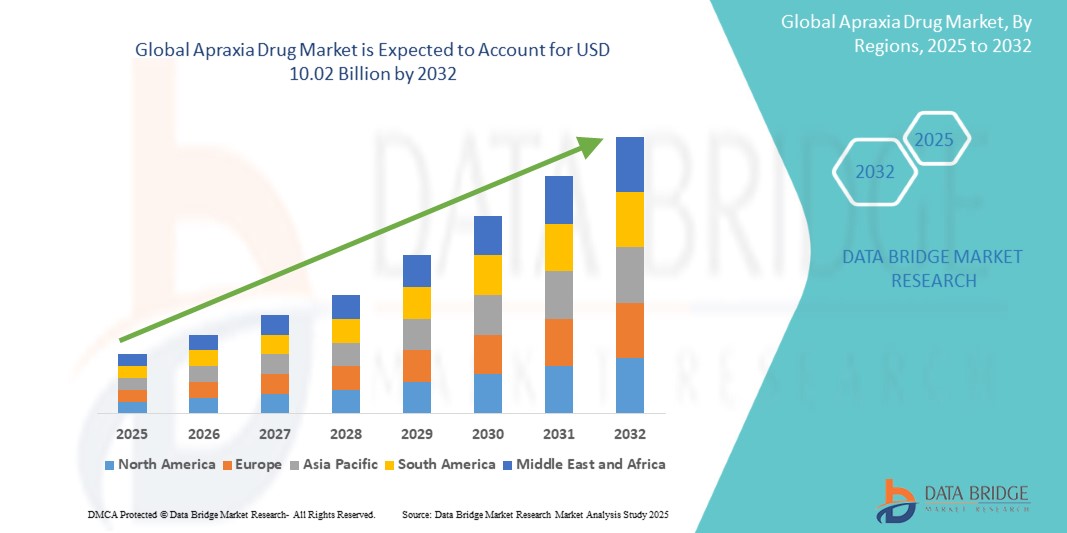
- The global Apraxia Drug Treatment market was valued at USD 6.68 billion in 2024 and is expected to reach USD 10.02 billion by 2032, at a CAGR of 5.2%, during the forecast period
- The rising incidence of neurological disorders and stroke-related complications is driving demand for Apraxia drugs globally. Additionally, growing awareness about early diagnosis and intervention, coupled with advancements in neuropharmacology—such as targeted drug delivery systems and novel therapeutic agents—is further accelerating market growth.
Apraxia Drug Market Analysis
- Apraxia drugs are specialized pharmacological treatments aimed at managing and improving motor planning deficits caused by neurological damage, often seen in patients with stroke, traumatic brain injury, or neurodegenerative diseases. These drugs play a crucial role in enhancing neural communication, supporting cognitive-motor rehabilitation, and improving patients’ ability to perform purposeful movements, thereby significantly contributing to their functional recovery and quality of life.
- North America emerges as a leading region in the Global Apraxia Drug Market, driven by a robust healthcare infrastructure, early adoption of novel neurological therapies, and growing awareness of post-stroke and neurodegenerative rehabilitation options.
- The region’s increasing investment in neuroscience research, availability of advanced diagnostic tools, and a rising elderly population—more susceptible to conditions like stroke and Alzheimer's disease—are further supporting the expansion of apraxia drug therapies and spurring innovation in neurological treatment approaches.
Report Scope and Apraxia Drug Segmentation
|
Attributes |
Apraxia Drug Key Market Insights |
|
Segments Covered |
|
|
Countries Covered |
North America
Europe
Asia-Pacific
Middle East and Africa
South America
|
|
Key Market Players |
|
|
Market Opportunities |
|
|
Value Added Data Infosets |
In addition to the insights on market scenarios such as market value, growth rate, segmentation, geographical coverage, and major players, the market reports curated by the Data Bridge Market Research also include import export analysis, production capacity overview, production consumption analysis, price trend analysis, climate change scenario, supply chain analysis, value chain analysis, raw material/consumables overview, vendor selection criteria, PESTLE Analysis, Porter Analysis, and regulatory framework. |
Apraxia Drug Market Trends
“Growing Preference for Minimally Invasive and Targeted Therapies”
- A key trend in the Global Apraxia Drug Market is the rising preference for targeted neurological therapies that offer improved efficacy with minimal side effects, particularly for stroke-induced and neurodegenerative apraxia.
- Novel drug formulations, including neuroprotective agents and neurotransmitter modulators, are gaining traction due to their ability to enhance cognitive-motor function, support synaptic plasticity, and facilitate targeted action within affected brain regions.
- For instance, emerging therapies with tailored pharmacokinetic profiles and improved blood-brain barrier penetration are showing promising results in clinical trials, aligning with the broader move toward personalized medicine in neurorehabilitation.
- The trend is further supported by advances in drug delivery technologies, such as nanoparticle-based carriers and intranasal delivery systems, enabling higher central nervous system bioavailability and reduced systemic toxicity.
- Additionally, integration of AI-driven diagnostic tools and neuroimaging techniques like fMRI and PET scans is enhancing the precision of treatment plans, allowing clinicians to monitor drug response and adjust interventions more effectively.
- This shift toward patient-specific, non-invasive neurological treatment strategies is reshaping neurotherapeutics and driving innovation in the Global Apraxia Drug Market.
Apraxia Drug Market Dynamics
Driver
“Increasing Prevalence of Neurological Disorders and Stroke”
- As the global population ages and risk factors such as hypertension, diabetes, and sedentary lifestyles become more widespread, the incidence of neurological conditions—particularly stroke and neurodegenerative disorders—is rising significantly. These conditions are key contributors to apraxia, a motor planning disorder that impairs a person’s ability to carry out purposeful movements, even when physical ability and desire remain intact.
- Apraxia drugs are emerging as critical therapeutic agents in improving neural communication and motor function among patients with post-stroke and neurodegenerative apraxia. Early pharmacological intervention can enhance rehabilitation outcomes, support cognitive recovery, and significantly improve quality of life.
For instance,
- In 2023, the World Stroke Organization reported that over 12 million new strokes occur globally each year, with approximately 30–50% of survivors experiencing some form of apraxia or motor planning deficit.
- According to the Alzheimer’s Association (2024), the number of people living with neurodegenerative diseases, such as Alzheimer's and Parkinson’s, is projected to double by 2050, further increasing demand for apraxia-targeted therapies.
- The rising burden of neurological disease, coupled with growing awareness of the benefits of early pharmacological and rehabilitative treatment, is driving the demand for effective and scalable apraxia drug solutions.
- As clinical research advances and new therapeutic agents are developed to better target motor planning pathways in the brain, the Global Apraxia Drug Market is expected to expand significantly in both scope and efficacy.
Opportunity
“Advancements in Neurological Drug Delivery and Targeted Therapies”
- Significant innovations in central nervous system (CNS) drug delivery—such as nanoparticle-based carriers, transdermal patches, and intranasal formulations—are transforming apraxia treatment by improving blood-brain barrier penetration, optimizing drug concentration at the site of action, and minimizing systemic side effects.
- These advanced therapies, including modulators of neurotransmitter activity and neuroplasticity-enhancing agents, are especially promising for treating apraxia resulting from stroke and neurodegenerative conditions, offering more personalized and effective interventions.
For instance,
- In 2024, clinical trials published in Neurology and Brain Research demonstrated the efficacy of new CNS-targeted compounds, such as selective dopamine agonists and GABA modulators, in improving motor coordination and speech functions in patients with limb and speech apraxia.
- Companies like Roche, Novartis, and Biogen are investing in research for next-generation neurological therapeutics that target specific motor planning regions of the brain with enhanced precision and fewer cognitive side effects.
- These breakthroughs align with the global shift toward precision medicine and integrated neurorehabilitation strategies.
- Firms that prioritize R&D in targeted CNS therapeutics, AI-assisted diagnostics, and multimodal drug delivery systems are well-positioned to gain a competitive edge in the expanding Apraxia Drug Market, especially in developed healthcare economies with strong clinical infrastructure.
Restraint/Challenge
“High Cost and Limited Accessibility of Neurological Therapies”
- The high cost of developing, manufacturing, and distributing CNS-targeted drugs, particularly those involving advanced delivery mechanisms or biologics, poses a significant barrier to widespread adoption of apraxia treatments. This issue is especially acute in low- and middle-income countries (LMICs), where healthcare systems may lack the infrastructure or funding to support access to high-cost neurological care.
- Even in high-income countries, patients often face coverage gaps or limited insurance reimbursement for off-label apraxia therapies, cognitive-enhancing drugs, or novel neuroprotective agents—reducing access to early and effective intervention.
For instance,
- A 2023 report by the World Health Organization emphasized that neurological disorders now constitute the second leading cause of disability-adjusted life years (DALYs) globally, but remain underfunded relative to their burden.
- In a 2024 Lancet Neurology study, researchers found that fewer than 40% of stroke rehabilitation centers in LMICs offer pharmacological support for apraxia or related cognitive-motor deficits, largely due to cost and drug availability.
- Post-treatment costs, including long-term therapy, occupational and speech-language rehabilitation, and caregiver support, further increase the financial burden for patients and families.
- To address this, healthcare policymakers, pharmaceutical companies, and international organizations must collaborate on pricing strategies, expanded insurance coverage, and funding for public health programs to ensure equitable access to apraxia therapies and support sustained market growth.
Apraxia Drug Market Scope
The market is segmented on the type, absorption rate, material, rate, application, mode of delivery and end users.
|
Segmentation |
Sub-Segmentation |
|
By Type |
|
|
By Drugs Class |
|
|
By Therapy |
|
|
By Treatment |
|
|
By Route of Administration |
|
|
By Distribution Channel |
|
|
By End Users |
|
In 2025, the Limb Apraxia Segments Projected to Dominate the Market with the Largest Share in the type Segment
The Limb Apraxia segment is expected to dominate the Global Apraxia Drug Market in 2025, accounting for the largest market share of approximately 68.7%. This leadership is primarily driven by its high prevalence among stroke survivors and increasing adoption of pharmacological therapies to enhance motor function and rehabilitation outcomes.
Medication are Expected to Account for the Largest Share During the Forecast Period in treatment segment
In 2025, Medication is projected to dominate the Global Apraxia Drug Market, accounting for the largest market share of approximately 64.9%. This segment's dominance is fueled by growing clinical preference for pharmacological interventions to support neural recovery and motor function, along with increasing availability of targeted CNS drugs.
Apraxia Drug Market Regional Analysis
“North America is the Dominant Region in the Global Apraxia Drug Market”
- North America leads the Global Apraxia Drug Market, driven by a well-established neurological care infrastructure, early adoption of novel CNS-targeted therapies, and strong emphasis on post-stroke rehabilitation and neurodegenerative disorder management.
- The United States holds the largest market share due to its high incidence of stroke and Alzheimer's disease, a growing elderly population, and increasing awareness of cognitive-motor impairments like apraxia.
- Supportive healthcare policies, extensive insurance coverage, and funding from institutions such as the NIH and CDC for neurological research enhance access to advanced pharmacological treatments.
- Additionally, the presence of major pharmaceutical companies including Pfizer, Eli Lilly, and Biogen, along with active clinical trials and rapid drug approvals, continues to fuel innovation and market expansion across North America.
“Asia-Pacific is Projected to Register the Highest Growth Rate”
- The Asia-Pacific region is anticipated to experience the fastest growth in the Apraxia Drug Market, driven by a rising prevalence of stroke and neurodegenerative diseases, increasing healthcare spending, and growing awareness of neurological rehabilitation.
- Countries like China, India, and Japan are emerging as key markets due to large aging populations, expanding access to neurological diagnostics, and a shift toward early intervention and pharmacotherapy for motor planning disorders.
- Japan, with its technologically advanced healthcare system and high stroke survival rate, is a leading adopter of cognitive and motor recovery drugs.
- In China and India, rising government investment in stroke care programs, growth in neuro-specialty hospitals, and increased availability of CNS-targeted therapies are accelerating market growth.
- Furthermore, the emergence of regional pharmaceutical manufacturers and a push for affordable neurological medications through policy reform are positioning Asia-Pacific as a strategic growth engine in the global Apraxia Drug Market.
Apraxia Drug Market Share
The market competitive landscape provides details by competitor. Details included are company overview, company financials, revenue generated, market potential, investment in research and development, new market initiatives, global presence, production sites and facilities, production capacities, company strengths and weaknesses, product launch, product width and breadth, application dominance. The above data points provided are only related to the companies' focus related to market.
The Major Market Leaders Operating in the Market Are:
- Pfizer Inc. (U.S.)
- Sunovion Pharmaceuticals Inc. (U.S.)
- BlackThorn Therapeutics (U.S.)
- Abide Therapeutics, Inc. (U.S.)
- Cogstate Ltd (Australia)
- Bioanalytical Systems, Inc. (U.S.
- Salarius Pharmaceuticals, Inc. (U.S.)
- Assertio Therapeutics, Inc. (U.S.)
- Implicit Bioscience (U.S.)
- Otsuka Holdings Co. Ltd (Japan)
- UCB S.A. (Belgium)
- Solvay (Belgium)
- Novartis AG (Switzerland)
- AbbVie Inc. (U.S.)
- Abbott (U.S.
- Neurocrine Biosciences, Inc. (U.S.
- ORION MEDIC (Finland
- Prexton Therapeutics (U.S.)
- Biogen (U.S.)
- Lilly (U.S.)
Latest Developments in Global Apraxia Drug Market
- In September 2022, Johnson and Johnson completed the acquisition of a company focused on language disorders aimed at strengthening their neurology division.

- Interactive Data Analysis Dashboard
- Company Analysis Dashboard for high growth potential opportunities
- Research Analyst Access for customization & queries
- Competitor Analysis with Interactive dashboard
- Latest News, Updates & Trend analysis
- Harness the Power of Benchmark Analysis for Comprehensive Competitor Tracking
Data collection and base year analysis are done using data collection modules with large sample sizes. The stage includes obtaining market information or related data through various sources and strategies. It includes examining and planning all the data acquired from the past in advance. It likewise envelops the examination of information inconsistencies seen across different information sources. The market data is analysed and estimated using market statistical and coherent models. Also, market share analysis and key trend analysis are the major success factors in the market report. To know more, please request an analyst call or drop down your inquiry.
The key research methodology used by DBMR research team is data triangulation which involves data mining, analysis of the impact of data variables on the market and primary (industry expert) validation. Data models include Vendor Positioning Grid, Market Time Line Analysis, Market Overview and Guide, Company Positioning Grid, Patent Analysis, Pricing Analysis, Company Market Share Analysis, Standards of Measurement, Global versus Regional and Vendor Share Analysis. To know more about the research methodology, drop in an inquiry to speak to our industry experts.
Data Bridge Market Research is a leader in advanced formative research. We take pride in servicing our existing and new customers with data and analysis that match and suits their goal. The report can be customized to include price trend analysis of target brands understanding the market for additional countries (ask for the list of countries), clinical trial results data, literature review, refurbished market and product base analysis. Market analysis of target competitors can be analyzed from technology-based analysis to market portfolio strategies. We can add as many competitors that you require data about in the format and data style you are looking for. Our team of analysts can also provide you data in crude raw excel files pivot tables (Fact book) or can assist you in creating presentations from the data sets available in the report.












