


Aquafeed Additives Market Overview
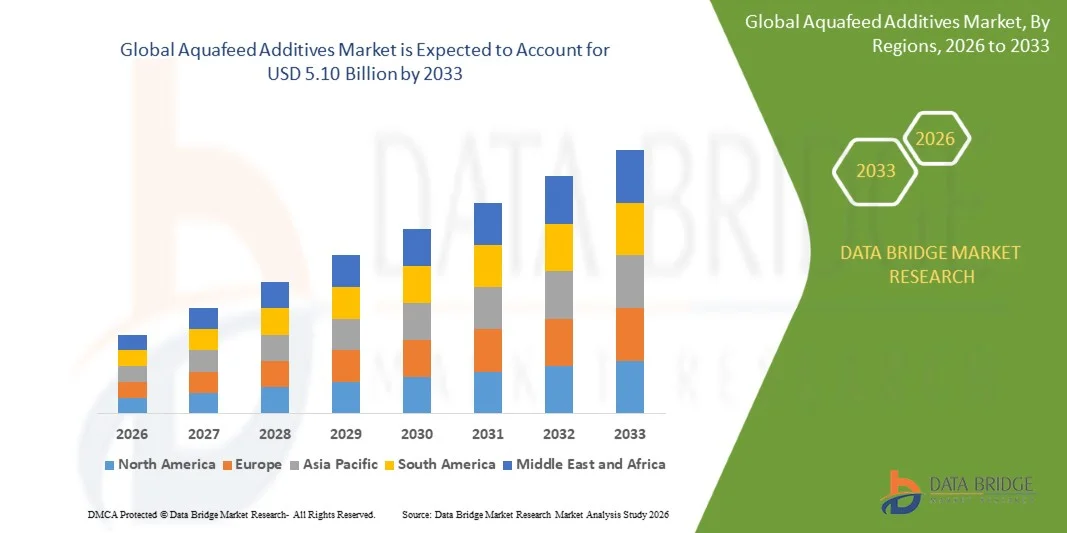
As per Data Bridge Market Research analysis The aquafeed additives market was valued at USD 3.70 billion in 2025 and is projected to reach USD 5.10 billion by 2033, growing at a CAGR of 4.1% from 2026 to 2033. The market is experiencing steady growth driven by increasing aquaculture production, rising demand for high-quality seafood, and the growing adoption of functional feed solutions to improve aquatic animal health, growth performance, and feed efficiency.
The expansion of commercial fish and shrimp farming worldwide, coupled with the need to enhance productivity while reducing disease outbreaks, is encouraging feed manufacturers and aquaculture producers to incorporate advanced additives into feed formulations. Amino acids, vitamins, probiotics, enzymes, antioxidants, and immunostimulants are increasingly being utilized to optimize nutrient absorption, strengthen immunity, and support sustainable aquaculture practices. Growing regulatory emphasis on feed quality, along with rising investments in precision nutrition and environmentally responsible aquaculture, is further accelerating the adoption of aquafeed additives across both developed and emerging markets.
Market Size & Forecast
- Global Market Value (2025): USD 3.70 Billion
- Expected Market Value (2033): USD 5.10 Billion
- Forecast CAGR (2026–2033): 4.1%
- Leading Region in 2025: North America
- Fastest Growing Region: Asia Pacific
Key Market Trends & Insights
- North America dominated the aquafeed additives market with the largest revenue share of 34.12% in 2025, supported by advanced aquaculture practices, high adoption of specialty feed ingredients, and strong investments in fish health and nutrition technologies.
- The Fishmeal segment led the market with a 32.48% share in 2025, driven by its superior protein content, balanced amino acid profile, and high digestibility for aquatic species.
- Asia-Pacific is expected to be the fastest-growing region at a CAGR of 7.1% from 2026 to 2033, fueled by expanding aquaculture production, rising seafood consumption, and increasing investments in modern feed manufacturing across China, India, and Southeast Asia.
- Soybean are the fastest-growing ingredient type, projected to register a CAGR of 7.3%, reflecting the surge in demand for sustainable and cost-effective alternatives to marine-based ingredients.
- The Amino Acids segment dominated the additive category with a 29.48% revenue share in 2025, led by their essential role in improving growth performance, feed utilization, and protein synthesis in aquatic animals.
- Fish accounted for 57.83% of the market, preferred by the substantial global production of salmon, tilapia, carp, trout, and other commercially important fish species.
- The Crustaceans segment is the fastest-growing species category, with a CAGR of 7.2%, driven by the rising global demand for shrimp and prawn products.
Report Scope and Aquafeed Additives Market Segmentation
|
Attributes |
Aquafeed Additives Key Market Insights |
|
Segments Covered |
|
|
Countries Covered |
North America · U.S. · Canada · Mexico Europe · Germany · France · U.K. · Netherlands · Switzerland · Belgium · Russia · Italy · Spain · Turkey · Rest of Europe Asia-Pacific · China · Japan · India · South Korea · Singapore · Malaysia · Australia · Thailand · Indonesia · Philippines · Rest of Asia-Pacific Middle East and Africa · Saudi Arabia · U.A.E. · South Africa · Egypt · Israel · Rest of Middle East and Africa South America · Brazil · Argentina · Rest of South America |
|
Key Market Players |
· Cargill, Incorporated (U.S.) · ADM (U.S.) · dsm-firmenich (Switzerland) · Evonik Industries AG (Germany) · BASF SE (Germany) · Kemin Industries, Inc. (U.S.) · Alltech, Inc. (U.S.) · Nutreco N.V. (Netherlands) · BioMar Group A/S (Denmark) · Novus International, Inc. (U.S.) · Phibro Animal Health Corporation (U.S.) · Lallemand Inc. (Canada) · Olmix Group (France) · Norel, S.A. (Spain) · Calysta, Inc. (U.S.) · Bentoli, Inc. (U.S.) · Biorigin (Brazil) · Camlin Fine Sciences Ltd. (India) · ADDCON GmbH (Germany) · Growel Feeds Pvt. Ltd. (India) |
|
Market Opportunities |
· Growing adoption of functional and health-promoting feed additives · Expansion of high-value species farming, including salmon, shrimp, and marine fish · Increasing focus on sustainable aquaculture practices |
|
Value Added Data Infosets |
In addition to the insights on market scenarios such as market value, growth rate, segmentation, geographical coverage, and major players, the market reports curated by the Data Bridge Market Research also include in-depth expert analysis, pricing analysis, brand share analysis, consumer survey, demography analysis, supply chain analysis, value chain analysis, raw material/consumables overview, vendor selection criteria, PESTLE Analysis, Porter Analysis, and regulatory framework. |
Aquafeed Additives Market Trends
Trend: Growth in Functional Nutrition & Disease Prevention Solutions
Aquaculture producers are increasingly adopting advanced aquafeed additives to enhance animal health, improve feed efficiency, and strengthen disease resistance without the cost and risk of excessive antibiotic usage. The integration of probiotics, prebiotics, enzymes, and phytogenic compounds enables precise optimization of nutrition and production performance. Feed manufacturers and aquaculture enterprises are similarly leveraging additives to support commercial farming through standardized, science-based feeding programs, while sustainable nutrition technologies create effective solutions that closely replicate optimal aquatic growth conditions.
For instance, in April 2024, dsm-firmenich expanded its aquaculture nutrition portfolio with functional feed solutions designed to improve fish health and production efficiency, reflecting the industry's increasing focus on performance-enhancing additives.
Aquafeed Additives Market Dynamics
Key Market Driver: Growing Adoption of Nutritional Solutions in Commercial Aquaculture
The rapid expansion of aquaculture production and increasing global seafood consumption has created substantial demand for advanced aquafeed additives that can enhance feed utilization, nutrient absorption, and aquatic animal performance in commercial farming. Feed manufacturers, aquaculture producers, and nutrition companies are deploying additives as a core component of their production strategies, reducing disease risks, accelerating growth cycles, and improving operational profitability. For instance, in June 2024, Cargill continued strengthening its aquaculture nutrition offerings with feed technologies aimed at improving feed conversion and supporting sustainable seafood production, highlighting the growing importance of advanced additives.
Key Restraint/Challenge: High Development Cost and Regulatory Approval Requirements
A significant restraint in the aquafeed additives market is the high upfront investment required for specialty additive development and regulatory approval processes. Modern formulations incorporate advanced microbial cultures, bioactive ingredients, and precision nutrition technologies, demanding substantial investment in research, testing, and compliance activities. The total cost burden extends to product registration, quality assurance programs, and validation studies, making adoption difficult for smaller feed manufacturers, aquaculture enterprises, and emerging-market participants. For instance, the increasingly stringent approval requirements for probiotics, enzymes, and specialty feed ingredients across major aquaculture regions illustrate the scale of compliance commitments required for innovative additive commercialization, reflecting broader market-entry challenges.
Key Market Opportunity: Integration of Sustainable and Antibiotic-Free Feed Technologies
The integration of sustainable nutrition technologies in aquaculture presents a significant market opportunity. Functional additives can improve gut health, strengthen immunity, and support disease management while reducing dependence on antibiotic treatments. The development of next-generation probiotics, phytogenic compounds, and precision nutrition platforms is further expanding adoption across commercial aquaculture operations, opening growth opportunities across cost-sensitive markets in Asia-Pacific, Latin America, and the Middle East. For instance, in September 2024, ADM expanded its specialty aquaculture nutrition initiatives focused on health and performance optimization, demonstrating the increasing commercial potential of sustainable feed additive solutions.
Aquafeed Additives Market Scope
The aquafeed additives market is segmented on the basis of ingredient, additive, species, form, and lifecycle.
- By Ingredient
On the basis of ingredient, the aquafeed additives market is segmented into soybean, fishmeal, corn, fish oil, additive, and others. The Fishmeal segment dominated the market with a 32.48% share in 2025, owing to its superior protein content, balanced amino acid profile, and high digestibility for aquatic species. Fishmeal remains a critical ingredient in aquafeed formulations due to its ability to support rapid growth and feed efficiency in fish and crustaceans. It is widely utilized across commercial aquaculture operations because of its proven nutritional performance. The ingredient also enhances palatability, encouraging higher feed intake among aquatic species. Strong demand from salmon, shrimp, and marine fish farming continues to support its market leadership. Despite sustainability concerns, fishmeal remains the benchmark protein source in premium aquafeed production.
The Soybean segment is projected to register the fastest growth at a CAGR of 7.3% from 2026 to 2033, driven by increasing demand for sustainable and cost-effective alternatives to marine-based ingredients. Soybean meal offers a reliable source of plant protein and is increasingly incorporated into aquafeed formulations to reduce dependence on fishmeal. Advancements in processing technologies have improved digestibility and minimized anti-nutritional factors. Growing environmental concerns and fluctuating fishmeal prices are encouraging greater adoption of plant-based ingredients. Expansion of sustainable aquaculture practices is further supporting demand. Increasing investments in alternative protein development are expected to accelerate growth throughout the forecast period.
- By Additive
On the basis of additive, the aquafeed additives market is segmented into amino acids, vitamins & minerals, probiotics & prebiotics, enzymes, antibiotics, antioxidants, and others. The Amino Acids segment dominated the market with a 29.48% share in 2025, driven by their essential role in improving growth performance, feed utilization, and protein synthesis in aquatic animals. Amino acids help optimize feed formulations while reducing feed costs and nutrient waste. They are extensively used in commercial aquaculture to improve productivity and achieve balanced nutrition. Rising demand for precision nutrition strategies is further boosting adoption. The segment benefits from increasing awareness regarding feed conversion efficiency and sustainable farming practices. Continuous innovations in amino acid supplementation technologies are strengthening market penetration.
The Probiotics & Prebiotics segment is expected to witness the fastest growth at a CAGR of 7.4% from 2026 to 2033, driven by increasing demand for antibiotic-free aquaculture production systems. These additives enhance gut health, improve nutrient absorption, and strengthen immune responses in aquatic species. Growing concerns regarding antimicrobial resistance are encouraging producers to adopt biological alternatives. Regulatory restrictions on antibiotic usage are further supporting market expansion. Technological advancements in microbial feed additives are improving product effectiveness and commercial viability. Rising focus on disease prevention and sustainable aquaculture is expected to accelerate growth significantly.
- By Species
On the basis of species, the aquafeed additives market is segmented into fish, crustaceans, mollusks, and others. The Fish segment dominated the market with a 57.83% share in 2025, owing to the substantial global production of salmon, tilapia, carp, trout, and other commercially important fish species. Fish farming represents the largest segment of global aquaculture and requires nutritionally optimized feed formulations. Aquafeed additives play a crucial role in improving growth rates, feed conversion, and disease resistance. Rising seafood consumption worldwide continues to increase production requirements. Technological advancements in fish nutrition are further strengthening additive adoption. The segment benefits from extensive commercial aquaculture infrastructure across major producing regions.
The Crustaceans segment is projected to register the fastest growth at a CAGR of 7.2% from 2026 to 2033, driven by rising global demand for shrimp and prawn products. Crustacean farming requires specialized feed formulations to support growth, immunity, and survival rates. Increasing disease challenges in shrimp farming are encouraging greater utilization of functional additives. Producers are adopting probiotics, enzymes, and immune-enhancing ingredients to improve productivity. Expanding export opportunities and premium seafood demand are further supporting growth. Investments in intensive aquaculture systems are expected to accelerate additive consumption within this segment.
- By Form
On the basis of form, the aquafeed additives market is segmented into dry form, wet form, and moist form. The Dry Form segment dominated the market with a 62.37% share in 2025, owing to its ease of handling, storage stability, and compatibility with large-scale feed manufacturing processes. Dry additives are widely used in commercial aquaculture due to their long shelf life and efficient incorporation into feed pellets. They enable precise dosing and consistent nutrient distribution across feed batches. Feed manufacturers prefer dry formulations because they simplify transportation and inventory management. Growing industrialization of aquafeed production is further supporting segment dominance. Their cost-effectiveness and operational convenience continue to drive widespread adoption globally.
The Moist Form segment is expected to witness the fastest growth at a CAGR of 6.9% from 2026 to 2033, driven by increasing use in high-value aquaculture species and specialized feeding programs. Moist formulations improve palatability and can enhance nutrient availability in certain production systems. They are particularly beneficial in hatcheries and intensive farming operations requiring customized nutrition. Technological developments are improving product stability and handling characteristics. Rising demand for premium aquaculture products is encouraging adoption of advanced feed formulations. Expanding research into species-specific nutrition requirements is further accelerating growth.
- By Lifecycle
On the basis of lifecycle, the aquafeed additives market is segmented into grower feed, finisher feed, starter feed, and brooder feed. The Grower Feed segment dominated the market with a 38.91% share in 2025, driven by its extensive use during the primary growth phase of aquatic species. This stage requires significant nutritional support to maximize weight gain, feed efficiency, and overall productivity. Aquafeed additives are heavily incorporated into grower feeds to enhance growth performance and disease resistance. Commercial aquaculture operations prioritize this phase due to its direct impact on production economics. Increasing focus on feed optimization is strengthening demand for specialized additive solutions. The segment continues to benefit from expanding aquaculture production volumes worldwide.
The Starter Feed segment is projected to register the fastest growth at a CAGR of 7.5% from 2026 to 2033, driven by increasing emphasis on early-stage survival, health, and developmental performance. Young aquatic species require highly digestible and nutrient-dense feed formulations to ensure successful growth. Functional additives such as probiotics, enzymes, and vitamins are increasingly incorporated to improve immunity and gut development. Advances in hatchery management practices are supporting adoption of specialized starter feeds. Rising investments in aquaculture productivity enhancement are further accelerating demand. Growing recognition of the importance of early-life nutrition is expected to sustain strong growth throughout the forecast period.
Aquafeed Additives Market Regional Analysis
North America dominated the aquafeed additives market with the largest revenue share of 34.12% in 2025, supported by advanced aquaculture practices, high adoption of specialty feed ingredients, and strong investments in fish health and nutrition technologies. The region also benefits from stringent feed quality standards, high adoption of functional feed additives, and growing use of probiotics, amino acids, and enzymes across commercial aquaculture operations. Increasing focus on sustainable seafood production and disease management continues to strengthen North America's leadership position in the global market.
U.S. Aquafeed Additives Market Insight
The U.S. aquafeed additives market is witnessing strong growth due to rising investments in sustainable aquaculture practices, aquatic animal health management, and advanced feed nutrition technologies. The country’s established aquaculture industry, along with increasing adoption of functional additives such as probiotics, enzymes, and amino acids, is driving demand across commercial fish and shellfish farming operations. In addition, growing emphasis on improving feed efficiency, reducing disease outbreaks, and enhancing seafood production standards is accelerating additive adoption among aquaculture producers and feed manufacturers.
Europe Aquafeed Additives Market Insight
The Europe aquafeed additives market remains a major contributor to global revenue, driven by strong regulatory support, nutritional innovation, and high demand for sustainable aquaculture solutions. The widespread use of specialty feed additives in salmon farming, marine aquaculture, and aquatic nutrition programs is supporting market expansion across the region. Increasing investments in functional feed technologies, coupled with strict feed quality regulations and growing focus on environmental sustainability, continue to enhance the adoption of aquafeed additives throughout Europe.
U.K. Aquafeed Additives Market Insight
The U.K. aquafeed additives market is experiencing steady growth, supported by rising adoption of advanced nutrition solutions in commercial aquaculture, fish farming, and aquatic health applications. Increasing investments in feed innovation and growing demand for efficient, sustainable aquaculture production systems are contributing to market growth. Furthermore, integration of precision nutrition, probiotics, and specialty feed ingredients is improving production performance and feed utilization efficiency, positioning the U.K. as a key innovation hub in the aquafeed additives industry.
Germany Aquafeed Additives Market Insight
The Germany aquafeed additives market is expanding steadily due to the country’s strong feed manufacturing sector, advanced research capabilities, and increasing adoption of next-generation aquaculture nutrition technologies. Feed producers, aquaculture enterprises, and research organizations are increasingly utilizing additives for health optimization, growth enhancement, and feed efficiency improvement. Continuous advancements in microbial nutrition, enzyme technologies, and sustainable feed solutions, along with strong government focus on food security and innovation, are further driving market growth in Germany.
Asia-Pacific Aquafeed Additives Market Insight
The Asia-Pacific aquafeed additives market is expected to witness rapid growth, driven by expanding aquaculture production, rising seafood consumption, and increasing investments in feed manufacturing infrastructure across countries such as China, India, and Vietnam. Growing awareness regarding aquatic animal health, rising adoption of functional feed additives, and increasing demand for efficient and cost-effective nutrition solutions are supporting regional market expansion. In addition, the growing presence of commercial aquaculture operations and export-oriented seafood industries is accelerating additive adoption across the region.
Japan Aquafeed Additives Market Insight
The Japan aquafeed additives market is witnessing consistent growth due to rising investments in aquatic nutrition technologies, sustainable seafood production, and fish health management initiatives. Aquaculture producers, feed manufacturers, and research institutes are increasingly adopting advanced additives for growth optimization, disease prevention, and feed performance enhancement. Moreover, increasing integration of functional nutrition solutions and the country’s focus on efficient and high-quality aquaculture production are further contributing to market growth.
China Aquafeed Additives Market Insight
The China aquafeed additives market is growing rapidly, driven by expanding aquaculture production, increasing seafood demand, and rising government focus on sustainable farming practices and food security. Growing adoption of probiotics, amino acids, and enzyme-based feed solutions across commercial fish and shrimp farming operations is significantly boosting market demand. In addition, rising investments in aquaculture modernization, increasing awareness regarding aquatic animal health, and rapid advancements in feed technology are positioning China as one of the fastest-growing markets for aquafeed additives globally.
Aquafeed Additives Market Share
The aquafeed additives industry is primarily led by well-established companies, including:
- Cargill, Incorporated (U.S.)
- ADM (U.S.)
- dsm-firmenich (Switzerland)
- Evonik Industries AG (Germany)
- BASF SE (Germany)
- Kemin Industries, Inc. (U.S.)
- Alltech, Inc. (U.S.)
- Nutreco N.V. (Netherlands)
- BioMar Group A/S (Denmark)
- Novus International, Inc. (U.S.)
- Phibro Animal Health Corporation (U.S.)
- Lallemand Inc. (Canada)
- Olmix Group (France)
- Norel, S.A. (Spain)
- Calysta, Inc. (U.S.)
- Bentoli, Inc. (U.S.)
- Biorigin (Brazil)
- Camlin Fine Sciences Ltd. (India)
- ADDCON GmbH (Germany)
- Growel Feeds Pvt. Ltd. (India)
Latest Developments in Aquafeed Additives Market
- In August 2025, dsm-firmenich inaugurated its first Animal Nutrition & Health feed additive manufacturing plant in Jadcherla, Hyderabad, India. The new facility manufactures Mycofix® Secure and Mycofix® Shield feed additive solutions for mycotoxin risk management and includes an advanced warehouse to improve regional supply capabilities. The investment supports the company's "Make in India" strategy, strengthens feed additive production for the Asia-Pacific region, and enables faster delivery of high-quality nutrition solutions to aquaculture and livestock feed manufacturers
- In May 2024, Skretting introduced AmiNova, an innovative aquafeed formulation concept based on an ideal digestible amino acid profile rather than conventional crude protein formulations. The technology enables more precise fish nutrition, improves protein utilization, enhances feed efficiency, and lowers nutrient discharge into the aquatic environment. AmiNova supports sustainable aquaculture production by reducing unnecessary nutrient losses while maintaining fish growth performance across commercial farming operations
- In April 2024, Skretting launched Armis, a new functional shrimp feed developed to improve resilience against challenging farming conditions such as EHP (Enterocytozoon hepatopenaei) and other environmental stressors. The diet combines advanced nutritional technologies with functional feed ingredients to support shrimp health, maintain growth performance, and improve farm productivity. The launch reinforces the industry's growing focus on health-promoting aquafeed additives and disease prevention strategies
- In June 2023, Veramaris continued expanding the commercial adoption of its algae-based EPA and DHA omega-3 ingredient for aquaculture feeds. The sustainable feed additive enables salmon producers to reduce dependence on wild-caught fish oil while maintaining essential omega-3 nutrition in farmed seafood. The expansion reflects increasing industry demand for sustainable aquafeed additives that improve environmental performance without compromising fish health or product quality
- In November 2022, Royal DSM updated its Optimum Vitamin Nutrition (OVN) Guidelines for Aquaculture, providing revised science-based recommendations for vitamin supplementation in aquafeeds. The updated guidelines help feed manufacturers optimize fish health, improve feed conversion efficiency, strengthen immunity, and enhance production performance across multiple aquaculture species. The initiative highlights DSM's continued investment in precision nutrition and sustainable aquaculture development

- Interactive Data Analysis Dashboard
- Company Analysis Dashboard for high growth potential opportunities
- Research Analyst Access for customization & queries
- Competitor Analysis with Interactive dashboard
- Latest News, Updates & Trend analysis
- Harness the Power of Benchmark Analysis for Comprehensive Competitor Tracking
Global Aquafeed Additives Market, Supply Chain Analysis and Ecosystem Framework
To support market growth and help clients navigate the impact of geopolitical shifts, DBMR has integrated in-depth supply chain analysis into its Global Aquafeed Additives Market research reports. This addition empowers clients to respond effectively to global changes affecting their industries. The supply chain analysis section includes detailed insights such as Global Aquafeed Additives Market consumption and production by country, price trend analysis, the impact of tariffs and geopolitical developments, and import and export trends by country and HSN code. It also highlights major suppliers with data on production capacity and company profiles, as well as key importers and exporters. In addition to research, DBMR offers specialized supply chain consulting services backed by over a decade of experience, providing solutions like supplier discovery, supplier risk assessment, price trend analysis, impact evaluation of inflation and trade route changes, and comprehensive market trend analysis.
Data collection and base year analysis are done using data collection modules with large sample sizes. The stage includes obtaining market information or related data through various sources and strategies. It includes examining and planning all the data acquired from the past in advance. It likewise envelops the examination of information inconsistencies seen across different information sources. The market data is analysed and estimated using market statistical and coherent models. Also, market share analysis and key trend analysis are the major success factors in the market report. To know more, please request an analyst call or drop down your inquiry.
The key research methodology used by DBMR research team is data triangulation which involves data mining, analysis of the impact of data variables on the market and primary (industry expert) validation. Data models include Vendor Positioning Grid, Market Time Line Analysis, Market Overview and Guide, Company Positioning Grid, Patent Analysis, Pricing Analysis, Company Market Share Analysis, Standards of Measurement, Global versus Regional and Vendor Share Analysis. To know more about the research methodology, drop in an inquiry to speak to our industry experts.
Data Bridge Market Research is a leader in advanced formative research. We take pride in servicing our existing and new customers with data and analysis that match and suits their goal. The report can be customized to include price trend analysis of target brands understanding the market for additional countries (ask for the list of countries), clinical trial results data, literature review, refurbished market and product base analysis. Market analysis of target competitors can be analyzed from technology-based analysis to market portfolio strategies. We can add as many competitors that you require data about in the format and data style you are looking for. Our team of analysts can also provide you data in crude raw excel files pivot tables (Fact book) or can assist you in creating presentations from the data sets available in the report.













