What is the Aquatic Herbicides Market Size and Growth Rate?
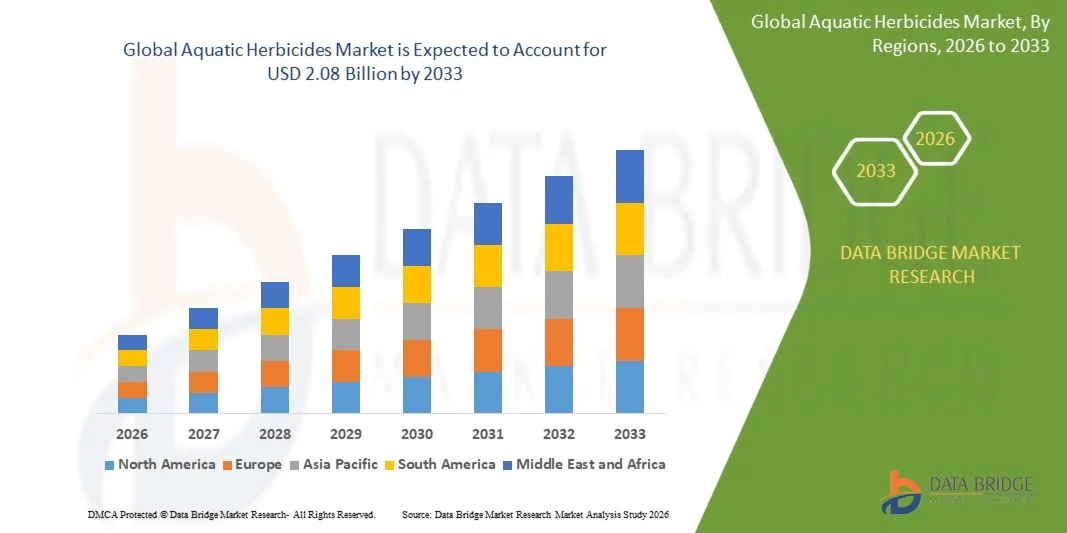
- As per Data Bridge Market Research analysis, the aquatic herbicides market was valued at USD 1.30 billion in 2025 and is projected to reach USD 2.08 billion by 2033, growing at a CAGR of 6.1% from 2026 to 2033.
- The market is experiencing consistent growth driven by increasing demand for effective aquatic weed management, rising investments in freshwater resource conservation, expanding agricultural and aquaculture activities, and growing adoption of herbicides for maintaining lakes, ponds, reservoirs, rivers, and irrigation systems.
- The increasing spread of invasive aquatic vegetation, growing contamination of freshwater resources, and the need to maintain water quality and flow are encouraging governments, agricultural operators, fisheries, and water-management organizations to adopt aquatic herbicides. Selective formulations and improved application technologies are gaining preference as they enable targeted weed control while supporting more sustainable aquatic ecosystem management.
Market Size & Forecast
- Global Market Value (2025): USD 1.30 Billion
- Expected Market Value (2033): USD 2.08 Billion
- Forecast CAGR (2026–2033): 6.1%
- Leading Region in 2025: North America
- Fastest Growing Region: Asia Pacific
What are the Major Takeaways of the Aquatic Herbicides Market?
- North America dominated the aquatic herbicides market with the largest revenue share of 35.7% in 2025, supported by advanced aquatic weed-management programs, extensive freshwater resources, and strong regulatory and ecosystem-restoration initiatives.
- Asia-Pacific is expected to be the fastest-growing region at a CAGR of 9.5% from 2026 to 2033, fueled by expanding aquaculture, increasing agricultural water demand, water-infrastructure investments, and growing adoption
- The glyphosate segment led the market with a 42.5% share in 2025, driven by its broad-spectrum weed-control capability and established use across aquatic vegetation-management programs.
- Imazamox are the fastest-growing type, projected to register a CAGR of 11.2%, reflecting the surge in demand for selective aquatic weed-control solutions
- The non-selective segment dominated the mode of action type category with a 55.1% revenue share in 2025, led by its ability to provide broad-spectrum control of unwanted aquatic vegetation.
- Foliar accounted for 47% of the market share in 2025, preferred by its established use for controlling floating and emergent aquatic weeds
- The pellet segment is the fastest-growing formulation category, with a CAGR of 12.1%, driven by increasing demand for controlled and targeted herbicide delivery.
Report Scope and Aquatic Herbicides Market Segmentation
|
Attributes |
Aquatic Herbicides Key Market Insights |
|
Segments Covered |
|
|
Countries Covered |
North America
Europe
Asia-Pacific
Middle East and Africa
South America
|
|
Key Market Players |
|
|
Market Opportunities |
|
|
Value Added Data Infosets |
In addition to the insights on market scenarios such as market value, growth rate, segmentation, geographical coverage, and major players, the market reports curated by the Data Bridge Market Research also include import export analysis, production capacity overview, production consumption analysis, price trend analysis, climate change scenario, supply chain analysis, value chain analysis, raw material/consumables overview, vendor selection criteria, PESTLE Analysis, Porter Analysis, and regulatory framework. |
What is the Key Trend in the Aquatic Herbicides Market?
- Aquatic herbicide management is increasingly shifting toward targeted and selective weed-control solutions, as water managers seek to control invasive vegetation while minimizing impacts on desirable aquatic plants, fish, and other non-target organisms.
- For instance, in March 2025, the U.S. Geological Survey reported results from whole-lake 2,4-D treatments in three northern Wisconsin lakes, with target concentrations of 0.3 ppm, supporting continued research into selective aquatic weed control while assessing potential effects on larval fish and zooplankton.
- Manufacturers are increasingly focusing on precision application and improved formulations, including granular, liquid, and slow-release products that enable more controlled herbicide distribution across specific aquatic environments and weed-infested areas.
- The growing emphasis on integrated aquatic vegetation management is encouraging water authorities to combine herbicide treatments with mechanical removal, biological controls, monitoring, and habitat restoration rather than relying exclusively on chemical treatment.
- Regulatory agencies are also strengthening aquatic ecological-risk assessment, increasing demand for herbicides with favorable environmental profiles, clearly defined application rates, and stronger evidence regarding effects on aquatic organisms and surrounding ecosystems.
- For instance, in March 2024, XAG Australia reported using drones to apply glyphosate over a 5-hectare Salvinia molesta infestation in Shoalhaven, New South Wales, completing the aquatic weed treatment in five hours and demonstrating the growing use of aerial technology for targeted aquatic herbicide application.
- Digital monitoring, mapping, and site-specific treatment planning are gaining importance as water managers increasingly use vegetation surveys and environmental data to determine treatment timing, application locations, and appropriate herbicide concentrations.
What are the Key Drivers of the Aquatic Herbicides Market?
- The rapid spread of invasive aquatic weeds such as water hyacinth, Eurasian watermilfoil, and other nuisance vegetation is increasing demand for effective chemical control across lakes, reservoirs, irrigation canals, and recreational water bodies
- For instance, in July 2024, the U.S. Environmental Protection Agency identified diquat dibromide as an important aquatic herbicide and algaecide used to control invasive and nuisance weeds in ponds, lakes, and other water bodies, highlighting the continued need for chemical solutions to manage aquatic vegetation
- Agricultural irrigation systems are increasingly requiring aquatic weed management because excessive vegetation can restrict water flow, obstruct canals, reduce irrigation efficiency, and interfere with water distribution, encouraging greater adoption of aquatic herbicides.
- Growing aquaculture and fisheries activities are also supporting demand for carefully managed aquatic vegetation control, as excessive weeds can interfere with fish production, water circulation, harvesting operations, and overall pond management.
- For instance, in October 2024, researchers at Kerala Agricultural University evaluated 11 herbicide treatments for managing the invasive aquatic weeds Limnocharis flava and Monochoria vaginalis in wetland rice, with 2,4-D sodium salt and florpyrauxifen-benzyl achieving total control of both weeds, demonstrating demand for effective aquatic weed-control solutions in agricultural water environments
- Municipalities and recreational-water operators are adopting aquatic herbicides to maintain usable lakes, ponds, reservoirs, and waterways, particularly where dense aquatic vegetation affects boating, fishing, swimming, navigation, and tourism activities.
Which Factors are Challenging the Growth of the Aquatic Herbicides Market?
- Strict application restrictions and water-use limitations can reduce operational flexibility because aquatic herbicides may require waiting periods before treated water can be used for irrigation, particularly in agricultural water bodies.
- For instance, in August 2024, the U.S. Environmental Protection Agency updated its Aquatic Life Benchmarks to cover 776 chemicals, including newly registered pesticides and revised values for existing active ingredients, reflecting the increasing ecological-risk assessment requirements that aquatic herbicide products must meet before and during use
- Potential ecological impacts from improper or excessive herbicide application remain a significant challenge because rapid destruction of aquatic vegetation can reduce dissolved oxygen during decomposition and adversely affect fish and aquatic organisms.
- High product development and application costs can restrict adoption, particularly among smaller water-management operators, because aquatic herbicides require specialized formulations, environmental testing, application equipment, and trained personnel.
- Limited availability of registered aquatic herbicide options can constrain treatment flexibility, particularly for diverse invasive weed species, while repeated use of the same active ingredients can increase concerns regarding herbicide resistance and reduce long-term treatment effectiveness.
- For instance, in July 2025, an EPA aquatic herbicide permit for invasive-weed control specified a three-day drinking-water restriction following diquat application and emphasized compliance with water-use restrictions, demonstrating how treatment requirements can limit the immediate use of treated water and complicate aquatic herbicide application planning
- Complexity of managing multiple water uses can further constrain adoption, as the same water body may simultaneously support irrigation, fisheries, recreation, livestock, or domestic uses, requiring herbicide selection and application to account for each use.
How is the Aquatic Herbicides Market Segmented?
The aquatic herbicides market is segmented on the basis of type, mode of action, application method, formulation, and application.
- By Type
On the basis of type, the aquatic herbicides market is segmented into glyphosate, 2,4-D, imazapyr, diquat, triclopyr, and others. The glyphosate segment dominated the market with 42.5% share in 2025, owing to its broad-spectrum weed-control capability and established use across aquatic vegetation-management programs. Glyphosate is widely utilized for controlling emergent and floating vegetation in managed water bodies. Its broad activity makes it suitable for applications requiring comprehensive vegetation suppression. Established availability and familiarity among aquatic weed-management operators further support its adoption. However, increasing environmental and regulatory considerations are encouraging greater interest in selective alternatives.
The imazamox segment is projected to register the fastest growth at 11.2% CAGR from 2026 to 2033, driven by increasing demand for selective aquatic weed-control solutions. Imazamox provides targeted control of several problematic aquatic weed species while supporting more environmentally conscious vegetation-management programs. Its growing relevance in fisheries and aquaculture is supported by the need to manage weeds while protecting desirable aquatic vegetation. The shift toward reduced-risk active ingredients is further strengthening its adoption potential. Regulatory emphasis on selectivity and ecological compatibility is encouraging greater interest in specialty active ingredients. Consequently, imazamox is expected to gain importance as aquatic herbicide demand shifts toward targeted and higher-value solutions.
- By Mode of Action
On the basis of mode of action, the aquatic herbicides market is segmented into non-selective and selective herbicides. The non-selective herbicides segment dominated the market with 55.1% share in 2025, supported by its ability to provide broad-spectrum control of unwanted aquatic vegetation. These products are particularly useful in heavily infested reservoirs, irrigation systems, canals, and other water bodies. Their broad activity allows multiple problematic weed species to be addressed through comprehensive treatment programs. Cost considerations and established application practices also support their continued use. However, concerns regarding impacts on desirable aquatic vegetation are increasing interest in selective alternatives.
The selective herbicides segment is projected to register the fastest growth at 9.4% CAGR from 2026 to 2033, driven by rising environmental considerations and demand for targeted weed management. Selective herbicides allow operators to suppress specific aquatic weed species while reducing damage to desirable plants. This characteristic is particularly important in fisheries, aquaculture, conservation areas, and mixed-use water bodies. Increasing regulatory attention toward ecological impacts is also encouraging adoption of more targeted chemistry. Selective products are gaining importance as water managers integrate chemical treatment with broader ecosystem-management programs. The shift toward species-specific control is therefore expected to support faster growth of selective herbicides during the forecast period.
- By Application Method
On the basis of application method, the aquatic herbicides market is segmented into foliar and submerged applications. The foliar application segment dominated the market with 47% share in 2025, owing to its established use for controlling floating and emergent aquatic weeds. Foliar treatment enables herbicides to be directly applied to vegetation above or near the water surface. The method is widely used in lakes, ponds, shorelines, irrigation channels, and recreational water bodies. Its straightforward application process and compatibility with commonly used aquatic herbicides support widespread adoption. However, increasing management of deeper reservoirs and submerged weed populations is creating opportunities for alternative delivery techniques.
The submerged application segment is projected to register the fastest growth at 10.5% CAGR from 2026 to 2033, driven by increasing demand for targeted treatment of underwater weed infestations. Submerged application enables herbicides to be delivered closer to submerged plant beds, improving treatment effectiveness in deeper water. Digital bathymetry and site-specific treatment planning are making this approach increasingly practical. It is particularly relevant for reservoirs where conventional surface treatment may provide less precise herbicide distribution. Rising investment in precision aquatic vegetation management is further supporting adoption. The combination of targeted delivery and improved treatment efficiency is expected to accelerate growth of submerged applications.
- By Formulation
On the basis of formulation, the aquatic herbicides market is segmented into liquid concentrates, pellet, tablet, water-soluble powders, and emulsifiable concentrates. The liquid concentrates segment dominated the market with 46% share in 2025, supported by ease of dilution, flexible dosing, and compatibility with commonly used application equipment. Liquid formulations are widely utilized for foliar treatments and can also be adapted for certain submerged applications. Their established handling and application procedures make them suitable for large-scale aquatic vegetation management. Liquid concentrates also provide flexibility in adjusting application rates according to weed density and treatment conditions. Their broad compatibility with aquatic weed-control programs continues to reinforce their leading position.
The pellet formulation segment is projected to register the fastest growth at 12.1% CAGR from 2026 to 2033, driven by increasing demand for controlled and targeted herbicide delivery. Pellet products can be particularly useful for treating submerged weeds where direct placement near plant beds is advantageous. They can reduce dependence on extensive surface spraying and provide more localized distribution of active ingredients. Improvements in controlled-release technologies are further enhancing the effectiveness and persistence of granular and pellet treatments. Increasing adoption of precision aquatic vegetation-management practices is creating additional demand for these formulations. As water managers seek improved placement accuracy and longer treatment effectiveness, pellet formulations are expected to gain market share rapidly.
- By Application
On the basis of application, the aquatic herbicides market is segmented into agricultural waters, fisheries, recreational waters, and others. The agricultural waters segment dominated the market with 38% share in 2025, driven by the need to maintain efficient water flow through irrigation systems and agricultural water bodies. Excessive aquatic vegetation can obstruct canals, reduce water-conveyance efficiency, and interfere with agricultural water distribution. Herbicide treatment provides an effective method for controlling invasive and nuisance vegetation across irrigation infrastructure. Rising agricultural water demand and emphasis on improving water-use efficiency further support this application. Continued investment in irrigation infrastructure and aquatic weed management is expected to sustain its leading position.
The fisheries segment is projected to register the fastest growth at 9.8% CAGR from 2026 to 2033, supported by expanding aquaculture production and increasing requirements for controlled aquatic vegetation management. Excessive aquatic weeds can interfere with fish feeding, harvesting, water circulation, and pond productivity. Selective herbicides are particularly relevant because operators need to control unwanted vegetation while protecting commercially valuable aquatic organisms. Rising investment in fisheries infrastructure across developing markets is creating additional demand for effective weed-control solutions. Increasing adoption of environmentally compatible active ingredients is also supporting this application. Consequently, fisheries are expected to become an increasingly important growth area for aquatic herbicide manufacturers.
Which Region Holds the Largest Share of the Aquatic Herbicides Market?
- North America dominated the aquatic herbicides market with the largest revenue share of 35.7% in 2025, supported by advanced aquatic weed-management programs, extensive freshwater resources, and strong regulatory and ecosystem-restoration initiatives.
- The region also benefits from substantial investments in lake restoration, fisheries management, irrigation systems, and recreational water-body maintenance, while the approval and adoption of newer selective herbicide active ingredients are supporting market development. Growing demand for targeted aquatic weed control, combined with advanced application technologies and established water-management infrastructure, continues to strengthen North America's leadership position in the global market.
U.S. Aquatic Herbicides Market Insight
The U.S. aquatic herbicides market is witnessing strong growth due to rising investments in freshwater resource management, invasive aquatic weed control, and lake and reservoir restoration programs. The country’s extensive freshwater resources, along with increasing adoption of selective herbicide formulations and advanced application technologies, is driving demand across agricultural, recreational, fisheries, and aquaculture applications. In addition, growing emphasis on maintaining water quality, controlling invasive vegetation, and protecting aquatic ecosystems is accelerating herbicide adoption across water-management programs.
Asia-Pacific Aquatic Herbicides Market Insight
The Asia-Pacific aquatic herbicides market is expected to witness rapid growth, driven by expanding agricultural activities, increasing aquaculture production, and rising investments in freshwater and irrigation infrastructure across countries such as China, India, and Japan. Growing concerns regarding invasive aquatic weeds, water-flow obstruction, and freshwater quality are supporting regional market expansion. In addition, increasing adoption of targeted weed-management practices, improved herbicide formulations, and advanced application technologies is accelerating aquatic herbicide use across agricultural, fisheries, and recreational water bodies.
Japan Aquatic Herbicides Market Insight
The Japan aquatic herbicides market is witnessing consistent growth due to rising investments in freshwater management, aquatic vegetation control, and environmental restoration initiatives. Agricultural water bodies, fisheries, reservoirs, and recreational lakes are increasingly utilizing targeted herbicide solutions to manage invasive and nuisance aquatic weeds. Moreover, growing integration of selective formulations, improved application practices, and environmental monitoring technologies, along with Japan’s focus on maintaining water quality and sustainable aquatic ecosystems, is further contributing to market growth.
China Aquatic Herbicides Market Insight
The China aquatic herbicides market is growing rapidly, driven by expanding agricultural production, increasing aquaculture activities, and rising government focus on freshwater resource management and aquatic weed control. Growing adoption of selective and non-selective herbicide formulations across agricultural waters, fisheries, reservoirs, and recreational water bodies is significantly boosting market demand. In addition, rising investments in water-quality improvement, invasive species management, and advanced aquatic weed-control technologies are positioning China as one of the fastest-growing markets for aquatic herbicides globally.
U.K. Aquatic Herbicides Market Insight
The U.K. aquatic herbicides market is experiencing steady growth, supported by rising adoption of aquatic vegetation-management solutions in agricultural water bodies, fisheries, reservoirs, and recreational waterways. Increasing investments in freshwater restoration and growing demand for targeted, environmentally responsible weed-control solutions are contributing to market growth. Furthermore, integration of improved herbicide formulations, monitoring practices, and precision application technologies is enhancing treatment efficiency and supporting the development of the U.K. aquatic herbicides market.
Germany Aquatic Herbicides Market Insight
The Germany aquatic herbicides market is expanding steadily due to the country’s strong focus on freshwater conservation, environmental management, and sustainable aquatic weed control. Agricultural water bodies, fisheries, reservoirs, and recreational waterways are increasingly utilizing targeted herbicide solutions for managing invasive and nuisance vegetation. Continuous advancements in selective formulations, precision application, and aquatic ecosystem monitoring, along with strong regulatory focus on water quality and environmental protection, are further driving market growth in Germany.
Which are the Top Companies in Aquatic Herbicides Market?
The aquatic herbicides industry is primarily led by well-established companies, including:
- SePRO Corporation (U.S.)
- Alligare, LLC (U.S.)
- BASF SE (Germany)
- UPL Limited (India)
- Nufarm Limited (Australia)
- FMC Corporation (U.S.)
- Valent U.S.A. LLC (U.S.)
- Syngenta (Switzerland)
- Corteva, Inc. (U.S.)
- ADAMA Agricultural Solutions Ltd. (Israel)
- Albaugh, LLC (U.S.)
- Gowan Company (U.S.)
- Helena Agri-Enterprises, LLC (U.S.)
- Brandt, Inc. (U.S.)
- Atticus LLC (U.S.)
- AMVAC Chemical Corporation (U.S.)
- Sharda Cropchem Limited (India)
- Precision Laboratories, LLC (U.S.)
- PBI-Gordon Companies, Inc. (U.S.)
- Sumitomo Chemical Company, Limited (Japan)
What are Latest Developments in Aquatic Herbicides Market?
- In July 2025, the U.S. Environmental Protection Agency (EPA) issued a final general permit covering the discharge of pesticides, including aquatic herbicides, for invasive aquatic plant control. The permit established requirements for applications involving approved aquatic herbicides and appropriate treatment methods, reinforcing regulatory oversight of aquatic weed-management activities. The development highlights the increasing emphasis on controlled herbicide application and protection of water resources during aquatic vegetation management.
- In April 2024, Peerless Aquacare became certified to use ProcellaCOR FX in Ontario, adding the newly available aquatic herbicide to its aquatic weed-control services. SePRO described ProcellaCOR FX as Canada’s newest tool for managing nuisance aquatic plants, while Peerless Aquacare began offering the product for aquatic weed management in Ontario. The development illustrates the commercial rollout of a newer selective aquatic herbicide technology into additional Canadian water bodies.
- In March 2024, SePRO introduced ProcellaCOR FX as a new aquatic weed-control option in Canada following regulatory approval by Health Canada’s Pest Management Regulatory Agency. The product was positioned as a new tool for managing nuisance aquatic plants, particularly invasive milfoil. Its introduction expanded the availability of selective aquatic herbicide technology in the Canadian market and strengthened SePRO’s portfolio of targeted aquatic vegetation-management solutions.
- In October 2023, UPL announced the registration of TOP DECK Aquatic Herbicide in California for controlling aquatic vegetation. The product was registered for use in and around aquatic sites as well as selected non-crop and industrial areas and rights-of-way. The registration expanded UPL’s aquatic vegetation-management portfolio and provided applicators with another herbicide option for controlling unwanted vegetation in water-management environments
- In September 2023, Alligare launched Ballast and Mainline herbicides after receiving U.S. Environmental Protection Agency registration. Although these products primarily target vegetation management outside aquatic applications, Alligare specifically operates an Aquatics business and positioned the launches as additions to its broader vegetation-management portfolio. Mainline provides selective applications around sensitive areas, while Ballast provides dual-action vegetation control, demonstrating continued product expansion by companies active in the aquatic herbicide industry.

- Interactive Data Analysis Dashboard
- Company Analysis Dashboard for high growth potential opportunities
- Research Analyst Access for customization & queries
- Competitor Analysis with Interactive dashboard
- Latest News, Updates & Trend analysis
- Harness the Power of Benchmark Analysis for Comprehensive Competitor Tracking
Data collection and base year analysis are done using data collection modules with large sample sizes. The stage includes obtaining market information or related data through various sources and strategies. It includes examining and planning all the data acquired from the past in advance. It likewise envelops the examination of information inconsistencies seen across different information sources. The market data is analysed and estimated using market statistical and coherent models. Also, market share analysis and key trend analysis are the major success factors in the market report. To know more, please request an analyst call or drop down your inquiry.
The key research methodology used by DBMR research team is data triangulation which involves data mining, analysis of the impact of data variables on the market and primary (industry expert) validation. Data models include Vendor Positioning Grid, Market Time Line Analysis, Market Overview and Guide, Company Positioning Grid, Patent Analysis, Pricing Analysis, Company Market Share Analysis, Standards of Measurement, Global versus Regional and Vendor Share Analysis. To know more about the research methodology, drop in an inquiry to speak to our industry experts.
Data Bridge Market Research is a leader in advanced formative research. We take pride in servicing our existing and new customers with data and analysis that match and suits their goal. The report can be customized to include price trend analysis of target brands understanding the market for additional countries (ask for the list of countries), clinical trial results data, literature review, refurbished market and product base analysis. Market analysis of target competitors can be analyzed from technology-based analysis to market portfolio strategies. We can add as many competitors that you require data about in the format and data style you are looking for. Our team of analysts can also provide you data in crude raw excel files pivot tables (Fact book) or can assist you in creating presentations from the data sets available in the report.