


Arc-Based Plasma Lighting Market Size
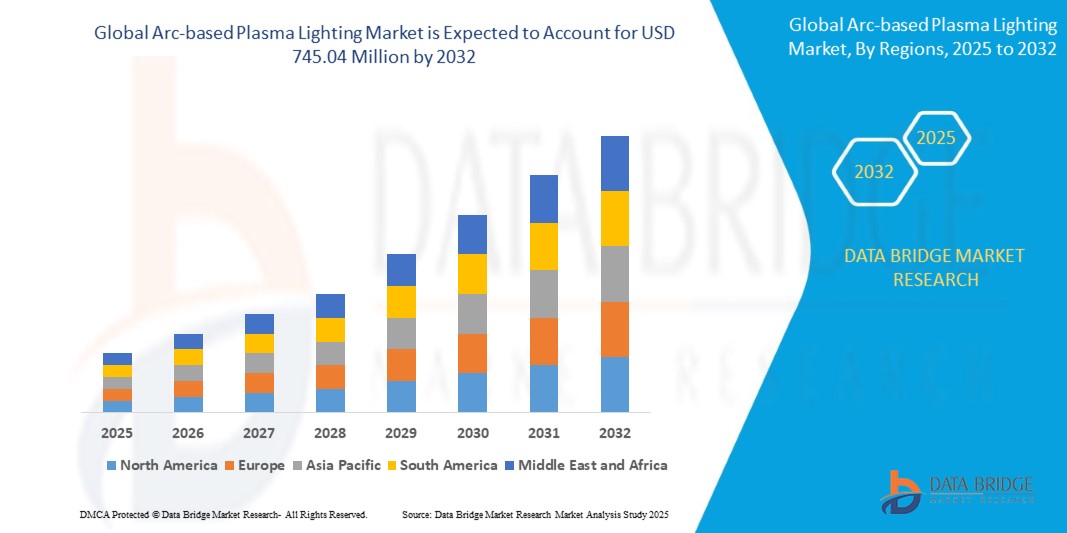
- The global arc-based plasma lighting market size was valued at USD 626.00 million in 2024 and is expected to reach USD 745.04 million by 2032, at a CAGR of 2.20% during the forecast period
- The market growth is largely fuelled by the increasing demand for energy-efficient and high-intensity lighting solutions across commercial, industrial, and outdoor applications
- Rising urbanization and infrastructure development, coupled with the need for sustainable and long-lasting lighting systems, are supporting the adoption of arc-based plasma lighting
Arc-Based Plasma Lighting Market Analysis
- Arc-based plasma lighting offers high luminous efficiency, uniform illumination, and extended operational life, making it suitable for large-scale outdoor and industrial applications
- The increasing preference for lighting solutions with lower maintenance requirements and reduced energy consumption is driving market demand
- Asia-Pacific dominated the arc-based plasma lighting market with the largest revenue share of 37.5% in 2024, driven by rapid industrialization, increasing urbanization, and growing demand for high-intensity lighting across entertainment, industrial, and research applications
- North America region is expected to witness the highest growth rate in the global arc-based plasma lighting market, driven by increasing adoption of smart and connected lighting solutions, government initiatives promoting energy efficiency, and high demand across entertainment, industrial, and medical applications
- The Xenon Arc Lamps segment held the largest market revenue share in 2024, driven by their high luminous efficiency, long operational life, and widespread use in entertainment, projection, and industrial applications. Xenon lamps are particularly preferred for their bright, uniform illumination and reliability in demanding environments
Report Scope and Arc-Based Plasma Lighting Market Segmentation
|
Attributes |
Arc-Based Plasma Lighting Key Market Insights |
|
Segments Covered |
|
|
Countries Covered |
North America
Europe
Asia-Pacific
Middle East and Africa
South America
|
|
Key Market Players |
|
|
Market Opportunities |
• Increasing Demand for Energy-Efficient Lighting Solutions |
|
Value Added Data Infosets |
In addition to the insights on market scenarios such as market value, growth rate, segmentation, geographical coverage, and major players, the market reports curated by the Data Bridge Market Research also include in-depth expert analysis, geographically represented company-wise production and capacity, network layouts of distributors and partners, detailed and updated price trend analysis and deficit analysis of supply chain and demand. |
Arc-Based Plasma Lighting Market Trends
Rise of High-Intensity and Energy-Efficient Lighting Solutions
The growing shift toward high-intensity, energy-efficient lighting is transforming the arc-based plasma lighting landscape by enabling brighter, long-lasting, and more uniform illumination for industrial, entertainment, and research applications. The precision and efficiency of these systems allow for optimized performance while reducing operational costs, especially in large-scale facilities requiring continuous lighting
The high demand for versatile lighting in entertainment, projection, and laboratory applications is accelerating the adoption of advanced plasma lighting systems. These solutions are particularly effective in sectors where conventional lighting falls short, providing superior color rendering and consistent output across challenging environments
The affordability and durability of modern arc-based plasma lighting units are making them attractive for long-term installation, reducing replacement frequency and maintenance costs. Facilities benefit from higher efficiency without significant capital expenditure, which ultimately improves overall operational productivity
For instance, in 2023, several broadcast studios in Europe reported enhanced production quality and lower electricity consumption after upgrading to xenon arc-based projection lights. These systems provided brighter, stable illumination while reducing downtime and energy costs
While high-intensity plasma lighting is driving adoption, its impact depends on ongoing innovation, efficient installation practices, and integration with smart lighting controls. Manufacturers must focus on localized solutions and scalable deployment strategies to fully capitalize on growing market demand
Arc-Based Plasma Lighting Market Dynamics
Driver
Growing Demand for Energy-Efficient and High-Performance Lighting Across Industries
- Rising energy costs and sustainability initiatives are pushing industries, research facilities, and entertainment venues to adopt arc-based plasma lighting as a high-performance and energy-efficient alternative. These lighting systems provide reliable, long-lasting illumination that reduces operational expenses. The adoption is also encouraged by rising corporate sustainability targets and green building certifications, which reward energy-efficient technologies and reduce environmental impact
- Facility managers increasingly recognize the benefits of high-intensity, uniform lighting for complex applications such as solar simulation, spectroscopy, and industrial testing. The precision and efficiency of arc-based plasma lighting improve operational productivity and safety. In addition, the superior color rendering and stability of these lights enhance accuracy in critical applications, making them indispensable in laboratories and production facilities
- Government incentives and industry standards promoting energy-efficient and environmentally friendly lighting solutions are strengthening adoption. From regulatory mandates to voluntary sustainability programs, supportive frameworks encourage upgrading conventional lighting systems. Policy-driven initiatives, combined with financial subsidies for energy-efficient upgrades, are further motivating companies to replace outdated lighting infrastructure with plasma-based alternatives
- For instance, in 2022, several European laboratories replaced mercury vapor lamps with xenon and metal halide plasma lights under energy efficiency programs, boosting demand for modern plasma lighting solutions. These replacements not only reduced energy consumption but also improved operational reliability and decreased maintenance frequency, reinforcing long-term cost savings
- While energy efficiency and performance are driving market growth, ongoing efforts to improve cost-effectiveness and installation flexibility are essential for broader adoption. Continuous R&D in compact, modular designs and smart control integration is helping expand usability across smaller facilities and diverse industrial applications
Restraint/Challenge
High Initial Cost and Specialized Maintenance Requirements
- The high upfront cost of arc-based plasma lighting systems, including xenon and metal halide units, limits adoption among small-scale venues and budget-constrained facilities. These systems are often reserved for large commercial, research, or entertainment operations. The capital-intensive nature of these solutions can delay procurement decisions, especially in developing regions where financing options are limited
- In many locations, lack of technical expertise for installation, calibration, and maintenance reduces accessibility. The absence of trained personnel and supporting infrastructure can hinder performance and longevity, especially in remote or under-resourced facilities. Improper installation or maintenance can also lead to operational inefficiencies, frequent downtimes, and safety concerns, deterring potential buyers
- Market penetration is also constrained by logistical challenges in transporting and installing high-intensity lighting systems, where equipment size and handling requirements are critical considerations. Complex shipment protocols, fragile components, and regulatory shipping requirements can delay deployment, particularly in regions with underdeveloped transport infrastructure
- For instance, in 2023, several smaller industrial plants in Southeast Asia reported delays in adopting arc-based plasma lighting due to high installation costs and limited local technical support. These delays not only affected operational timelines but also limited the energy and maintenance savings that could have been realized with faster adoption
- While technology continues to advance, addressing affordability, ease of maintenance, and scalable solutions remains crucial for unlocking the full potential of the arc-based plasma lighting market. Manufacturers focusing on modular, plug-and-play systems, along with training programs for local technicians, are key to expanding market reach and sustaining long-term growth
Arc-Based Plasma Lighting Market Scope
The market is segmented on the basis of light source, wattage type, and application
• By Light Source
On the basis of light source, the arc-based plasma lighting market is segmented into Xenon Arc Lamps, Metal Halide Lamps, Krypton Arc Lamps, Mercury Vapor Lamps, and Deuterium Lamps. The Xenon Arc Lamps segment held the largest market revenue share in 2024, driven by their high luminous efficiency, long operational life, and widespread use in entertainment, projection, and industrial applications. Xenon lamps are particularly preferred for their bright, uniform illumination and reliability in demanding environments.
The Metal Halide Lamps segment is expected to witness the fastest growth rate from 2025 to 2032, driven by their high color rendering index, energy efficiency, and versatility across commercial and outdoor applications. Metal halide lamps are increasingly adopted in stadiums, searchlights, and large-scale outdoor lighting projects.
• By Wattage Type
On the basis of wattage type, the market is segmented into Below 500 W, 501 W to 1500 W, and Above 1500 W. The 501 W to 1500 W segment held the largest market revenue share in 2024, due to its optimal balance of luminous output, energy consumption, and suitability for a wide range of industrial and commercial applications.
The Above 1500 W segment is expected to witness the fastest growth rate from 2025 to 2032, driven by the growing demand for high-intensity lighting in entertainment, solar simulation, and large-scale industrial testing applications.
• By Application
On the basis of application, the market is segmented into Entertainment & Projection, Searchlight & Spotlight, Solar Simulation and Environmental Testing, Spectroscopy, Medical Lighting, Microscopic Lights, UV Applications, and Others. The Entertainment & Projection segment held the largest market revenue share in 2024, driven by increasing adoption in cinema, stage productions, and broadcast lighting.
The Solar Simulation and Environmental Testing segment is expected to witness the fastest growth rate from 2025 to 2032, driven by rising research and development activities, increasing industrial testing requirements, and demand for precise simulation of natural lighting conditions.
Arc-Based Plasma Lighting Market Regional Analysis
Asia-Pacific dominated the arc-based plasma lighting market with the largest revenue share of 37.5% in 2024, driven by rapid industrialization, increasing urbanization, and growing demand for high-intensity lighting across entertainment, industrial, and research applications
Consumers and businesses in the region highly value long-lasting, energy-efficient, and high-performance lighting solutions suitable for large-scale applications
This widespread adoption is further supported by technological advancements, rising disposable incomes, and government initiatives promoting energy-efficient and sustainable lighting solutions, establishing arc-based plasma lighting as a preferred choice across commercial and industrial sectors
China Arc-based Plasma Lighting Market Insight
The China arc-based plasma lighting market captured the largest revenue share in 2024 within Asia-Pacific, fueled by increasing industrial projects, expanding entertainment and projection applications, and high adoption of advanced lighting systems. The push towards energy-efficient and precise lighting solutions, coupled with strong domestic manufacturers and growing R&D activities, further propels market growth in China.
Japan Arc-based Plasma Lighting Market Insight
The Japan arc-based plasma lighting market is expected to witness the fastest growth rate from 2025 to 2032 due to the country’s focus on advanced technology, industrial research, and high adoption of precision lighting systems. The integration of arc-based plasma lighting in medical, research, and industrial applications is driving growth, while innovations in high-intensity and UV lighting continue to expand market adoption.
North America Arc-based Plasma Lighting Market Insight
The North America arc-based plasma lighting market is expected to witness the fastest growth rate from 2025 to 2032, driven by strong adoption in entertainment, projection, and industrial testing applications. Consumers and businesses are increasingly preferring energy-efficient and high-performance lighting solutions, supported by research initiatives and a well-established industrial infrastructure.
U.S. Arc-based Plasma Lighting Market Insight
The U.S. arc-based plasma lighting market is expected to witness the fastest growth rate from 2025 to 2032, fueled by growing demand for high-intensity lighting in research, industrial, and entertainment sectors. Technological advancements, government incentives for energy-efficient lighting, and increasing adoption of smart lighting solutions further support market growth.
Europe Arc-based Plasma Lighting Market Insight
The Europe arc-based plasma lighting market is expected to witness the fastest growth rate from 2025 to 2032, driven by rising demand in industrial, medical, and research applications, coupled with increasing focus on energy-efficient and long-lasting lighting solutions. The growing adoption of advanced projection and entertainment systems, along with expansion of laboratory and testing facilities, is further fueling market growth. Technological advancements in high-intensity and UV lighting, as well as government initiatives promoting sustainable and energy-saving solutions, are encouraging broader adoption.
Germany Arc-based Plasma Lighting Market Insight
The Germany arc-based plasma lighting market is expected to witness the fastest growth rate from 2025 to 2032, fueled by technological innovations, strong R&D initiatives, and the adoption of high-intensity lighting in industrial and research applications. Consumers and businesses prefer reliable, sustainable, and high-performance lighting solutions, further supporting market growth.
U.K. Arc-based Plasma Lighting Market Insight
The U.K. arc-based plasma lighting market is expected to witness the fastest growth rate from 2025 to 2032, driven by increasing adoption in entertainment, projection, and industrial testing applications. The focus on precision lighting, energy efficiency, and integration with modern technological solutions is expected to continue stimulating market growth.
Arc-Based Plasma Lighting Market Share
The Arc-based Plasma Lighting industry is primarily led by well-established companies, including:
- ams-OSRAM AG (Germany)
- Signify Holding (Netherlands)
- Ushio Inc. (Japan)
- Excelitas Technologies Corp. (U.S.)
- Hamamatsu Photonics K.K. (Japan)
- LEDVANCE GmbH (Germany)
- Newport Corporation (U.S.)
Latest Developments in Global Arc-Based Plasma Lighting Market
- In January 2024, Excelitas Technologies acquired the Noblelight business from Heraeus Group, including global operations and application centers. The acquisition expands the company’s portfolio in specialty lighting across UV to IR applications, enhancing market reach in analytical instrumentation, medical therapy, industrial curing, and electronics manufacturing
- In January 2024, Excelitas Technologies announced the relocation of its headquarters to Pittsburgh, creating over 250 jobs and securing a $2.3 million funding proposal from the Department of Community and Economic Development. The move is expected to boost operational efficiency and contribute to regional economic growth
- In December 2023, Ushio Inc. extended its collaboration with Dutch research organization TNO through a five-year maintenance and partnership agreement. Building on five years of supplying high-intensity EUV light sources, the extension supports continued innovation and strengthens Ushio’s leadership in precision EUV lighting solutions
- In October 2023, ams OSRAM launched the OSRAM NIGHT BREAKER H1-LED, a street-approved LED retrofit lamp enabling drivers to legally convert traditional H1 halogen low-beam and high-beam headlights to advanced LED technology. This innovation provides improved visibility, energy efficiency, and convenience, strengthening the company’s position in the automotive lighting market
- In August 2023, Hamamatsu Photonics K.K. completed a new factory building (Building No. 11) at its Toyooka site to support growing sales of microfocus X-ray sources and electron tube products. The expansion enhances production capacity, ensures timely delivery, and reinforces the company’s competitiveness in the high-precision lighting and imaging sectors
- In January 2022, Excelitas Technologies unveiled the µPAX-3 Pulsed Xenon Light Source, featuring an innovative lamp design with integrated circuitry, flash lamp, and precision arc alignment. The module delivers microsecond-duration broadband light pulses with high stability, benefiting analytical, industrial, and research applications, and strengthening the company’s market presence

- Interactive Data Analysis Dashboard
- Company Analysis Dashboard for high growth potential opportunities
- Research Analyst Access for customization & queries
- Competitor Analysis with Interactive dashboard
- Latest News, Updates & Trend analysis
- Harness the Power of Benchmark Analysis for Comprehensive Competitor Tracking
Global Arc Based Plasma Lighting Market, Supply Chain Analysis and Ecosystem Framework
To support market growth and help clients navigate the impact of geopolitical shifts, DBMR has integrated in-depth supply chain analysis into its Global Arc Based Plasma Lighting Market research reports. This addition empowers clients to respond effectively to global changes affecting their industries. The supply chain analysis section includes detailed insights such as Global Arc Based Plasma Lighting Market consumption and production by country, price trend analysis, the impact of tariffs and geopolitical developments, and import and export trends by country and HSN code. It also highlights major suppliers with data on production capacity and company profiles, as well as key importers and exporters. In addition to research, DBMR offers specialized supply chain consulting services backed by over a decade of experience, providing solutions like supplier discovery, supplier risk assessment, price trend analysis, impact evaluation of inflation and trade route changes, and comprehensive market trend analysis.
Data collection and base year analysis are done using data collection modules with large sample sizes. The stage includes obtaining market information or related data through various sources and strategies. It includes examining and planning all the data acquired from the past in advance. It likewise envelops the examination of information inconsistencies seen across different information sources. The market data is analysed and estimated using market statistical and coherent models. Also, market share analysis and key trend analysis are the major success factors in the market report. To know more, please request an analyst call or drop down your inquiry.
The key research methodology used by DBMR research team is data triangulation which involves data mining, analysis of the impact of data variables on the market and primary (industry expert) validation. Data models include Vendor Positioning Grid, Market Time Line Analysis, Market Overview and Guide, Company Positioning Grid, Patent Analysis, Pricing Analysis, Company Market Share Analysis, Standards of Measurement, Global versus Regional and Vendor Share Analysis. To know more about the research methodology, drop in an inquiry to speak to our industry experts.
Data Bridge Market Research is a leader in advanced formative research. We take pride in servicing our existing and new customers with data and analysis that match and suits their goal. The report can be customized to include price trend analysis of target brands understanding the market for additional countries (ask for the list of countries), clinical trial results data, literature review, refurbished market and product base analysis. Market analysis of target competitors can be analyzed from technology-based analysis to market portfolio strategies. We can add as many competitors that you require data about in the format and data style you are looking for. Our team of analysts can also provide you data in crude raw excel files pivot tables (Fact book) or can assist you in creating presentations from the data sets available in the report.













