


Global Arch Liner Market Size
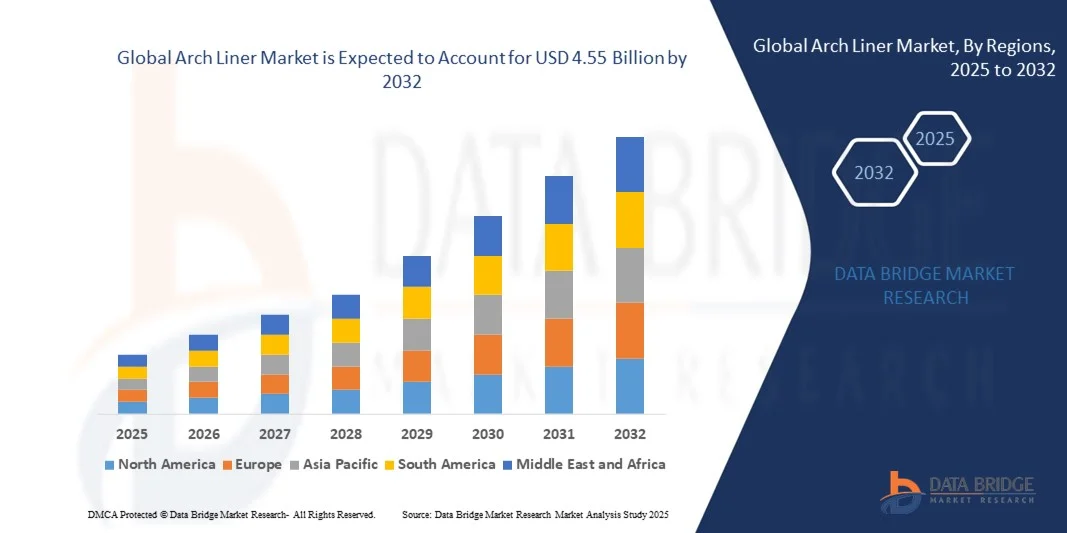
- The global arch liner market size was valued at USD 3.03 billion in 2024 and is projected to reach USD 4.55 billion by 2032, growing at a CAGR of 5.20% during the forecast period.
- Market expansion is being driven by the rising demand for advanced infrastructure solutions and the increasing focus on sustainable construction practices across industrial and municipal sectors.
- In addition, growing investments in rehabilitation of aging sewer and drainage systems, along with innovations in trenchless technology, are fueling the adoption of arch liners, significantly accelerating industry growth.
Global Arch Liner Market Analysis
- Arch liners, used primarily in trenchless rehabilitation of underground infrastructure like culverts, sewers, and storm drains, are becoming critical to modern civil engineering due to their structural integrity, durability, and minimal disruption to surface activities during installation.
- The surging demand for arch liners is driven by aging global infrastructure, increased environmental regulations, and the growing emphasis on cost-effective and sustainable rehabilitation solutions.
- Europe dominated the global arch liner market with the largest revenue share of 36% in 2024, attributed to significant infrastructure renewal projects, strong government funding, and early adoption of trenchless technologies, especially in the U.S. where municipalities are prioritizing long-term, low-maintenance solutions for aging water and sewer systems.
- Asia-Pacific is projected to be the fastest-growing region in the arch liner market during the forecast period, fueled by rapid urbanization, infrastructure modernization initiatives, and increasing investments in resilient public utility systems across developing nations.
- The continuous arch liners segment dominated the market with a revenue share of 40.2% in 2024, owing to their seamless design that reduces leakage risks and enhances hydraulic efficiency.
Report Scope and Global Arch Liner Market Segmentation
|
Attributes |
Arch Liner Key Market Insights |
|
Segments Covered |
|
|
Countries Covered |
North America
Europe
Asia-Pacific
Middle East and Africa
South America
|
|
Key Market Players |
|
|
Market Opportunities |
|
|
Value Added Data Infosets |
In addition to the insights on market scenarios such as market value, growth rate, segmentation, geographical coverage, and major players, the market reports curated by the Data Bridge Market Research also include in-depth expert analysis, pricing analysis, brand share analysis, consumer survey, demography analysis, supply chain analysis, value chain analysis, raw material/consumables overview, vendor selection criteria, PESTLE Analysis, Porter Analysis, and regulatory framework. |
Global Arch Liner Market Trends
Infrastructure Efficiency Through Advanced Liner Technologies
- A significant and accelerating trend in the global Arch Liner Market is the integration of advanced materials and precision-engineered designs aimed at enhancing structural performance, durability, and ease of installation in trenchless infrastructure rehabilitation. This evolution is improving the overall efficiency of pipeline restoration while minimizing surface disruption and project costs.
- For Instance, corrugated HDPE and GRP (Glass Reinforced Plastic) liners are increasingly preferred for their high resistance to corrosion, chemical exposure, and load-bearing capacity. These materials are ideal for culvert and stormwater pipe relining, offering extended service life with minimal maintenance.
- Innovations in liner manufacturing have led to the development of flexible arch-shaped liners that can be custom-fitted to deteriorating or misshaped pipelines. Technologies like UV-cured-in-place-pipe (UV CIPP) and slip-lining systems enable faster curing times and improved structural conformity, significantly reducing downtime and labor costs on-site.
- Moreover, the adoption of smart monitoring tools alongside liner installation is gaining traction. These tools utilize embedded sensors and inspection robots to ensure precise placement and monitor long-term liner performance, helping municipalities proactively manage infrastructure health.
- Companies such as Röchling SE & Co. KG and 3M are advancing liner technology with patented composite materials and surface treatments that enhance adhesion, abrasion resistance, and longevity under high flow or load conditions.
- The rising need for sustainable and cost-effective infrastructure renewal, especially in aging urban areas, is driving strong demand for advanced arch liner systems. This trend is reshaping how governments and private contractors approach pipeline rehabilitation—favoring non-disruptive, intelligent, and long-lasting solutions.
Global Arch Liner Market Dynamics
Driver
Growing Need Due to Aging Infrastructure and Sustainability Demands
-
The rising incidence of aging and deteriorating underground infrastructure—particularly stormwater systems, culverts, and sewer pipelines—is a key driver fueling the demand for arch liner solutions globally. Municipalities and industrial sectors are increasingly seeking cost-effective, durable, and non-invasive rehabilitation methods.
- For instance, in March 2024, Röchling SE & Co. KG introduced a new range of high-performance thermoplastic liners designed specifically for harsh chemical environments in wastewater management. This reflects a growing trend among key players to innovate products that meet evolving infrastructure demands.
- As governments and utility operators become more focused on sustainability, arch liners offer a low-impact solution that extends the life of existing systems without the need for full excavation or replacement. These methods significantly reduce environmental disruption, traffic impact, and project costs—making them attractive for both urban and rural applications.
- Additionally, regulatory bodies across North America and Europe are mandating improved resilience and sustainability in public infrastructure, pushing public and private sectors to adopt modern trenchless technologies such as slip-lining and cured-in-place pipe (CIPP) techniques using arch liners.
- The growing emphasis on climate adaptation—such as upgrading flood control systems and managing stormwater—has also boosted demand for arch liners that can reinforce older culverts and drainage systems quickly and efficiently. Their ability to conform to irregular shapes and deliver long-term performance under dynamic flow conditions makes them especially valuable in high-risk areas.
Restraint/Challenge
Challenges Related to High Installation Costs and Material Durability
- The high initial installation and maintenance costs associated with arch liners pose a significant challenge to broader market adoption, particularly in cost-sensitive projects and developing regions. The complex engineering and specialized materials required for effective arch liner solutions often lead to substantial upfront investments.
- For instance, projects in mining and tunneling sectors may face budget constraints that limit the adoption of advanced arch liner systems despite their long-term benefits in safety and durability.
- Additionally, concerns over the durability and wear resistance of certain materials, such as polymers and composites, in extreme environmental conditions can create hesitancy among potential buyers. These materials may degrade faster under high pressure or corrosive surroundings compared to traditional metal liners.
- Addressing these challenges through innovations in cost-effective manufacturing, enhanced material resilience, and offering customizable liner solutions tailored to specific applications is crucial for encouraging wider adoption. Companies like XYZ and ABC are focusing on R&D to improve material performance and reduce lifecycle costs.
- While advancements are underway to lower installation expenses and improve product longevity, the perceived high capital expenditure and concerns over material suitability can still restrain market growth.
- Overcoming these challenges through improved material technologies, strategic partnerships for cost reduction, and educating end-users on the long-term benefits of arch liners will be vital for sustained growth in the global arch liner market.
Global Arch Liner Market Scope
The arch liner market is segmented on the basis of material type, product type , application and end use
- By Material Type
On the basis of material type, global arch liner market is segmented into rubber, polymer, metal, and composite. The Polymer segment held the largest market revenue share of 36.8% in 2024, driven by its lightweight, corrosion-resistant, and flexible properties, making it ideal for sewer and drainage rehabilitation projects. Polymer-based liners such as HDPE and PP are favored for their cost-effectiveness and ease of installation, especially in trenchless applications. These materials also offer high resistance to chemical exposure, making them suitable for a wide range of environmental conditions.
The composite segment is anticipated to register the fastest growth rate from 2025 to 2032, as infrastructure projects increasingly demand high-performance materials that offer both strength and durability. Composite liners, which blend polymers with reinforcing materials like fiberglass, are gaining traction in projects where structural load-bearing and environmental resilience are critical. Their growing adoption in mining and industrial applications contributes significantly to this segment's rapid expansion.
- By Product Type
On the basis of product type, arch liner market is divided into continuous arch liners, segmented arch liners, and precast arch liners. The continuous arch liners segment dominated the market with a revenue share of 40.2% in 2024, owing to their seamless design that reduces leakage risks and enhances hydraulic efficiency. These liners are preferred for long-span culvert rehabilitation and sewer relining where consistent performance and minimal disruption are key. Their ability to conform to irregular pipe shapes further supports their dominance in large-scale municipal projects.
The segmented arch liners segment is expected to grow at the fastest CAGR from 2025 to 2032, driven by their ease of transport, modular assembly, and flexibility in installation across varied infrastructure conditions. These liners are especially suited for difficult-to-access or remote locations where continuous liners are less practical. Their adaptability and ability to fit non-standard structures are driving strong interest across construction and transportation sectors.
- By Application
On the basis of application, the arch liner market is segmented into mining, tunneling, construction, and transportation. The construction segment accounted for the largest revenue share of 38.4% in 2024, driven by increasing urban infrastructure rehabilitation, particularly in stormwater and sewer systems. Governments and private contractors are turning to trenchless technologies like arch liners to minimize surface disruption and reduce long-term maintenance costs.
The tunneling segment is projected to witness the fastest growth rate from 2025 to 2032, owing to the surge in underground infrastructure projects, including metro expansions, utility tunnels, and hydropower developments. Arch liners provide vital reinforcement and water ingress protection in tunnel environments, especially where existing infrastructure is aging or at risk. As global urbanization intensifies, tunneling applications are expected to play a central role in driving market demand for durable, easy-to-install arch liners.
- By End Use
By end use, the arch liner market is segmented into residential, commercial, and industrial. The industrial segment dominated the market in 2024 with a revenue share of 41.7%, supported by the widespread need for pipeline rehabilitation, chemical resistance, and structural reinforcement in heavy-duty applications such as oil & gas, chemical processing, and water treatment facilities. Industrial end users demand long-lasting, low-maintenance solutions, and arch liners fulfil these needs with precision and reliability.
The residential segment is projected to experience the fastest CAGR from 2025 to 2032, driven by growing municipal investments in residential drainage upgrades and increased awareness about water infrastructure safety. Suburban development and smart city initiatives are encouraging the integration of sustainable and low-disruption solutions such as trenchless arch liners for residential stormwater systems, especially in flood-prone or aging neighbourhood. Enhanced government support and subsidies are also supporting this trend.
Global Arch Liner Market Regional Analysis
- Europe dominated the global arch liner market with the largest revenue share of 36% in 2024, driven by extensive infrastructure development and rehabilitation projects across residential, commercial, and industrial sectors.
- The region's strong emphasis on upgrading aging water, sewer, and transportation systems, along with favorable government initiatives supporting trenchless technologies, is fueling high demand for arch liner solutions.
- High investment capacity, advanced construction technologies, and growing environmental regulations encouraging sustainable and cost-effective pipeline rehabilitation further bolster market growth. This combination establishes North America as a leading adopter of arch liner products for enhancing infrastructure durability and minimizing maintenance costs.
U.K. Arch Liner Market Insight
The U.K. arch liner market is expected to register a notable CAGR over the forecast period, fueled by national infrastructure upgrade programs and the emphasis on reducing surface disruptions during pipeline rehabilitation. The adoption of arch liners is gaining traction in water management and urban drainage projects, driven by sustainability goals and the need for long-lasting, corrosion-resistant solutions. Growing investments in transport infrastructure renewal and residential development projects also contribute to market growth. The U.K.’s favorable policies for trenchless technology and innovative construction methods further accelerate demand.
Germany Arch Liner Market Insight
Germany’s arch liner market is set to experience robust growth, driven by the country’s advanced engineering sector and commitment to infrastructure sustainability. The rising focus on retrofitting aging water and wastewater pipelines, combined with Germany’s leadership in environmentally conscious construction, supports increased demand for durable and efficient arch liner solutions. Integration of composite and polymer materials to enhance performance and lifespan aligns with local preferences for quality and eco-friendly technologies. Additionally, Germany’s strong industrial base and urban expansion projects continue to propel the market across residential, commercial, and industrial sectors.
U.S. Arch Liner Market Insight
The U.S. arch liner market accounted for the largest revenue share of 82% within North America in 2024, driven by extensive investments in infrastructure maintenance and rehabilitation projects. The growing focus on upgrading aging sewer and drainage systems using trenchless technologies like arch liners is a key growth driver. Increasing government funding for sustainable water management and stormwater control initiatives further propels market demand. Additionally, advancements in polymer and composite materials that improve durability and reduce installation time support the widespread adoption of arch liners across residential, commercial, and industrial sectors.
Asia-Pacific Arch Liner Market Insight
The Asia-Pacific arch liner market is poised to grow at the fastest CAGR of 23% from 2025 to 2032, driven by rapid urbanization, industrialization, and infrastructure development in countries such as China, India, Japan, and Australia. Governments in the region are heavily investing in upgrading aging urban water and sewage infrastructure, while expanding transportation networks also create significant demand for arch liners. The rise in large-scale construction projects and increasing awareness of sustainable trenchless rehabilitation technologies are accelerating market growth. Additionally, the presence of regional manufacturers and cost-effective solutions improve accessibility for a broad consumer base.
Japan Arch Liner Market Insight
Japan’s arch liner market is gaining traction due to the country’s focus on resilient infrastructure, disaster mitigation, and urban renewal programs. The aging water and sewer systems require innovative rehabilitation methods, with arch liners offering an efficient solution that minimizes disruption in densely populated areas. The demand is also driven by technological advancements in liner materials and the integration of smart monitoring systems for infrastructure health. Japan’s emphasis on environmental sustainability and infrastructure longevity is fostering steady adoption of arch liners in both residential and commercial projects.
China Arch Liner Market Insight
China led the Asia-Pacific arch liner market with the largest revenue share in 2024, fueled by rapid urbanization, extensive infrastructure expansion, and government initiatives toward smart city development. The country’s investment in upgrading municipal water and drainage systems and expanding transportation infrastructure is driving significant demand for durable, cost-effective arch liner solutions. The increasing prevalence of trenchless technologies and the strong presence of domestic manufacturers offering competitive products further boost market growth. China’s large-scale urban projects and rising environmental regulations continue to propel arch liner adoption across commercial, industrial, and residential applications.
Global Arch Liner Market Share
The arch liner industry is primarily led by well-established companies, including:
- Ball Corporation (U.S.)
- Crown Holdings Inc. (U.S.)
- Can-Pack S.A. (Poland)
- Silgan Holdings Incorporated (U.S.)
- Ardagh Group (Luxembourg)
- Tubex GmbH (Germany)
- Greif Incorporated (U.S.)
- Mauser Packaging Solutions (U.S.)
- DS Containers Inc. (U.S.)
- CCL Containers Inc. (U.S.)
- Röchling SE & Co. KG (Germany)
- 3M (United States)
- Borgers SE & Co. KGaA (Germany)
What are the Recent Developments in Global Arch Liner Market?
- In April 2023, Rehau Group, a global leader in polymer solutions, launched a strategic initiative in South Africa focused on improving underground infrastructure durability through its advanced arch liner technologies. This initiative emphasizes Rehau’s commitment to delivering sustainable, high-performance trenchless rehabilitation solutions tailored to the region’s unique environmental and structural challenges. Leveraging its global expertise and innovative product portfolio, Rehau aims to address local infrastructure needs while strengthening its foothold in the rapidly expanding global Global Arch Liner Market.
- In March 2023, TekFlow Technologies, a pioneer in trenchless rehabilitation, introduced its latest composite arch liner system designed specifically for mining and tunneling applications. Engineered for enhanced durability and ease of installation, this system offers superior corrosion resistance and mechanical strength, addressing the critical demands of harsh underground environments. This launch highlights TekFlow’s dedication to advancing infrastructure safety and longevity, reinforcing its position as a key innovator within the arch liner market.
- In March 2023, GEHR Plastics, a global provider of plastic piping systems, completed the deployment of a major urban tunneling project in Bengaluru, India, utilizing its cutting-edge arch liner solutions. This project aimed at modernizing the city’s water and sewage infrastructure, enhancing resilience, and minimizing disruption to urban life. GEHR’s involvement underscores the growing importance of arch liners in sustainable urban development and demonstrates the company’s expertise in delivering large-scale infrastructure upgrades.
- In February 2023, Sekisui Chemical Co., Ltd., a leading manufacturer of polymer materials, announced a strategic partnership with the European Tunnel Association to promote the adoption of eco-friendly and high-performance arch liner systems across the continent. This collaboration seeks to facilitate knowledge sharing and encourage the use of advanced composite liners in tunneling and infrastructure rehabilitation projects. The initiative highlights Sekisui’s commitment to innovation and environmental sustainability in the global arch liner market.
- In January 2023, Krah Pipes GmbH, a prominent supplier of precast arch liners and pipeline systems, unveiled its latest continuous arch liner product line at the International No-Dig Show 2023. Featuring enhanced flexibility and strength, these liners enable faster installation and improved lifespan for underground infrastructure. Krah Pipes’ new offering demonstrates the company’s focus on integrating advanced materials and engineering techniques to meet evolving market demands, offering clients reliable solutions for complex infrastructure challenges.

- Interactive Data Analysis Dashboard
- Company Analysis Dashboard for high growth potential opportunities
- Research Analyst Access for customization & queries
- Competitor Analysis with Interactive dashboard
- Latest News, Updates & Trend analysis
- Harness the Power of Benchmark Analysis for Comprehensive Competitor Tracking
Data collection and base year analysis are done using data collection modules with large sample sizes. The stage includes obtaining market information or related data through various sources and strategies. It includes examining and planning all the data acquired from the past in advance. It likewise envelops the examination of information inconsistencies seen across different information sources. The market data is analysed and estimated using market statistical and coherent models. Also, market share analysis and key trend analysis are the major success factors in the market report. To know more, please request an analyst call or drop down your inquiry.
The key research methodology used by DBMR research team is data triangulation which involves data mining, analysis of the impact of data variables on the market and primary (industry expert) validation. Data models include Vendor Positioning Grid, Market Time Line Analysis, Market Overview and Guide, Company Positioning Grid, Patent Analysis, Pricing Analysis, Company Market Share Analysis, Standards of Measurement, Global versus Regional and Vendor Share Analysis. To know more about the research methodology, drop in an inquiry to speak to our industry experts.
Data Bridge Market Research is a leader in advanced formative research. We take pride in servicing our existing and new customers with data and analysis that match and suits their goal. The report can be customized to include price trend analysis of target brands understanding the market for additional countries (ask for the list of countries), clinical trial results data, literature review, refurbished market and product base analysis. Market analysis of target competitors can be analyzed from technology-based analysis to market portfolio strategies. We can add as many competitors that you require data about in the format and data style you are looking for. Our team of analysts can also provide you data in crude raw excel files pivot tables (Fact book) or can assist you in creating presentations from the data sets available in the report.













