


Architectural Coatings Market Size
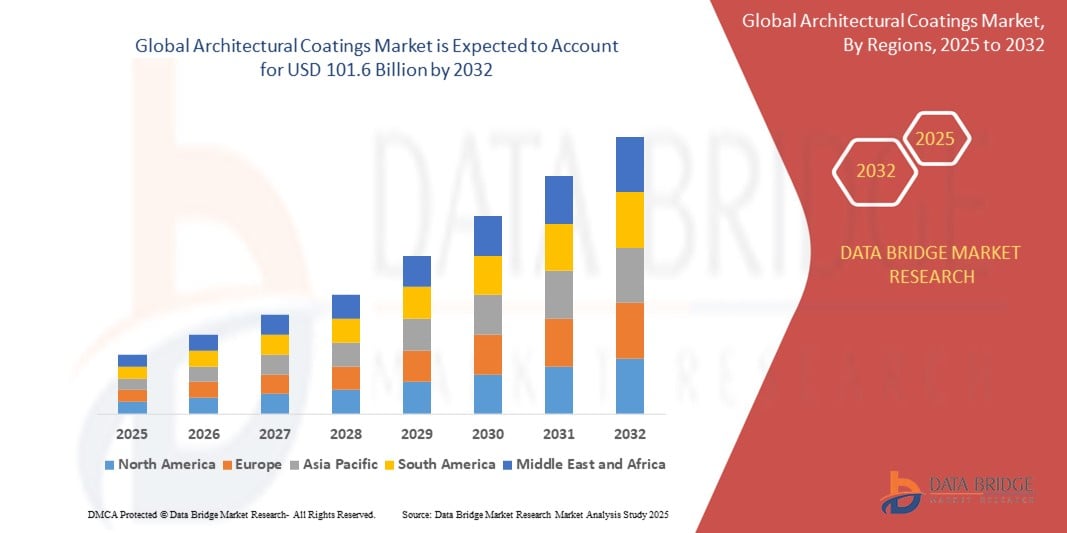
- The Global Architectural Coatings Market size was valued at USD 80.3 Billion in 2024 and is expected to reach USD 101.6 Billion by 2032, at a CAGR of4.2% during the forecast period
- This growth is driven by factors such as increase in demand from the construction industry
Architectural Coatings Market Analysis
- Architectural Coatings are protective and decorative layers applied to buildings and structures to enhance aesthetics, durability, and resistance to environmental factors such as moisture, UV rays, and chemicals. These coatings include paints, primers, sealers, and varnishes used for both interior and exterior surfaces
- The demand for Architectural Coatings is significantly driven by rapid urbanization, increasing construction activities in residential and commercial sectors, and rising consumer preference for aesthetically appealing and energy-efficient buildings
- Asia-Pacific is expected to dominate the Architectural Coatings market due to booming construction industries in countries like China, India, and Southeast Asia, rising population, and government initiatives promoting infrastructure development and smart cities
- North America is expected to be the fastest growing region in the Architectural Coatings market during the forecast period due to growing renovation and remodeling projects, rising demand for sustainable and low-VOC coatings, and technological advancements in coating formulations
- The water-borne segment is expected to dominate the market with a market share of 35.54% in 2025, due to growing environmental regulations, increased awareness of health and safety, and preference for low-emission, odorless, and easy-to-clean coating solutions.
Report Scope and Architectural Coatings Market Segmentation
|
Attributes |
Architectural Coatings Key Market Insights |
|
Segments Covered |
|
|
Countries Covered |
North America
Europe
Asia-Pacific
Middle East and Africa
South America
|
|
Key Market Players |
|
|
Market Opportunities |
|
|
Value Added Data Infosets |
In addition to the insights on market scenarios such as market value, growth rate, segmentation, geographical coverage, and major players, the market reports curated by the Data Bridge Market Research also include import export analysis, production capacity overview, production consumption analysis, price trend analysis, climate change scenario, supply chain analysis, value chain analysis, raw material/consumables overview, vendor selection criteria, PESTLE Analysis, Porter Analysis, and regulatory framework. |
Architectural Coatings Market Trends
“Sustainable Formulations and Smart Coating Technologies”
- One prominent trend in the Architectural Coatings market is the rising demand for eco-friendly and sustainable coatings, driven by stricter environmental regulations, increasing awareness of VOC emissions, and the global shift toward green building practices
- Manufacturers are innovating with water-based, low-VOC, and bio-based coatings that minimize environmental impact while maintaining durability, color retention, and resistance to weathering
- For instance, bio-based resins derived from soybeans or castor oil are being integrated into architectural coatings to reduce dependence on petrochemicals and align with LEED certification goals.
- The emergence of smart coatings—including self-cleaning, anti-microbial, and temperature-regulating paints—is gaining traction in residential and commercial construction. These coatings improve indoor air quality, reduce maintenance needs, and enhance energy efficiency, providing value-added benefits beyond traditional aesthetics
Architectural Coatings Market Dynamics
Driver
“Growing Demand for Sustainable and Energy-Efficient Building Materials”
- The increasing focus on sustainability and energy efficiency in construction is significantly driving the demand for architectural coatings in both residential and commercial sectors
- Building regulations are becoming more stringent, emphasizing the use of eco-friendly materials, which has led to a rise in demand for low-VOC and water-based architectural coatings. These coatings provide superior durability and aesthetic appeal while minimizing environmental impact
- Additionally, the demand for coatings with energy-saving properties, such as reflective and thermal insulating coatings, is rising to help reduce building energy consumption
For instance,
- The U.S. Green Building Council (USGBC) reported that more than 50% of new commercial buildings in the U.S. are being designed to meet LEED (Leadership in Energy and Environmental Design) standards, driving the adoption of sustainable coatings
- As a result, there is a growing need for architectural coatings that comply with environmental standards and contribute to green building certifications, which is boosting market growth globally.
Opportunity
“Advancements in Smart Coating Technologies and Anti-Microbial Solutions”
- One of the key opportunities in the architectural coatings market is the rise in smart coatings, which are used for self-cleaning, anti-microbial, and temperature-regulating applications
- These innovations offer enhanced functionality by combining traditional aesthetic appeal with the ability to improve building performance, reduce maintenance costs, and provide long-term durability
- Anti-microbial coatings are gaining traction due to their ability to prevent the growth of bacteria, mold, and mildew on surfaces, which is particularly important in healthcare, food processing, and high-traffic commercial buildings
For instance,
- In 2023, PPG Industries launched an anti-microbial architectural coating line designed to enhance building hygiene, particularly in environments like hospitals and schools.
- This growth in smart coatings presents significant opportunities for manufacturers to develop innovative products that address consumer concerns regarding building maintenance, safety, and environmental impact.
Restraint/Challenge
“Rising Raw Material Costs and Supply Chain Disruptions”
- The architectural coatings market faces challenges related to the rising prices of key raw materials such as resins, pigments, and solvents, which can increase production costs and affect the overall profitability of manufacturers
- The ongoing global supply chain disruptions, particularly in the aftermath of the COVID-19 pandemic, have further exacerbated these cost pressures and made it more difficult for manufacturers to maintain consistent pricing for consumers
- In addition, supply chain issues may result in delayed product deliveries, affecting construction timelines and project completions.
For instance,
- AkzoNobel reported in 2023 that the prices of key raw materials, including resins and pigments, had increased by nearly 10% due to supply shortages, impacting their overall margins
- These challenges could limit the affordability of advanced architectural coatings, especially for smaller construction projects or companies with tighter budgets, hindering broader market adoption
Architectural Coatings Market Scope
The market is segmented on the basis of resin type, technology, function and application.
|
Segmentation |
Sub-Segmentation |
|
By Resin Type |
|
|
By Technology |
|
|
By Function |
|
|
By Application |
|
In 2025, the residential is projected to dominate the market with a largest share in application segment
The residential segment is expected to dominate the Architectural Coatings market with the largest share of 56.22% in 2025 due to the increasing focus on home improvement and renovation, driven by rising disposable incomes, consumer preference for modern aesthetics, and the desire to enhance property value, is significantly contributing to the demand for architectural coatings in residential applications.
The waterborne is expected to account for the largest share during the forecast period in application market
In 2025, the waterborne segment is expected to dominate the market with the largest market share of 51.31% due to their low volatile organic compound (VOC) content, making them more environmentally friendly compared to solvent-based alternatives.
Architectural Coatings Market Regional Analysis
“North America Holds the Largest Share in the Architectural Coatings Market”
- North America dominates the Architectural Coatings market with a significant market share of 38.15%. This dominance is attributed to the region's highly developed construction industry, strong demand for sustainable and energy-efficient building materials, and increasing focus on green building certifications
- The U.S. holds the largest share in this region due to the robust real estate sector, growing demand for energy-efficient coatings, and increasing investments in infrastructure development and renovation projects
- Canada is also contributing significantly to regional growth, driven by government initiatives encouraging the use of low-VOC and eco-friendly coatings in residential and commercial buildings
- The adoption of smart coatings and anti-microbial solutions is further accelerating the demand for architectural coatings in North America. The presence of major manufacturers such as PPG Industries, Sherwin-Williams, and AkzoNobel supports regional market growth, driving innovation in coating technologies.
“Asia-Pacific is Projected to Register the Highest CAGR in the Architectural Coatings Market”
- The Asia-Pacific region is expected to register the highest CAGR in the Architectural Coatings market, driven by rapid urbanization, increased demand for energy-efficient buildings, and growing construction activities in developing countries
- China and India are witnessing strong market growth due to the boom in residential and commercial construction projects, as well as increasing government focus on sustainable building practices. The demand for coatings with thermal insulation and reflective properties is rising in these countries as they aim to reduce energy consumption in buildings
- Japan and South Korea are leading the charge in terms of innovation, with high consumer interest in eco-friendly and energy-saving coatings. These markets are seeing increased adoption of smart coatings with self-cleaning, anti-microbial, and temperature-regulating capabilities
- Southeast Asia is also emerging as a key growth area due to increasing urbanization, rising disposable incomes, and a shift toward modern building technologies, further driving the demand for high-performance architectural coatings in countries like Indonesia, Vietnam, and Thailand.
Architectural Coatings Market Share
The market competitive landscape provides details by competitor. Details included are company overview, company financials, revenue generated, market potential, investment in research and development, new market initiatives, global presence, production sites and facilities, production capacities, company strengths and weaknesses, product launch, product width and breadth, application dominance. The above data points provided are only related to the companies' focus related to market.
The Major Market Leaders Operating in the Market Are:
- Sherwin-Williams Company (US)
- PPG Industries, Inc (US)
- AkzoNobel N.V. (The Netherlands)
- BASF Coating GMBH (Germany)
- Jotun A/s (Norway)
- Asian Paints Limited (India)
- Kansai Paint Co., Ltd (Japan)
- Nippon Paint Holding Co., Ltd (Japan)
- RPM International, Inc (US)
- Masco Corporation (US)
Latest Developments in Global Architectural Coatings Market
- In January 2025, AkzoNobel launched a new line of sustainable architectural coatings that feature low-VOC and energy-efficient properties. This product line is designed to meet increasing demand for eco-friendly solutions in both commercial and residential construction, addressing the growing consumer and regulatory push for greener building materials.
- In December 2024, Sherwin-Williams introduced a smart coating technology designed for exterior walls that not only improves the aesthetic appearance of buildings but also offers self-cleaning properties. The coating uses nano-technology to break down dirt and pollutants, reducing maintenance costs and improving the longevity of the structure.
- In November 2024, PPG Industries launched its Ultraclean Exterior Paint, which offers advanced stain resistance and mold prevention. This innovative coating is targeted at regions with high humidity levels, making it ideal for use in coastal areas. The product is also designed to be low-VOC and provides long-lasting color retention, contributing to the growing demand for sustainable solutions in the construction industry.
- In October 2024, BASF introduced a new biodegradable architectural coating for interior surfaces. This coating offers a long-lasting finish while being completely free of harmful chemicals. BASF’s new product aligns with consumer trends toward more sustainable and health-conscious building materials and aims to tap into the increasing demand for non-toxic coatings.
- In September 2024, Jotun Group launched a new line of high-performance coatings for use in extreme climates. These coatings are designed to provide thermal insulation and anti-corrosion properties for buildings located in arctic and desert regions, offering energy savings and reducing maintenance needs.

- Interactive Data Analysis Dashboard
- Company Analysis Dashboard for high growth potential opportunities
- Research Analyst Access for customization & queries
- Competitor Analysis with Interactive dashboard
- Latest News, Updates & Trend analysis
- Harness the Power of Benchmark Analysis for Comprehensive Competitor Tracking
Global Architectural Coatings Market, Supply Chain Analysis and Ecosystem Framework
To support market growth and help clients navigate the impact of geopolitical shifts, DBMR has integrated in-depth supply chain analysis into its Global Architectural Coatings Market research reports. This addition empowers clients to respond effectively to global changes affecting their industries. The supply chain analysis section includes detailed insights such as Global Architectural Coatings Market consumption and production by country, price trend analysis, the impact of tariffs and geopolitical developments, and import and export trends by country and HSN code. It also highlights major suppliers with data on production capacity and company profiles, as well as key importers and exporters. In addition to research, DBMR offers specialized supply chain consulting services backed by over a decade of experience, providing solutions like supplier discovery, supplier risk assessment, price trend analysis, impact evaluation of inflation and trade route changes, and comprehensive market trend analysis.
Data collection and base year analysis are done using data collection modules with large sample sizes. The stage includes obtaining market information or related data through various sources and strategies. It includes examining and planning all the data acquired from the past in advance. It likewise envelops the examination of information inconsistencies seen across different information sources. The market data is analysed and estimated using market statistical and coherent models. Also, market share analysis and key trend analysis are the major success factors in the market report. To know more, please request an analyst call or drop down your inquiry.
The key research methodology used by DBMR research team is data triangulation which involves data mining, analysis of the impact of data variables on the market and primary (industry expert) validation. Data models include Vendor Positioning Grid, Market Time Line Analysis, Market Overview and Guide, Company Positioning Grid, Patent Analysis, Pricing Analysis, Company Market Share Analysis, Standards of Measurement, Global versus Regional and Vendor Share Analysis. To know more about the research methodology, drop in an inquiry to speak to our industry experts.
Data Bridge Market Research is a leader in advanced formative research. We take pride in servicing our existing and new customers with data and analysis that match and suits their goal. The report can be customized to include price trend analysis of target brands understanding the market for additional countries (ask for the list of countries), clinical trial results data, literature review, refurbished market and product base analysis. Market analysis of target competitors can be analyzed from technology-based analysis to market portfolio strategies. We can add as many competitors that you require data about in the format and data style you are looking for. Our team of analysts can also provide you data in crude raw excel files pivot tables (Fact book) or can assist you in creating presentations from the data sets available in the report.













