


Architectural Lighting Market Overview
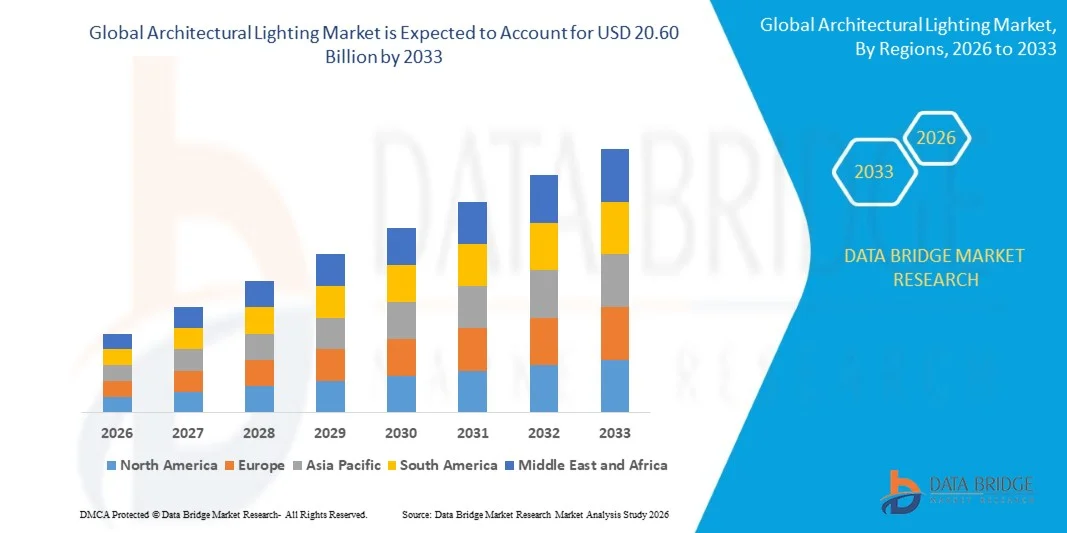
As per Data Bridge Market Research Analysis, the Architectural Lighting Market was valued at USD 11.90 billion in 2025 and is projected to reach USD 20.60 billion by 2033, growing at a CAGR of 7.10% from 2026 to 2033. The market is experiencing robust growth driven by rising urbanization, increasing infrastructure development, and growing demand for energy-efficient and aesthetically appealing lighting solutions across residential, commercial, and industrial sectors. Architectural lighting involves the design, manufacturing, and implementation of lighting systems that enhance both the aesthetic and functional aspects of buildings and spaces. The growing emphasis on sustainable building practices, combined with rapid advancements in LED and smart lighting technologies, is accelerating market adoption globally. Furthermore, the increasing integration of Internet of Things (IoT) capabilities, building automation systems, and human-centric lighting designs is transforming the architectural lighting landscape, creating new opportunities for innovation and value creation across the value chain.
Key Market Trends & Insights
- Asia-Pacific dominated the Architectural Lighting Market with the largest revenue share in 2025, supported by rapid urbanization, expanding infrastructure projects, and increasing construction activities across emerging economies.
- North America is expected to be the fastest-growing region, driven by high levels of renovation work, stringent energy efficiency regulations, and growing adoption of smart lighting technologies in commercial and residential buildings.
- The LED Lighting segment led the product type category with a significant market share in 2025, driven by energy efficiency, long lifespan, design versatility, and widespread adoption across indoor and outdoor applications.
- Smart Lighting emerged as the fastest-growing product type segment, reflecting increasing demand for IoT-integrated, connected lighting systems that deliver 30–50% energy savings and enable remote monitoring and control.
- The Commercial end-user segment dominated the market, supported by extensive adoption of architectural lighting in offices, retail spaces, hospitality venues, and institutional buildings.
- Growing focus on human-centric lighting and circadian rhythm solutions is driving demand for tunable and color-changing lighting systems, with adoption growing at over 12% annually in commercial and healthcare spaces.
- Retrofit installation accounted for a significant market share, driven by increasing renovation activities and the replacement of traditional lighting systems with energy-efficient LED and smart lighting solutions.
- Investments in smart cities, urban infrastructure, and facade lighting are supporting strong growth in outdoor architectural lighting demand.
Market Size & Forecast
- Global Market Value (2025): USD 11.90 Billion
- Expected Market Value (2033): USD 20.60 Billion
- Forecast CAGR (2026–2033): 7.10%
- Leading Region in 2025: Asia-Pacific
- Fastest Growing Region: North America
Report Scope and Architectural Lighting Market Segmentation
|
Attributes |
Architectural Lighting Key Market Insights |
|
Segments Covered |
|
|
Countries Covered |
North America · U.S. · Canada · Mexico Europe · Germany · France · U.K. · Netherlands · Switzerland · Belgium · Russia · Italy · Spain · Turkey · Rest of Europe Asia-Pacific · China · Japan · India · South Korea · Singapore · Malaysia · Australia · Thailand · Indonesia · Philippines · Rest of Asia-Pacific Middle East and Africa · Saudi Arabia · U.A.E. · South Africa · Egypt · Israel · Rest of Middle East and Africa South America · Brazil · Argentina · Rest of South America |
|
Key Market Players |
· Signify Holdings B.V. (Netherlands) · OSRAM GmbH (Germany) · Acuity Brands Lighting Inc. (USA) · Cree Lighting (USA) · Eaton Corporation (Ireland) · Zumtobel Group (Austria) · Lutron Electronics (USA) · Hubbell Incorporated (USA) · ERCO GmbH (Germany) · Siteco Beleuchtungstechnik GmbH (Germany) · Louis Poulsen A/S (Denmark) · Reggiani Illuminazione SpA (Italy) · Targetti Sankey SpA (Italy) · LEDVANCE GmbH (Germany) · Samsung LED (South Korea) · Seoul Semiconductor (South Korea) · GE Lighting (USA) · OPPLE Lighting (China) · NVC Lighting Technology Corporation (China) · MLS Co. Ltd. (China) |
|
Market Opportunities |
· Rising demand for human-centric lighting solutions that mimic natural light patterns to enhance occupant well-being and productivity · Integration of AI and IoT-enabled smart lighting systems with building automation platforms · Growing adoption of sustainable and energy-efficient lighting solutions driven by green building certification programs such as LEED and BREEAM · Expansion of smart city initiatives and intelligent infrastructure projects across emerging economies |
|
Value Added Data Infosets |
In addition to the insights on market scenarios such as market value, growth rate, segmentation, geographical coverage, and major players, the market reports curated by the Data Bridge Market Research also include in-depth expert analysis, geographically represented company-wise production and capacity, network layouts of distributors and partners, detailed and updated price trend analysis and deficit analysis of supply chain and demand. |
Architectural Lighting Market Trends
Trend: Accelerating Transition to LED and Smart Lighting Technologies
The architectural lighting industry is witnessing a significant transformation driven by the rapid adoption of LED technology and smart lighting systems. LEDs now represent over 65% of new installations across indoor and outdoor applications, driven by their energy efficiency, long lifespan, and design versatility. Smart lighting integrated with IoT and building management systems is gaining substantial traction, delivering 30–50% energy savings while enabling remote monitoring, automated controls, and predictive maintenance. The integration of wireless communication technologies, occupancy sensors, and daylight harvesting systems is further enhancing system scalability and operational efficiency. This transition from traditional lighting to intelligent, connected solutions is reshaping product differentiation strategies, with manufacturers increasingly focusing on systems integration, software interoperability, and lifecycle service offerings rather than purely on luminaire efficacy.
Architectural Lighting Market Dynamics
Key Market Driver: Rising Urbanization and Infrastructure Development
The expansion of the architectural lighting market is primarily driven by increasing urbanization and infrastructure development worldwide. Global urban construction spending surpassed USD 4.5 trillion in 2024, with architectural lighting accounting for a growing share of interior and exterior building systems. The construction of commercial complexes, residential buildings, public infrastructure, and mixed-use developments is driving demand for integrated lighting solutions that combine aesthetics with functionality. Governments and commercial developers are increasingly incorporating modern lighting schemes into their urban planning, reinforcing the industry's strong growth trajectory. Additionally, rising construction activities, with public construction spending in the U.S. reaching an estimated $515.8 billion in July 2025, are fueling demand for architectural lighting solutions across residential, commercial, and civil engineering sectors.
Key Restraint/Challenge: High Initial Investment and Design Complexity
A significant challenge facing the architectural lighting market is the high initial investment required for advanced lighting systems. High-end architectural lighting solutions frequently require specialized expertise, advanced infrastructure, and customized design, leading to higher installation and maintenance costs. Smart lighting systems, in particular, demand integration with building automation platforms, software licensing, firmware updates, and cybersecurity considerations alongside traditional electrical specifications. These financial and technical barriers may limit adoption, especially among small and medium-sized projects and in price-sensitive markets. Furthermore, rapid technological advancements necessitate continuous innovation to stay competitive, adding to the complexity and cost burden for manufacturers and system integrators.
Key Market Opportunity: Human-Centric Lighting and AI Integration
The rising demand for human-centric lighting (HCL) presents a significant growth opportunity in the architectural lighting market. Growing awareness of lighting's impact on health, performance, and well-being is driving adoption across offices, healthcare facilities, and educational institutions. AI-driven lighting solutions that adjust brightness, color temperature, and energy consumption based on occupancy and environmental conditions are enabling adaptive and automated systems. Automated lighting controls, occupancy sensors, and daylight integration enhance both energy efficiency and user comfort. As smart building ecosystems expand, AI-powered lighting systems are expected to drive innovation and value creation across the market. Additionally, the integration of IoT-enabled monitoring and predictive maintenance capabilities presents new opportunities for value-added services and recurring revenue models.
Architectural Lighting Market Scope
The architectural lighting market is segmented on the basis of product type, technology, installation type, application, and end user.
By Product Type:
On the basis of product type, the Architectural Lighting Market is segmented into LED lighting, fluorescent lighting, incandescent lighting, halogen lighting, smart lighting and others. The LED Lighting segment dominated the market in 2025, owing to energy efficiency, long lifespan, design versatility, and widespread adoption across indoor and outdoor applications. LEDs represent over 65% of new installations, driven by declining costs and increasing performance capabilities. The Smart Lighting segment is projected to register the fastest growth from 2026 to 2033, driven by increasing demand for IoT-integrated, connected lighting systems that deliver significant energy savings and enable remote monitoring and control. Smart lighting systems incorporate wireless communication, occupancy sensors, daylight harvesting, and automated controls to optimize energy consumption and enhance user experience.
By Technology:
On the basis of technology, the Architectural Lighting Market is segmented into wired and wireless. Wireless technology is gaining significant traction due to its flexibility, ease of installation, and scalability in retrofitting applications. Wired systems continue to dominate in new construction projects where infrastructure can be planned and integrated from the design stage. The growing adoption of IoT and wireless communication technologies is enhancing system scalability and enabling seamless integration with building automation platforms. Wireless lighting controls eliminate the need for complex cabling, reducing installation costs and enabling flexible reconfiguration of lighting layouts.
By Installation Type:
On the basis of installation type, the Architectural Lighting Market is segmented into new installation and retrofit installation. Retrofit installation holds a significant market share, driven by increasing renovation activities and the replacement of traditional lighting systems with energy-efficient LED and smart lighting solutions. New installation continues to grow steadily, supported by rising construction activities and new building projects worldwide. Retrofit projects are particularly attractive for building owners seeking to reduce energy consumption and operating costs without undertaking major construction work.
By Application:
On the basis of application, the Architectural Lighting Market is segmented into indoor lighting, outdoor lighting, architectural lighting, decorative lighting and others. Indoor lighting dominates the market, driven by extensive applications in residential, commercial, and institutional buildings. Outdoor lighting is experiencing strong growth, supported by investments in smart cities, urban infrastructure, and facade lighting projects. Decorative lighting is gaining traction in retail, hospitality, and premium residential spaces, with around 40% of premium retail spaces adopting customized lighting solutions to enhance customer experience and brand identity.
By End User:
On the basis of end user, the Architectural Lighting Market is segmented into residential, commercial, industrial, institutional, hospitality and others. The Commercial segment dominates the market, driven by extensive adoption of architectural lighting in offices, retail spaces, hospitality venues, and institutional buildings. The Residential segment is gaining traction, supported by growing awareness of energy efficiency, smart home technologies, and aesthetic lighting designs. The Institutional and Hospitality segments represent significant growth areas, driven by increasing focus on occupant well-being and experiential lighting. Healthcare facilities, educational institutions, and hotels are increasingly adopting human-centric and smart lighting solutions to enhance occupant comfort and operational efficiency.
Architectural Lighting Market Regional Analysis
Asia-Pacific Architectural Lighting Market Insight
Asia-Pacific dominated the architectural lighting market and accounted for the largest revenue share in 2025, supported by rapid urbanization, expanding infrastructure projects, and increasing construction activities across emerging economies. The region benefits from the presence of major manufacturing hubs, growing commercial and residential construction, and rising government investments in smart city initiatives. Countries such as China, India, Japan, and Southeast Asian nations are witnessing significant growth in building and infrastructure development, driving demand for advanced architectural lighting solutions. Continuous investments in urban development, along with increasing focus on energy efficiency and sustainable building practices, reinforce Asia-Pacific's leadership position in the global market.
Europe Architectural Lighting Market Insight
Europe represents a mature and technologically advanced market for architectural lighting, supported by strong regulatory frameworks governing energy efficiency, stringent building codes, and high adoption of sustainable lighting technologies. The region benefits from the presence of leading lighting manufacturers, established design and architectural firms, and a strong focus on innovation and quality. Continuous investments in renovation and retrofitting projects, along with growing demand for smart and human-centric lighting solutions, are driving market growth across Western and Eastern European countries. The European Union's energy efficiency directives and green building regulations are further accelerating the adoption of sustainable lighting solutions.
North America Architectural Lighting Market Insight
North America is expected to be the fastest-growing region in the architectural lighting market, driven by high levels of renovation work, stringent energy efficiency regulations, and growing adoption of smart lighting technologies in commercial and residential buildings. The U.S. market is poised for substantial expansion, fueled by the country's thriving construction industry, increasing investments in infrastructure modernization, and growing demand for high-end lighting solutions in commercial spaces, retail environments, and residential constructions. The integration of IoT-enabled smart lighting systems and growing emphasis on energy savings are further accelerating market growth in the region.
Architectural Lighting Market Share
The Architectural Lighting industry is primarily led by well-established companies, including:
- Signify Holdings B.V. (Netherlands)
- OSRAM GmbH (Germany)
- Acuity Brands Lighting Inc. (USA)
- Cree Lighting (USA)
- Eaton Corporation (Ireland)
- Zumtobel Group (Austria)
- Lutron Electronics (USA)
- Hubbell Incorporated (USA)
- ERCO GmbH (Germany)
- Siteco Beleuchtungstechnik GmbH (Germany)
- Louis Poulsen A/S (Denmark)
- Reggiani Illuminazione SpA (Italy)
- Targetti Sankey SpA (Italy)
- LEDVANCE GmbH (Germany)
- Samsung LED (South Korea)
- Seoul Semiconductor (South Korea)
- GE Lighting (USA)
- OPPLE Lighting (China)
- NVC Lighting Technology Corporation (China)
- MLS Co. Ltd. (China)
Latest Developments in Architectural Lighting Market
- In March 2026, Signify Holdings B.V. announced the acquisition of a leading smart lighting control platform to strengthen its connected lighting portfolio for commercial and residential applications. This strategic move enables Signify to offer comprehensive lighting solutions with advanced energy management and automation capabilities, reinforcing its leadership position in the Architectural Lighting Market.
- In November 2025, Acuity Brands Lighting Inc. launched a new line of sustainable architectural lighting fixtures manufactured using recycled materials and designed for circular economy principles. The new product line incorporates advanced LED technology and wireless controls, targeting LEED-certified commercial buildings and sustainable construction projects.
- In September 2025, OSRAM GmbH expanded its human-centric lighting portfolio with the introduction of tunable white solutions specifically designed for healthcare and educational facilities. These systems support circadian rhythm alignment and occupant well-being, enabling dynamic adjustment of light color and intensity throughout the day to enhance recovery, focus, and overall comfort.
- In June 2025, Zumtobel Group entered into a strategic partnership with a leading building automation provider to develop integrated lighting and building management solutions for smart office buildings. The partnership aims to deliver seamless integration of lighting controls with HVAC, security, and other building systems, enabling centralized management and optimization of building performance.
- In March 2025, Lutron Electronics introduced a new wireless lighting control system featuring advanced sensing and AI-driven automation capabilities. The system integrates occupancy sensors, daylight harvesting, and predictive analytics to optimize energy consumption, reduce operational costs, and enhance occupant comfort in commercial spaces.
- In January 2025, LEDVANCE GmbH announced the expansion of its smart lighting product portfolio with the launch of new connected luminaires designed for residential and small commercial applications. The new products incorporate voice control integration, mobile app connectivity, and energy monitoring features, making smart lighting more accessible to a wider range of consumers.
- In October 2024, GE Lighting partnered with a leading IoT platform provider to develop integrated smart building solutions combining lighting controls with energy management and facility monitoring capabilities. The collaboration enables building owners to achieve significant energy savings while improving operational efficiency and occupant satisfaction.

- Interactive Data Analysis Dashboard
- Company Analysis Dashboard for high growth potential opportunities
- Research Analyst Access for customization & queries
- Competitor Analysis with Interactive dashboard
- Latest News, Updates & Trend analysis
- Harness the Power of Benchmark Analysis for Comprehensive Competitor Tracking
Global Architectural Lighting Market, Supply Chain Analysis and Ecosystem Framework
To support market growth and help clients navigate the impact of geopolitical shifts, DBMR has integrated in-depth supply chain analysis into its Global Architectural Lighting Market research reports. This addition empowers clients to respond effectively to global changes affecting their industries. The supply chain analysis section includes detailed insights such as Global Architectural Lighting Market consumption and production by country, price trend analysis, the impact of tariffs and geopolitical developments, and import and export trends by country and HSN code. It also highlights major suppliers with data on production capacity and company profiles, as well as key importers and exporters. In addition to research, DBMR offers specialized supply chain consulting services backed by over a decade of experience, providing solutions like supplier discovery, supplier risk assessment, price trend analysis, impact evaluation of inflation and trade route changes, and comprehensive market trend analysis.
Data collection and base year analysis are done using data collection modules with large sample sizes. The stage includes obtaining market information or related data through various sources and strategies. It includes examining and planning all the data acquired from the past in advance. It likewise envelops the examination of information inconsistencies seen across different information sources. The market data is analysed and estimated using market statistical and coherent models. Also, market share analysis and key trend analysis are the major success factors in the market report. To know more, please request an analyst call or drop down your inquiry.
The key research methodology used by DBMR research team is data triangulation which involves data mining, analysis of the impact of data variables on the market and primary (industry expert) validation. Data models include Vendor Positioning Grid, Market Time Line Analysis, Market Overview and Guide, Company Positioning Grid, Patent Analysis, Pricing Analysis, Company Market Share Analysis, Standards of Measurement, Global versus Regional and Vendor Share Analysis. To know more about the research methodology, drop in an inquiry to speak to our industry experts.
Data Bridge Market Research is a leader in advanced formative research. We take pride in servicing our existing and new customers with data and analysis that match and suits their goal. The report can be customized to include price trend analysis of target brands understanding the market for additional countries (ask for the list of countries), clinical trial results data, literature review, refurbished market and product base analysis. Market analysis of target competitors can be analyzed from technology-based analysis to market portfolio strategies. We can add as many competitors that you require data about in the format and data style you are looking for. Our team of analysts can also provide you data in crude raw excel files pivot tables (Fact book) or can assist you in creating presentations from the data sets available in the report.













