


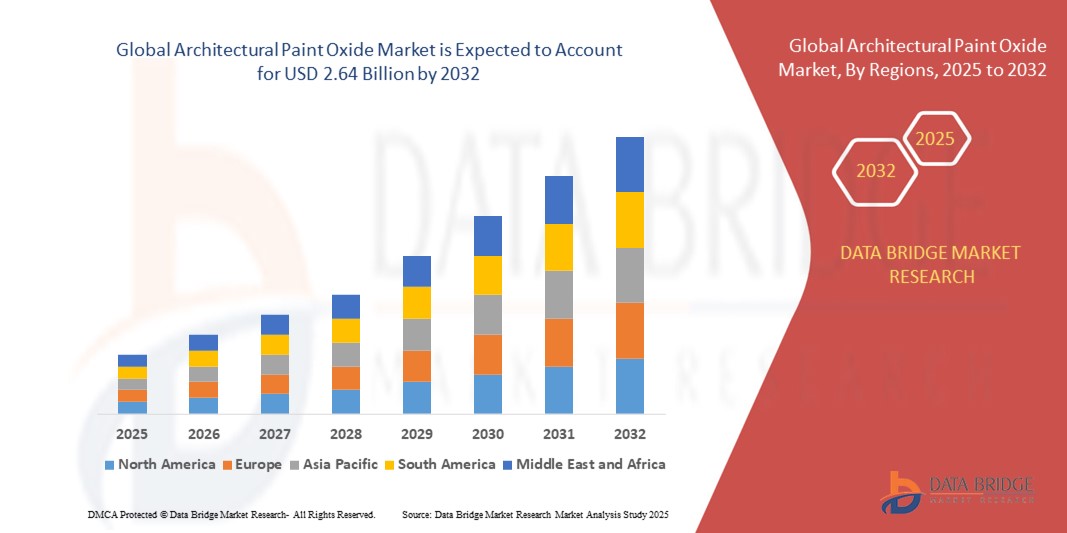
Architectural Paint Oxide Market Size
- The global architectural paint oxide market size was valued at USD 1.87 billion in 2024 and is expected to reach USD 2.64 billion by 2032, at a CAGR of 4.40% during the forecast period
- The market growth is largely fueled by the increasing demand for eco-friendly and durable paints, rising construction and renovation activities worldwide, and the growing preference for high-performance coatings that offer enhanced weather resistance and aesthetic appeal
- In addition, the expanding DIY home improvement trend and increasing consumer awareness about the benefits of protective and decorative coatings are further driving market demand
Architectural Paint Oxide Market Analysis
- The rising urbanization and infrastructure development in emerging economies are driving the adoption of architectural paint oxides in both residential and commercial projects.
- Advances in pigment technology, including the development of nano-sized oxide particles, are improving paint quality, durability, and color retention, thereby boosting market growth
- Asia-Pacific dominated the architectural paint oxide market with the largest revenue share of 42.3% in 2024, driven by rapid urbanization, expanding infrastructure projects, and increasing government initiatives promoting sustainable and eco-friendly building materials
- North America region is expected to witness the highest growth rate in the global architectural paint oxide market, driven by increasing construction activities, rising consumer awareness of sustainable products, and government incentives for green building certifications
- The acrylic segment dominated the market with the largest revenue share in 2024, driven by its excellent durability, weather resistance, and versatility across various surfaces. Acrylic paints are widely preferred for both interior and exterior applications due to their quick drying time and environmental friendliness. The growing demand for water-based acrylic paints in sustainable construction is further boosting this segment’s growth
Report Scope and Architectural Paint Oxide Market Segmentation
|
Attributes |
Architectural Paint Oxide Key Market Insights |
|
Segments Covered |
|
|
Countries Covered |
North America
Europe
Asia-Pacific
Middle East and Africa
South America
|
|
Key Market Players |
|
|
Market Opportunities |
• Growing Demand for Sustainable And Eco-Friendly Paint Solutions |
|
Value Added Data Infosets |
In addition to the insights on market scenarios such as market value, growth rate, segmentation, geographical coverage, and major players, the market reports curated by the Data Bridge Market Research also include import export analysis, production capacity overview, production consumption analysis, price trend analysis, climate change scenario, supply chain analysis, value chain analysis, raw material/consumables overview, vendor selection criteria, PESTLE Analysis, Porter Analysis, and regulatory framework. |
Architectural Paint Oxide Market Trends
Advancements in Eco-Friendly and Durable Pigments
- The rising focus on sustainability is driving innovation in architectural paint oxides, with manufacturers developing eco-friendly pigments that offer enhanced durability and weather resistance. These advancements help paints maintain color vibrancy and protective qualities for longer periods, reducing maintenance needs
- Increasing demand for low-VOC and non-toxic paint formulations is pushing the adoption of natural and synthetic oxide pigments that meet environmental regulations without compromising performance. This trend supports healthier indoor air quality and greener building certifications
- The growing popularity of decorative and specialty coatings with unique textures and finishes is fueling the use of innovative oxide blends, enabling architects and designers to create visually appealing and functional surfaces
- For instance, in 2023, several European architectural projects incorporated new iron oxide pigments that improved UV resistance and reduced fading, enhancing the longevity of exterior paints while supporting sustainable building practices
- While these innovations are accelerating market growth, success depends on continued R&D, regulatory compliance, and educating end-users about the benefits of advanced oxide pigments. Manufacturers must also focus on regional customization to cater to diverse climate and aesthetic requirements
Architectural Paint Oxide Market Dynamics
Driver
Increasing Construction Activities and Demand for Sustainable Coatings
• Rapid urbanization and expanding infrastructure projects globally are driving demand for architectural paints with durable and environmentally friendly oxide pigments. The growing construction of residential, commercial, and industrial buildings is creating continuous demand for high-performance coatings that can withstand harsh weather conditions and reduce maintenance costs
• Growing consumer awareness regarding indoor air quality and environmental impact is encouraging the shift toward low-VOC and non-toxic paint formulations, increasing the adoption of oxide pigments that meet these standards. Consumers are prioritizing healthier living environments, which in turn influences manufacturers to innovate and supply greener paint options with improved safety profiles
• Government regulations promoting green building certifications and sustainable construction practices are accelerating investments in advanced architectural paint oxides. These regulations encourage builders and developers to adopt materials that reduce environmental footprints, enhancing market opportunities for sustainable pigment solutions and driving competition among manufacturers
• For instance, in 2022, North America introduced stricter emission guidelines for construction materials, prompting manufacturers to reformulate paints with safer oxide pigments, which in turn spurred market demand for compliant products. This led to accelerated product innovation cycles and increased R&D spending aimed at meeting evolving regulatory requirements
• While demand is growing, challenges such as raw material price fluctuations and the need for innovation to meet evolving environmental standards persist. Market players must balance cost-effectiveness with regulatory compliance to maintain competitiveness and meet customer expectations
Restraint/Challenge
Raw Material Price Volatility and Regulatory Compliance Complexity
• The architectural paint oxide market faces challenges due to the fluctuating prices of raw materials such as iron and titanium oxides, which can impact production costs and pricing strategies for manufacturers. These price changes often result from geopolitical tensions, supply shortages, and increased demand from other industries, creating uncertainty in procurement and budgeting
• Strict and varying environmental regulations across regions increase the complexity and cost of product development, as manufacturers must ensure compliance without sacrificing product performance. Navigating diverse regulatory frameworks requires substantial investments in testing, certification, and reformulation efforts to satisfy both domestic and international standards
• Limited availability of high-quality natural oxide pigments and dependence on synthetic alternatives can affect supply chain stability and market growth. Synthetic pigments often require complex manufacturing processes and raw materials that may face supply constraints, which can lead to production delays and increased costs
• For instance, in 2023, supply chain disruptions in Asia caused delays and price hikes for key pigment raw materials, affecting production schedules and market pricing. These disruptions underscored the need for diversified sourcing strategies and greater supply chain resilience within the industry
• Addressing these challenges requires innovation in sourcing, formulation, and production efficiency, alongside active collaboration with regulatory bodies to streamline compliance. Manufacturers are investing in sustainable raw material alternatives and advanced pigment technologies to reduce reliance on volatile resources and meet stricter environmental demands
Architectural Paint Oxide Market Scope
The market is segmented on the basis of product, type, oxide type, application, and end-use.
- By Product
On the basis of product, the architectural paint oxide market is segmented into polyurethane, acrylic, epoxy, polyester, and alkyd. The acrylic segment dominated the market with the largest revenue share in 2024, driven by its excellent durability, weather resistance, and versatility across various surfaces. Acrylic paints are widely preferred for both interior and exterior applications due to their quick drying time and environmental friendliness. The growing demand for water-based acrylic paints in sustainable construction is further boosting this segment’s growth.
The epoxy segment is expected to witness the fastest CAGR from 2025 to 2032, fueled by its superior adhesion, chemical resistance, and protective properties. Epoxy coatings are increasingly adopted in industrial and commercial buildings, where durability and resistance to harsh conditions are critical. Their ability to form strong, long-lasting films makes them highly attractive for specialized applications.
- By Type
On the basis of type, the market is segmented into water-based paints, solvent-based paints, specialty coatings, and inorganic coatings. The water-based paints segment held the largest market share in 2024 due to growing environmental regulations and consumer preference for low-VOC and eco-friendly paint solutions. Water-based formulations offer ease of application, lower toxicity, and faster drying times, driving their adoption in residential and commercial projects.
The specialty coatings segment is expected to witness the fastest CAGR from 2025 to 2032, supported by rising demand for high-performance coatings with unique properties such as anti-corrosion, UV resistance, and self-cleaning capabilities. Specialty coatings cater to niche applications requiring enhanced protection and aesthetics.
- By Oxide Type
Based on oxide type, the market is segmented into titanium dioxide, zinc oxide, iron oxide, chromate, and other oxides. Titanium dioxide dominated the market in 2024, owing to its superior whiteness, opacity, and UV resistance that enhance the durability and appearance of architectural paints. It is a critical pigment in both interior and exterior coatings and widely used in eco-friendly paint formulations.
The iron oxide segment is expected to witness the fastest CAGR from 2025 to 2032, driven by its cost-effectiveness, color stability, and versatility in producing a wide range of shades. Iron oxides are extensively used in decorative paints and protective coatings, contributing significantly to market expansion.
- By Application
On the basis of application, the market is segmented into exterior wall, interior wall, ceiling, and floor and roof waterproof coatings. The exterior wall segment held the largest market share in 2024, fueled by increasing demand for weather-resistant and aesthetically appealing coatings in residential and commercial buildings. Protective properties such as UV resistance and moisture protection are critical factors driving this segment.
The floor and roof waterproof coatings segment is expected to witness the fastest CAGR from 2025 to 2032 due to rising construction activities and the need for durable, moisture-resistant solutions in both new construction and renovation projects. These coatings enhance the lifespan and safety of structures, particularly in regions with harsh climatic conditions.
- By End-Use
The market is segmented into residential and non-residential end-uses. The residential segment dominated the market in 2024, driven by growing urbanization, rising disposable incomes, and increased consumer interest in home aesthetics and sustainability. Residential construction projects increasingly demand high-quality architectural paints with enhanced durability and eco-friendly properties.
The non-residential segment is expected to witness the fastest CAGR from 2025 to 2032, supported by expanding commercial infrastructure, industrial buildings, and public facilities. Demand for specialty and high-performance coatings in this segment is rising, aligned with the need for longer-lasting and protective finishes.
Architectural Paint Oxide Market Regional Analysis
• Asia-Pacific dominated the architectural paint oxide market with the largest revenue share of 42.3% in 2024, driven by rapid urbanization, expanding infrastructure projects, and increasing government initiatives promoting sustainable and eco-friendly building materials.
• Consumers and builders in the region highly value durable, weather-resistant coatings with low environmental impact, boosting demand for advanced oxide pigments in residential and commercial construction.
• This widespread adoption is further supported by rising disposable incomes, growing environmental awareness, and the region’s position as a major manufacturing hub for paint pigments, enhancing affordability and accessibility.
China Architectural Paint Oxide Market Insight
The China architectural paint oxide market captured the largest revenue share in Asia-Pacific in 2024, fueled by rapid urban development, a burgeoning middle class, and strong government focus on sustainable construction practices. China’s expanding smart city projects and increasing demand for eco-friendly coatings are key growth drivers. Domestic manufacturers’ growing capabilities and competitive pricing further accelerate market expansion.
Japan Architectural Paint Oxide Market Insight
The Japan architectural paint oxide market is expected to witness the fastest CAGR from 2025 to 2032 due to the country’s high technological advancement, increasing urban renewal initiatives, and emphasis on environmentally responsible materials. Demand is driven by the need for durable, low-VOC coatings in residential and commercial applications. Japan’s aging population is also likely to boost demand for easy-to-apply, safe, and sustainable paint solutions.
North America Architectural Paint Oxide Market Insight
The North America architectural paint oxide market is expected to witness the fastest CAGR from 2025 to 2032, driven by strong construction and renovation activities, stringent environmental regulations, and high demand for low-VOC, durable coatings. Consumers and contractors in the U.S. and Canada increasingly prefer sustainable paint solutions that improve indoor air quality and reduce environmental impact, fueling market growth.
U.S. Architectural Paint Oxide Market Insight
The U.S. architectural paint oxide market is expected to witness the fastest CAGR from 2025 to 2032, driven by rapid urbanization, strong home renovation trends, and increasing demand for sustainable and low-VOC paint products. Consumers and contractors prioritize durable, weather-resistant coatings that enhance energy efficiency and indoor air quality. In addition, stringent environmental regulations and government incentives promoting green building certifications are accelerating the adoption of advanced oxide pigments in residential and commercial construction projects
Europe Architectural Paint Oxide Market Insight
The Europe architectural paint oxide market is expected to witness the fastest CAGR from 2025 to 2032, owing to strict environmental policies, growing urban redevelopment projects, and consumer demand for sustainable and energy-efficient coatings. Countries such as Germany and the U.K. are leading the adoption of advanced oxide pigments in residential, commercial, and heritage restoration applications.
Germany Architectural Paint Oxide Market Insight
The Germany architectural paint oxide market is expected to witness the fastest CAGR from 2025 to 2032, driven by its strong construction sector and commitment to innovation and sustainability. Demand for coatings with superior durability, corrosion resistance, and compliance with environmental standards is increasing across new builds and renovation projects. Germany’s focus on green building practices supports the use of advanced pigment technologies.
U.K. Architectural Paint Oxide Market Insight
The U.K. architectural paint oxide market is expected to witness the fastest CAGR from 2025 to 2032, fueled by rising construction activities, increasing focus on sustainability, and awareness of the benefits of eco-friendly coatings. The country’s mature construction market and well-established supply chain infrastructure facilitate the adoption of advanced architectural paint oxides in both residential and commercial sectors.
Architectural Paint Oxide Market Share
The architectural paint oxide industry is primarily led by well-established companies, including:
- The Sherwin-Williams Company (U.S.)
- PPG Industries, Inc. (U.S.)
- Nippon Paints (India) Private Limited (India)
- Asian Paints (India)
- Akzo Nobel N.V. (Netherlands)
- Kansai Paint Co., Ltd. (Japan)
- DuPont (U.S.)
- BASF SE (Germany)
- RPM International Inc. (U.S.)
- Axalta Coating Systems Ltd. (U.S.)
- Jotun A/S (Norway)
- Berger Paints India Ltd. (India)
Latest Developments in Global Architectural Paint Oxide Market
- In June 2021, AkzoNobel N.V. announced the acquisition of Colombia-based paints and coatings manufacturer Grupo Orbis. This strategic move aims to expand AkzoNobel’s presence across South and Central America, leveraging Grupo Orbis’s established operations in ten countries throughout the region. The acquisition is expected to strengthen AkzoNobel’s market footprint, enhance its product portfolio, and improve delivery capabilities. This growth initiative will enable the company to better serve regional customers and capitalize on rising demand for architectural paints, ultimately boosting its competitive position in the Latin American market

- Interactive Data Analysis Dashboard
- Company Analysis Dashboard for high growth potential opportunities
- Research Analyst Access for customization & queries
- Competitor Analysis with Interactive dashboard
- Latest News, Updates & Trend analysis
- Harness the Power of Benchmark Analysis for Comprehensive Competitor Tracking
Global Architectural Paint Oxide Market, Supply Chain Analysis and Ecosystem Framework
To support market growth and help clients navigate the impact of geopolitical shifts, DBMR has integrated in-depth supply chain analysis into its Global Architectural Paint Oxide Market research reports. This addition empowers clients to respond effectively to global changes affecting their industries. The supply chain analysis section includes detailed insights such as Global Architectural Paint Oxide Market consumption and production by country, price trend analysis, the impact of tariffs and geopolitical developments, and import and export trends by country and HSN code. It also highlights major suppliers with data on production capacity and company profiles, as well as key importers and exporters. In addition to research, DBMR offers specialized supply chain consulting services backed by over a decade of experience, providing solutions like supplier discovery, supplier risk assessment, price trend analysis, impact evaluation of inflation and trade route changes, and comprehensive market trend analysis.
Data collection and base year analysis are done using data collection modules with large sample sizes. The stage includes obtaining market information or related data through various sources and strategies. It includes examining and planning all the data acquired from the past in advance. It likewise envelops the examination of information inconsistencies seen across different information sources. The market data is analysed and estimated using market statistical and coherent models. Also, market share analysis and key trend analysis are the major success factors in the market report. To know more, please request an analyst call or drop down your inquiry.
The key research methodology used by DBMR research team is data triangulation which involves data mining, analysis of the impact of data variables on the market and primary (industry expert) validation. Data models include Vendor Positioning Grid, Market Time Line Analysis, Market Overview and Guide, Company Positioning Grid, Patent Analysis, Pricing Analysis, Company Market Share Analysis, Standards of Measurement, Global versus Regional and Vendor Share Analysis. To know more about the research methodology, drop in an inquiry to speak to our industry experts.
Data Bridge Market Research is a leader in advanced formative research. We take pride in servicing our existing and new customers with data and analysis that match and suits their goal. The report can be customized to include price trend analysis of target brands understanding the market for additional countries (ask for the list of countries), clinical trial results data, literature review, refurbished market and product base analysis. Market analysis of target competitors can be analyzed from technology-based analysis to market portfolio strategies. We can add as many competitors that you require data about in the format and data style you are looking for. Our team of analysts can also provide you data in crude raw excel files pivot tables (Fact book) or can assist you in creating presentations from the data sets available in the report.













