


Armor Materials Market Overview
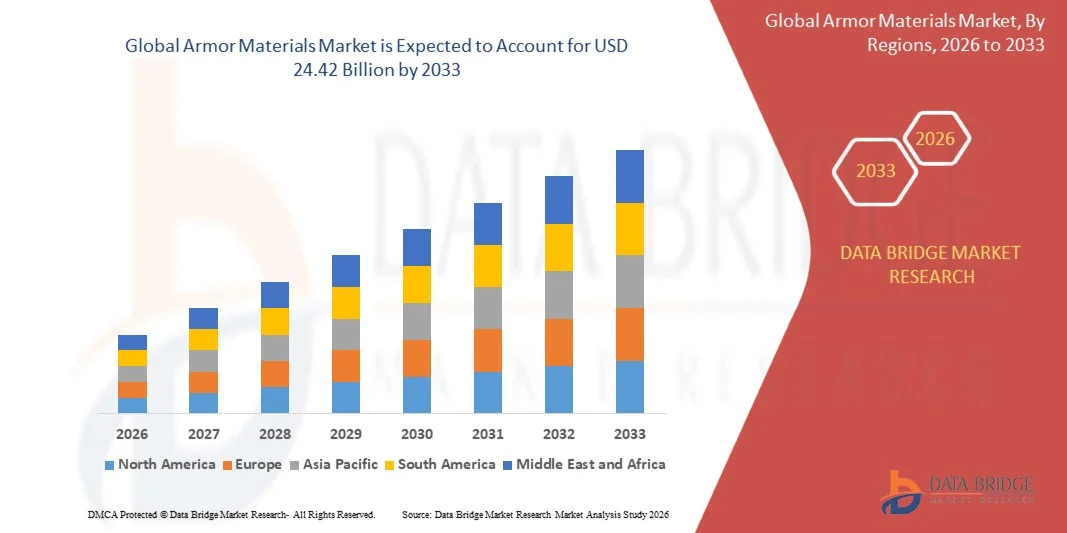
The global armor materials market was valued at USD 15.04 Billion in 2025 and is projected to reach USD 24.42 Billion by 2033, growing at a CAGR of 6.25% from 2026 to 2033. The market is experiencing consistent growth driven by increasing defense modernization programs, rising geopolitical tensions, and growing demand for advanced ballistic protection systems across military and homeland security applications. Expanding adoption of lightweight composite materials, ceramics, UHMWPE, and aramid fibers is further supporting market expansion across vehicle armor, body armor, aerospace armor, and marine protection systems.
The increasing global focus on soldier survivability and next-generation defense capabilities, combined with rising investments in armored vehicle fleets and personal protective equipment, is accelerating demand for high-performance armor materials. Governments across North America, Europe, and Asia-Pacific are prioritizing modernization of defense infrastructure and procurement of advanced protective systems. Continuous advancements in material science, including hybrid composites and ultra-lightweight armor technologies, are enabling improved protection efficiency while reducing weight and operational burden, further driving market growth.
Key Market Trends & Insights
- North America dominated the global armor materials market with the largest revenue share of 37.90% in 2025, supported by strong defense spending, advanced military modernization programs, and high adoption of next-generation protective materials
- The metal and alloys segment led the market with a 51.80% share in 2025, driven by their superior structural strength, high durability, and long-standing use in ballistic protection systems. These materials are widely deployed in vehicle and personnel armor due to their ability to withstand high-impact kinetic energy and harsh operational environments
- Asia-Pacific is expected to be the fastest-growing region at a CAGR of 7.50% from 2026 to 2033, fueled by rising defense expenditures, territorial security concerns, and rapid military modernization programs
- Body armor are the fastest-growing application type, projected to register a CAGR of 7.58% from 2026 to 2033, supported by increasing focus on soldier survivability and personal protection systems
- The airborne ballistics segment dominated the protection type category with a 47.3% revenue share in 2025, led by extensive demand for protection against bullets, shrapnel, and high-velocity projectiles in military and homeland security applications
- Vehicle armor accounted for 41.90% of the market in 2025, preferred by rising deployment of armored vehicles for defense, border security, and tactical operations
- The ceramics segment is the fastest-growing material type category, with a CAGR of 7.55% from 2026 to 2033, driven by increasing demand for high-hardness, lightweight armor solutions capable of defeating advanced ballistic threats
Market Size & Forecast
- Global Market Value (2025): USD 15.04 Billion
- Expected Market Value (2033): USD 24.42 Billion
- Forecast CAGR (2026–2033): 24.42%
- Leading Region in 2025: North America
- Fastest Growing Region: Asia-Pacific
Report Scope and Global Armor Materials Market Segmentation
|
Attributes |
Armor Materials Key Market Insights |
|
Segments Covered |
|
|
Countries Covered |
North America · U.S. · Canada · Mexico Europe · Germany · France · U.K. · Netherlands · Switzerland · Belgium · Russia · Italy · Spain · Turkey · Rest of Europe Asia-Pacific · China · Japan · India · South Korea · Singapore · Malaysia · Australia · Thailand · Indonesia · Philippines · Rest of Asia-Pacific Middle East and Africa · Saudi Arabia · U.A.E. · South Africa · Egypt · Israel · Rest of Middle East and Africa South America · Brazil · Argentina · Rest of South America |
|
Key Market Players |
· DuPont de Nemours, Inc. (U.S.) · DSM (Netherlands) · Honeywell International Inc. (U.S.) · 3M Company (U.S.) · Saab AB (Sweden) · Koninklijke Ten Cate B.V. (Netherlands) · Saint-Gobain S.A. (France) · Teijin Aramid B.V. (Netherlands) · Tata Steel Limited (India) · Alcoa Corporation (U.S.) · ATI Inc. (U.S.) · CeramTec Group (Germany) · CoorsTek Inc. (U.S.) · Morgan Advanced Materials plc (U.K.) · CerCo Corporation (U.S.) · AGY Holding Corp. (U.S.) · PPG Industries, Inc. (U.S.) · Safariland, LLC (U.S.) · Leeco Steel LLC (U.S.) · ArmorWorks Enterprises, LLC (U.S.) |
|
Market Opportunities |
· Expansion of UHMWPE and Aramid Fiber-Based Lightweight Armor Systems · Growing Demand for Vehicle Armor in Emerging Defense Markets · Rising Integration of Advanced Armor Materials in Aerospace and Naval Defense Applications |
|
Value Added Data Infosets |
In addition to the insights on market scenarios such as market value, growth rate, segmentation, geographical coverage, and major players, the market reports curated by the Data Bridge Market Research also include in-depth expert analysis, geographically represented company-wise production and capacity, network layouts of distributors and partners, detailed and updated price trend analysis and deficit analysis of supply chain and demand. |
Global Armor Materials Market Trends
Trend: Increasing Lightweight Composite and Ceramic Armor Adoption
Armor materials market is witnessing a strong shift toward lightweight composites, ceramics, UHMWPE, and aramid-based solutions to enhance ballistic protection while reducing overall system weight. This trend is driven by rising demand for high-mobility defense equipment, improved soldier survivability, and next-generation armored vehicle platforms. Ceramic armor components such as alumina and silicon carbide are increasingly used in vehicle and body armor due to superior hardness and energy absorption capabilities.
Companies such as 3M (Ceradyne) are actively supplying advanced ceramic armor solutions for military vehicles and personnel protection systems used by the U.S. Department of Defense, reinforcing large-scale adoption of lightweight armor technologies.
Global Armor Materials Market Dynamics
Key Market Driver: Rising Defense Modernization Spending
Increasing defense budgets and modernization programs across the U.S., Europe, and Asia-Pacific are significantly driving demand for advanced armor materials. Military forces are upgrading armored vehicles, infantry protection systems, and aerospace defense platforms with high-performance materials such as UHMWPE, ceramics, and titanium alloys. Focus on soldier survivability, mobility enhancement, and next-generation combat readiness is accelerating procurement of advanced ballistic protection systems.
For instance, the U.S. Department of Defense continues to invest in next-generation personal protective equipment and armored vehicle upgrades through programs such as the Improved Outer Tactical Vest (IOTV) and Joint Light Tactical Vehicle (JLTV), supporting strong material demand.
Key Restraint/Challenge: High Cost and Production Complexity
The armor materials market faces significant challenges due to the high cost of advanced materials and complex manufacturing processes required for high-performance ballistic protection systems. Production of ceramics, UHMWPE fibers, and hybrid composites involves energy-intensive processes, precision engineering, and strict quality standards, which increases overall cost. Integration of multi-layer armor systems further adds to design and fabrication complexity.
Programs such as CPS Technologies’ U.S. Army SBIR contract for ultra-low-temperature sintered ceramic armor (2025) highlight the technical challenges and high-cost innovation required to improve manufacturability while maintaining ballistic performance standards.
Key Market Opportunity: Vehicle Armor Demand in Emerging Markets
Growing geopolitical tensions, border security concerns, and rising defense modernization initiatives in emerging economies are creating strong opportunities for vehicle armor systems. Demand for mine-resistant ambush protected (MRAP) vehicles, armored personnel carriers, and lightweight composite vehicle armor is increasing across Asia-Pacific, Middle East, and Latin America. Adoption of advanced materials is improving mobility, protection, and fuel efficiency of modern armored fleets.
For instance, Saab AB and Tata Steel are actively involved in supplying and integrating advanced armored vehicle solutions and high-strength steel materials for defense programs across developing markets, supporting expansion of vehicle armor applications globally.
Global Armor Materials Market Scope
The armor materials market is segmented on the basis of material type, protection type, and application.
- By Material Type
On the basis of material type, the global armor materials market is segmented into metals and alloys, ceramics, composites, para-aramid fiber, ultra-high-molecular-weight polyethylene (UHMWPE), fiberglass, and others. The Metals and Alloys segment dominated the market with the largest share of 51.80% in 2025, driven by their superior structural strength, high durability, and long-standing use in ballistic protection systems. These materials are widely deployed in vehicle and personnel armor due to their ability to withstand high-impact kinetic energy and harsh operational environments. Established manufacturing processes and cost efficiency further support large-scale adoption across defense applications. Continuous upgrades in advanced steel and lightweight aluminum alloys reinforce their leading position.
The ceramics segment is projected to register the fastest growth at a CAGR of 7.55% from 2026 to 2033, driven by increasing demand for high-hardness, lightweight armor solutions capable of defeating advanced ballistic threats. Rising adoption in body armor and vehicle armor systems is strengthening its role due to its excellent energy absorption and penetration resistance capabilities. Growing defense modernization programs are accelerating integration of ceramic-based composites in next-generation protective systems. In addition, continuous advancements in ceramic matrix composites and manufacturing techniques are improving durability and reducing brittleness.
- By Protection Type
On the basis of protection type, the market is segmented into airborne ballistics, blasts, and explosions. The Airborne Ballistics segment dominated the market with the largest share of 47.3% in 2025, supported by extensive demand for protection against bullets, shrapnel, and high-velocity projectiles in military and homeland security applications. Its dominance is reinforced by continuous procurement of ballistic helmets, vests, and vehicle armor systems across global defense forces. Established threat scenarios in conflict zones and border security operations sustain strong demand. Ongoing improvements in ballistic resistance materials further enhance performance and reliability.
The Blasts and Explosions segment is projected to register the fastest growth at a CAGR of 5.7% from 2026 to 2033, driven by rising asymmetric warfare threats and increasing use of improvised explosive devices in conflict regions. Growing emphasis on counter-IED protection systems is accelerating adoption of advanced blast-resistant armor solutions. Military modernization programs are prioritizing enhanced survivability against explosive impacts in both vehicles and infrastructure. In addition, increasing investment in protective engineering for critical facilities is strengthening demand. Continuous innovation in energy-absorbing materials supports the segment’s rapid expansion.
- By Application
On the basis of application, the market is segmented into vehicle armor, aerospace armor, body armor, civil armor, and marine armor. The Vehicle Armor segment dominated the market with the largest share of 41.90% in 2025, driven by rising deployment of armored vehicles for defense, border security, and tactical operations. Increasing demand for mine-resistant and ambush-protected vehicles strengthens adoption across military fleets. Integration of advanced composite materials enhances protection levels while maintaining mobility and fuel efficiency. Large-scale procurement programs across major defense economies further reinforce segment leadership. Continuous upgrades in armored vehicle platforms support sustained dominance.
The Body Armor segment is projected to register the fastest growth at a CAGR of 7.58% from 2026 to 2033, driven by increasing focus on soldier survivability and personal protection systems. Rising geopolitical tensions and internal security challenges are accelerating procurement of advanced ballistic vests and protective gear. Lightweight and flexible armor solutions are gaining traction due to improved comfort and operational efficiency. Expanding use among law enforcement agencies and special forces further supports growth. Technological advancements in soft armor materials and hybrid composites are significantly enhancing performance and driving rapid adoption.
Global Armor Materials Market Regional Analysis
North America dominated the armor materials market and accounted for the largest revenue share of 37.90% in 2025, driven by strong defense spending, advanced military modernization programs, and high adoption of next-generation protective materials. The region benefits from a well-established defense manufacturing base, extensive R&D investments, and rapid integration of lightweight composite armor systems. Increasing procurement of advanced vehicle armor, body armor, and aerospace protection systems across military and homeland security agencies is further strengthening market dominance. In addition, strong presence of leading defense contractors and continuous innovation in ballistic protection technologies continue to reinforce North America’s leadership position in the global market.
U.S. Armor Materials Market Insight
The U.S. armor materials market is witnessing strong growth driven by rising defense budget allocations, increasing focus on soldier survivability, and rapid modernization of armored vehicle fleets. Demand for advanced lightweight materials such as UHMWPE, ceramics, and hybrid composites is expanding across military and homeland security applications. The country’s strong R&D ecosystem and presence of leading defense manufacturers are accelerating innovation in high-performance armor systems. In addition, growing investments in next-generation battlefield protection and increasing adoption of modular armor solutions are further supporting market expansion in the U.S.
Canada Armor Materials Market Insight
The Canada armor materials market is experiencing steady growth supported by increasing defense modernization initiatives and rising investments in military equipment upgrades. Demand for advanced ballistic protection systems is growing across vehicle armor and personnel protection applications. The country’s focus on enhancing border security and defense readiness is driving procurement of lightweight and high-strength armor materials. In addition, collaboration with global defense suppliers and growing adoption of composite-based armor solutions are further contributing to market development in Canada.
Europe Armor Materials Market Insight
The Europe armor materials market is expanding steadily due to rising geopolitical tensions, increasing defense budgets, and strong emphasis on military modernization programs. The region benefits from advanced defense manufacturing capabilities and growing adoption of lightweight composite and ceramic armor technologies. Countries across Europe are investing heavily in next-generation armored vehicles, body armor systems, and naval protection solutions. In addition, strong regulatory standards and increasing collaboration among defense organizations continue to support technological advancements and market growth across the region.
U.K. Armor Materials Market Insight
The U.K. armor materials market is growing steadily, driven by increasing defense expenditure, modernization of military fleets, and strong focus on soldier protection systems. Rising adoption of advanced materials such as ceramics and UHMWPE is enhancing performance and mobility of personal armor solutions. The country’s strong defense R&D infrastructure and partnerships with global defense contractors are further supporting innovation. In addition, growing investments in armored vehicle upgrades and counter-terrorism operations are strengthening market expansion in the U.K.
Germany Armor Materials Market Insight
The Germany armor materials market is expanding due to strong industrial capabilities, increasing defense modernization programs, and rising adoption of advanced material technologies. Demand for high-performance armor systems is growing across vehicle protection and aerospace applications. The country’s emphasis on engineering excellence and material innovation is driving development of advanced ceramic and composite armor solutions. In addition, increasing investments in NATO-aligned defense initiatives are further supporting market growth in Germany.
Asia-Pacific Armor Materials Market Insight
The Asia-Pacific armor materials market is projected to register the fastest growth with a CAGR of 7.50% from 2026 to 2033, driven by rising defense expenditures, territorial security concerns, and rapid military modernization programs. Expanding procurement of armored vehicles, body armor, and naval protection systems is significantly boosting demand across the region. Countries such as China, India, Japan, and South Korea are heavily investing in advanced composite and ceramic armor technologies. In addition, growing domestic defense manufacturing capabilities and increasing focus on indigenous production are further accelerating regional market expansion.
Japan Armor Materials Market Insight
The Japan armor materials market is witnessing steady growth supported by advanced technological capabilities, strong defense modernization efforts, and increasing focus on national security enhancement. Demand for lightweight and high-strength armor materials is rising across aerospace and vehicle protection applications. The country’s strong emphasis on material innovation and robotics integration is further supporting development of advanced protective systems. In addition, increasing defense collaborations and adoption of next-generation composite materials are strengthening market growth in Japan.
China Armor Materials Market Insight
The China armor materials market is growing rapidly due to large-scale defense modernization, strong domestic manufacturing capabilities, and increasing investment in advanced military technologies. Demand for high-performance armor systems is rising across vehicle, aerospace, and personnel protection applications. The country’s focus on self-reliance in defense production is accelerating development of advanced ceramic, composite, and UHMWPE-based materials. In addition, continuous expansion of military capabilities and strong government support for defense innovation are further driving market growth in China.
Global Armor Materials Market Share
The armor materials industry is primarily led by well-established companies, including:
- DuPont de Nemours, Inc. (U.S.)
- DSM (Netherlands)
- Honeywell International Inc. (U.S.)
- 3M Company (U.S.)
- Saab AB (Sweden)
- Koninklijke Ten Cate B.V. (Netherlands)
- Saint-Gobain S.A. (France)
- Teijin Aramid B.V. (Netherlands)
- Tata Steel Limited (India)
- Alcoa Corporation (U.S.)
- ATI Inc. (U.S.)
- CeramTec Group (Germany)
- CoorsTek Inc. (U.S.)
- Morgan Advanced Materials plc (U.K.)
- CerCo Corporation (U.S.)
- AGY Holding Corp. (U.S.)
- PPG Industries, Inc. (U.S.)
- Safariland, LLC (U.S.)
- Leeco Steel LLC (U.S.)
- ArmorWorks Enterprises, LLC (U.S.)
Latest Developments in Global Armor Materials Market
- In June 2025, Premier Graphene, formerly known as Premier Biomedical, in collaboration with its affiliate HGI Industrial Technologies SAPI and Nevada Ballistic Armor Corp., launched a multinational joint venture focused on producing advanced protective body armor for military applications. As part of this initiative, armored plates were delivered for final testing in a Latin American country, marking a significant step toward commercialization. This development is expected to strengthen the global armor materials market by expanding production capacity for next-generation lightweight and high-performance ballistic solutions, thereby supporting increasing defense modernization requirements across emerging regions
- In January 2025, CPS Technologies secured a Phase I SBIR contract from the U.S. Army to develop ultra-low-tzmperature sintered ceramic armor designed to maintain high compressive strength while reducing energy consumption during manufacturing. This innovation is expected to enhance the efficiency and scalability of advanced ceramic armor production, strengthening its adoption in military protection systems. It further supports the armor materials market by accelerating the transition toward cost-effective, high-performance ceramic-based solutions for next-generation defense applications
- In January 2025, DSM Firmenich (Avient) introduced Dyneema HB330/332, a third-generation UHMWPE sheet technology that enables weight reductions of up to 45% in hard armor inserts, helmets, and vehicle appliqué panels. This advancement is expected to significantly improve soldier mobility and operational endurance while maintaining high ballistic protection standards. It strengthens the armor materials market by accelerating demand for ultra-lightweight composite materials across personal and vehicle armor systems
- In February 2021, Teijin Limited expanded its Teijin Aramid manufacturing facility in the Netherlands as part of a multi-year program aimed at increasing production capacity and improving sustainability in aramid fiber manufacturing. This expansion is expected to enhance global supply stability of high-performance para-aramid fibers used in ballistic protection systems. It supports the armor materials market by ensuring consistent availability of critical raw materials for body armor, aerospace protection, and vehicle armor applications
- In December 2020, NP Aerospace launched the 4030 ELITE Bomb Disposal Suit, a next-generation explosive ordnance disposal (EOD) protective system designed for North America and other key international markets. The suit enhances operator safety through improved blast resistance and ergonomic design, addressing evolving explosive threat environments. This development is expected to support the armor materials market by driving demand for advanced blast protection solutions in military and security operations

- Interactive Data Analysis Dashboard
- Company Analysis Dashboard for high growth potential opportunities
- Research Analyst Access for customization & queries
- Competitor Analysis with Interactive dashboard
- Latest News, Updates & Trend analysis
- Harness the Power of Benchmark Analysis for Comprehensive Competitor Tracking
Global Armor Materials Market, Supply Chain Analysis and Ecosystem Framework
To support market growth and help clients navigate the impact of geopolitical shifts, DBMR has integrated in-depth supply chain analysis into its Global Armor Materials Market research reports. This addition empowers clients to respond effectively to global changes affecting their industries. The supply chain analysis section includes detailed insights such as Global Armor Materials Market consumption and production by country, price trend analysis, the impact of tariffs and geopolitical developments, and import and export trends by country and HSN code. It also highlights major suppliers with data on production capacity and company profiles, as well as key importers and exporters. In addition to research, DBMR offers specialized supply chain consulting services backed by over a decade of experience, providing solutions like supplier discovery, supplier risk assessment, price trend analysis, impact evaluation of inflation and trade route changes, and comprehensive market trend analysis.
Data collection and base year analysis are done using data collection modules with large sample sizes. The stage includes obtaining market information or related data through various sources and strategies. It includes examining and planning all the data acquired from the past in advance. It likewise envelops the examination of information inconsistencies seen across different information sources. The market data is analysed and estimated using market statistical and coherent models. Also, market share analysis and key trend analysis are the major success factors in the market report. To know more, please request an analyst call or drop down your inquiry.
The key research methodology used by DBMR research team is data triangulation which involves data mining, analysis of the impact of data variables on the market and primary (industry expert) validation. Data models include Vendor Positioning Grid, Market Time Line Analysis, Market Overview and Guide, Company Positioning Grid, Patent Analysis, Pricing Analysis, Company Market Share Analysis, Standards of Measurement, Global versus Regional and Vendor Share Analysis. To know more about the research methodology, drop in an inquiry to speak to our industry experts.
Data Bridge Market Research is a leader in advanced formative research. We take pride in servicing our existing and new customers with data and analysis that match and suits their goal. The report can be customized to include price trend analysis of target brands understanding the market for additional countries (ask for the list of countries), clinical trial results data, literature review, refurbished market and product base analysis. Market analysis of target competitors can be analyzed from technology-based analysis to market portfolio strategies. We can add as many competitors that you require data about in the format and data style you are looking for. Our team of analysts can also provide you data in crude raw excel files pivot tables (Fact book) or can assist you in creating presentations from the data sets available in the report.













