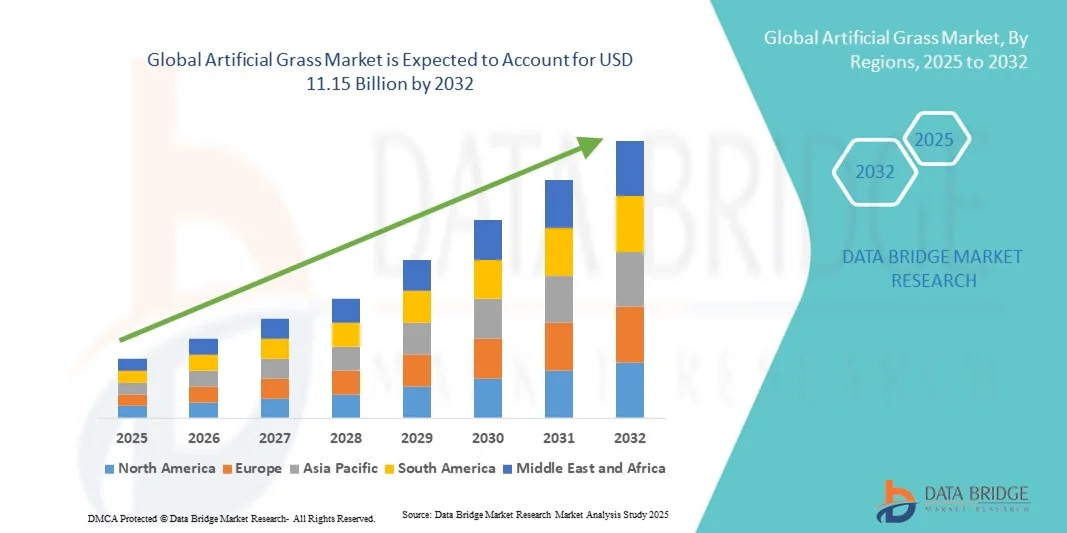
Artificial Grass Market Size
- The global artificial grass market size was valued at USD 6.19 billion in 2024 and is expected to reach USD 11.15 billion by 2032, at a CAGR of 7.62% during the forecast period
- The market growth is largely fuelled by the increasing demand for sustainable and low-maintenance landscaping solutions across residential, commercial, and sports applications
- The growing preference for water conservation and eco-friendly alternatives to natural grass is further driving market adoption, supported by advancements in fiber technology and infill materials
Artificial Grass Market Analysis
- The artificial grass market is witnessing robust growth as consumers and industries shift toward durable and environmentally sustainable surfacing solutions. Innovations in synthetic turf materials, UV-resistant fibers, and natural-looking textures are enhancing aesthetic appeal and performance standards
- The increasing use of artificial grass in sports fields, urban green spaces, and residential lawns is accelerating demand, particularly in water-scarce regions. Moreover, its cost-effectiveness, minimal upkeep requirements, and long lifespan make it a preferred choice over natural turf across multiple end-use sectors
- Europe dominated the artificial grass market with the largest revenue share of 38.24% in 2024, driven by the region’s strong focus on sustainability, water conservation, and eco-friendly landscaping solutions across residential and commercial sectors
- Asia-Pacific region is expected to witness the highest growth rate in the global artificial grass market, driven by large-scale infrastructure development, increasing disposable incomes, and expanding applications in residential and sports sectors
- The Tuft Grass Between 10 and 25 mm segment held the largest market revenue share in 2024, attributed to its balanced height, natural appearance, and wide applicability across residential lawns and commercial spaces. This type offers a realistic texture and durability, making it suitable for moderate foot traffic areas
Report Scope and Artificial Grass Market Segmentation
|
Attributes |
Artificial Grass Key Market Insights |
|
Segments Covered |
|
|
Countries Covered |
North America
Europe
Asia-Pacific
Middle East and Africa
South America
|
|
Key Market Players |
|
|
Market Opportunities |
|
|
Value Added Data Infosets |
In addition to the insights on market scenarios such as market value, growth rate, segmentation, geographical coverage, and major players, the market reports curated by the Data Bridge Market Research also include import export analysis, production capacity overview, production consumption analysis, price trend analysis, climate change scenario, supply chain analysis, value chain analysis, raw material/consumables overview, vendor selection criteria, PESTLE Analysis, Porter Analysis, and regulatory framework. |
Artificial Grass Market Trends
Rising Adoption of Sustainable and Low-Maintenance Landscaping Solutions
- The increasing preference for sustainable and low-maintenance outdoor spaces is driving the adoption of artificial grass across residential, commercial, and sports applications. Homeowners and facility managers are shifting toward synthetic turf due to its durability, water-saving benefits, and aesthetic consistency throughout the year, even in harsh climates. This transition supports eco-friendly landscaping practices while reducing ongoing maintenance costs, fertilizers, and energy use associated with lawn maintenance
- Urbanization and the rise of green building initiatives are accelerating the use of artificial grass in rooftops, balconies, and public parks. These spaces are being designed to improve air quality and visual appeal without the need for irrigation or pesticides. Government efforts to promote sustainable urban landscapes further support this trend, as synthetic turf contributes to energy efficiency and reduces the carbon footprint of urban developments
- The growing awareness of water scarcity issues, particularly in regions facing drought conditions, is a major factor behind the increasing demand for artificial turf. Synthetic lawns offer a long-term, cost-effective solution by eliminating the need for regular watering, mowing, and fertilization, aligning with global sustainability goals. This shift is especially prominent in dry regions such as the Middle East, Southern Europe, and Western U.S., where water conservation is a top priority
- For instance, in 2023, several U.S. municipalities encouraged homeowners to replace natural lawns with artificial turf through rebate programs, helping conserve millions of gallons of water annually. This initiative significantly contributed to the expansion of artificial grass use across residential areas. Similar initiatives in drought-prone regions of Australia and Spain have also promoted widespread adoption of synthetic lawns as an eco-friendly landscaping alternative
- While sustainability is a key driver, continued innovation in fiber technology, recyclability, and surface cooling solutions will be essential to address environmental concerns and enhance the appeal of artificial grass products in eco-conscious markets. Manufacturers are focusing on developing bio-based polymers, advanced UV-resistant coatings, and recyclable backing materials to ensure product longevity and environmental compliance
Artificial Grass Market Dynamics
Driver
Growing Demand from Sports and Recreational Facilities
- The rising investment in sports infrastructure worldwide is one of the primary drivers of the artificial grass market. Synthetic turf fields are preferred in football, hockey, tennis, and golf due to their durability, consistent performance, and year-round usability, even under adverse weather conditions. These benefits make artificial turf an ideal choice for professional and community-level sports, ensuring reduced downtime and extended playing hours
- Governments and private organizations are increasingly developing multipurpose sports complexes equipped with synthetic turf to reduce maintenance costs and enhance facility utilization. The long lifespan and minimal upkeep required further strengthen its adoption in recreational and athletic venues. In addition, synthetic turf fields contribute to uniform playing conditions and reduced injuries, improving overall player safety and performance
- The continuous advancement in turf technologies, such as infill systems that replicate natural grass feel, is enhancing player safety and comfort. These developments are further expanding the market scope across schools, universities, and training centers globally. The introduction of advanced shock-absorbing layers and cooling technologies is also helping artificial turf meet international sports standards
- For instance, in 2022, the International Hockey Federation (FIH) announced plans to upgrade multiple stadiums with sustainable artificial turf ahead of major tournaments, reinforcing the product’s importance in global sports infrastructure. Similarly, the growing adoption of hybrid turf systems in football stadiums worldwide is boosting the demand for innovative and eco-friendly artificial turf solutions
- While demand from sports applications continues to rise, manufacturers must ensure compliance with performance and environmental standards, focusing on recyclability and player well-being to sustain long-term market growth. Developing closed-loop recycling processes and eco-certified turf products will play a critical role in maintaining regulatory compliance and market competitiveness
Restraint/Challenge
Environmental Concerns and Disposal Challenges of Synthetic Turf
- Despite its sustainability benefits in water conservation, artificial grass faces scrutiny due to the environmental impact of plastic materials used in its production. Polyethylene and polypropylene-based fibers are non-biodegradable, posing challenges in waste management and recycling at the end of their life cycle. The accumulation of these materials over time raises concerns about landfill congestion and long-term ecological effects
- The accumulation of used turf in landfills contributes to growing environmental concerns, prompting calls for improved recycling technologies and eco-friendly alternatives. Many regions are exploring regulations to ensure responsible disposal and promote circular economy practices in turf manufacturing. Manufacturers are now investing in reclaimable backing systems and biodegradable components to minimize waste generation
- Heat retention in synthetic grass surfaces during summer months remains another challenge, as it can limit usability and comfort in high-temperature regions. This issue has led to increased research on cooling technologies and the use of reflective pigments to reduce surface temperatures. The introduction of advanced materials designed to reflect sunlight and enhance airflow is gaining traction in markets across the Middle East and the U.S. Southwest
- For instance, in 2023, European environmental agencies raised awareness regarding the microplastic release from artificial turf infill materials, pushing manufacturers to develop biodegradable or recyclable infill solutions to minimize ecological impact. Some leading turf producers have since introduced infill-free designs and natural alternatives such as cork and sand-based infill systems to reduce microplastic pollution
- Addressing these sustainability challenges requires continued investment in green materials, recycling programs, and environmentally responsible manufacturing to ensure the long-term viability and acceptance of artificial grass products across markets. Collaboration between turf producers, recyclers, and environmental organizations will be critical to creating a circular economy model within the artificial grass industry
Artificial Grass Market Scope
The market is segmented on the basis of type, installation, fiber base material, infill material, application, and distribution channel.
- By Type
On the basis of type, the global artificial grass market is segmented into Tuft Grass Below 10 mm, Tuft Grass Between 10 and 25 mm, and Tuft Grass Above 25 mm. The Tuft Grass Between 10 and 25 mm segment held the largest market revenue share in 2024, attributed to its balanced height, natural appearance, and wide applicability across residential lawns and commercial spaces. This type offers a realistic texture and durability, making it suitable for moderate foot traffic areas.
The Tuft Grass Above 25 mm segment is expected to witness the fastest growth rate from 2025 to 2032, driven by increasing adoption in sports fields, playgrounds, and luxury landscaping projects. Its enhanced cushioning effect and lush aesthetic appeal make it ideal for high-performance and premium installations.
- By Installation
On the basis of installation, the market is segmented into Flooring and Wall Cladding. The Flooring segment accounted for the largest revenue share in 2024 due to its dominant use in sports grounds, gardens, and public recreation areas. The convenience of installation, cost-effectiveness, and low maintenance requirements continue to fuel its demand.
The Wall Cladding segment is anticipated to record significant growth during 2025–2032, supported by the growing trend of vertical gardens and decorative indoor applications. Architects and designers increasingly prefer wall-mounted artificial turf for aesthetic enhancement and noise insulation in commercial and residential settings.
- By Fiber Base Material
On the basis of fiber base material, the market is categorized into Polyethylene, Polypropylene, Polyamides, and Nylon. The Polyethylene segment held the largest share in 2024, attributed to its superior softness, natural grass-like texture, and high UV resistance. It is extensively used in landscaping and sports surfaces due to its long lifespan and comfort underfoot.
The Polypropylene segment is projected to grow rapidly during the forecast period, driven by its lower cost, lightweight properties, and suitability for decorative applications. Its affordability and versatility make it a preferred choice for temporary or indoor installations.
- By Infill Material
On the basis of infill material, the market is segmented into Petroleum-based Infills, Sand Infill, and Plant-based Infills. The Sand Infill segment dominated the market in 2024, owing to its affordability, stability, and ability to provide natural support to turf fibers. It remains the standard choice for various applications due to its low maintenance and consistent performance.
The Plant-based Infills segment is expected to register the highest growth rate from 2025 to 2032, driven by rising environmental concerns and the demand for sustainable alternatives. Bio-based infills derived from cork, coconut husk, and other natural materials are gaining popularity for their eco-friendly properties and lower surface heat retention.
- By Application
On the basis of application, the artificial grass market is divided into Leisure, Residential, Commercial, Sports, and Landscaping. The Sports segment captured the largest market share in 2024, supported by increasing investments in modern sports infrastructure and the need for durable, all-weather playing surfaces. Its consistent performance and minimal upkeep make it ideal for professional sports arenas and recreational facilities.
The Residential segment is expected to experience notable growth during the forecast period due to the increasing adoption of synthetic turf in gardens, balconies, and rooftops. Consumers are drawn to its aesthetic appeal, low maintenance, and long-term cost savings.
- By Distribution Channel
On the basis of distribution channel, the market is segmented into Online and Offline. The Offline segment accounted for the largest revenue share in 2024, as consumers and contractors prefer physical inspection and consultation before purchase. Retail stores, specialty distributors, and construction suppliers continue to dominate the sales channel.
The Online segment is anticipated to grow at the fastest rate from 2025 to 2032, fuelled by the expansion of e-commerce platforms and the convenience of doorstep delivery. The availability of product customization, virtual demos, and competitive pricing online is accelerating the digital transformation of the artificial grass market.
Artificial Grass Market Regional Analysis
- Europe dominated the artificial grass market with the largest revenue share of 38.24% in 2024, driven by the region’s strong focus on sustainability, water conservation, and eco-friendly landscaping solutions across residential and commercial sectors
- Consumers in the region are increasingly adopting artificial turf for its low maintenance, aesthetic appeal, and ability to remain green year-round, aligning with environmental goals and urban greening initiatives
- This growth is further supported by advanced turf manufacturing technologies, government support for water-efficient solutions, and the widespread installation of synthetic grass in sports complexes and public spaces
U.K. Artificial Grass Market Insight
The U.K. artificial grass market captured the largest revenue share in 2024 within Europe, supported by the rising trend of low-maintenance residential lawns and eco-conscious landscaping. Increasing restrictions on water use and a preference for sustainable outdoor solutions are boosting adoption across homes, schools, and commercial facilities. In addition, sports infrastructure upgrades and the replacement of natural turf fields with synthetic alternatives are further propelling market demand across the country.
Germany Artificial Grass Market Insight
The Germany artificial grass market is expected to witness the fastest growth rate from 2025 to 2032, driven by expanding demand from the sports and commercial sectors. Strong government emphasis on green infrastructure and energy-efficient construction projects is encouraging the use of artificial turf in stadiums, recreational areas, and corporate campuses. Moreover, technological advancements in recyclable turf materials and the preference for durable, eco-friendly landscaping options are reinforcing market expansion in Germany.
North America Artificial Grass Market Insight
The North America artificial grass market is expected to witness the fastest growth rate from 2025 to 2032, propelled by increasing adoption in residential lawns, sports arenas, and commercial landscapes. Consumers across the region are prioritizing sustainable, water-efficient alternatives to natural grass, particularly in drought-prone areas such as California and Arizona. Furthermore, the region’s strong sports culture and ongoing investments in school and community athletic facilities are accelerating the use of artificial turf across multiple applications.
U.S. Artificial Grass Market Insight
The U.S. artificial grass market is expected to witness the fastest growth rate from 2025 to 2032, owing to growing consumer awareness of water conservation and the long-term cost benefits of synthetic lawns. The expansion of sports infrastructure, including football, baseball, and golf facilities, has significantly contributed to market growth. Moreover, supportive municipal initiatives, such as turf rebate programs, are encouraging households and businesses to switch to artificial grass for environmental and economic reasons.
Asia-Pacific Artificial Grass Market Insight
The Asia-Pacific artificial grass market is expected to witness the fastest growth rate from 2025 to 2032, fuelled by increasing urbanization, infrastructure development, and rising disposable incomes in countries such as China, Japan, and India. Growing adoption of artificial turf in residential complexes, sports facilities, and public recreation spaces is transforming the landscaping industry in the region. Moreover, government-backed sustainability programs and increasing availability of cost-effective synthetic turf solutions are enhancing market penetration across APAC.
China Artificial Grass Market Insight
The China artificial grass market captured the largest revenue share in Asia-Pacific in 2024, driven by large-scale investments in sports facilities, rapid urban development, and expanding green city initiatives. The country’s strong manufacturing base and advancements in polymer production have made high-quality artificial turf more affordable and widely available. The growing use of synthetic grass in schools, commercial properties, and public parks is further propelling market growth.
Japan Artificial Grass Market Insight
The Japan artificial grass market is expected to witness steady growth from 2025 to 2032, driven by space-efficient landscaping trends and increasing adoption in sports and leisure facilities. With limited availability of arable land and a dense urban environment, artificial turf offers a practical, low-maintenance solution for enhancing aesthetic appeal in small outdoor and rooftop spaces. Furthermore, the country’s emphasis on innovation and eco-friendly materials is fostering demand for high-performance, recyclable turf solutions.
Artificial Grass Market Share
The Artificial Grass industry is primarily led by well-established companies, including:
• ACT Global (U.S.)
• Domo Sports Grass (Belgium)
• Condor Group (Netherlands)
• Limonta Sport S.p.A. (Italy)
• Controlled Products, LLC (U.S.)
• Edel Grass B.V. (Netherlands)
• CCGrass (China)
• SIS Pitches (U.K.)
• Wonderlawn (U.K.)
• SportGroup Holding (Germany)
• Beaulieu International Group (Belgium)
• ForestGrass (China)
• Unisport AB (Sweden)
• Koninklijke Ten Cate bv. (Netherlands)
• Victoria PLC (U.K.)
• Shaw Sports Turf Inc. (U.S.)
• Challenger Turf, Inc. (U.S.)
• DuPont (U.S.)
• Forbex Export Corporation (Argentina)
• Mondo S.p.A. (Italy)
• Global Syn-Turf (U.S.)
• Nurteks (Turkey)
• Synthetic Grass Warehouse (U.S.)

- Interactive Data Analysis Dashboard
- Company Analysis Dashboard for high growth potential opportunities
- Research Analyst Access for customization & queries
- Competitor Analysis with Interactive dashboard
- Latest News, Updates & Trend analysis
- Harness the Power of Benchmark Analysis for Comprehensive Competitor Tracking
Data collection and base year analysis are done using data collection modules with large sample sizes. The stage includes obtaining market information or related data through various sources and strategies. It includes examining and planning all the data acquired from the past in advance. It likewise envelops the examination of information inconsistencies seen across different information sources. The market data is analysed and estimated using market statistical and coherent models. Also, market share analysis and key trend analysis are the major success factors in the market report. To know more, please request an analyst call or drop down your inquiry.
The key research methodology used by DBMR research team is data triangulation which involves data mining, analysis of the impact of data variables on the market and primary (industry expert) validation. Data models include Vendor Positioning Grid, Market Time Line Analysis, Market Overview and Guide, Company Positioning Grid, Patent Analysis, Pricing Analysis, Company Market Share Analysis, Standards of Measurement, Global versus Regional and Vendor Share Analysis. To know more about the research methodology, drop in an inquiry to speak to our industry experts.
Data Bridge Market Research is a leader in advanced formative research. We take pride in servicing our existing and new customers with data and analysis that match and suits their goal. The report can be customized to include price trend analysis of target brands understanding the market for additional countries (ask for the list of countries), clinical trial results data, literature review, refurbished market and product base analysis. Market analysis of target competitors can be analyzed from technology-based analysis to market portfolio strategies. We can add as many competitors that you require data about in the format and data style you are looking for. Our team of analysts can also provide you data in crude raw excel files pivot tables (Fact book) or can assist you in creating presentations from the data sets available in the report.