


Artificial Intelligence of Things (AIoT) Market Size
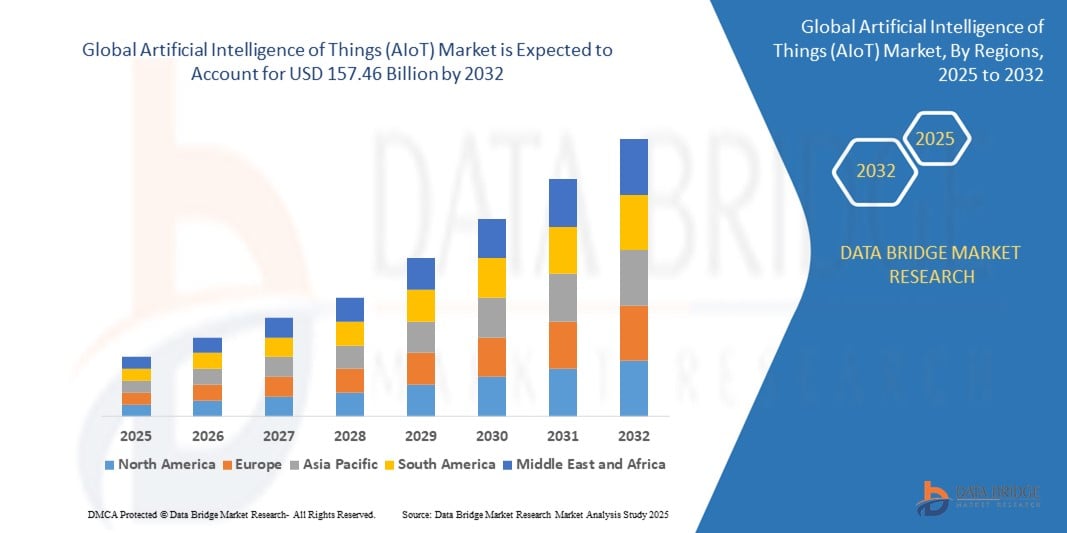
- The global artificial intelligence of things (AIoT) market size was valued at USD 27.72 billion in 2024 and is expected to reach USD 157.46 billion by 2032, at a CAGR of 24.25% during the forecast period
- The market growth is primarily driven by the increasing integration of artificial intelligence with IoT devices, enabling enhanced data processing, automation, and decision-making capabilities across various industries
- Rising demand for real-time analytics, improved operational efficiency, and the growing adoption of smart devices in both industrial and consumer applications are key factors propelling the AIoT market forward
Artificial Intelligence of Things (AIoT) Market Analysis
- AIoT combines artificial intelligence with IoT infrastructure to enable intelligent, connected devices that can process data locally or in the cloud, offering advanced analytics, automation, and real-time decision-making
- The surge in demand for AIoT solutions is fueled by the need for enhanced operational efficiency, predictive maintenance, and smart automation across industries such as manufacturing, healthcare, and retail
- North America dominated the AIoT market with the largest revenue share of 38.5% in 2024, driven by early adoption of advanced technologies, robust digital infrastructure, and the presence of leading AIoT solution providers
- Asia-Pacific is expected to be the fastest-growing region during the forecast period, propelled by rapid urbanization, increasing investments in smart infrastructure, and rising adoption of AIoT in countries such as China, Japan, and India
- The cloud-based segment dominated the largest market revenue share of 52.3% in 2024, driven by its scalability, cost-effectiveness, and ability to handle large-scale data processing and storage for AIoT applications
Report Scope and Artificial Intelligence of Things (AIoT) Market Segmentation
|
Attributes |
Artificial Intelligence of Things (AIoT) Key Market Insights |
|
Segments Covered |
|
|
Countries Covered |
North America
Europe
Asia-Pacific
Middle East and Africa
South America
|
|
Key Market Players |
|
|
Market Opportunities |
|
|
Value Added Data Infosets |
In addition to the market insights such as market value, growth rate, market segments, geographical coverage, market players, and market scenario, the market report curated by the Data Bridge Market Research team includes in-depth expert analysis, import/export analysis, pricing analysis, production consumption analysis, and pestle analysis. |
Artificial Intelligence of Things (AIoT) Market Trends
“Increasing Integration of AI and IoT Technologies”
- The Global Artificial Intelligence of Things (AIoT) market is experiencing a transformative trend with the deep integration of Artificial Intelligence (AI) and Internet of Things (IoT) technologies
- This convergence enables enhanced data processing, real-time analytics, and actionable insights across various applications such as video surveillance, predictive maintenance, and supply chain management
- AIoT solutions leverage AI algorithms to process data collected from IoT devices, enabling proactive decision-making, such as identifying equipment failures before they occur or optimizing energy consumption in real time
- For instances, companies are developing AIoT platforms that use real-time machinery condition monitoring to reduce downtime in manufacturing or employ video surveillance analytics to enhance security in retail environments
- This trend is significantly enhancing the value of AIoT systems, making them increasingly appealing to industries such as healthcare, manufacturing, retail, agriculture, logistics, and BFSI
- AI algorithms analyze diverse IoT data streams, including sensor readings, environmental conditions, and operational patterns, to deliver tailored solutions such as optimized inventory management or predictive maintenance schedules
Artificial Intelligence of Things (AIoT) Market Dynamics
Driver
“Rising Demand for Smart and Connected Ecosystems”
- The growing consumer and enterprise demand for smart, connected ecosystems, such as real-time asset tracking, intelligent supply chain management, and automated energy management, is a key driver for the AIoT market
- AIoT systems enhance operational efficiency and safety by offering features such as predictive maintenance, real-time machinery condition monitoring, and intelligent video surveillance for threat detection
- Government initiatives and regulations, particularly in North America, which dominates the AIoT market, are promoting the adoption of smart technologies in sectors such as healthcare and logistics to improve efficiency and safety
- The widespread adoption of 5G technology and advancements in edge computing are further accelerating AIoT applications by enabling faster data processing and lower latency for real-time services
- Industries are increasingly integrating AIoT solutions as standard or optional features to meet evolving demands and enhance operational value across applications
Restraint/Challenge
“High Implementation Costs and Data Privacy Concerns”
- The high initial costs associated with deploying AIoT solutions, including hardware, software, and integration, pose a significant barrier, particularly in emerging markets within the Asia-Pacific region, which is the fastest-growing market for AIoT
- Integrating AIoT systems into existing infrastructure can be complex and resource-intensive, requiring specialized expertise and investment
- Data security and privacy concerns are major challenges, as AIoT systems collect and process vast amounts of sensitive data from IoT devices, raising risks of breaches, unauthorized access, or non-compliance with data protection regulations
- The fragmented regulatory environment across regions, with varying standards for data collection, storage, and usage, complicates operations for global manufacturers and service providers
- These challenges can deter adoption, especially in industries such as healthcare and BFSI, where data privacy is critical, or in cost-sensitive regions, potentially limiting market growth
Artificial Intelligence of Things (AIoT) market Scope
The market is segmented on the basis of deployment, application, and industry vertical
- By Deployment
On the basis deployment, the global artificial intelligence of things (AIoT) market is segmented into cloud-based and edge AIoT deployments. The cloud-based segment dominated the largest market revenue share of 52.3% in 2024, driven by its scalability, cost-effectiveness, and ability to handle large-scale data processing and storage for AIoT applications. Cloud platforms enable seamless integration with IoT devices, supporting real-time analytics and machine learning across industries.
The edge AIoT segment is expected to witness the fastest growth rate of 32.1% from 2025 to 2032. Edge-based systems provide real-time responses by processing data locally, reducing latency and dependency on cloud connectivity. This is critical for applications such as autonomous vehicles and predictive maintenance, where immediate decision-making is essential.
- By Application
On the basis application, the global artificial intelligence of things (AIoT) market is segmented into video surveillance, robust asset management, inventory management, energy consumption management, predictive maintenance, real-time machinery condition monitoring, and supply chain management. The video surveillance segment dominated with a market revenue share of 31.2% in 2024, driven by its widespread adoption in retail, transportation, and smart cities for enhanced security and analytics.
The predictive maintenance segment is anticipated to experience the fastest growth from 2025 to 2032, propelled by its ability to use AI-driven analytics to predict equipment failures, reducing downtime and costs. This is particularly impactful in manufacturing, energy, and transportation industries, where proactive maintenance enhances operational efficiency.
- By Industry Vertical
On the basis industry vertical, the global artificial intelligence of things (AIoT) market is segmented into healthcare, manufacturing, retail, agriculture, logistics, bfsi, and others. The manufacturing segment held the largest market revenue share of 24.2% in 2024, driven by the adoption of AIoT for predictive maintenance, process automation, and supply chain optimization in smart factories.
The healthcare segment is expected to witness the fastest growth rate from 2025 to 2032, with a projected CAGR of 23.2%. This growth is fueled by AIoT-enabled remote patient monitoring, predictive diagnostics, and personalized care, leveraging data from wearable devices and medical sensors to improve patient outcomes and accessibility.
Artificial Intelligence of Things (AIoT) Market Regional Analysis
- North America dominated the AIoT market with the largest revenue share of 38.5% in 2024, driven by early adoption of advanced technologies, robust digital infrastructure, and the presence of leading AIoT solution providers
- Enterprises prioritize AIoT solutions for enhancing operational efficiency, real-time decision-making, and predictive analytics, particularly in regions with advanced digital infrastructure
- Growth is supported by advancements in cloud and edge computing, alongside increasing integration in both industrial and consumer applications
U.S. Artificial Intelligence of Things (AIoT) Market Insight
The U.S. artificial intelligence of things (AIoT) market captured the largest revenue share of 74.8% in 2024 within North America, fueled by strong demand for smart solutions in video surveillance, predictive maintenance, and supply chain management. Growing investments in IoT infrastructure and increasing awareness of AI-driven analytics benefits drive market expansion. The trend towards smart cities and Industry 4.0 initiatives further boosts adoption across manufacturing and logistics sectors.
Europe Artificial Intelligence of Things (AIoT) Market Insight
The Europe AIoT market is expected to witness significant growth, supported by regulatory focus on digital transformation and sustainability. Enterprises seek AIoT solutions for energy consumption management and real-time machinery monitoring to optimize operations. Growth is prominent in both industrial automation and smart retail, with countries such as Germany and France showing substantial uptake due to rising environmental concerns and technological advancements.
U.K. Artificial Intelligence of Things (AIoT) Market Insight
The U.K. market for AIoT is expected to witness rapid growth, driven by demand for robust asset management and inventory management in retail and logistics. Increased focus on operational efficiency and rising awareness of AIoT’s predictive capabilities encourage adoption. Evolving regulations promoting data privacy and smart infrastructure influence enterprise choices, balancing innovation with compliance.
Germany Artificial Intelligence of Things (AIoT) Market Insight
Germany is expected to witness rapid growth in AIoT, attributed to its advanced manufacturing sector and high focus on Industry 4.0. German enterprises prefer AIoT solutions for predictive maintenance and energy efficiency to reduce costs and enhance productivity. The integration of AIoT in premium manufacturing equipment and smart logistics supports sustained market growth.
Asia-Pacific Artificial Intelligence of Things (AIoT) Market Insight
The Asia-Pacific region is expected to witness the fastest growth rate, driven by expanding IoT adoption and rising investments in AI technologies in countries such as China, India, and Japan. Increasing awareness of real-time monitoring, supply chain optimization, and smart agriculture boosts demand. Government initiatives promoting digital economies and smart cities further encourage the use of AIoT solutions.
Japan Artificial Intelligence of Things (AIoT) Market Insight
Japan’s AIoT market is expected to witness rapid growth due to strong consumer and enterprise preference for high-quality, AI-driven solutions that enhance operational efficiency and safety. The presence of major technology manufacturers and integration of AIoT in smart manufacturing accelerate market penetration. Rising interest in aftermarket IoT customization also contributes to growth.
China Artificial Intelligence of Things (AIoT) Market Insight
China holds the largest share of the Asia-Pacific AIoT market, propelled by rapid urbanization, increasing IoT device penetration, and growing demand for video surveillance and supply chain management solutions. The country’s expanding middle class and focus on smart cities support the adoption of AIoT. Strong domestic manufacturing capabilities and competitive pricing enhance market accessibility.
Artificial Intelligence of Things (AIoT) Market Share
The artificial intelligence of things (AIoT) industry is primarily led by well-established companies, including:
- NVIDIA (U.S.)
- Intel (U.S.)
- Microsoft (U.S.)
- Amazon Web Services (AWS) (U.S.)
- Google (U.S.)
- IBM (U.S.)
- Cisco Systems (U.S.)
- Qualcomm (U.S.)
- Siemens (Germany)
- SAP (Germany)
- Huawei (China)
- Alibaba Cloud (China)
- Tencent (China)
- Samsung Electronics (South Korea)
- Bosch (Germany)
- General Electric (U.S.)
- Honeywell (U.S.)
- Oracle (U.S.)
- Arm (U.K.)
- PTC (U.S.)
What are the Recent Developments in Global Artificial Intelligence of Things (AIoT) Market?
- In November 2024, HTEC, a global leader in end-to-end digital product development and engineering services, announced the acquisition of eesy-innovation, a German-based firm specializing in embedded hardware and software engineering. With offices in Munich, Germany, and Granada, Spain, eesy-innovation brings deep expertise in IoT technologies, AI integration, and cloud-connected embedded systems. This strategic move enhances HTEC’s capabilities in delivering AIoT solutions and expands its footprint in the DACH region. The acquisition aims to create greater value for clients by offering comprehensive, scalable solutions across industries, from concept to deployment
- In August 2024, SEALSQ Corp officially announced its entry into the AI chip market, reinforcing its strategic focus on AIoT (Artificial Intelligence for the Internet of Things). This move positions SEALSQ at the forefront of the convergence between AI and IoT technologies, aiming to deliver advanced semiconductors, smart sensors, and secure cloud-connected platforms. The company’s AIoT strategy integrates edge computing, post-quantum security, and interoperable APIs, enabling intelligent, autonomous decision-making across sectors such as healthcare, manufacturing, and environmental monitoring. This development underscores the rising importance of specialized hardware in powering the next generation of connected, intelligent systems
- In January 2024, Vodafone and Microsoft announced a transformative 10-year strategic partnership to deliver generative AI, cloud services, and digital enterprise solutions to over 300 million businesses and consumers across Europe and Africa. The collaboration includes deploying Microsoft Azure OpenAI and Copilot to enhance customer experiences, migrating Vodafone’s global data centers to the Azure cloud, and scaling Vodafone’s IoT connectivity platform into a standalone business. The partnership also aims to expand M-Pesa for financial inclusion in Africa and support SMEs with Microsoft’s digital tools. This initiative reflects the growing convergence of AI, cloud, and telecom, fueling the broader AIoT ecosystem
- In May 2022, Intel, through its subsidiary Habana Labs, unveiled the Gaudi2 processor at the Intel Vision 2022 event. This second-generation AI training chip is built on 7nm process technology and features 24 Tensor Processor Cores, tripling the memory to 96 GB and doubling on-chip SRAM to 48 MB compared to its predecessor. Gaudi2 delivers up to three times the training throughput of the original Gaudi and outperforms Nvidia’s A100 GPU in key AI workloads such as ResNet-50 and BERT. This launch underscores Intel’s commitment to advancing AI hardware, a critical enabler for AIoT applications requiring high-performance edge computing
- In March 2022, Cisco Meraki expanded its IoT portfolio with the launch of three innovative solutions tailored for smart workspaces and enterprise automation. These include the MT30 Smart Automation Button, which enables custom workflows through a simple press; the MT14 Indoor Air Quality Sensor, which monitors humidity, temperature, TVOCs, PM2.5, and noise levels to enhance indoor comfort and safety; and enhanced MV analytics capabilities that support custom computer vision models on smart cameras. These advancements reflect Cisco Meraki’s commitment to delivering AIoT-enabled solutions that improve operational efficiency, safety, and sustainability in modern hybrid work environments

- Interactive Data Analysis Dashboard
- Company Analysis Dashboard for high growth potential opportunities
- Research Analyst Access for customization & queries
- Competitor Analysis with Interactive dashboard
- Latest News, Updates & Trend analysis
- Harness the Power of Benchmark Analysis for Comprehensive Competitor Tracking
Data collection and base year analysis are done using data collection modules with large sample sizes. The stage includes obtaining market information or related data through various sources and strategies. It includes examining and planning all the data acquired from the past in advance. It likewise envelops the examination of information inconsistencies seen across different information sources. The market data is analysed and estimated using market statistical and coherent models. Also, market share analysis and key trend analysis are the major success factors in the market report. To know more, please request an analyst call or drop down your inquiry.
The key research methodology used by DBMR research team is data triangulation which involves data mining, analysis of the impact of data variables on the market and primary (industry expert) validation. Data models include Vendor Positioning Grid, Market Time Line Analysis, Market Overview and Guide, Company Positioning Grid, Patent Analysis, Pricing Analysis, Company Market Share Analysis, Standards of Measurement, Global versus Regional and Vendor Share Analysis. To know more about the research methodology, drop in an inquiry to speak to our industry experts.
Data Bridge Market Research is a leader in advanced formative research. We take pride in servicing our existing and new customers with data and analysis that match and suits their goal. The report can be customized to include price trend analysis of target brands understanding the market for additional countries (ask for the list of countries), clinical trial results data, literature review, refurbished market and product base analysis. Market analysis of target competitors can be analyzed from technology-based analysis to market portfolio strategies. We can add as many competitors that you require data about in the format and data style you are looking for. Our team of analysts can also provide you data in crude raw excel files pivot tables (Fact book) or can assist you in creating presentations from the data sets available in the report.













