


Artificial Intelligence Robots Market Size
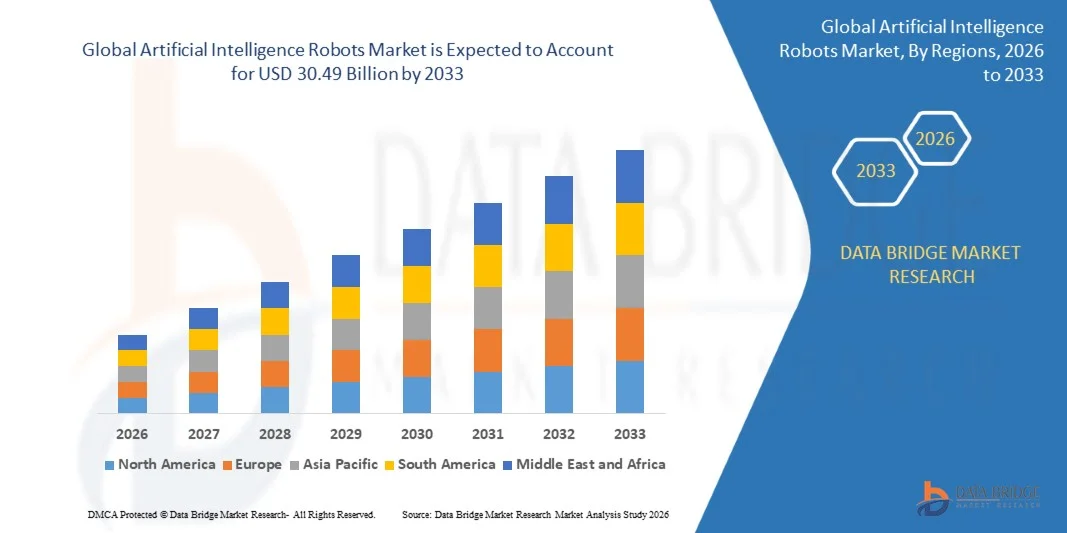
- The global artificial intelligence robots market size was valued at USD 6.69 billion in 2025 and is expected to reach USD 30.49 billion by 2033, at a CAGR of 20.88% during the forecast period
- The market growth is largely fuelled by the increasing integration of artificial intelligence technologies with robotics to improve automation, decision-making, and operational efficiency across industries
- Rising adoption of AI-powered robots in manufacturing, healthcare, logistics, and service sectors to enhance productivity and reduce human intervention is further supporting market expansion
Artificial Intelligence Robots Market Analysis
- The market is witnessing rapid growth due to the increasing demand for intelligent automation systems capable of performing complex tasks with higher accuracy, efficiency, and adaptability across industrial and commercial environments
- Continuous technological advancements in artificial intelligence, computer vision, natural language processing, and sensor technologies are further accelerating the development and deployment of advanced AI-enabled robotic systems across multiple industries
- North America dominated the artificial intelligence robots market with the largest revenue share in 2025, driven by the rapid adoption of advanced automation technologies and strong investments in artificial intelligence and robotics research
- Asia-Pacific region is expected to witness the highest growth rate in the global artificial intelligence robots market, driven by rapid industrialization, increasing investments in robotics and automation technologies, and strong government initiatives supporting artificial intelligence innovation across countries such as China, Japan, and India
- The Industrial segment held the largest market revenue share in 2025 driven by the increasing adoption of automation in manufacturing, logistics, and warehouse operations. AI-enabled industrial robots are widely used for tasks such as assembly, welding, material handling, and quality inspection, helping organizations improve productivity, precision, and operational efficiency
Report Scope and Artificial Intelligence Robots Market Segmentation
|
Attributes |
Artificial Intelligence Robots Key Market Insights |
|
Segments Covered |
|
|
Countries Covered |
North America
Europe
Asia-Pacific
Middle East and Africa
South America
|
|
Key Market Players |
• ABB Ltd. (Switzerland) |
|
Market Opportunities |
• Increasing Adoption Of AI-Enabled Robots In Healthcare And Surgical Applications |
|
Value Added Data Infosets |
In addition to the insights on market scenarios such as market value, growth rate, segmentation, geographical coverage, and major players, the market reports curated by the Data Bridge Market Research also include in-depth expert analysis, geographically represented company-wise production and capacity, network layouts of distributors and partners, detailed and updated price trend analysis and deficit analysis of supply chain and demand. |
Artificial Intelligence Robots Market Trends
“Rising Adoption of Intelligent Automation Across Industries”
• The increasing integration of artificial intelligence technologies with robotics is significantly shaping the artificial intelligence robots market, as organizations increasingly seek intelligent systems capable of performing complex tasks with minimal human intervention. AI-powered robots are gaining traction due to their ability to analyze large volumes of data, adapt to dynamic environments, and enhance operational efficiency. This trend is encouraging industries such as manufacturing, healthcare, logistics, and retail to adopt advanced robotic systems that improve productivity and reduce operational errors
• Growing demand for automation and improved operational efficiency has accelerated the adoption of artificial intelligence robots in industrial and service applications. Companies are increasingly deploying AI-enabled robots to perform repetitive, hazardous, and precision-based tasks in order to improve safety and productivity. The expansion of smart factories, autonomous logistics systems, and automated service environments is further supporting the growth of intelligent robotic solutions across global industries
• Technological advancements in machine learning, computer vision, natural language processing, and sensor technologies are influencing purchasing decisions across organizations. These innovations enable robots to perform tasks such as object recognition, predictive maintenance, quality inspection, and human–robot collaboration more efficiently. Manufacturers are also focusing on developing collaborative robots and autonomous mobile robots that can operate alongside human workers while improving workflow efficiency
• For instance, in 2024, several technology companies expanded their portfolios of AI-enabled robotic systems designed for logistics automation, healthcare assistance, and industrial manufacturing operations. These robotic solutions were introduced to improve operational efficiency, reduce labor dependency, and enhance real-time decision-making capabilities. The growing deployment of intelligent robotic systems is expected to accelerate automation across multiple industries and strengthen market growth
• While demand for artificial intelligence robots is rapidly increasing, sustained market expansion depends on continuous advancements in AI algorithms, hardware capabilities, and system integration. Companies are also focusing on improving robot adaptability, safety standards, and cost efficiency to ensure broader adoption across industrial and commercial environments
Artificial Intelligence Robots Market Dynamics
Driver
“Growing Demand for Intelligent Automation and Smart Robotics”
• Rising demand for advanced automation technologies is a major driver for the artificial intelligence robots market. Organizations are increasingly deploying AI-powered robots to improve productivity, reduce operational costs, and enhance efficiency across manufacturing, logistics, healthcare, and service sectors. Intelligent robotic systems enable businesses to automate complex tasks while maintaining accuracy and operational consistency
• Expanding applications in industries such as automotive manufacturing, healthcare services, warehouse logistics, agriculture, and retail are further supporting market growth. Artificial intelligence robots help improve operational speed, perform precision-based tasks, and support data-driven decision-making processes. The increasing adoption of Industry 4.0 technologies and smart factory solutions is also encouraging the deployment of AI-enabled robotic systems
• Technology providers and robotics manufacturers are actively investing in research and development, strategic collaborations, and new product launches to expand their AI robotics capabilities. These initiatives are supported by the rising demand for intelligent machines capable of autonomous navigation, predictive analysis, and collaborative operations. Integration with advanced digital platforms and cloud computing is further enhancing the performance and scalability of AI robotics systems
• For instance, in 2023, several global robotics companies introduced AI-powered collaborative robots and autonomous mobile robots designed for industrial automation and warehouse logistics operations. These innovations improved operational productivity, enhanced workplace safety, and enabled organizations to optimize labor utilization. Such developments are strengthening the adoption of intelligent robotic technologies and supporting long-term market expansion
• Although rising demand for intelligent automation supports market growth, widespread adoption depends on improving system affordability, advancing AI capabilities, and ensuring seamless integration with existing operational infrastructures. Continued investments in robotics research, artificial intelligence development, and digital automation technologies will remain essential for sustaining growth in the artificial intelligence robots market
Restraint/Challenge
“High Development Costs and Integration Complexity”
• The relatively high cost associated with developing and deploying artificial intelligence robots remains a key challenge for market growth. Advanced robotic systems require sophisticated hardware components, sensors, AI algorithms, and computing capabilities, which significantly increase overall system costs. These high initial investments may limit adoption among small and medium-sized enterprises
• Limited technical expertise and workforce readiness in certain regions can also hinder market expansion. Implementing AI-enabled robotic systems often requires skilled professionals capable of managing programming, maintenance, and system integration processes. The shortage of trained robotics specialists may slow adoption, particularly in developing markets
• Integration challenges with existing operational systems and infrastructure further impact deployment. Organizations often need to modify workflows, upgrade digital systems, and invest in employee training to ensure efficient implementation of AI robotics solutions. These operational adjustments may temporarily disrupt processes and increase implementation timelines
• For instance, in 2024, several manufacturing and logistics companies reported delays in adopting AI-powered robotic systems due to high development costs and integration complexities with existing production and warehouse infrastructures. Concerns regarding system compatibility, maintenance requirements, and workforce training also contributed to slower adoption in certain organizations
• Overcoming these challenges will require the development of cost-efficient robotic systems, improved training programs for robotics professionals, and simplified integration frameworks. Collaboration between technology providers, research institutions, and industrial organizations will help accelerate innovation and unlock the long-term growth potential of the global artificial intelligence robots market.
Artificial Intelligence Robots Market Scope
The market is segmented on the basis of robot types, offering, technology, and vertical.
• By Robot Types
On the basis of robot types, the artificial intelligence robots market is segmented into Services and Industrial. The Industrial segment held the largest market revenue share in 2025 driven by the increasing adoption of automation in manufacturing, logistics, and warehouse operations. AI-enabled industrial robots are widely used for tasks such as assembly, welding, material handling, and quality inspection, helping organizations improve productivity, precision, and operational efficiency.
The Services segment is expected to witness the fastest growth rate from 2026 to 2033, driven by the rising use of intelligent robots in healthcare assistance, personal caregiving, retail services, and hospitality. Service robots powered by artificial intelligence can perform tasks such as customer interaction, cleaning, delivery, and monitoring, making them increasingly popular across commercial and domestic environments.
• By Offering
On the basis of offering, the artificial intelligence robots market is segmented into Hardware and Software. The Hardware segment held the largest market revenue share in 2025 driven by the high demand for robotic components such as sensors, actuators, processors, and robotic arms required for building intelligent robotic systems. Continuous advancements in sensor technology and robotic hardware design are further strengthening the deployment of AI-enabled robots across industries.
The Software segment is expected to witness the fastest growth rate from 2026 to 2033, driven by the growing importance of artificial intelligence algorithms, machine learning models, and robotics control platforms. Software solutions enable robots to analyze data, learn from experience, and perform autonomous decision-making, significantly improving the overall performance and capabilities of robotic systems.
• By Technology
On the basis of technology, the artificial intelligence robots market is segmented into Machine Learning, Computer Vision, Context Awareness and Natural Language Processing. The Machine Learning segment held the largest market revenue share in 2025 driven by its critical role in enabling robots to learn from data, recognize patterns, and improve performance over time. Machine learning algorithms allow robots to perform predictive analysis, optimize processes, and adapt to changing operational environments.
The Computer Vision segment is expected to witness the fastest growth rate from 2026 to 2033, driven by the increasing need for robots to interpret visual information and interact with their surroundings. Computer vision technologies allow robots to perform tasks such as object detection, facial recognition, quality inspection, and navigation, making them essential for applications across manufacturing, healthcare, and logistics.
• By Vertical
On the basis of vertical, the artificial intelligence robots market is segmented into Military and Defense, Law Enforcement, Personal Assistance and Caregiving, Public Relations, Education and Entertainment, Research and Space Exploration, Industrial, Agriculture, Healthcare Assistance, Stock Management and Others. The Industrial segment held the largest market revenue share in 2025 driven by the extensive deployment of AI-powered robots in manufacturing plants, warehouses, and logistics centers. These robots help improve productivity, reduce operational errors, and support advanced automation in industrial processes.
The Healthcare Assistance segment is expected to witness the fastest growth rate from 2026 to 2033, driven by the growing demand for robotic systems capable of assisting in surgeries, patient monitoring, rehabilitation, and elderly care. Artificial intelligence robots are increasingly supporting healthcare professionals by improving precision, reducing workload, and enhancing patient care outcomes.
Artificial Intelligence Robots Market Regional Analysis
• North America dominated the artificial intelligence robots market with the largest revenue share in 2025, driven by the rapid adoption of advanced automation technologies and strong investments in artificial intelligence and robotics research
• Organizations in the region increasingly value intelligent robotic systems for improving operational efficiency, productivity, and workplace safety across industries such as manufacturing, healthcare, logistics, and defense
• This widespread adoption is further supported by strong technological infrastructure, significant R&D investments, and the presence of leading robotics and technology companies, establishing artificial intelligence robots as a key component of next-generation automation solutions
U.S. Artificial Intelligence Robots Market Insight
The U.S. artificial intelligence robots market captured the largest revenue share in 2025 within North America, fueled by strong technological innovation and widespread adoption of automation solutions across industries. Businesses are increasingly prioritizing intelligent robotic systems to enhance operational efficiency and reduce labor-intensive processes. The growing deployment of AI-powered robots in manufacturing, logistics, healthcare, and defense sectors further supports market growth. Moreover, the presence of leading technology companies and continued investments in robotics research and artificial intelligence development are significantly contributing to the market’s expansion.
Europe Artificial Intelligence Robots Market Insight
The Europe artificial intelligence robots market is expected to witness the fastest growth rate from 2026 to 2033, primarily driven by increasing investments in industrial automation and artificial intelligence technologies. The region’s strong focus on advanced manufacturing, digital transformation, and robotics innovation is encouraging the adoption of AI-enabled robotic systems. European industries are also adopting intelligent robots to enhance operational efficiency, maintain product quality, and address labor shortages, further supporting market expansion.
U.K. Artificial Intelligence Robots Market Insight
The U.K. artificial intelligence robots market is expected to witness the fastest growth rate from 2026 to 2033, driven by increasing adoption of robotics technologies across manufacturing, healthcare, and service industries. Businesses are increasingly investing in AI-powered robots to improve productivity and support digital transformation initiatives. The country’s growing technology ecosystem, combined with government initiatives supporting artificial intelligence research and innovation, is expected to continue stimulating market growth.
Germany Artificial Intelligence Robots Market Insight
The Germany artificial intelligence robots market is expected to witness the fastest growth rate from 2026 to 2033, fueled by the country’s strong industrial base and emphasis on advanced manufacturing technologies. Germany’s leadership in Industry 4.0 initiatives encourages the integration of AI-powered robotics in manufacturing facilities and smart factories. The growing demand for automation in automotive, engineering, and industrial production sectors is further driving the adoption of intelligent robotic systems.
Asia-Pacific Artificial Intelligence Robots Market Insight
The Asia-Pacific artificial intelligence robots market is expected to witness the fastest growth rate from 2026 to 2033, driven by rapid industrialization, increasing technological adoption, and rising investments in automation technologies in countries such as China, Japan, and India. The region’s expanding manufacturing sector and increasing focus on smart factories are accelerating the deployment of AI-enabled robots. In addition, government initiatives promoting digital transformation and robotics innovation are further supporting regional market growth.
Japan Artificial Intelligence Robots Market Insight
The Japan artificial intelligence robots market is expected to witness the fastest growth rate from 2026 to 2033 due to the country’s strong robotics industry and advanced technological capabilities. Japan has long been a global leader in robotics innovation, with widespread deployment of intelligent robots across manufacturing, healthcare, and service sectors. The growing demand for automation, coupled with the country’s aging population, is encouraging the adoption of AI-powered robots to support workforce efficiency and productivity.
China Artificial Intelligence Robots Market Insight
The China artificial intelligence robots market accounted for the largest market revenue share in Asia Pacific in 2025, attributed to rapid industrial growth, strong government support for artificial intelligence development, and increasing adoption of automation technologies. China is emerging as a major hub for robotics manufacturing and AI innovation, with extensive deployment of intelligent robots in manufacturing, logistics, and industrial applications. The country’s focus on smart manufacturing and technological advancement is significantly contributing to the expansion of the artificial intelligence robots market.
Artificial Intelligence Robots Market Share
The Artificial Intelligence Robots industry is primarily led by well-established companies, including:
• ABB Ltd. (Switzerland)
• FANUC UK Ltd. (U.K.)
• YASKAWA ELECTRIC CORPORATION. (Japan)
• KUKA AG (Germany)
• Universal Robots A/S (Denmark)
• Robolink (U.S.)
• Kawasaki Heavy Industries, Ltd. (Japan)
• Krones AG (Germany)
• I.M.A. INDUSTRIA MACCHINE AUTOMATICHE S.P.A. (Italy)
• Sidel Group (France)
• Toshiba Corporation. (Japan)
• Asic Robotics AG (Germany)
• Columbia/Okura LLC (U.S.)
• Clearpath Robotics Inc. (Canada)
• Fetch Robotics, Inc. (U.S.)
• OMRON Corporation (Japan)
• BA Systèmes SAS (France)
• KION GROUP AG (Germany)
• Midea Group (China)
• Bastian Solutions, Inc. (U.S.)
Latest Developments in Global Artificial Intelligence Robots Market
- In March, 2024, ABB Robotics, Product Launch, introduced the Flexley Tug T702 autonomous mobile robot equipped with AI-based Visual SLAM navigation and AMR Studio software to simplify configuration and operation without programming skills. The solution is designed for dynamic warehouse and intralogistics environments, improving operational flexibility and reducing system commissioning time by nearly 20%. This development strengthens automation capabilities in logistics facilities and accelerates the adoption of AI-powered mobile robots across warehouse operations
- In March, 2024, Franka Robotics, Product Launch, introduced the Franka AI Companion designed to support robotics researchers through enhanced data acquisition, real-time control capabilities, and compatibility with advanced hardware and software systems such as NVIDIA Isaac Manipulator. The platform expands the company’s robotics ecosystem and enables faster experimentation and development of AI-driven robotic applications, supporting innovation in robotics research and industrial automation
- In November, 2023, Brain Corp, Strategic Partnership, collaborated with Dane Technologies to develop retail inventory scanning solutions powered by Brain Corp’s modular robotics platform and BrainOS operating system. The partnership combines AI expertise with manufacturing capabilities to improve retail inventory management and operational efficiency. This initiative supports the deployment of autonomous robots in commercial environments and strengthens automation adoption in the retail sector
- In July, 2023, SoftBank Robotics Group Corp., Product Launch, introduced Keenbot, an AI-powered tray delivery robot designed for food service operations to improve service efficiency and reduce staff workload. The robot can carry multiple dishes simultaneously and operate alongside human staff to support restaurant operations. This innovation enhances service automation in hospitality environments and demonstrates the expanding role of AI robotics in customer-facing applications
- In March, 2023, ECOVACS, Product Launch, launched the DEEBOT T10 OMNI AI-powered robotic vacuum equipped with advanced navigation technologies such as TrueMapping 2.0 and OZMO Turbo 2.0 cleaning system. The device provides automated cleaning with voice control through the YIKO assistant, enabling hands-free operation and improved home maintenance efficiency. The launch strengthens the adoption of AI robots in consumer and smart home applications
- In March, 2023, Google, Technology Development, introduced PaLM-E, an embodied multimodal language model designed to integrate visual data, sensor inputs, and language processing to improve robotic learning and control. The model enables robots to perform complex tasks such as navigation and object manipulation by interpreting real-world information. This innovation enhances the capabilities of AI-driven robotics systems and contributes to advancements in intelligent automation technologies

- Interactive Data Analysis Dashboard
- Company Analysis Dashboard for high growth potential opportunities
- Research Analyst Access for customization & queries
- Competitor Analysis with Interactive dashboard
- Latest News, Updates & Trend analysis
- Harness the Power of Benchmark Analysis for Comprehensive Competitor Tracking
Data collection and base year analysis are done using data collection modules with large sample sizes. The stage includes obtaining market information or related data through various sources and strategies. It includes examining and planning all the data acquired from the past in advance. It likewise envelops the examination of information inconsistencies seen across different information sources. The market data is analysed and estimated using market statistical and coherent models. Also, market share analysis and key trend analysis are the major success factors in the market report. To know more, please request an analyst call or drop down your inquiry.
The key research methodology used by DBMR research team is data triangulation which involves data mining, analysis of the impact of data variables on the market and primary (industry expert) validation. Data models include Vendor Positioning Grid, Market Time Line Analysis, Market Overview and Guide, Company Positioning Grid, Patent Analysis, Pricing Analysis, Company Market Share Analysis, Standards of Measurement, Global versus Regional and Vendor Share Analysis. To know more about the research methodology, drop in an inquiry to speak to our industry experts.
Data Bridge Market Research is a leader in advanced formative research. We take pride in servicing our existing and new customers with data and analysis that match and suits their goal. The report can be customized to include price trend analysis of target brands understanding the market for additional countries (ask for the list of countries), clinical trial results data, literature review, refurbished market and product base analysis. Market analysis of target competitors can be analyzed from technology-based analysis to market portfolio strategies. We can add as many competitors that you require data about in the format and data style you are looking for. Our team of analysts can also provide you data in crude raw excel files pivot tables (Fact book) or can assist you in creating presentations from the data sets available in the report.













