


Global Artificial Knee Joint Market Size
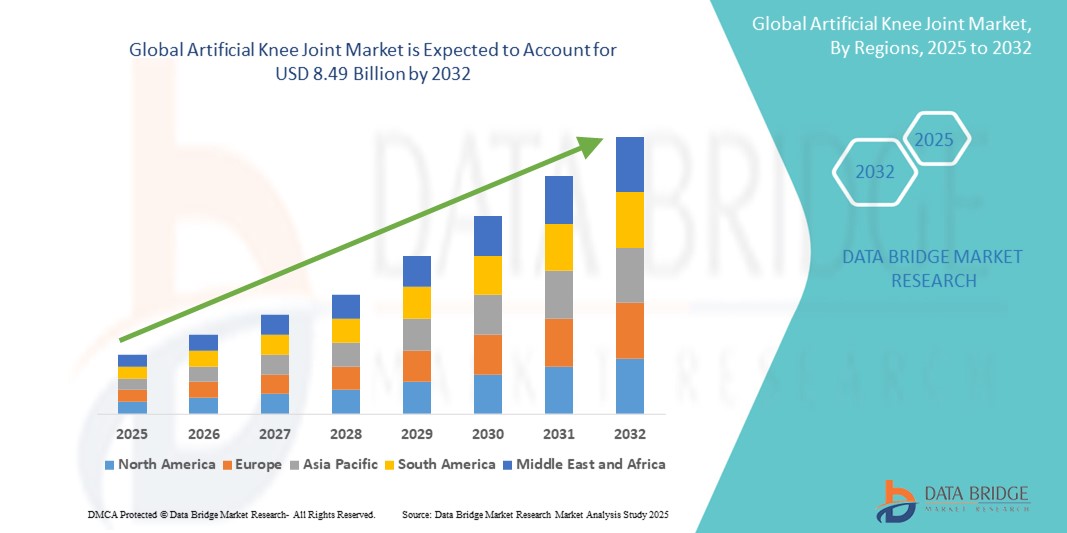
- The global artificial knee joint market size was valued at USD 5.05 billion in 2024 and is expected to reach USD 8.49 billion by 2032, at a CAGR of 6.70% during the forecast period
- The market growth is largely fueled by the rising prevalence of osteoarthritis and other degenerative joint diseases, coupled with an aging global population seeking improved mobility and quality of life. Advancements in implant materials, surgical techniques, and robotics-assisted procedures are further contributing to the increased adoption of artificial knee joint solutions across healthcare systems worldwide
- Furthermore, growing patient awareness, expanding access to healthcare in emerging economies, and the rising demand for minimally invasive procedures are establishing artificial knee joints as a preferred solution for long-term joint pain relief and mobility restoration. These converging factors are accelerating the uptake of Global Artificial Knee Joint solutions, thereby significantly boosting the industry's growth
Global Artificial Knee Joint Market Analysis
- Artificial knee joints, designed to replace damaged or worn-out knee structures, are increasingly vital components of orthopedic treatment plans in both aging and active populations due to their ability to restore mobility, reduce chronic pain, and improve quality of life following degenerative joint diseases or injuries
- The escalating demand for artificial knee joints is primarily fueled by the rising incidence of osteoarthritis, advancements in surgical techniques (including minimally invasive and robotic-assisted procedures), and the growing adoption of customized implant solutions based on patient-specific anatomy
- North America dominated the global artificial knee joint market with the largest revenue share of 40.04% in 2024, characterized by a high volume of knee replacement surgeries, favorable reimbursement policies, and widespread adoption of advanced orthopedic technologies
- Asia-Pacific is expected to be the fastest growing region in the global artificial knee joint market, with a CAGR of 8.7% from 2025 to 2032, due to increasing urbanization, expanding geriatric population, and improving access to healthcare facilities across countries such as China, India, and Japan. Government support for joint replacement programs and rising medical tourism are further accelerating market growth in the region
- Cobalt-chromium alloys segment dominated the global artificial knee joint market with a market share of 34.6% in 2024, attributed to its excellent wear resistance, high strength, and proven biocompatibility. These properties make it the preferred choice for total knee replacement procedures, particularly for weight-bearing components such as femoral and tibial parts
Report Scope and Global Artificial Knee Joint Market Segmentation
|
Attributes |
Global Artificial Knee Joint Key Market Insights |
|
Segments Covered |
|
|
Countries Covered |
North America
Europe
Asia-Pacific
Middle East and Africa
South America
|
|
Key Market Players |
|
|
Market Opportunities |
|
|
Value Added Data Infosets |
In addition to the insights on market scenarios such as market value, growth rate, segmentation, geographical coverage, and major players, the market reports curated by the Data Bridge Market Research also include in-depth expert analysis, pricing analysis, brand share analysis, consumer survey, demography analysis, supply chain analysis, value chain analysis, raw material/consumables overview, vendor selection criteria, PESTLE Analysis, Porter Analysis, and regulatory framework. |
Global Artificial Knee Joint Market Trends
“Personalized Implants and Technological Advancements Enhancing Patient Outcomes”
- A significant and accelerating trend in the global artificial knee joint market is the development of customized and patient-specific implants, designed to match an individual’s unique anatomy, improving fit, function, and long-term outcomes. This personalization is supported by advanced imaging technologies and 3D printing innovations, which enable orthopedic surgeons to plan procedures with high precision and deliver tailored solutions
- For instance, companies such as Conformis Inc. offer custom-made knee implants based on a patient’s CT scan, which enhances post-operative mobility and reduces the risk of misalignment and revision surgeries. Similarly, Stryker’s Triathlon system utilizes data-driven preoperative planning tools to optimize implant selection and surgical outcomes
- These technological advancements are enabling better surgical efficiency, reduced operative time, and faster patient recovery. Tools such as robotic-assisted surgery and computer navigation are being increasingly adopted to enhance implant positioning accuracy and ensure optimal joint mechanics
- The integration of digital planning platforms and minimally invasive surgical approaches also contributes to reduced hospital stays and postoperative complications, supporting the shift towards outpatient or same-day knee replacement procedures
- This movement toward more intelligent, customized, and outcome-driven knee replacement solutions is transforming patient expectations and surgeon practices. As a result, key players in the market are heavily investing in R&D and digital technologies to meet the rising demand for personalized orthopedic care
- The demand for artificial knee joints that deliver better comfort, quicker recovery, and higher longevity is growing rapidly across both public and private healthcare sectors, particularly as patients and providers seek solutions that align with enhanced mobility, lifestyle improvement, and long-term value
Global Artificial Knee Joint Market Dynamics
Driver
“Growing Prevalence of Osteoarthritis, Aging Population, and Technological Advancements”
- The increasing global prevalence of osteoarthritis, particularly knee osteoarthritis, coupled with a rapidly aging population and significant technological advancements in implant design and surgical techniques, is a major driver for the heightened demand for artificial knee joints
- As more individuals seek relief from chronic knee pain and disability, artificial knee joints offer advanced features such as improved biomechanics, enhanced durability, and better patient-specific fit, providing a compelling upgrade over conservative treatments
- Furthermore, the growing adoption of robotic-assisted surgery and 3D printing for custom implants is making artificial knee replacements more precise and personalized, leading to better patient outcomes and faster recovery times. These innovations are making knee replacement a more attractive and integral component of orthopedic care
- The convenience of less invasive surgical techniques, shorter hospital stays (with a 304% increase in knee replacements performed in outpatient centers from 2018-2022), and rehabilitation programs tailored for quicker recovery are key factors propelling the adoption of artificial knee joints globally. The trend towards personalized medicine and the increasing availability of user-friendly implant options further contributes to market growth
Restraint/Challenge
“High Cost of Surgery and Cybersecurity Concerns in Smart Implants”
- Concerns surrounding the relatively high initial cost of artificial knee joint surgery, coupled with emerging cybersecurity vulnerabilities in technologically advanced "smart" implants, pose significant challenges to broader market penetration. As these procedures involve expensive implants, specialized surgical teams, and rehabilitation, the financial burden can be substantial, raising anxieties among potential patients, especially in regions with limited insurance coverage
- For instance, in the U.S., a knee replacement surgery can cost anywhere from USD 30,000 to USD 50,000, which can be a significant barrier for many without robust health insurance. In India, the average cost ranges from INR 1.5 lakh to INR 6 lakh per knee, varying by hospital, implant type, and city. High-profile reports on the cost of healthcare and out-of-pocket expenses for major surgeries can make some consumers hesitant
- Addressing these cost concerns through improved reimbursement policies, the development of more affordable implant options, and value-based care models is crucial for expanding market access. Companies are increasingly focusing on cost-effective solutions and demonstrating the long-term economic benefits of successful joint replacement. In addition, with the rise of "smart implants" that contain sensors and connectivity features, cybersecurity vulnerabilities are becoming a new concern. While not as prevalent as in consumer smart devices, the potential for unauthorized access or data breaches in implantable medical devices raises patient safety and privacy concerns
- While prices for some standard implants are gradually becoming more competitive, the perceived premium for cutting-edge materials, patient-specific implants, and robotic-assisted surgeries can still hinder widespread adoption, especially for those who do not see an immediate need for the advanced features offered or cannot afford them
Global Artificial Knee Joint Market Scope
The global artificial knee joint market is segmented into two notable segments based on type and application.
- By Type
On the basis of type, the global artificial knee joint market is segmented into stainless steel, cobalt-chromium alloys, titanium, titanium alloys, polyethylene, ceramics, and others. The cobalt-chromium alloys segment held the largest market revenue share of 34.6% in 2024, attributed to its excellent wear resistance, high strength, and proven biocompatibility. These properties make it a preferred material in total knee replacement procedures, especially for weight-bearing components such as femoral and tibial parts. The durability and long service life of cobalt-chromium implants continue to drive their widespread use.
The titanium alloys segment is expected to witness the fastest CAGR of 9.8% from 2025 to 2032, fueled by its lightweight nature, superior corrosion resistance, and compatibility with bone tissues. Increasing adoption of titanium-based implants, particularly in patients with metal sensitivities or osteoporosis, contributes significantly to the growth of this segment.
- By Application
On the basis of application, the global artificial knee joint market is segmented into hospitals, specialized orthopaedic clinics, and ambulatory surgical centers. The hospitals segment accounted for the largest market revenue share of 48.2% in 2024, driven by the availability of advanced surgical infrastructure, skilled orthopedic surgeons, and comprehensive post-operative care facilities. Hospitals are often the primary centers for complex total knee arthroplasty procedures, especially in developed regions.
The ambulatory surgical centers (ASCs) segment is anticipated to register the fastest CAGR of 10.3% from 2025 to 2032, owing to the increasing preference for cost-effective, same-day surgical procedures and the growing availability of minimally invasive knee replacement options. ASCs offer reduced hospital stays and lower infection risks, making them an increasingly popular choice among both patients and healthcare providers.
Global Artificial Knee Joint Market Regional Analysis
- North America dominated the global artificial knee joint market with the largest revenue share of 40.04% in 2024, driven by a growing geriatric population, high prevalence of osteoarthritis, and widespread adoption of technologically advanced joint replacement solutions
- Strong healthcare infrastructure, favorable reimbursement policies, and the presence of leading market players further support regional dominance
- The region benefits from increased demand for minimally invasive surgeries and robotic-assisted knee replacements, offering improved patient outcomes and faster recovery times. These trends are fostering rapid adoption across both private and public healthcare facilities
U.S. Artificial Knee Joint Market Insight
The U.S. artificial knee joint market accounted for 82% of the North American market revenue share in 2024, fueled by a high volume of knee replacement procedures, increasing awareness of joint health, and early adoption of digital surgery tools. Rising healthcare spending, coupled with strong orthopedic care accessibility, continues to drive growth. The U.S. also leads in innovation, with major players such as Zimmer Biomet and Stryker investing heavily in R&D and digital surgical planning systems.
Europe Artificial Knee Joint Market Insight
The Europe artificial knee joint market is projected to grow at a CAGR of 6.8% from 2025 to 2032, driven by rising cases of joint disorders, aging demographics, and increasing demand for revision surgeries. Government initiatives to reduce waiting times for orthopedic procedures and the integration of digital health technologies into surgical workflows support regional expansion. Germany, the U.K., and France are leading contributors due to their advanced healthcare systems and high surgical volumes.
U.K. Artificial Knee Joint Market Insight
The U.K. artificial knee joint market is expected to grow at a CAGR of 6.4% during the forecast period, supported by the National Health Service (NHS) initiatives to address musculoskeletal conditions and reduce surgery backlogs. The rising demand for faster, less invasive procedures and the availability of state-of-the-art implants are key growth enablers. Increasing preference for outpatient knee replacement surgeries is also reshaping the care delivery model.
Germany Artificial Knee Joint Market Insight
Germany’s artificial knee joint market is anticipated to expand at a CAGR of 6.9% between 2025 and 2032, owing to its strong orthopedic infrastructure, early technology adoption, and growing focus on sustainability in implant materials. The country’s emphasis on precision medicine and surgeon training in robotics and navigation systems is further driving the uptake of advanced artificial knee joint solutions.
Asia-Pacific Artificial Knee Joint Market Insight
The Asia-Pacific artificial knee joint market is poised to grow at the fastest CAGR of 8.7% from 2025 to 2032, fueled by an expanding aging population, rising awareness of orthopedic treatments, and government efforts to improve healthcare access. Increasing investments in healthcare infrastructure in countries such as India, China, and Japan are making knee replacement surgeries more accessible. Rising medical tourism, particularly in India and Thailand, and growing adoption of cost-effective implant options further contribute to regional market expansion.
Japan Artificial Knee Joint Market Insight
Japan artificial knee joint market is expected to witness a CAGR of 8.9% through 2032, supported by one of the world’s oldest populations and a strong preference for high-tech, minimally invasive orthopedic procedures. The country's healthcare system emphasizes early intervention for degenerative conditions, driving demand for knee replacement solutions. Japanese manufacturers are also advancing in robotics and precision implant technology, contributing to domestic growth.
China Artificial Knee Joint Market Insight
China artificial knee joint market accounted for the largest market share in the Asia-Pacific region in 2024, driven by rapid urbanization, a growing middle class, and the increasing prevalence of joint diseases. The Chinese government’s healthcare reform efforts and support for local medical device innovation have boosted the availability and affordability of artificial knee joints. Furthermore, domestic companies are expanding their presence, offering competitive pricing and localized production.
Global Artificial Knee Joint Market Share
The global artificial knee joint industry is primarily led by well-established companies, including:
- Aesculap, Inc. (U.S.)
- B. Braun SE (Germany)
- Corin Group (U.K.)
- Smith+Nephew (U.K.)
- Stryker (U.S.)
- Zimmer Biomet (U.S.)
- Exactech, Inc. (U.S.)
- Medacta International (U.S.)
- MicroPort Orthopedics Inc. (Switzerland)
- Medtronic (U.S.)
- Johnson & Johnson Services, Inc. (U.S.)
- MicroPort Orthopedics, Inc. (U.S.)
- Conformis (U.S.)
- THINK Surgical, Inc. (U.S.)
- Maxx Orthopedics, Inc. (U.S.)
Latest Developments in Global Artificial Knee Joint Market
- In May 2024, Zimmer Biomet announced the global launch of its Persona IQ, The Smart Knee, the world’s first and only smart knee implant cleared by the FDA for total knee replacement. It integrates sensors into the implant to provide real-time post-operative data on patient movement, aiding physicians in monitoring recovery remotely. This innovation highlights Zimmer Biomet’s commitment to combining orthopedic implants with digital health technologies to improve surgical outcomes
- In March 2024, Stryker Corporation expanded its Mako SmartRobotics platform across multiple international markets, enhancing precision in total knee arthroplasty. The expansion is part of Stryker’s strategy to meet the growing demand for minimally invasive and robotic-assisted surgeries that enable better alignment, quicker recovery, and reduced complications
- In February 2024, Smith+Nephew introduced its LEGION CONCELOC Cementless Total Knee System in select European and Asian markets. The system leverages proprietary 3D printing technology to create a porous structure that promotes biological fixation, eliminating the need for bone cement. This advancement aligns with the industry trend toward more durable, biologically integrated implant solutions
- In January 2024, Medacta Group SA launched the GMK Sphere with Kinematic Guidance, designed to improve joint stability and natural motion in knee replacement patients. The innovation supports personalized surgical planning through its MyKnee preoperative platform and aims to enhance functional outcomes in younger, more active patients
- In November 2023, MicroPort Orthopedics Inc. unveiled its new Evolution NitrX Medial-Pivot Knee System, featuring a titanium-niobium-nitride (TiNbN) coating to improve wear resistance and reduce the risk of metal allergies. This development demonstrates the company’s continued focus on advanced surface technologies and long-term implant performance

- Interactive Data Analysis Dashboard
- Company Analysis Dashboard for high growth potential opportunities
- Research Analyst Access for customization & queries
- Competitor Analysis with Interactive dashboard
- Latest News, Updates & Trend analysis
- Harness the Power of Benchmark Analysis for Comprehensive Competitor Tracking
Data collection and base year analysis are done using data collection modules with large sample sizes. The stage includes obtaining market information or related data through various sources and strategies. It includes examining and planning all the data acquired from the past in advance. It likewise envelops the examination of information inconsistencies seen across different information sources. The market data is analysed and estimated using market statistical and coherent models. Also, market share analysis and key trend analysis are the major success factors in the market report. To know more, please request an analyst call or drop down your inquiry.
The key research methodology used by DBMR research team is data triangulation which involves data mining, analysis of the impact of data variables on the market and primary (industry expert) validation. Data models include Vendor Positioning Grid, Market Time Line Analysis, Market Overview and Guide, Company Positioning Grid, Patent Analysis, Pricing Analysis, Company Market Share Analysis, Standards of Measurement, Global versus Regional and Vendor Share Analysis. To know more about the research methodology, drop in an inquiry to speak to our industry experts.
Data Bridge Market Research is a leader in advanced formative research. We take pride in servicing our existing and new customers with data and analysis that match and suits their goal. The report can be customized to include price trend analysis of target brands understanding the market for additional countries (ask for the list of countries), clinical trial results data, literature review, refurbished market and product base analysis. Market analysis of target competitors can be analyzed from technology-based analysis to market portfolio strategies. We can add as many competitors that you require data about in the format and data style you are looking for. Our team of analysts can also provide you data in crude raw excel files pivot tables (Fact book) or can assist you in creating presentations from the data sets available in the report.













