


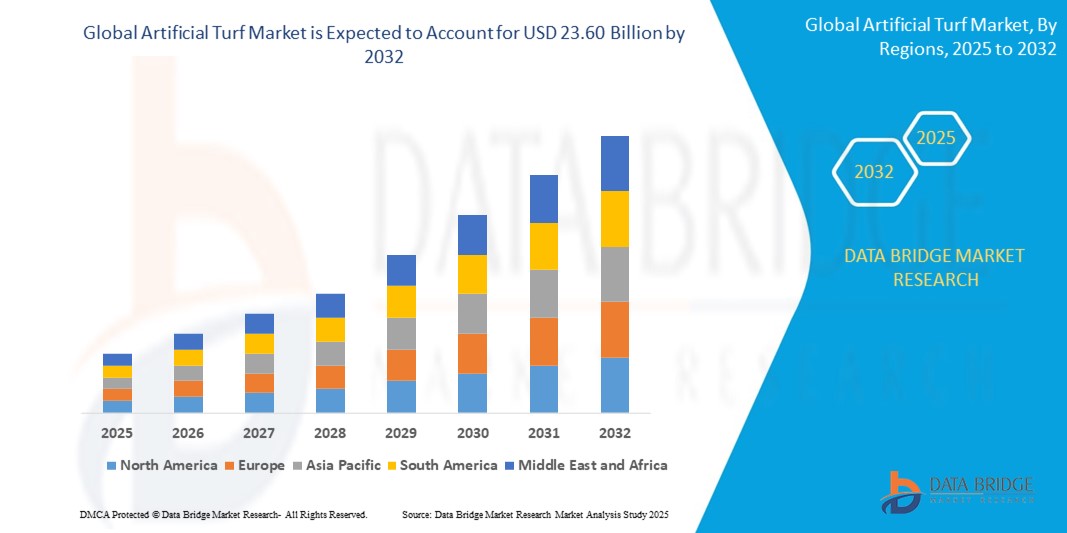
Artificial Turf Market Size
- The global artificial turf market size was valued at USD 5.67 billion in 2024 and is expected to reach USD 23.60 billion by 2032, at a CAGR of 19.50% during the forecast period
- The market growth is largely fuelled by the increasing demand for low-maintenance landscaping solutions across sports facilities, residential lawns, and commercial spaces
- Rising environmental concerns and water conservation efforts are encouraging the shift from natural grass to artificial turf, especially in regions facing water scarcity and high maintenance costs
Artificial Turf Market Analysis
- The artificial turf market is experiencing consistent growth as sports facilities and schools increasingly adopt synthetic surfaces for durability and lower upkeep. This shift reflects a broader trend toward cost-effective, all-weather playing fields across various applications
- Innovation in fiber technology and infill materials is improving turf performance, offering more realistic textures and better safety features. These advancements are helping manufacturers meet the expectations of professional and recreational users alike
- Europe dominated the global artificial turf market in 2024, holding the largest revenue share due to strict environmental regulations, urbanization, and high adoption in sports, residential, and commercial sectors
- The Asia-Pacific region is expected to witness the highest growth rate in the global artificial turf market, driven by rapid urbanization, increasing investments in sports infrastructure, and rising demand for sustainable landscaping solutions in countries such as China and Japan
- Polyethylene holds the largest market revenue share in 2024, driven by its excellent durability, softness, and UV resistance, making it a preferred choice for residential lawns and sports fields
Report Scope and Artificial Turf Market Segmentation
|
Attributes |
Artificial Turf Key Market Insights |
|
Segments Covered |
|
|
Countries Covered |
North America
Europe
Asia-Pacific
Middle East and Africa
South America
|
|
Key Market Players |
|
|
Market Opportunities |
|
|
Value Added Data Infosets |
In addition to the insights on market scenarios such as market value, growth rate, segmentation, geographical coverage, and major players, the market reports curated by the Data Bridge Market Research also include in-depth expert analysis, geographically represented company-wise production and capacity, network layouts of distributors and partners, detailed and updated price trend analysis and deficit analysis of supply chain and demand. |
Artificial Turf Market Trends
“Rising Preference for Sustainable and Eco-Friendly Turf Solutions”
- Manufacturers are focusing on recyclable materials and non-toxic infills to meet growing consumer preference for sustainable solutions, as seen in brands offering lead-free and fully recyclable turf products in the U.S. and Europe
- Artificial turf is being adopted in drought-prone areas such as California and parts of Australia, where public parks and residential landscapes are replacing natural grass to conserve water resources
- Sports facilities, including major European football stadiums and school athletic fields in Japan, are increasingly installing bio-based or partially recycled turf systems to reduce environmental impact
- The rise in green building certifications, such as LEED and BREEAM, is encouraging the use of eco-friendly landscaping solutions, pushing real estate developers to choose artificial turf that aligns with sustainability goals
- Government and municipal bodies are shifting to low-maintenance, eco-conscious turf for public spaces, as demonstrated by installations in city parks in the Middle East and school playgrounds in South Korea
Artificial Turf Market Dynamics
Driver
“Increasing Demand for Low-Maintenance Landscaping Solutions”
- The artificial turf market is growing due to the increasing demand for landscaping options that require minimal maintenance and upkeep
- Unlike natural grass, artificial turf eliminates the need for regular watering, mowing, and chemical treatments, saving both time and resources
- It provides a long-lasting, visually consistent solution that suits residential, commercial, institutional, and sports environments
- Water-scarce regions are increasingly adopting synthetic turf to reduce water consumption and maintenance expenses
- For instance, the Los Angeles Department of Water and Power offers a rebate of $5 per square foot to customers who replace their lawns with sustainable landscaping, encouraging the adoption of artificial turf as a water-saving measure
Restraint/Challenge
“Environmental and Health Concerns Related to Synthetic Materials”
- Environmental and health concerns are becoming a major challenge in the artificial turf market due to the presence of chemicals and microplastics in traditional turf materials
- Synthetic turfs made with crumb rubber infill, often sourced from recycled tires, may release harmful substances into soil and air over time
- Safety concerns are growing, especially for children and athletes regularly exposed to these surfaces in playgrounds, schools, and sports arenas
- Limited recyclability and landfill accumulation from worn-out artificial turf are prompting regulatory and public scrutiny in many regions
- For instance, municipalities in the Netherlands and the U.S. such as Montgomery County, Maryland, have introduced regulations or proposed bans on crumb rubber infill to address health and contamination concerns from synthetic turf systems
Artificial Turf Market Scope
The global artificial turf market is segmented on the basis of raw material, infill materials, pile height, distribution channel, and end-user.
- By Raw Material
On the basis of raw material, the artificial turf market is segmented into nylon, polypropylene, polyethylene, polyamides, jute, rubber, and others. Polyethylene holds the largest market revenue share in 2024, driven by its excellent durability, softness, and UV resistance, making it a preferred choice for residential lawns and sports fields.
Nylon is expected to witness the fastest growth rate during the forecast period from 2025 to 2032, due to its high resilience and ability to retain shape under heavy foot traffic, making it suitable for commercial and sports applications.
- By Infill Materials
The market is segmented into petroleum-based, organic infill, sand (silica) infill, and others based on infill materials. Petroleum-based infill dominates the market in 2024 because of its affordability and shock-absorbing properties, enhancing safety on sports surfaces.
Organic infill is expected to witness the fastest growth rate during the forecast period from 2025 to 2032, fuelled by increasing demand for eco-friendly and non-toxic alternatives in environmentally conscious regions.
- By Pile Height
Based on pile height, the market is categorized into less than 10 mm, 10-30 mm, 30-50 mm, 50-70 mm, 70-100 mm, and more than 100 mm. The 30-50 mm segment held the largest revenue share in 2024, favored for its natural appearance and balance between comfort and durability, widely used in residential and commercial landscapes.
Longer pile heights above 70 mm is expected to witness the fastest growth rate during the forecast period from 2025 to 2032, especially for sports and leisure applications requiring enhanced cushioning.
- By Distribution Channel
On the basis of distribution channel, the market is divided into direct sales/B2B, e-commerce, specialty stores, convenience stores, and others. Direct sales/B2B segment dominated in 2024, driven by bulk purchases from sports organizations and commercial projects.
E-commerce is expected to witness the fastest growth rate during the forecast period from 2025 to 2032, as consumers increasingly prefer online shopping for convenience and access to a wide product range.
- By End-User
The market is segmented by end-user into households, sports and leisure, restaurants, hotels, airports, commercial offices, pet areas, and others. Households accounted for the largest revenue share in 2024, attributed to rising adoption of artificial turf for low-maintenance landscaping.
The sports and leisure segment is expected to witness the fastest growth rate during the forecast period from 2025 to 2032, with expanding investments in sports infrastructure and increasing popularity of synthetic turf fields worldwide.
Artificial Turf Market Regional Analysis
- Europe dominated the global artificial turf market in 2024, holding the largest revenue share due to strict environmental regulations, urbanization, and high adoption in sports, residential, and commercial sectors
- The region’s emphasis on sustainability and water conservation drives demand for low-maintenance synthetic turf
- Investments in infrastructure and renovation projects, particularly in countries such as the U.K. and Germany, further support market growth
U.K. Artificial Turf Market Insight
The U.K. artificial turf market is expected to witness the fastest growth rate during the forecast period from 2025 to 2032, fuelled by rising environmental awareness and water scarcity issues. Synthetic turf’s low maintenance and visual appeal make it a preferred choice for sports venues, residential lawns, and commercial spaces.
Germany Artificial Turf Market Insight
The Germany holds a significant position in the European artificial turf market, driven by strong environmental regulations and a focus on sustainable urban development. The demand for eco-friendly, low-maintenance turf solutions is rising across residential, commercial, and sports applications. Investments in public infrastructure and green spaces, alongside growing awareness about water conservation, support market growth in Germany.
Asia-Pacific Artificial Turf Market Insight
The Asia-Pacific market is expected to witness the fastest growth rate during the forecast period from 2025 to 2032, driven by rapid urbanization, increasing disposable incomes, and expanding sports and recreational infrastructure in countries such as China, India, and Japan. Government initiatives promoting water-efficient landscaping and sustainable urban development are boosting demand across residential, commercial, and public areas.
China Artificial Turf Market Insight
The China’s market growth is supported by rising urban development, government policies favoring water conservation, and growing investments in sports facilities. The increasing preference for cost-effective, durable turf solutions in residential and commercial sectors fuels demand.
Japan Artificial Turf Market Insight
The Japan is expected to witness the fastest growth rate during the forecast period from 2025 to 2032, due to urbanization, an aging population, and the need for safe, hygienic, and low-maintenance landscaping solutions in residential and public spaces.
North America Artificial Turf Market Insight
The North America is expected to witness the fastest growth rate during the forecast period from 2025 to 2032, supported by strong adoption in sports facilities, commercial properties, and residential landscaping. Increasing awareness about water conservation and landscaping cost savings drive demand.
U.S. Artificial Turf Market Insight
The U.S. leads North America’s artificial turf market, propelled by widespread adoption in sports, residential, and commercial applications. Government rebate programs encouraging synthetic grass installations to conserve water and ongoing investments in sports infrastructure contribute to market expansion.
Artificial Turf Market Share
The Artificial Turf industry is primarily led by well-established companies, including:
- Dow (U.S.)
- Victoria PLC (U.K.)
- Sport Group (U.K.)
- Tarkett Group (France)
- Condor Group (U.K.)
- Act Global (Subsidiary of BIG) (U.S.)
- LIMONTA SPORT S.P.A (Italy)
- SpectraTurf, Inc. (U.S.)
- TenCate Grass (Netherlands)
- CCGrass (China)
- EnvyLawn (U.S.)
- EUROPEAN TURF GROUP (Belgium)
- PRACTICE SPORTS (U.K.)
- XGrass (U.S.)
- Matrix Turf (U.S.)
- Shawgrass (U.S.)
- Synthetic Turf International (U.S.)
Latest Developments in Global Artificial Turf Market
- In February 2024, Act Global celebrated two decades of innovation, delivering inclusive and sustainable artificial turf solutions across more than 90 countries. The company’s recognized contributions by organizations such as NFL and FIFA highlight its focus on enhancing performance, safety, and community well-being. Act Global’s ongoing commitment to tackling industry challenges reinforces its role in shaping a sustainable future and strengthening its market position
- In October 2023, Condor Grass introduced its Colorshift technology, a pioneering development in artificial grass that changes color with outdoor temperature variations. This innovative product offers dynamic seasonal aesthetics, setting Condor Grass apart from competitors. The breakthrough has generated strong market interest and expanded demand by providing customers with an adaptable and visually engaging landscaping option

- Interactive Data Analysis Dashboard
- Company Analysis Dashboard for high growth potential opportunities
- Research Analyst Access for customization & queries
- Competitor Analysis with Interactive dashboard
- Latest News, Updates & Trend analysis
- Harness the Power of Benchmark Analysis for Comprehensive Competitor Tracking
Global Artificial Turf Market, Supply Chain Analysis and Ecosystem Framework
To support market growth and help clients navigate the impact of geopolitical shifts, DBMR has integrated in-depth supply chain analysis into its Global Artificial Turf Market research reports. This addition empowers clients to respond effectively to global changes affecting their industries. The supply chain analysis section includes detailed insights such as Global Artificial Turf Market consumption and production by country, price trend analysis, the impact of tariffs and geopolitical developments, and import and export trends by country and HSN code. It also highlights major suppliers with data on production capacity and company profiles, as well as key importers and exporters. In addition to research, DBMR offers specialized supply chain consulting services backed by over a decade of experience, providing solutions like supplier discovery, supplier risk assessment, price trend analysis, impact evaluation of inflation and trade route changes, and comprehensive market trend analysis.
Data collection and base year analysis are done using data collection modules with large sample sizes. The stage includes obtaining market information or related data through various sources and strategies. It includes examining and planning all the data acquired from the past in advance. It likewise envelops the examination of information inconsistencies seen across different information sources. The market data is analysed and estimated using market statistical and coherent models. Also, market share analysis and key trend analysis are the major success factors in the market report. To know more, please request an analyst call or drop down your inquiry.
The key research methodology used by DBMR research team is data triangulation which involves data mining, analysis of the impact of data variables on the market and primary (industry expert) validation. Data models include Vendor Positioning Grid, Market Time Line Analysis, Market Overview and Guide, Company Positioning Grid, Patent Analysis, Pricing Analysis, Company Market Share Analysis, Standards of Measurement, Global versus Regional and Vendor Share Analysis. To know more about the research methodology, drop in an inquiry to speak to our industry experts.
Data Bridge Market Research is a leader in advanced formative research. We take pride in servicing our existing and new customers with data and analysis that match and suits their goal. The report can be customized to include price trend analysis of target brands understanding the market for additional countries (ask for the list of countries), clinical trial results data, literature review, refurbished market and product base analysis. Market analysis of target competitors can be analyzed from technology-based analysis to market portfolio strategies. We can add as many competitors that you require data about in the format and data style you are looking for. Our team of analysts can also provide you data in crude raw excel files pivot tables (Fact book) or can assist you in creating presentations from the data sets available in the report.













