


Asbestosis Treatment Market Size
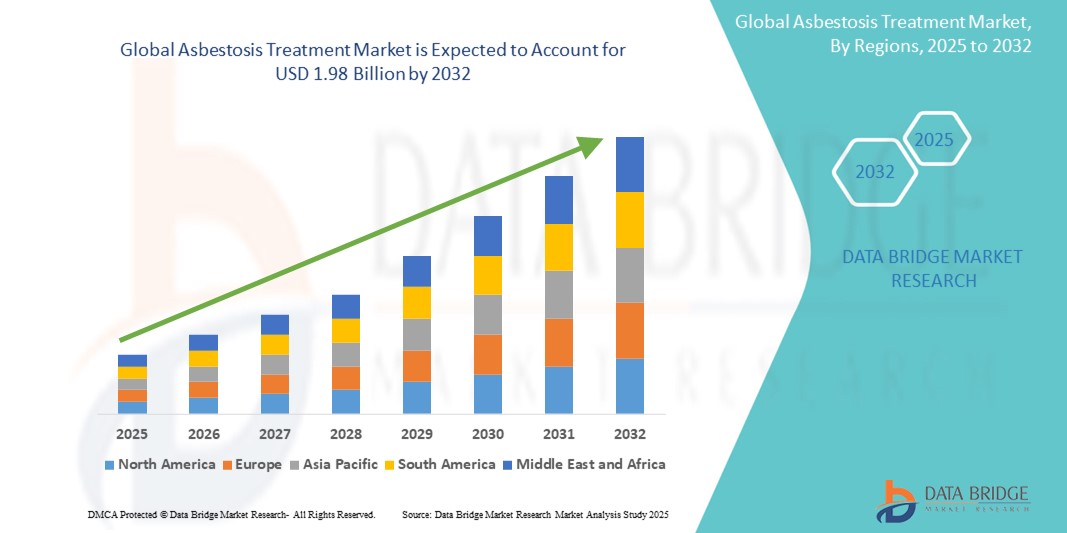
- The global asbestosis treatment market size was valued at USD 1.26 Billion in 2024 and is expected to reach USD 1.98 Billion by 2032, at a CAGR of 5.05% during the forecast period
- This growth is driven by factors such as the increasing prevalence of asbestosis due to occupational exposure and rising awareness about early diagnosis and treatment options
Asbestosis Treatment Market Analysis
- Asbestosis treatment focuses on managing symptoms and preventing complications caused by prolonged exposure to asbestos fibers, which lead to chronic lung disease and respiratory issues
- The market growth is primarily driven by rising industrialization in developing countries, increasing awareness of occupational safety, and early disease detection initiatives
- North America is expected to dominate the global asbestosis treatment market due to stringent regulations, high awareness levels, and well-established healthcare systems
- Asia-Pacific is expected to be the fastest growing region in the asbestosis treatment market during the forecast period due to ongoing industrial expansion and growing government efforts to regulate asbestos use
- The Prednisone segment is expected to dominate the market with a market share of 45.05% due to its strong anti-inflammatory properties, which help alleviate lung inflammation and improve breathing in asbestosis patients. It is widely prescribed as a first-line treatment to manage chronic respiratory symptoms and slow disease progression.
Report Scope and Asbestosis Treatment Market Segmentation
|
Attributes |
Asbestosis Treatment Key Market Insights |
|
Segments Covered |
|
|
Countries Covered |
North America
Europe
Asia-Pacific
Middle East and Africa
South America
|
|
Key Market Players |
|
|
Market Opportunities |
|
|
Value Added Data Infosets |
In addition to the insights on market scenarios such as market value, growth rate, segmentation, geographical coverage, and major players, the market reports curated by the Data Bridge Market Research also include import export analysis, production capacity overview, production consumption analysis, price trend analysis, climate change scenario, supply chain analysis, value chain analysis, raw material/consumables overview, vendor selection criteria, PESTLE Analysis, Porter Analysis, and regulatory framework. |
Asbestosis Treatment Market Trends
“Shift Toward Advanced Respiratory Therapies and Targeted Drug Delivery”
- One prominent trend in the global asbestosis treatment market is the growing adoption of advanced respiratory therapies and targeted drug delivery systems to improve symptom management and patient quality of life
- Inhalation-based treatments and precision-targeted corticosteroids are becoming increasingly popular due to their ability to deliver medication directly to affected lung tissues, reducing systemic side effects
- For instance, innovations such as smart nebulizers and inhalers are enabling controlled and efficient drug delivery, enhancing therapeutic efficacy in managing chronic respiratory conditions such as asbestosis
- These advancements are significantly improving treatment outcomes, reducing hospitalization rates, and propelling demand for more specialized and patient-centric asbestosis therapies
Asbestosis Treatment Market Dynamics
Driver
“Increasing Incidence of Occupational Asbestos Exposure”
- The growing incidence of asbestosis is primarily driven by prolonged occupational exposure to asbestos, particularly in industries such as construction, shipbuilding, and manufacturing where asbestos was historically used
- Despite regulatory efforts, many workers in developing and transitional economies continue to face exposure due to the presence of legacy asbestos in old buildings and insufficient workplace safety standards
- This rising disease burden is prompting healthcare systems and governments to focus more on early diagnosis, improved treatment options, and enhanced patient support systems, thereby driving market growth
For instance,
- According to the World Health Organization (WHO), approximately 125 million people worldwide are exposed to asbestos at the workplace, and over 90,000 deaths annually are attributed to asbestos-related diseases, including asbestosis
- As a result, the increasing global burden of occupational asbestos exposure is significantly fueling the demand for effective asbestosis treatment solutions
Opportunity
“Emergence of AI-Powered Diagnostic and Monitoring Tools”
- The integration of artificial intelligence into respiratory healthcare is creating new opportunities in the asbestosis treatment market, especially in the early detection and monitoring of disease progression
- AI-based imaging tools can analyze chest X-rays and CT scans with high precision, enabling earlier identification of asbestosis-related lung abnormalities, even in asymptomatic stages
- In addition, AI can help stratify patients based on risk, personalize treatment plans, and monitor therapeutic responses more effectively over time
For instance,
- In November 2024, a study published in The Lancet Digital Health highlighted the use of AI algorithms trained on radiographic data to detect early signs of asbestos-related lung disease with over 90% accuracy. These systems not only reduce diagnostic delays but also support pulmonologists in making more informed decisions
- The adoption of AI-powered diagnostic tools is expected to improve patient outcomes, reduce healthcare costs through early intervention, and create growth avenues for companies investing in digital healthcare solutions for chronic respiratory diseases such as asbestosis
Restraint/Challenge
“High Treatment Costs and Limited Accessibility”
- The high costs associated with asbestosis treatments, including medications, respiratory therapies, and long-term care, present a significant challenge, especially for low-income patients and healthcare systems in developing regions
- Treatments for asbestosis, such as corticosteroids and supplemental oxygen, require ongoing management, adding to the financial burden on patients and healthcare facilities
- This financial strain can limit access to timely and effective treatments, particularly in areas with limited healthcare budgets or insurance coverage, hindering market penetration
For instance,
- In December 2024, a report from the American Lung Association highlighted that the cost of managing chronic respiratory conditions, including asbestosis, is one of the major healthcare challenges in low-income countries. High treatment costs often result in patients not receiving the necessary care, leading to worsened health outcomes
- Consequently, the limited accessibility to effective treatments due to high costs can impede the overall growth of the asbestosis treatment market, particularly in underdeveloped and emerging economies
Asbestosis Treatment Market Scope
The market is segmented on the basis of type, mechanism of action, drugs, diagnosis, treatment, route of administration, distribution channel, and end user
|
Segmentation |
Sub-Segmentation |
|
By Type |
|
|
By Mechanism of Action |
|
|
By Drugs |
|
|
By Diagnosis |
|
|
By Treatment |
|
|
By Route of Administration |
|
|
By Distribution Channel
|
|
|
By End User
|
|
In 2025, the Prednisone segment is projected to dominate the market with a largest share in drugs segment
The Prednisone segment is expected to dominate the Asbestosis Treatment market with the largest share of 45.05% in 2025 due to its strong anti-inflammatory properties, which help alleviate lung inflammation and improve breathing in asbestosis patients. It is widely prescribed as a first-line treatment to manage chronic respiratory symptoms and slow disease progression.
The Inhalation segment is expected to account for the largest share during the forecast period in route of administration market
In 2025, the inhalation segment is expected to dominate the market with the largest market share of 40.05% due to its efficient delivery method, allowing medications to be directly administered to the lungs, where the effects are most needed. This targeted approach ensures rapid absorption, faster symptom relief, and minimal systemic side effects. In addition, inhalation therapies, such as bronchodilators, are essential in managing respiratory symptoms associated with chronic lung diseases such as asbestosis
Asbestosis Treatment Market Regional Analysis
“North America Holds the Largest Share in the Asbestosis Treatment Market”
- North America dominates the asbestosis treatment market due to its advanced healthcare infrastructure, high awareness of occupational health issues, and strong presence of leading pharmaceutical companies
- U.S. holds a significant share, driven by the high prevalence of asbestosis in workers from industries such as construction and shipbuilding, along with strong governmental regulations around occupational safety
- The availability of well-established healthcare facilities, comprehensive insurance coverage, and ongoing research in respiratory therapies further bolster the market in North America
- In addition, the increasing emphasis on early diagnosis and the availability of specialized treatments, such as bronchodilators and corticosteroids, contribute to the growth in this region
“Asia-Pacific is Projected to Register the Highest CAGR in the Asbestosis Treatment Market”
- Asia-Pacific is expected to witness the highest growth rate in the asbestosis treatment market due to the rapid industrialization and increasing awareness about occupational health risks
- Countries such as China, India, and Japan are emerging as key markets, with growing industrial sectors that still use asbestos in some manufacturing processes, leading to a rising incidence of asbestosis
- Increased government focus on improving occupational safety standards and expanding healthcare access is driving the demand for better treatment options in this region
- India and China, with their large industrial workforces, are witnessing rising cases of asbestos-related diseases, prompting both public and private sector investments in advanced diagnostic and treatment solutions
Asbestosis Treatment Market Share
The market competitive landscape provides details by competitor. Details included are company overview, company financials, revenue generated, market potential, investment in research and development, new market initiatives, global presence, production sites and facilities, production capacities, company strengths and weaknesses, product launch, product width and breadth, application dominance. The above data points provided are only related to the companies' focus related to market.
The Major Market Leaders Operating in the Market Are:
- Merck & Co., Inc., (U.S.)
- Boehringer Ingelheim International GmbH. (Germany)
- Pfizer Inc. (U.S.)
- Novartis AG (Switzerland)
- Lilly (U.S.)
- Bristol-Myers Squibb Company (U.S.)
- AstraZeneca (U.K.)
- Gilead Sciences, Inc. (U.S.)
- Johnson & Johnson Services, Inc. (U.S.)
- Sanofi (France)
- Amgen Inc. (U.S.)
- F. Hoffmann-La Roche Ltd (Switzerland)
- AbbVie Inc. (U.S.)
- Medtronic (Ireland)
- Teva Pharmaceutical Industries Ltd. (Israel)
- Viatris Inc. (U.S.)
- Hikma Pharmaceuticals PLC (U.K.)
- Sandoz Group AG (Switzerland)
- Fujifilm Holdings Corporation (Japan)
- Merck KGaA (Germany)
Latest Developments in Global Asbestosis Treatment Market
- In September 2024, Merck & Co. Inc. announced that the U.S. Food and Drug Administration (FDA) approved its cancer drug, Keytruda, for the treatment of malignant pleural mesothelioma, a rare cancer associated with asbestos exposure. This approval marked a significant advancement in treatment options for this aggressive form of cancer, providing new hope for patients affected by this life-threatening disease
- In April 2024, Amneal Pharmaceuticals announced the launch of PEMRYDI RTU, the first and only ready-to-use formulation of pemetrexed for injection. Unlike other versions, this product requires no reconstitution, dilution, or refrigeration, offering a more convenient alternative for healthcare providers. The ready-to-use format simplified preparation and administration compared to existing pemetrexed options
- In March 2024, the U.S. Environmental Protection Agency finalized a rule to prohibit ongoing uses of chrysotile asbestos, the only known form of asbestos currently used in or imported to the United States. This move aims to protect public health from the carcinogenic effects of asbestosis
- In February 2024, a significant advancement was reported with the combination of ADI-PEG20 (pegargiminase) and chemotherapy, marking the first such combination in 20 years. This treatment has shown promise in improving survival rates for mesothelioma, a cancer linked to asbestos exposure
- In October 2024, an official from China's National Health Commission announced the opening of 829 sites for the free treatment of patients suffering from pneumoconiosis, a category of occupational lung diseases that includes asbestosis. This initiative aimed to provide accessible healthcare to affected individuals, particularly in regions with high industrial activity

- Interactive Data Analysis Dashboard
- Company Analysis Dashboard for high growth potential opportunities
- Research Analyst Access for customization & queries
- Competitor Analysis with Interactive dashboard
- Latest News, Updates & Trend analysis
- Harness the Power of Benchmark Analysis for Comprehensive Competitor Tracking
Data collection and base year analysis are done using data collection modules with large sample sizes. The stage includes obtaining market information or related data through various sources and strategies. It includes examining and planning all the data acquired from the past in advance. It likewise envelops the examination of information inconsistencies seen across different information sources. The market data is analysed and estimated using market statistical and coherent models. Also, market share analysis and key trend analysis are the major success factors in the market report. To know more, please request an analyst call or drop down your inquiry.
The key research methodology used by DBMR research team is data triangulation which involves data mining, analysis of the impact of data variables on the market and primary (industry expert) validation. Data models include Vendor Positioning Grid, Market Time Line Analysis, Market Overview and Guide, Company Positioning Grid, Patent Analysis, Pricing Analysis, Company Market Share Analysis, Standards of Measurement, Global versus Regional and Vendor Share Analysis. To know more about the research methodology, drop in an inquiry to speak to our industry experts.
Data Bridge Market Research is a leader in advanced formative research. We take pride in servicing our existing and new customers with data and analysis that match and suits their goal. The report can be customized to include price trend analysis of target brands understanding the market for additional countries (ask for the list of countries), clinical trial results data, literature review, refurbished market and product base analysis. Market analysis of target competitors can be analyzed from technology-based analysis to market portfolio strategies. We can add as many competitors that you require data about in the format and data style you are looking for. Our team of analysts can also provide you data in crude raw excel files pivot tables (Fact book) or can assist you in creating presentations from the data sets available in the report.












